
Game review
The Killing Antidote
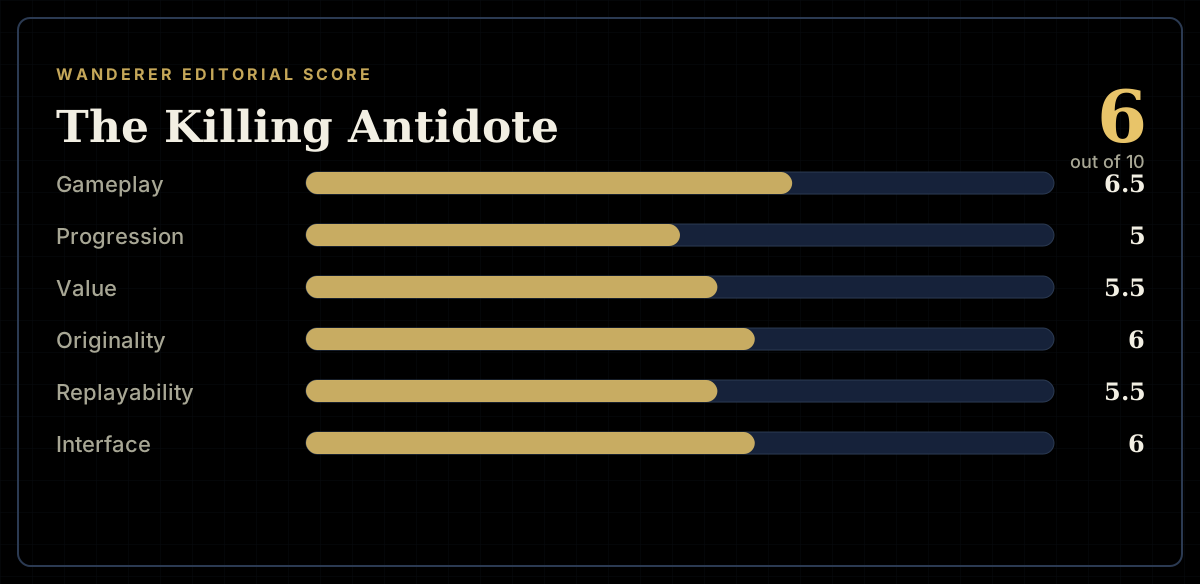
6 / 10
- Developer
- MetalStar Studio
- Publisher
- MetalStar Studio
- Released
- 5 October 2024
- Platforms
- Windows
- Genre
- Third-person survival-horror action RPG
- Monetisation
- One-time purchase, with an optional cosmetic DLC pack available alongside the base Early Access game
- Players
- Single-player only
The short version
The Killing Antidote sends journalist protagonist Jodi into a zombie-infested facility armed with satisfying gunplay, deep character customization, and a clear Resident Evil influence, and its first chapter earned exactly the kind of enthusiastic word of mouth that builds a genuine following for a small studio's Early Access project. The trouble is almost everyone in this review's sample agrees on what happened next: the long-awaited second chapter, released roughly a year later, is widely described as a significant step down, trading the first chapter's careful pacing for bullet-sponge enemies, an over-used weapon-stripping gimmick, and confusing level design. The developer has kept working — patches have continued at a steady clip through early 2026 — but as of this review, the second chapter's specific complaints remain the dominant story in the review sample rather than a resolved footnote.
Biggest strengths
- Gunplay and melee combat are consistently praised as satisfying and weighty, with reviewers specifically highlighting how good ranged weapons, the axe, and other melee options feel to use
- Chapter 1 is described with striking consistency as a genuinely strong, well-paced survival-horror experience, with even the game's harshest recent critics carving out an exception for it
- Character customization is deep and widely praised, with reviewers noting the game clearly telegraphs its mature content options and provides settings to opt out of them entirely if a player prefers a more conventional survival-horror experience
Biggest weaknesses
- The single most repeated and detailed complaint in the review sample concerns Chapter 2 specifically, with numerous independent reviewers describing bullet-sponge enemies, confusing level layouts, and pacing that undoes the careful design of Chapter 1
- A repeated, specific mechanical complaint targets a forced weapon-and-equipment-stripping sequence in Chapter 2, which multiple reviewers describe as an unwelcome, poorly balanced repeat of a device that worked better used sparingly elsewhere
- At least one reviewer raises an unconfirmed suspicion that some positive reviews may not be genuine, though this review found no independent, named-source evidence of manipulation and treats the review sample as presented
Who it's for: Survival-horror and third-person shooter fans who want satisfying, weighty gunplay and don't mind extensive character customization options (including mature content that can be toggled), as long as they go in aware the game's quality is currently uneven between its two available chapters.
Our recommendation: Worth trying for Chapter 1 alone, which a large majority of reviewers still recommend on its own merits. Go in with tempered expectations for Chapter 2, and consider waiting for further balance patches if bullet-sponge enemies and forced weapon-stripping sections are dealbreakers for you.
6 / 10
The Killing Antidote wears its influences openly: a third-person survival-horror shooter about a journalist named Jodi investigating a pandemic outbreak, built around the kind of resource-tight combat, weighty gunplay, and unsettling facility environments that will feel immediately familiar to anyone who's played a modern Resident Evil remake. It layers in a genuinely deep character customization system alongside that horror framework, and its review sample is candid about that combination's appeal — "unironically came for the boobies but stayed for the gameplay," one reviewer writes, "surprisingly tight gunplay and controls." What makes this review sample specifically useful, though, is how consistently it separates two distinct halves of the game's current content, and how sharply those two halves are rated against each other.
A first chapter that earned its following
Reviewers across the sample, including many now writing critically, go out of their way to praise the game's first chapter on its own terms. "Chapter 1 and all its content is really solid," one long-session reviewer with over 5,600 minutes logged writes, a sentiment echoed almost verbatim by others even in reviews explicitly marked negative overall. The gunplay draws specific, repeated praise — "the axe (main melee weapon) specifically feels really satisfying," one detailed early-access review notes — and the customization system, while clearly built around fan service, is described by multiple reviewers as more thoughtfully implemented than it might first appear: one specifically notes the game "has plenty of normal clothes to wear" and lets players disable automatic outfit changes entirely, a detail worth naming for readers assuming the mature content is unavoidable or mandatory.
Where the second chapter lost the room
Against that backdrop, the negative sample's core complaint is remarkably consistent and specific. "Chapter 2 is super lazy," one reviewer with nearly 5,700 minutes logged writes, "the fact it took this long to release with its numerous bad decisions is baffling." Reviewers repeatedly cite the same concrete issues: enemies described as "bullet sponges" that "charge you and stun you," turrets requiring "literal pixel perfect aim," and a low-visibility toxic-gas section that multiple reviewers separately flag as a specific frustration point. One especially detailed account frames the shift bluntly: "PSA: The first impression of a Resident Evil-like game is now a blatant lie... Chapter 2 is not fun, Chapter 2 is frustration and BS without rhyme or reason."
A specific mechanical complaint, repeated independently
Beyond general difficulty complaints, several reviewers independently zero in on one specific design choice: a forced sequence that strips the player of weapons and equipment, echoing a similar moment from Chapter 1 but reportedly overused and poorly paced in Chapter 2. "The devs decided to take away all your weapons and equipment and let you run away from a monster, collecting weapons again only to take them away a couple of moments later again," one reviewer writes, and another separately describes losing access to "equipment boxes that provided ammo in chapter 1" as a specific regression rather than a new challenge. The repetition of this exact complaint, worded differently by reviewers who don't appear to be quoting each other, suggests a real and specific pacing misstep rather than a subjective difficulty preference.
An unconfirmed suspicion, worth naming and setting aside
At least one reviewer states directly that they suspect some of the game's positive reviews may not be genuine. This review takes that kind of concern seriously in general, but found no independent, named-source evidence supporting it here — no curator flag, no specific pattern beyond one reviewer's stated hunch — which is a meaningfully weaker basis than cases where this review has parked or heavily caveated other candidates over similar concerns. Given the scale and specificity of the game's other, well-corroborated complaints about Chapter 2, this review treats the broader review sample as presented rather than discounting it.
Real, ongoing development — with priorities some players question
To its credit, MetalStar Studio has kept working on The Killing Antidote continuously since well before its official October 2024 Early Access launch, with the partner-events feed showing development updates as far back as mid-2023 and a steady patch cadence running through March 2026, including a specific "Chapter 2 is Nearing Completion" update in October 2025 followed by a cluster of balance-focused patches into 2026. That's a genuinely sustained effort. It's worth noting, though, that at least one long-session reviewer specifically criticises the studio's decision to release a cosmetic DLC pack while the base game remained incomplete, arguing the core experience should have taken priority — a fair point given how much of the current review sample is preoccupied with fixing Chapter 2 rather than adding cosmetic extras.
What the achievement data says about the difficulty complaints
Steam's own completion figures add useful independent texture to the balance complaints running through this review. An early combat-related achievement sits at 45%, meaning under half the playerbase even clears what should be a relatively approachable opening milestone, and the curve falls steeply from there, with several of the rarest unlocks sitting below 3%. That's a notably steep drop-off for a game whose own Chapter 1 is widely praised as well-paced, and it lines up with reviewers' accounts that a meaningful share of players either stall out in Chapter 2's harder sections or lose motivation to continue once the pacing problems set in — this isn't just a handful of vocal reviewers overstating a minor issue, but a pattern with some independent numeric backing.
Value at full price for a still-incomplete game
At NZD 43.59, The Killing Antidote sits at a genuinely premium price point for a game that, by its own description, remains "in development and is not yet complete." That's a reasonable ask for a well-regarded first chapter and continued active support, but it's worth being direct about the trade-off: buyers today are paying full price for roughly one strong chapter, one widely criticised chapter, and a promise of more to come, with no guarantee of when Chapter 3 arrives or how it will compare to either predecessor. Reviewers who bought in early and have watched the game evolve over nearly two years of patches are, on balance, more forgiving of that uncertainty than a new buyer walking in cold today should necessarily be.
Final verdict
The Killing Antidote is a game of two clearly different qualities running side by side: a genuinely well-regarded first chapter that built real goodwill through satisfying combat and surprisingly thoughtful customization options, and a widely criticised second chapter that a large, consistent share of the game's own dedicated fans say actively undermines that goodwill. The developer's continued, visible patching gives real reason for optimism that Chapter 2 will improve, but as of this review, its specific and well-documented problems remain the dominant story for anyone approaching the game today. Worth playing for Chapter 1 alone; go in with tempered expectations for what comes after it.
Pros and cons
Pros
- Gunplay and melee combat are consistently praised as satisfying and weighty, with reviewers specifically highlighting how good ranged weapons, the axe, and other melee options feel to use
- Chapter 1 is described with striking consistency as a genuinely strong, well-paced survival-horror experience, with even the game's harshest recent critics carving out an exception for it
- Character customization is deep and widely praised, with reviewers noting the game clearly telegraphs its mature content options and provides settings to opt out of them entirely if a player prefers a more conventional survival-horror experience
- The developer has maintained a dense, ongoing patch cadence across roughly three years of visible development, including regular update notes running from pre-launch progress reports through patches in early 2026
- Steam Workshop support is specifically praised by at least one experienced reviewer as a genuine strength extending the game's replayability beyond its base content
Cons
- The single most repeated and detailed complaint in the review sample concerns Chapter 2 specifically, with numerous independent reviewers describing bullet-sponge enemies, confusing level layouts, and pacing that undoes the careful design of Chapter 1
- A repeated, specific mechanical complaint targets a forced weapon-and-equipment-stripping sequence in Chapter 2, which multiple reviewers describe as an unwelcome, poorly balanced repeat of a device that worked better used sparingly elsewhere
- At least one reviewer raises an unconfirmed suspicion that some positive reviews may not be genuine, though this review found no independent, named-source evidence of manipulation and treats the review sample as presented
- A cosmetic DLC pack was released while the base game remained incomplete, drawing pointed criticism from at least one long-session reviewer who argues the studio's priorities should be finishing the core game first
- Steam's own achievement data shows a fairly steep completion drop-off, with the rarest unlocks sitting below 3%, broadly consistent with reviewers' accounts that a meaningful share of players stall out or lose enthusiasm partway through the game's more punishing later sections
Screenshots
-

The Killing AntidoteImage: MetalStar Studio via Steam -

The Killing AntidoteImage: MetalStar Studio via Steam -

The Killing AntidoteImage: MetalStar Studio via Steam -
How the review scores each part of the gameWanderer Editorial -
The short versionWanderer Editorial