Game review
The Bible Roguelike Deckbuilder
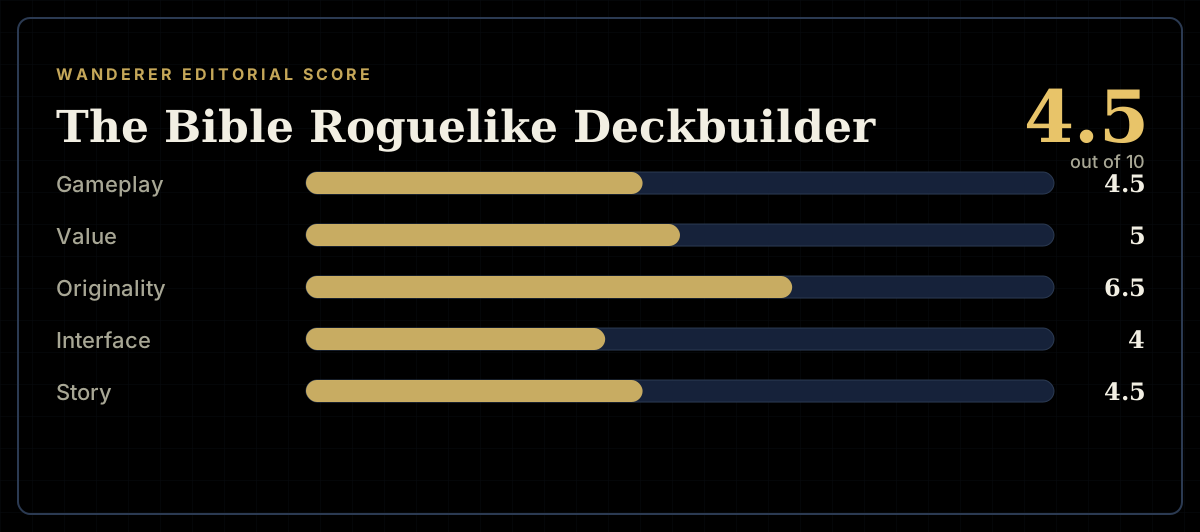
4.5 / 10
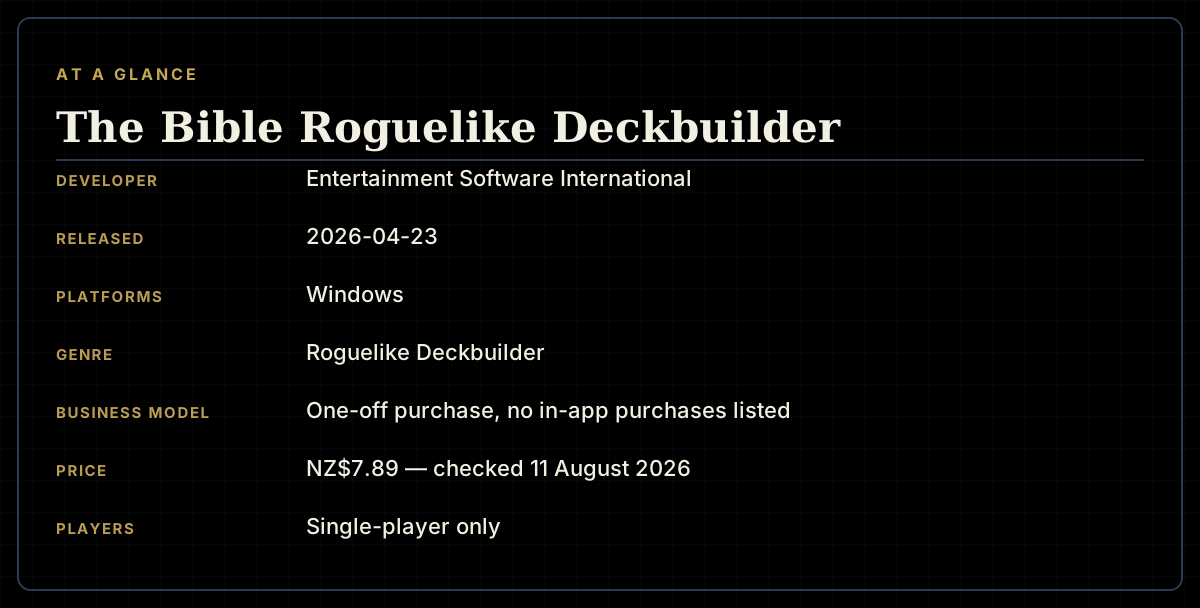
- Developer
- Entertainment Software International
- Publisher
- Entertainment Software International
- Released
- 23 April 2026
- Platforms
- Windows
- Genre
- Roguelike Deckbuilder
- Monetisation
- One-off purchase, no in-app purchases listed
- Players
- Single-player only
The short version
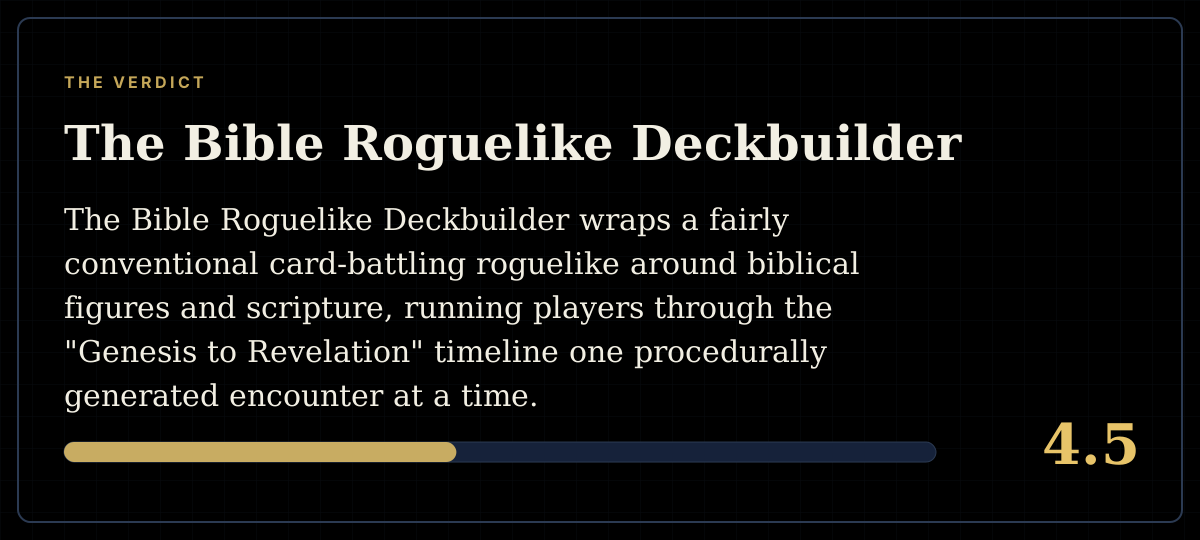
The Bible Roguelike Deckbuilder wraps a fairly conventional card-battling roguelike around biblical figures and scripture, running players through the "Genesis to Revelation" timeline one procedurally generated encounter at a time. The premise is genuinely distinct within its own Steam tag — the Roguelike Deckbuilder shelf is crowded with fantasy and sci-fi settings, and this is not that.
What it does not have, three and a half months after release, is any meaningful evidence that the idea works in practice. The Steam review count sits at three in total, achievement tracking shows no data at all, and the storefront listing itself runs to two sentences of pitch text above a bare feature list. I read every one of the handful of user reviews this game has, and none of them describe the game's systems in any depth.
Biggest strengths
- A genuinely uncommon premise for the Roguelike Deckbuilder tag — biblical figures and scripture instead of another fantasy or sci-fi skin
- Two structured modes on offer, a fixed "Genesis to Revelation" campaign and a Free Play mode for mixing unlocked figures and decks once they're earned
- Priced at the low end of the genre, under NZ$8, with no in-app purchases listed on the store page
Biggest weaknesses
- Almost no independent review history to check the pitch against — three user reviews in total as of this writing, too few to establish any pattern of praise or complaint
- No achievement completion data is available at all, which usually signals either a very small player base or a game shipped without achievement tracking wired up — neither is reassuring
- The store listing itself is thin: two short paragraphs of flavour text, a bare two-mode feature list, and no video, making it hard for a buyer to judge the actual card pool or combat depth before purchase
Who it's for: Players specifically curious about biblical subject matter expressed through a deckbuilder, and players comfortable buying into a genre entry with almost no independent track record yet.
Our recommendation: Wait for the review count to grow before spending on this one — there simply isn't enough evidence yet, from Valve's own data or from players, to say whether the systems underneath the premise hold up.
4.5 / 10
An unusual setting for a familiar genre
Steam's Roguelike Deckbuilder tag is dominated by the same handful of aesthetic choices — dungeon-crawling fantasy, cosmic horror, cyberpunk, the odd historical curiosity. The Bible Roguelike Deckbuilder picks a setting none of its neighbours touch. Its "Genesis to Revelation" mode runs players across the biblical timeline as a structured campaign, unlocking figures, cards and what the store page calls "revelations" as they progress; a second Free Play mode lets players mix whatever figures and decks they've already unlocked into a randomized survival run. The store description leans hard into that framing — "every run is a pilgrimage," "every card drawn is a prayer" — treating the genre's familiar deck-and-map loop as the mechanical language for a scriptural journey rather than a dungeon crawl.
That's a real point of difference. Most card roguelikes reach for a fantasy or sci-fi coat of paint because that's what the genre's founding games did; building the same skeleton around biblical narrative structure instead is a choice with some actual editorial intent behind it, whatever a player ends up thinking of the execution. Community tags on the store page — Card Battler, Dungeon Crawler, Deckbuilding, Procedural Generation, Turn-Based Combat, but also Horror, Demons and Supernatural — suggest the tone leans into conflict and dread rather than a purely reverent retelling, which tracks with a "fight every elite" framing one of its few reviewers uses.
The evidence problem
Here is the harder issue: there is barely anything to check that premise against. Valve's own review API returns exactly three user reviews for this game as of writing, two positive and one negative, all short and none of them describing card pools, run structure, encounter design or balance in any detail — one positive review runs to a single line about fighting elites and "not leaving Adam's ribs behind," and both the sole negative review and the third positive review consist of the single word "amen." I read every one of them; there is no larger, quieter negative sample of substantive complaints sitting behind a rounded-up score, because there is no rounded-up score at all — Steam doesn't calculate a percentage until a review count crosses its own threshold, and this game is nowhere close.
Achievement data tells a similar story. Steam's public achievement-percentage endpoint, which normally shows what share of players cleared each milestone even for very small games, returns nothing for this title at all — no achievement list, no completion curve. That either means the game shipped without achievements wired into Steam's stats system, or that so few people have launched it that Valve has nothing to report. Combined with SteamSpy's owner estimate sitting at its lowest possible bucket, the honest read is that this is a release with a very small player base three and a half months after launch, not a hidden gem waiting to be discovered.
What the storefront actually promises
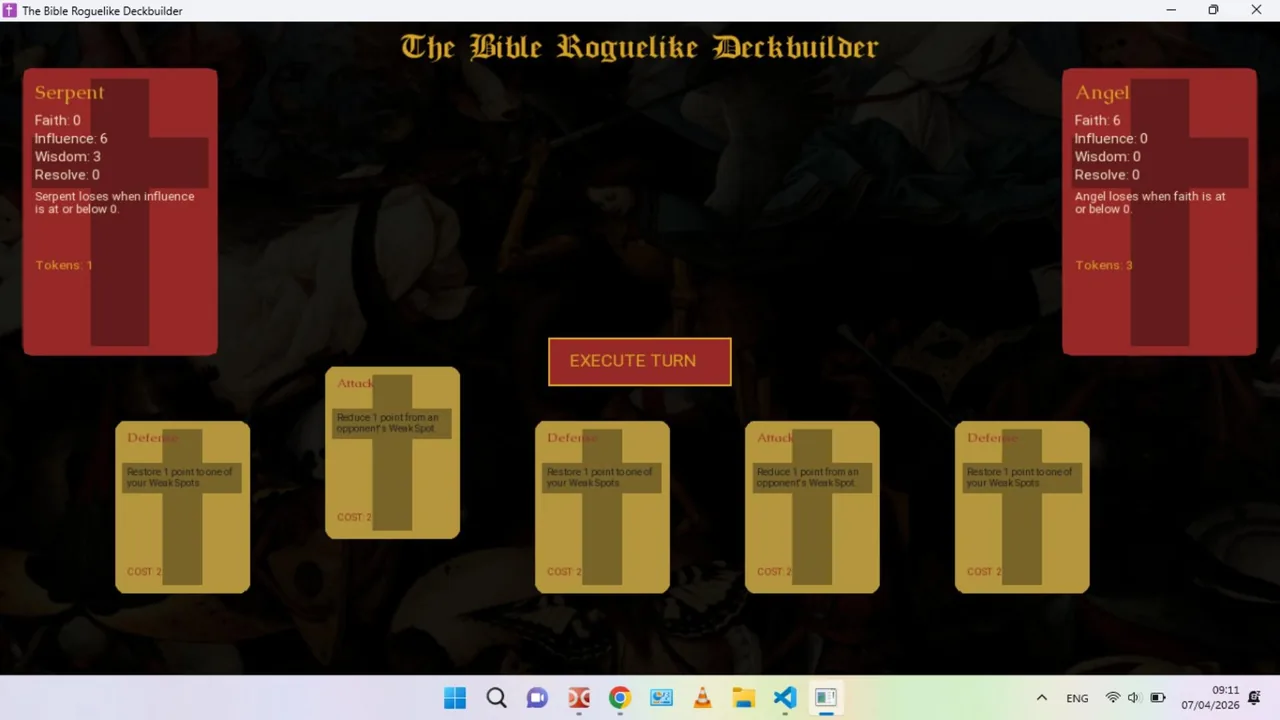
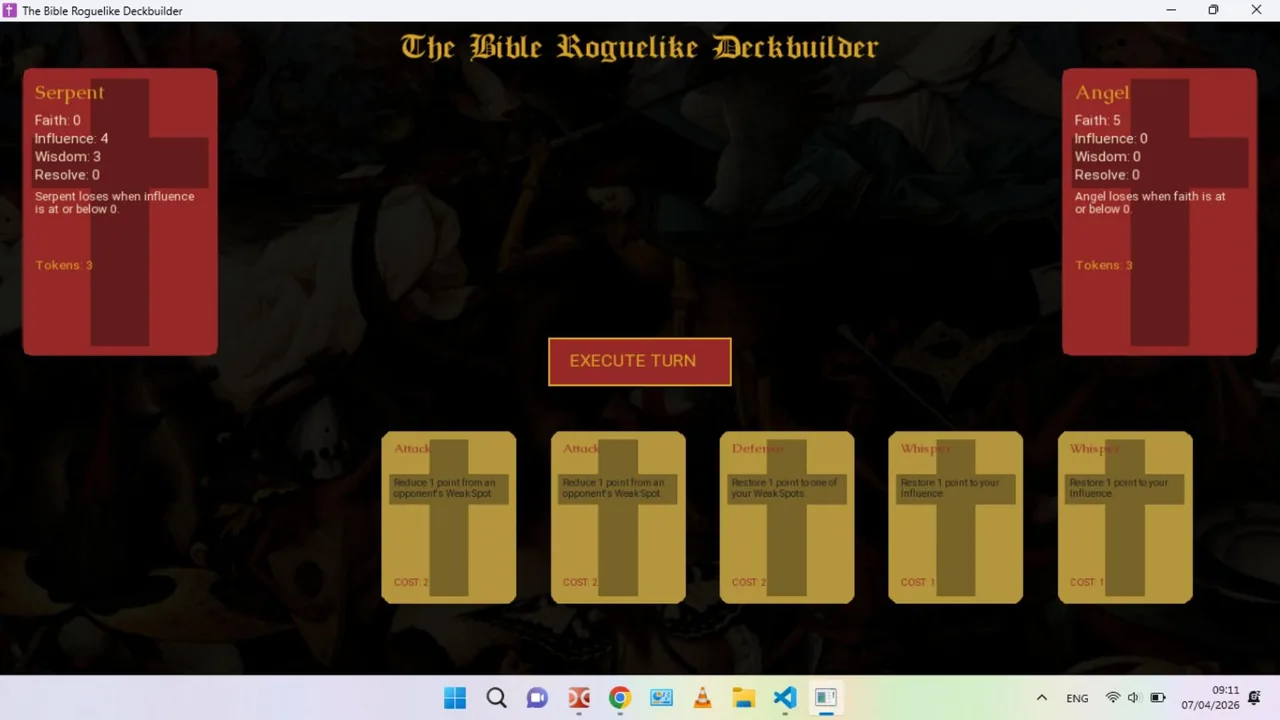
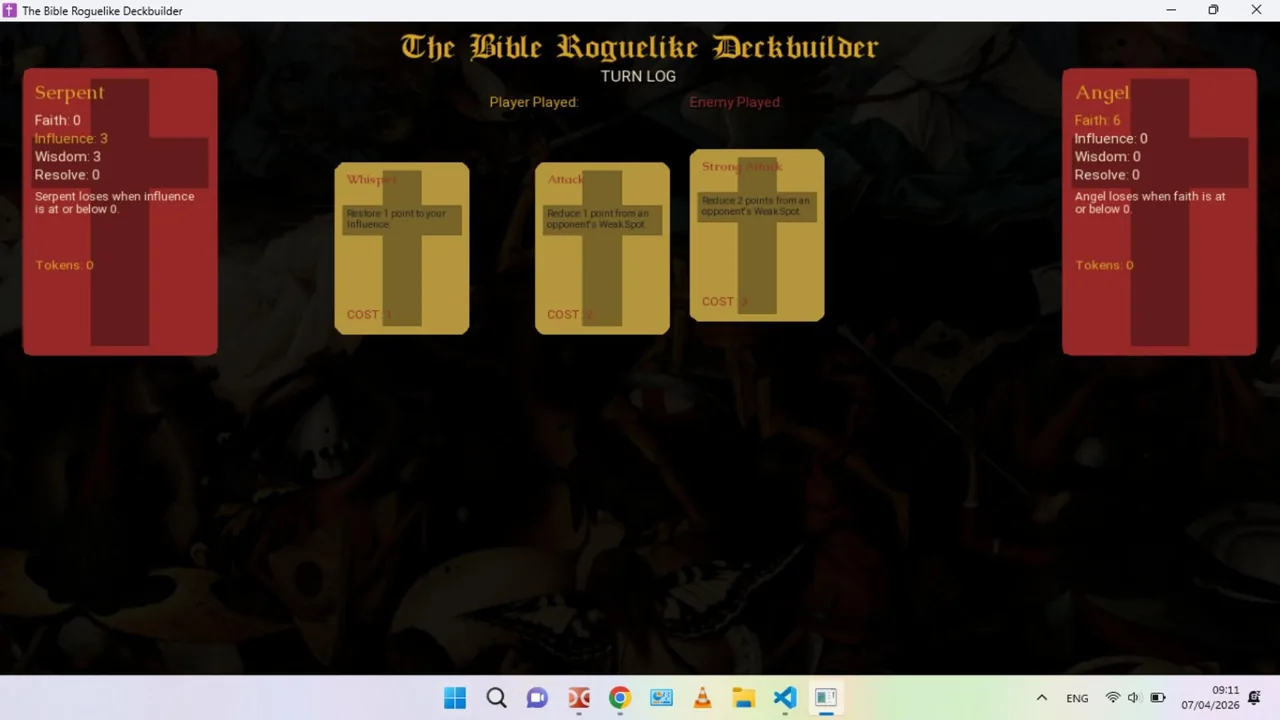
Stripped of its evocative framing, the feature list is short: two modes, a roster of biblical figures with their own decks, and procedurally generated runs across a fixed historical arc from Genesis through Revelation. The system requirements are minimal — a DirectX 9-class card and 8MB of storage are listed for the minimum spec, an unusually low figure even for a small 2D card game, and the recommended-spec block on the store page lists nothing beyond a 64-bit requirement. None of that is disqualifying for a card battler, where the actual game is in the writing on each card and the balance of the encounter design, but it does mean a prospective buyer has almost nothing concrete to evaluate before paying — no video, no detailed screenshots of the card text or map structure beyond a handful of static shots, and no meaningful third-party account of how a run actually plays out.
Where this leaves a buyer
None of this means the underlying game is bad — a card roguelike built around scripture is a premise with real room to be interesting, and Free Play's promise of mixing unlocked figures and decks into a randomized survival mode is a structure that works well in stronger entries in this genre. But a review has to weigh what's actually verifiable, and what's verifiable here is thin: a two-paragraph store pitch, a scattering of screenshots, and three user reviews that don't describe the game's systems. Priced under NZ$8 it's a low-stakes purchase in absolute terms, but "low-stakes" isn't the same as "worth recommending" when there's essentially no track record to point to yet. This score reflects a release that hasn't yet earned the benefit of the doubt its premise deserves — not a verdict on the idea itself, which remains one of the more distinctive things on the Roguelike Deckbuilder shelf.
Pros and cons
Pros
- A genuinely uncommon premise for the Roguelike Deckbuilder tag — biblical figures and scripture instead of another fantasy or sci-fi skin
- Two structured modes on offer, a fixed "Genesis to Revelation" campaign and a Free Play mode for mixing unlocked figures and decks once they're earned
- Priced at the low end of the genre, under NZ$8, with no in-app purchases listed on the store page
Cons
- Almost no independent review history to check the pitch against — three user reviews in total as of this writing, too few to establish any pattern of praise or complaint
- No achievement completion data is available at all, which usually signals either a very small player base or a game shipped without achievement tracking wired up — neither is reassuring
- The store listing itself is thin: two short paragraphs of flavour text, a bare two-mode feature list, and no video, making it hard for a buyer to judge the actual card pool or combat depth before purchase
- Single language (English only) and Windows only, which narrows the audience considerably for a full-price indie release
Screenshots
-
The Bible Roguelike DeckbuilderImage: Entertainment Software International via Steam -
The Bible Roguelike DeckbuilderImage: Entertainment Software International via Steam -
The Bible Roguelike DeckbuilderImage: Entertainment Software International via Steam -
How the review scores each part of the gameWanderer Editorial -
The specsWanderer Editorial -
The short versionWanderer Editorial