Game review
The Ash Remembers Review
7 / 10
- Developer
- Veyr Works
- Publisher
- Veyr Works
- Released
- 7 September 2026
- Platforms
- ["Windows"]
- Genre
- RPG
Ash Falls, and It Remembers Everything
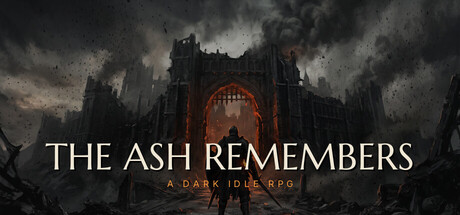
The Ash Remembers is a dark fantasy idle RPG that keeps ticking whether or not the game window is open, sending a nameless "Wanderer" through the ash-choked town of Emberwake to level 21 different skills, hunt 85 distinct enemies, and eventually take on titans that grow harder with each of the game's rebirth cycles. It's a crowded genre right now, and multiple reviewers reach for the same comparisons: "The game is melvor-like and it has a lot of competitors in that like Eldara, Visseron idle, Vespera and others," one wrote, "but still it stands out by a big number of different mechanics that even allow some time of active play." That's a fair summary of both the opportunity and the risk here, this is a genre with an established formula, and The Ash Remembers has to earn its place in a field that already has several well-liked incumbents.
Depth That Doesn't Turn Into a Spreadsheet
The headline numbers are legitimately large for an indie release: 21 skills to level 100 apiece, six playable heroes each with seven unlockable garments, five dungeons spanning 25 bosses across three difficulty tiers, seven world bosses, eight titans, and more than 730 items. One reviewer, 1,337 minutes deep, framed the achievement precisely: "If you've spent any time in the incremental genre, you know how quickly most games turn into glorified spreadsheets. The Ash Remembers manages to break out of that loop completely, offering a surprisingly complete, rich experience that actually feels like a living game." The rebirth system, called "Ashfall" in-game, adds permanent buffs and unlocks a harder "Mystic Depth" tier of content, giving the genre's usual prestige-and-restart loop a specific, story-flavored hook rather than a generic numeric reset.
No Energy Bars, No Microtransactions, No Catch
Idle and incremental games are notorious for aggressive monetization, energy timers, paid skips, gacha-style loot boxes, so it's worth stating plainly what The Ash Remembers does instead: it's an $11.99 one-time purchase with no microtransactions and no artificial waiting mechanics gating progress behind a store screen. Reviewers who've logged real time with it back this up in practice rather than just repeating marketing copy, one German-language reviewer reported roughly 45 hours in and "noch lange nicht fertig" (nowhere near finished), describing exactly the kind of low-friction, run-alongside-other-things play the genre promises but doesn't always deliver without a paywall in the way.
The Eldara Question
The most substantive criticism in the review set isn't about bugs or balance, it's about originality. Several reviewers explicitly flag how closely the game's presentation echoes a specific competitor, Eldara, down to specific shared visual details. One wrote: "It does still look very similar to Eldara as the screenshots below show," linking two Steam Community screenshots and captioning them "Same starting screen" and "Same interface design," before concluding "Despite the comparison to Eldara this game is it's own thing and sets itself apart." A German-language review made the same observation more bluntly: "einiges ist von Eldara abgeschaut" (quite a bit is copied from Eldara), while allowing that "es sind jedoch auch viele Aspekte drinnen die Eldara nicht hat" (there are also many aspects here that Eldara doesn't have). This is a specific, documented, screenshot-backed accusation of derivative design from the game's own review base, not vague grumbling, and it's a legitimate reason to mark originality down even while the broader player base still recommends the game on its merits.
An Uncomfortable AI Debate in the Reviews Themselves
A second, related thread running through the reviews concerns how the game was actually made. One detailed, otherwise positive review states it outright: "Yes, it's heavily AI-built. Graphics, UI, writing are distinctively AI (maybe the code, too, which I didn't check). However, AI isn't necessarily 'slop', the tool is what it is in the hands of the craftsman. This game has clearly been iterated with care." A second reviewer, less charitable, disagreed sharply in a one-line German review that translates to "AI slop. Barely bearable. Feels like an AI-generated concept that was probably never deeply reworked by a human." Both reviewers are describing the same underlying observation, distinctly AI-flavored art, interface, and writing, and reaching opposite conclusions about whether that matters once it ships in a finished, well-supported game. That split is worth taking seriously rather than resolving one way or the other on the reviewer's behalf: it's a credible, specific claim from the people who actually played it, not a paranoid guess, and it sits uncomfortably next to the Eldara-resemblance complaints above.
Rough Start, Smoother Middle
Onboarding is the other consistent complaint. "I honestly almost stop playing it in the first 15 mins, there was just too much going on and the game tutorial was throwing it all at you at once," one reviewer wrote, "and this is context of playing plenty of games like this one before." The same reviewer, and several others, describe the payoff as worth pushing through: "Overall, once you learn the UI, it's very well made." A useful search bar that surfaces how to obtain any item and jumps directly to the relevant screen gets specific praise, a genuinely helpful quality-of-life feature that a lot of bigger-budget idle games skip entirely.
A Developer Who Shows Up
Whatever the provenance of its art and interface, the post-launch support record here is not in question. Eight patch notes landed in the eleven days between the September 7 launch and this review, ranging from balance passes to a new "Ash Tower" and "Ash Wound" content update, and multiple reviewers independently praise the developer's presence in the Steam discussion forums. "This is not just some random publish semi finish and abandware, the dev is very active on the Steam Discussion space and takes bug reporting and feedback very professionally," one wrote. That pace of visible iteration, on a solo or small-team budget, is a meaningfully different post-launch posture than either the Eldara-comparison or the AI-authorship debate would suggest on their own.
Verdict
The Ash Remembers delivers on the raw content promise of a dark fantasy idle RPG, deep skill trees, a real rebirth loop, a fair one-time price with none of the genre's usual monetization traps, and a developer actively shipping fixes and new content within days of launch. Set against that is a legitimate, reviewer-documented resemblance to a specific competitor down to shared screenshots, and an open, unresolved question among the people who've played it about how much of its art, interface, and writing came from AI tools rather than a human hand. Neither issue stops the moment-to-moment loop from being genuinely engaging once the overwhelming first fifteen minutes pass, but they're real enough, and specific enough, that they belong in the final tally rather than being waved away by an otherwise strong 89% positive score.
Screenshots
-
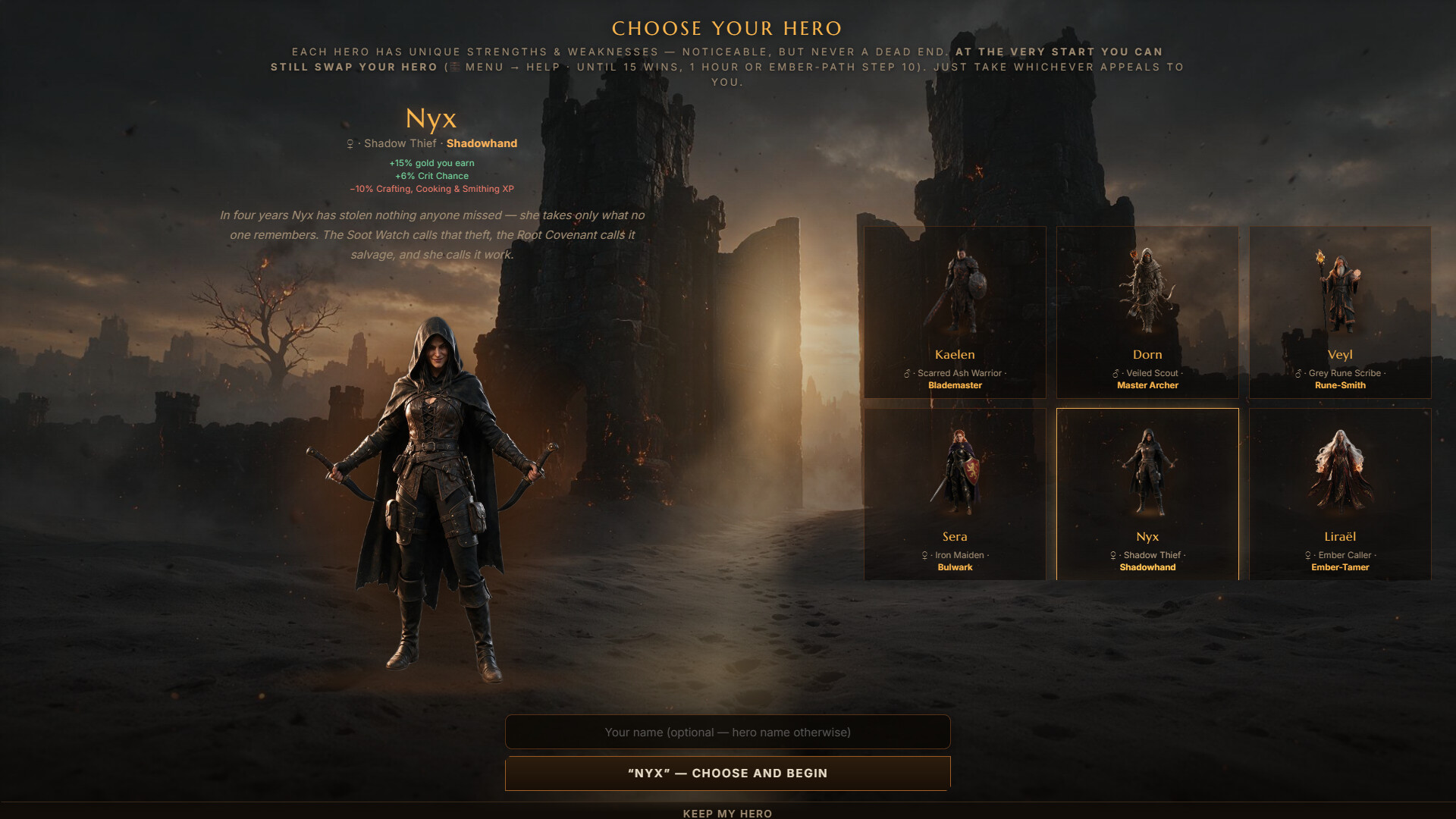
Six heroes to choose from at the start, Nyx the Shadow Thief shown here with her gold-earning bonus and crafting penalty.Image: Veyr Works via Steam -
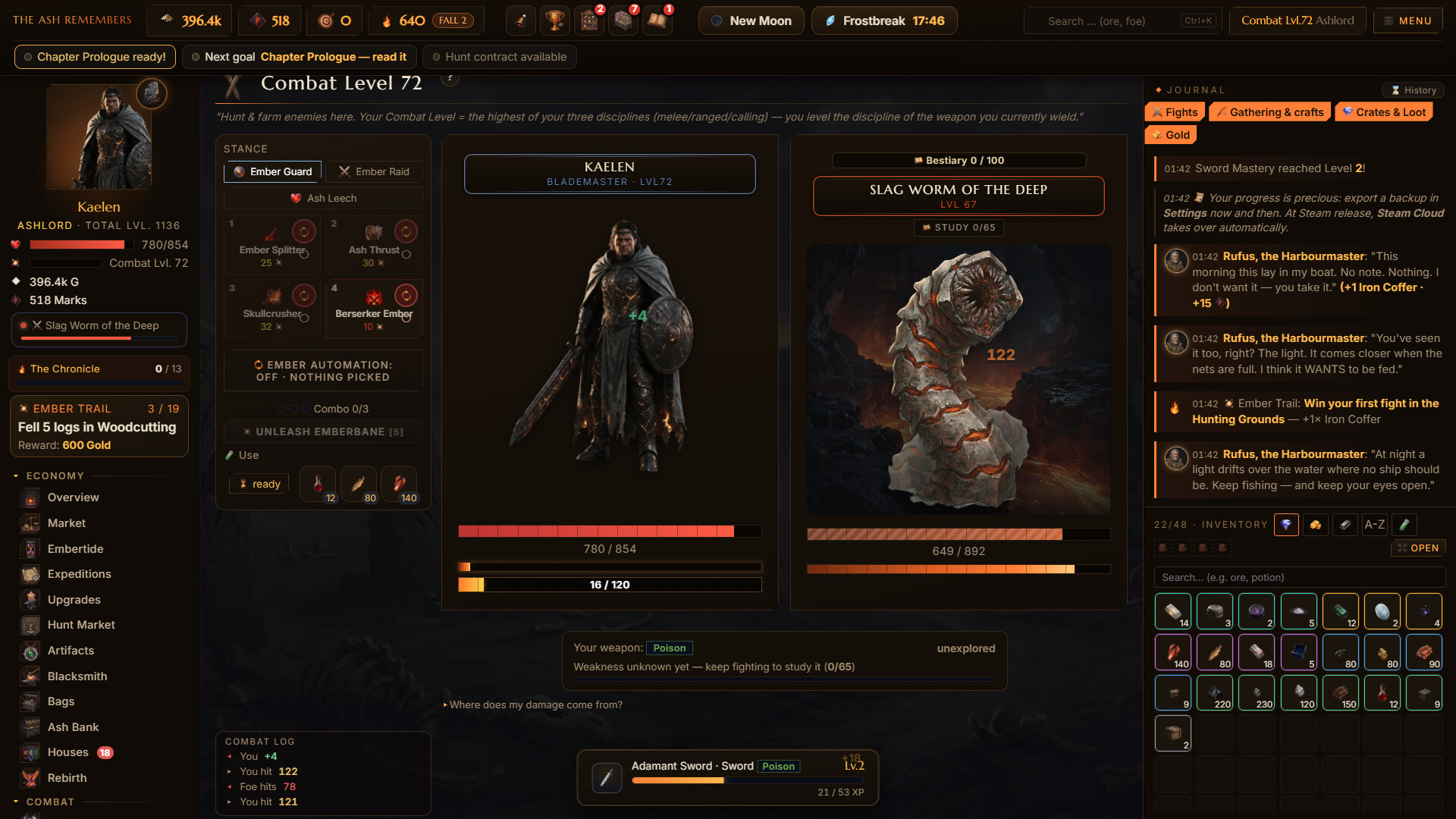
The interface reviewers found overwhelming at first, health bars, a journal log, an inventory grid, and a combat panel all visible at once.Image: Veyr Works via Steam -
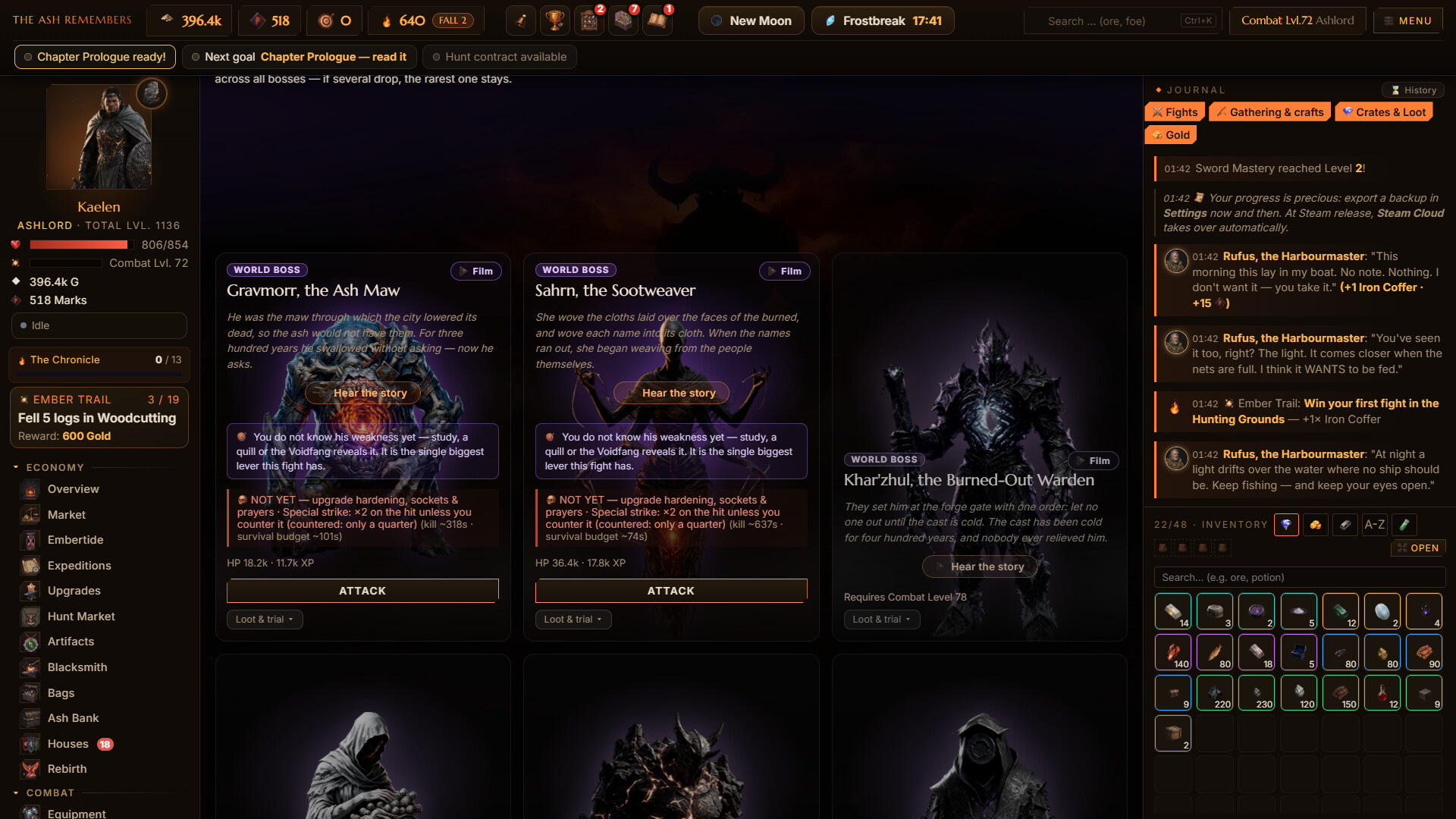
Three of the game's seven world bosses, each with its own short piece of lore rather than a reused template.Image: Veyr Works via Steam