
Game review
Path of the Idle Cultivator Review
5.9 / 10
- Developer
- Wuxia dev
- Publisher
- Wuxia Games
- Released
- 5 September 2026
- Platforms
- ["Windows"]
- Genre
- RPG
Meditate, Break Through, Die, Come Back Stronger
Path of the Idle Cultivator is a free-to-play xianxia-flavored incremental RPG that entered Steam Early Access on September 5, 2026, carrying over an existing player base from a pre-Steam version — several reviews describe months of prior play, with logged playtimes running well past 80 hours already. The pitch, lifted straight from the store page, is pure power-fantasy incrementalism: sit and absorb Qi, break through cultivation realms, fight, die, and return stronger with each rebirth unlocking new paths, races, and systems, eventually scaling from mortal nobody toward godhood and beyond.
One reviewer sums up the genre lineage neatly: "Melvor meets NGU," name-checking two well-regarded browser-idler touchstones, and offers the game's own in-built walkthrough as the fastest way in — Guide, then "What to do?", then Full Walkthrough. That same reviewer reports a single character surviving "over 4000+ years" of in-game lifespan across a long, escalating loop of meditation, combat, and stat investment.
A Mixed-But-Mostly-Positive Pool Shadowed by an AI-Coding Controversy
Path of the Idle Cultivator has drawn 33 total Steam reviews, 22 of them positive, for a 67 percent "Mixed" score; the English-language sample of 22 splits 16 positive to 6 negative, roughly matching the overall ratio. Several long-playtime reviewers are enthusiastic almost to the point of confession — "Can not remember the last time I have been so thoroughly addicted to something," writes one, while another with over 5,500 minutes logged calls it "addictive, simple yet brilliantly fun."
A notable thread running through both positive and negative reviews concerns AI involvement in the game's development. The game's own Steam AI disclosure reportedly states that "AI was used for UI and some translations. No AI was used for creative content, progression balanceament nor any game-design related." One reviewer disputes that framing directly, citing a Reddit post they attribute to the developer stating "AI disclosure: AI used for coding," and arguing the inconsistent UI behavior across the game supports that claim. Two other reviewers independently describe the game as "AI slop" or "AI generated," citing balance problems with escalating numbers and inconsistent interface behavior as their evidence — accusations this outlet cannot independently verify, but which recur often enough across the negative-review sample to be worth noting rather than dismissing.
A Genuinely Deep, Addictive Core Loop for Cultivation-Genre Fans
Setting the AI-authenticity dispute aside, the reviewers who stuck around describe real mechanical depth. "The best Cultivation Incremental game i have ever played. Everything you ever heard of in Cultivation Fantasy is in this game," writes one enthusiast, while another notes the loop is deceptively active rather than purely passive: "it's an 'idler' but don't let the title fool you, it's actually an active game," since characters have finite lifespans and can die from extended AFK periods — a meaningful twist on the genre that rewards engaged play over pure numbers-tick-up neglect.
Multiple reviewers also credit the solo developer directly for hands-on community support, describing a Discord server where bug reports get fast, friendly responses: "When I talked to the dev, he was friendly, professional and you really feel that this dev cares about his game and playerbase." Given the volume of bug and balance complaints in the negative reviews, that responsiveness matters — it suggests an actively maintained Early Access project rather than an abandoned one, even if the current build has rough edges.
Confusing Onboarding, Inconsistent UI, and Balance Complaints Undercut the Depth
The interface is the pool's clearest and most consistent weak point. "There are alot of inconsistencies with the UI, some work one way, the others work another way," one reviewer writes, and a second confirms the in-game guide "does need to be overhauled," singling out sect management mechanics and elder stats as poorly explained even by the game's own admission. Several reviewers describe the crucial first two hours as overwhelming, front-loading dense explanations of systems that only become relevant much later — though one reviewer notes the developer has explicitly said the density is intentional, meant to establish tone rather than teach cleanly.
Balance complaints compound the confusion: one reviewer describes power-level spikes that occur inconsistently, and a negative review specifically flags broken sect functionality after a rebirth cycle along with graphical glitches when selecting mantras, plus an unintended pinch-to-zoom UI bug. A separate reviewer got only six minutes in before writing off the whole experience as "typical AI-slop incremental," underscoring how quickly a rocky first impression can sour an otherwise deep system for players unwilling to push through the early confusion.
Verdict
Path of the Idle Cultivator offers a genuinely deep, addictive cultivation-incremental loop with real long-term structure — rebirths, realms, sects, and a lifespan mechanic that keeps the "idler" label honest by demanding active engagement rather than pure neglect. It earns comparisons to genre standouts like NGU and Melvor Idle from players who push through its rough start, and its solo developer appears responsive to bug reports and community feedback. But the interface is inconsistent, the guide undersells its own systems, and a recurring, unverified but persistent reviewer claim that AI tools were used more extensively in development than disclosed adds a credibility shadow the developer will need to address directly. At zero cost, cultivation and incremental-RPG fans willing to tolerate a confusing first two hours will likely find a rewarding long-term project here; players who bounce off an unclear UI in the opening stretch have good reason to wait for a polish pass before returning.
Screenshots
-
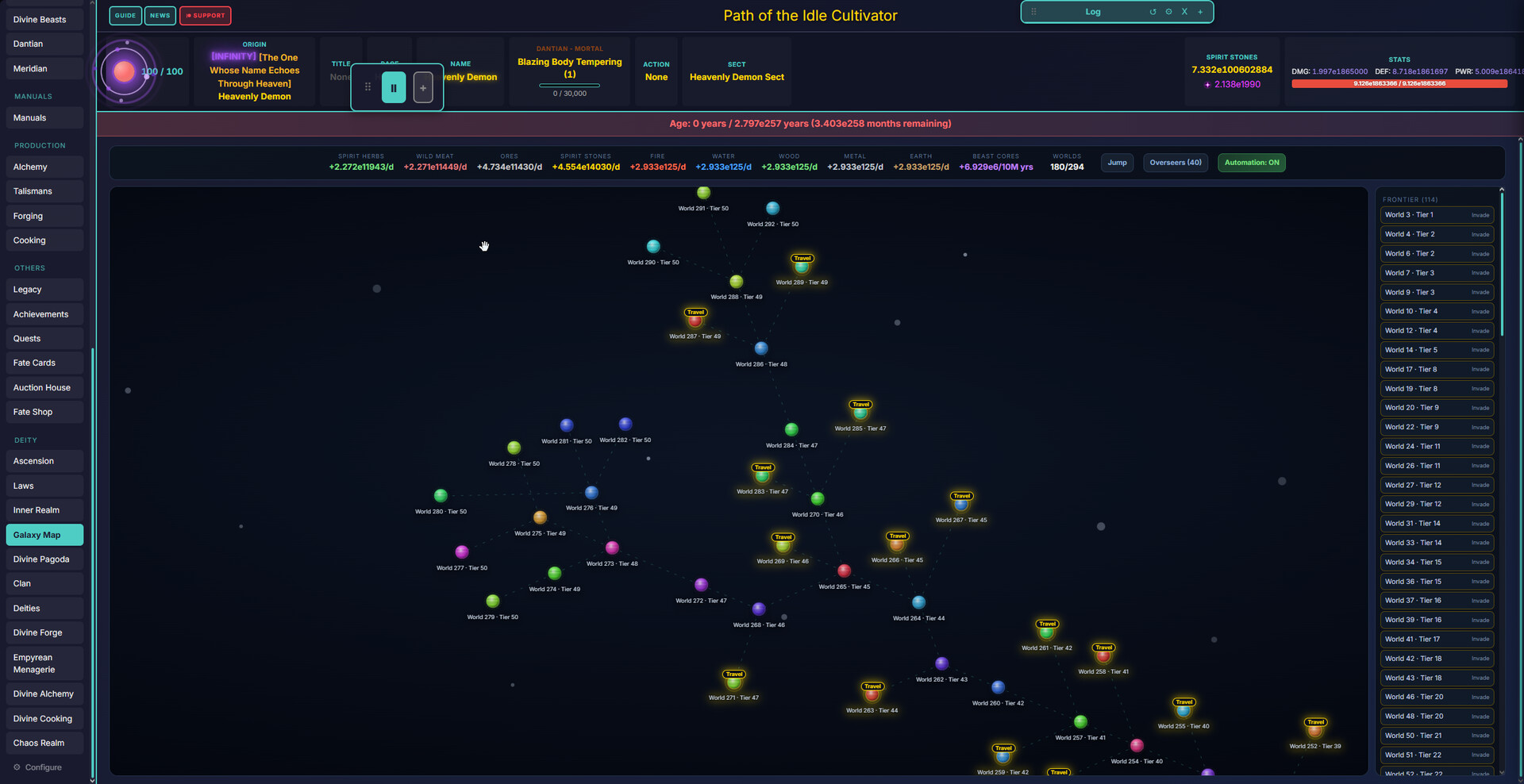
The late-game Galaxy Map, tracking hundreds of tiered worlds alongside resource totals that stretch into the hundred-vigintillions.Image: Wuxia Games via Steam -

The Divine Pagoda, one of the game's many late-game systems, here showing a character who has reached its pinnacle.Image: Wuxia Games via Steam -

The Dantian development screen, one of many interlocking stat systems new players must learn to navigate.Image: Wuxia Games via Steam