
Game review
ORACLE: Humanity, Automated Review
4 / 10
- Developer
- ZANKYO GAMES
- Publisher
- ZANKYO GAMES
- Released
- 14 September 2026
- Platforms
- ["Windows"]
- Genre
- Simulation
Raising a Civilization From Campfire to AI, One Assigned Worker at a Time
ORACLE: Humanity, Automated is a contemplative idle strategy game from solo studio ZANKYO GAMES that asks players to grow a civilization from a first campfire all the way to an age of artificial intelligence, assigning townsfolk to trades, raising their proficiency levels, and slowly unlocking new crafts and technologies as population and knowledge accumulate. Its hook is a built-in AI advisor named ORACLE, which players can query directly for hints about what to research or unlock next, framed narratively as a kind of in-world intelligence quietly observing the civilization's progress and, per the store description, "what progress creates — and what it quietly leaves behind." It's a slow, numbers-driven incremental game at its core, closer in spirit to a spreadsheet-management sim than an active-strategy title, and it entered Steam Early Access on September 14, 2026 at $9.99.
A Small, Mixed, Overwhelmingly Non-English Launch
ORACLE launched to just 19 reviews, 8 of them positive, for a 42% "Mixed" score on Steam. This is an unusually small pool for a title with this much text-driven detail per review, and it skews heavily Japanese and Korean, with only a handful of English-language reviews scattered in — worth noting given how central its untranslated content and unlock-clarity problems are to the negative reviews specifically. What stands out most in this pool isn't a split between fans and detractors so much as a split within individual reviews: several of the more detailed write-ups praise the core concept while simultaneously documenting real frustration with how opaque and gated the early game currently is.
A Genuine, Novel Concept for Patient Incremental Fans
The reviewers who stick with ORACLE describe a real, if slow-building, sense of progress once its systems click. One Japanese-language reviewer calls the built-in AI advisor "a fresh attempt at finding a foothold through strategy," while noting its actual usefulness is currently limited and hoping updates improve it (translated); another separately writes that even without leaning on ORACLE, steadily raising whichever activity levels are currently available keeps the game moving forward, so players rarely feel completely stuck, just slow (translated). A reviewer who reached roughly 300 population over several play sessions describes a real rhythm forming once rice-paddy farming unlocked and food stopped being a constant emergency, writing that they mostly just ask ORACLE "what opens next?" and follow the answer, while wishing the game would surface two or three upcoming unlocks in parallel rather than just one (translated). Another, more measured review frames the core loop plainly: "the incremental part itself is simple — you juggle resources while steadily raising activity proficiency and wait for the civilization to make new discoveries. Compared to other idle games, it's a quieter kind of game, and I think it suits people who specifically enjoy pure, unhurried incremental play" (translated). One of the pool's few English reviews echoes that sentiment concisely: "nice chill game, hopefully the dev's plan to add more, but it already plays well." For the right audience, this is clearly landing as intended.
A Brutal Food Bottleneck, Opaque Unlocks, and an AI Advisor That Doesn't Deliver
The negative reviews in this pool are unusually consistent and specific, centering on three overlapping problems. The most common by far is a punishing early-game food bottleneck: multiple reviewers describe reaching a population ceiling where virtually the entire workforce must be assigned to food production just to stay even, leaving no room to develop any other trade, with one English-language reviewer writing that "even over 12 hours in, the vast majority of the population is working on food production so any other progress is fully stagnant," and a Japanese reviewer describing food math that goes negative even at full food-focused staffing. Closely related is a broader complaint about unclear unlock logic: reviewers report hidden skill requirements, no visible quest or tutorial structure pointing toward what to do next, and difficulty even locating newly-unlocked activities in the interface once they appear, with a detailed Korean-language review listing missing translations, unlabeled maintenance costs on housing, and villagers who leave due to food shortages and never return even once the shortage is resolved, describing losing a 40-minute save to that exact problem (translated). The built-in ORACLE AI advisor, the game's headline feature, draws pointed skepticism rather than praise from several critical reviewers: one Korean-language review argues that when asked substantive in-world questions, ORACLE mostly returns generic, copy-pasted-sounding deflections rather than real answers, calling the feature's implementation closer to "bluffing" than a functioning system (translated), while a blunt English-language review states, "this game is clearly made by ChatGPT... it has its own built-in AI helper clearly made [with] ChatGPT... you play for 20 minutes and realize there is nothing to it," and reports refunding. A recurring smaller complaint concerns random "disaster" events that fog over the screen and disrupt otherwise idle-friendly pacing, which one reviewer dismisses as "just a nuisance element" that undermines the genre's normal appeal of stepping away and letting the game run.
Verdict
ORACLE: Humanity, Automated pairs a quiet, patience-rewarding incremental civilization loop with a genuinely novel hook — an in-world AI advisor meant to guide players through its tech tree — but its Early Access launch stumbles badly on exactly the fundamentals an idle game needs to get right: a food-production bottleneck several reviewers describe as a hard wall rather than a challenge, unlock logic that's frequently invisible or untranslated, and an AI advisor that multiple reviewers say fails to deliver on its own premise. Its most engaged reviewers, largely writing in Japanese, do find real satisfaction in slowly puzzling out its balance and watching a population creep upward, which suggests the underlying loop has promise. But at $9.99, with a 42% Mixed score built on a pool this small and this consistent in its complaints, prospective buyers should treat this as an unusually rough, still-forming Early Access foundation rather than a polished incremental experience, and wait for clearer guidance and a reworked food economy before diving in.
Screenshots
-
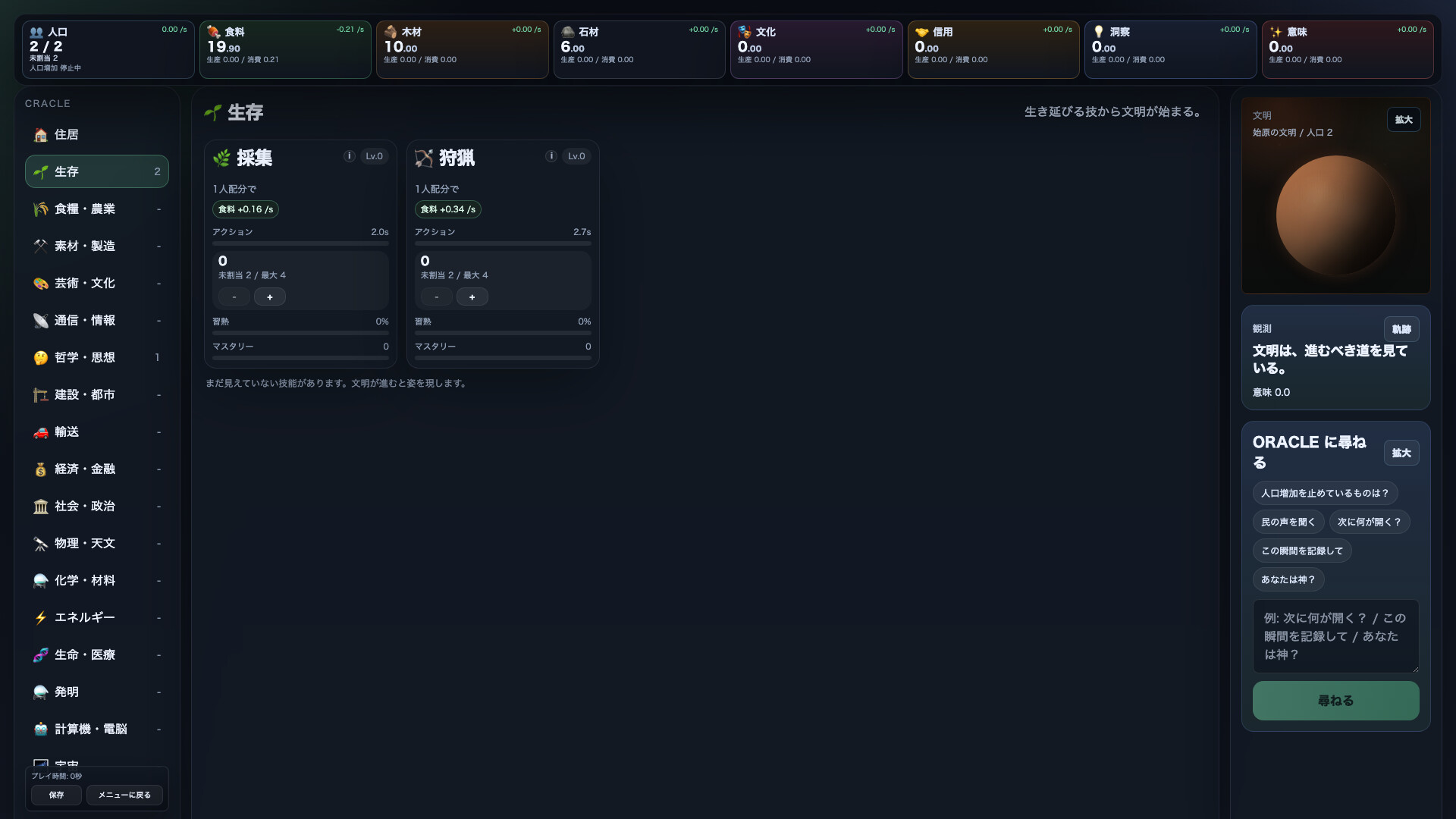
Early-game survival tasks like gathering and hunting sit alongside the ORACLE advisor panelImage: ZANKYO GAMES via Steam -
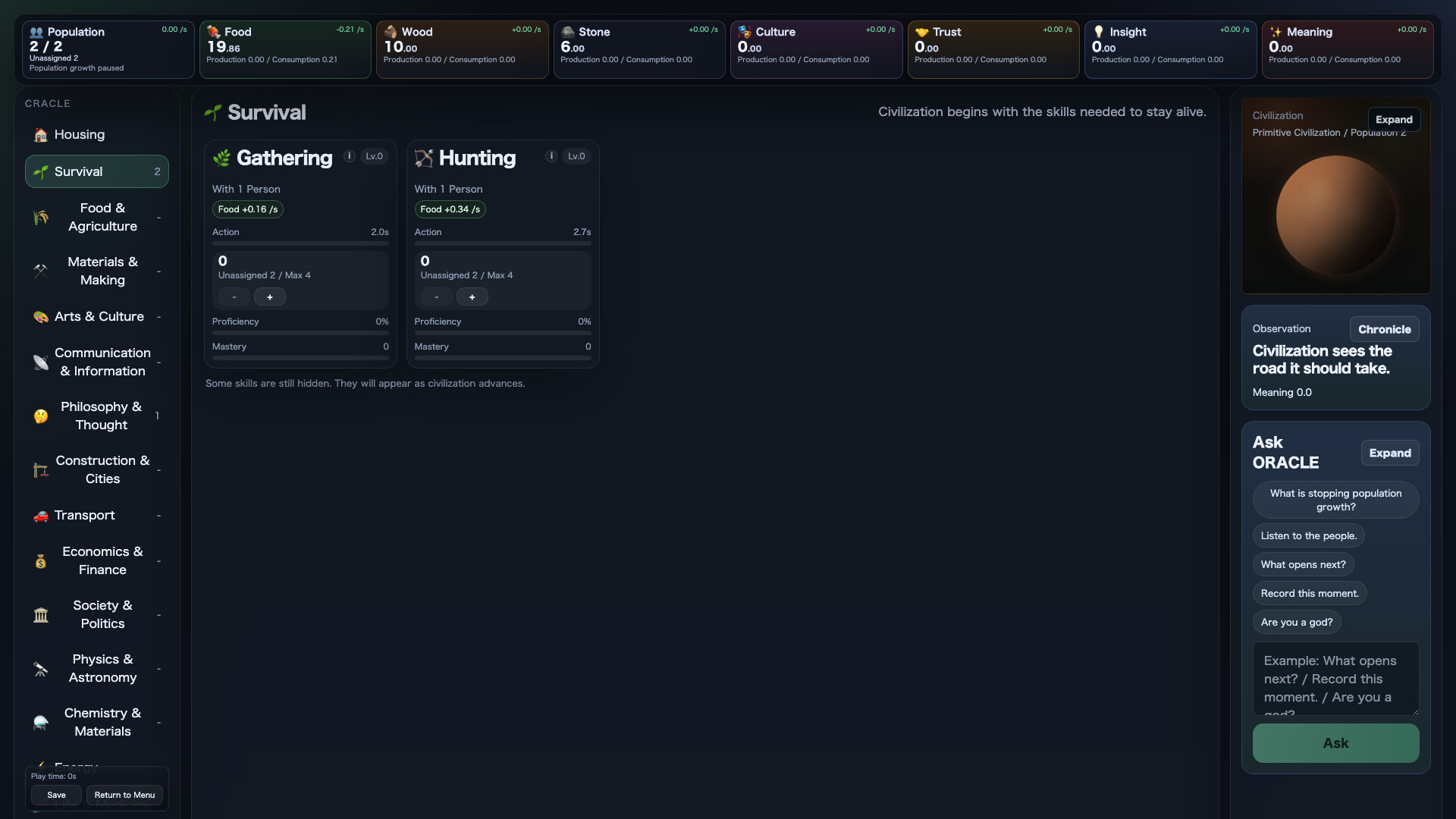
A long sidebar of tech categories hints at the civilization's eventual scope, most still locked at the startImage: ZANKYO GAMES via Steam -
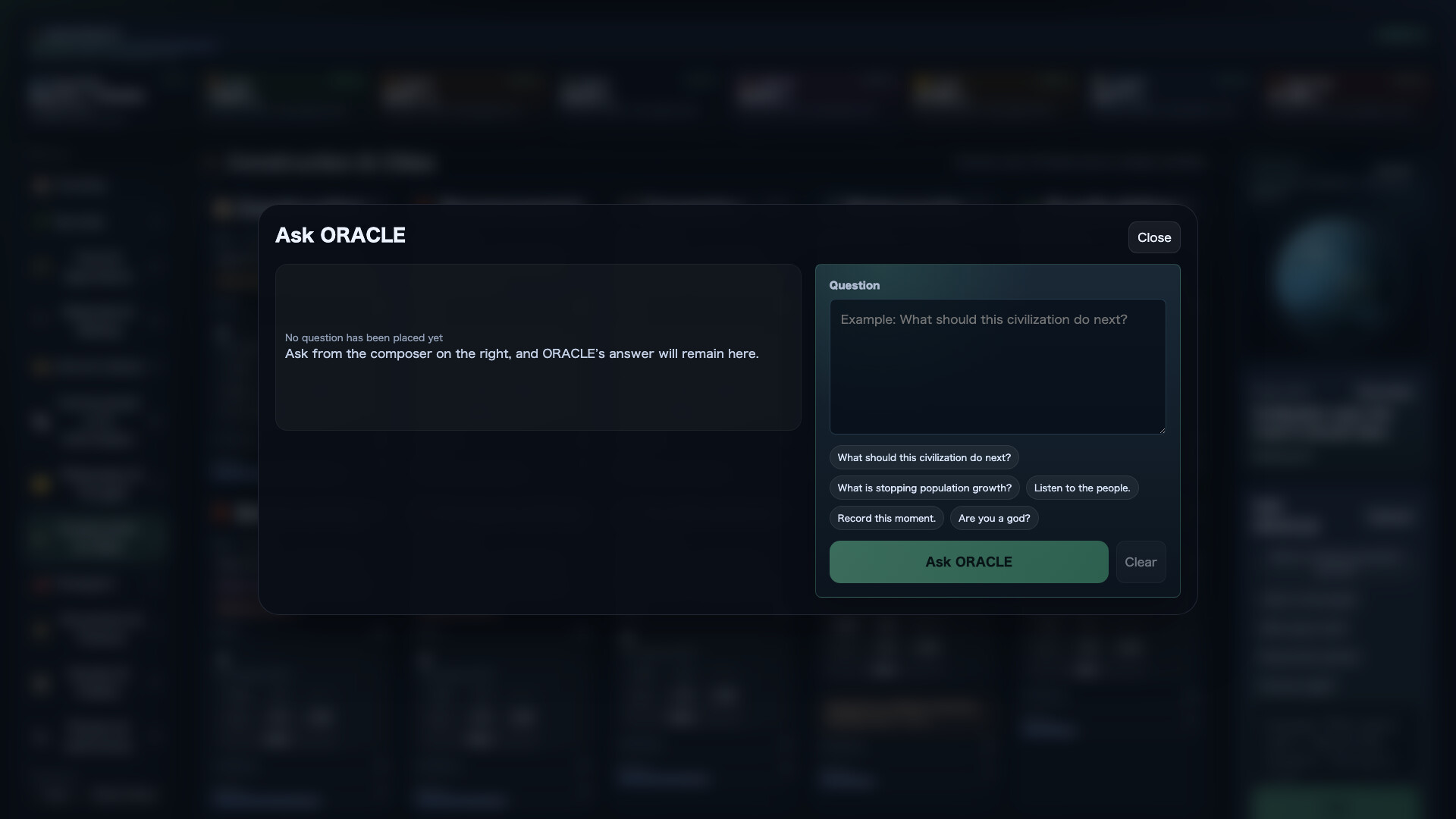
The Ask ORACLE dialogue offers suggested prompts for hints on what to do nextImage: ZANKYO GAMES via Steam