Game review
Nuclear Design Bureau Review
5.6 / 10
- Developer
- Design Bureau KB-11
- Publisher
- Design Bureau KB-11
- Released
- 14 September 2026
- Platforms
- ["Windows"]
- Genre
- Simulation
Kerbal Space Program for Nuclear Weapons Design
Nuclear Design Bureau is a hardcore engineering sandbox that casts you as a junior engineer at a thinly-fictionalized Kurchatov Institute, tasked by "the State" with designing functioning nuclear devices out of a warehouse of dangerous materials, under increasingly specific directives about yield, materials, and delivery constraints. Under the hood it's a genuine physics simulation modeling hydrodynamics, neutron transport, and thermonuclear fusion, letting players actually build gun-type, implosion, and multi-stage thermonuclear designs component by component and then detonate them to see whether the numbers work out. It's an almost aggressively niche premise executed with real technical ambition, and one reviewer sums up the pitch about as well as anyone could: "it's Kerbal Space Program for nuclear engineering." The developer has said the game is being built in the open specifically so its campaign, physics, and toolset can evolve based on what early players get stuck on, which is the stated reason it entered Steam Early Access on September 14, 2026 at $9.99.
A Mostly Positive Score Masking a Deeply Split, Contentious Launch
Nuclear Design Bureau launched to 131 reviews, 95 of them positive, for a 73% "Mostly Positive" score on Steam. That headline number undersells just how loud and specific the dissent is: the single most-upvoted review in the entire pool, sitting at 186 votes, is a negative one, and it's far from an outlier — a large, repeated cluster of reviews across the top of the list levels the same accusation in different words. This is a launch where the underlying idea has won over a real audience, but where a vocal, technically literate slice of that audience is withholding its recommendation over how the game was actually built, not just how it currently plays.
A Genuinely Novel, Government-Cleared Sandbox With Real Fans
For the audience it's aimed at, Nuclear Design Bureau clearly delivers on its central promise. Reviewers describe completing full campaigns, engineering multi-megaton devices, and losing hours to a subject most games never touch, with one writing plainly, "I now know a lot more about how to build atomic bomb, very cool." Another calls it "tons of fun to play with even in its current state," specifically praising the developer's responsiveness on Discord in fixing bugs, while a third frames the whole experience as remarkable simply for existing, noting the developer "literally had to get clearance from the US government to release it because of the subject matter." Several reviewers explicitly separate their enjoyment of the simulation from their discomfort with parts of its production, with one writing "do I care that generative AI was used? No, not everyone is a graphic design artist. For 5 odd bucks, the entertainment value is very high," and framing the price as more than fair for a genuinely one-of-a-kind sandbox. Even critics who ultimately can't recommend it tend to concede the underlying idea is strong: one particularly detailed negative review still opens by calling the concept "really cool" and says the developer should use Early Access revenue to hire proper collaborators and finish the project properly rather than abandon it.
Widespread "Vibe Coded" Accusations, a Breaking Simulation, and a UI Reviewers Call Unusable
The dominant complaint across this launch, by a wide margin, is that large parts of Nuclear Design Bureau — its tutorial and campaign text, its in-game manual, its artwork, and reportedly its code and UI — were generated by AI with minimal human editing, a practice reviewers repeatedly call "vibe coding." The top review, at 186 votes, calls the writing "clearly lightly edited LLM output," pointing to recurring "X isn't Y, it's Z" phrasing and even a settings-menu string reviewers say reads like leftover debugging notes from a coding assistant, literally labeled "Windows 11 Alt+Tab investigation." Another widely-upvoted review states flatly, "the entire in-game manual is almost entirely AI generated, and the images are also clearly AI," while a shorter, blunter one reads: "IT'S VIBE CODED. NONE OF THE SIMULATION ACTUALLY WORKS. IT'S VIBE CODED JUST ENOUGH TO MAKE IT LOOK LIKE IT WORKS AT A GLANCE." Several reviewers go further and connect this directly to functional problems rather than treating it as a purely aesthetic complaint, reporting that the simulation "breaks down at a very low degree of complexity," that lithium deuteride fuel simply fails to ignite under any configuration they tried, and that the tools and UI actively "fight the user." Performance is a second consistent complaint, with multiple reviewers noting the simulation step runs single-threaded and slows dramatically once a design grows past a modest size, and at least one reviewer reporting a full system crash within two minutes of first launching the game. Not every reviewer treats the AI-use question the same way — one negative reviewer writes they're specifically bothered by generated content but still calls this "the best case for AI slop, a random dude who had an idea but not the means to realize it," framing it as a resourcing compromise rather than a cash grab — but the sheer volume and specificity of the complaints, echoed almost identically across dozens of separate reviews, marks this as the launch's defining controversy far more than any individual bug.
Verdict
Nuclear Design Bureau is one of the more genuinely original Early Access debuts of the year, delivering a real, if rough, physics simulation of nuclear weapons design wrapped in a premise no other game on Steam is attempting, and its most engaged players clearly find something worth returning to in its campaign and open sandbox. But the launch is defined less by that novelty than by a loud, specific, and broadly corroborated accusation that its writing, art, and possibly its code were produced with minimal human oversight via AI tools, a complaint that shows up in the platform's single most-upvoted review and dozens more like it, and that several reviewers connect directly to real simulation inaccuracies and an interface they describe as actively hostile to use. At $9.99, the idea alone is enough to make this worth a look for players fascinated by hardcore engineering sandboxes, but anyone put off by heavily AI-assisted production, or expecting a stable, fully-realized simulation, should wait to see whether the promised open development actually closes that gap.
Screenshots
-
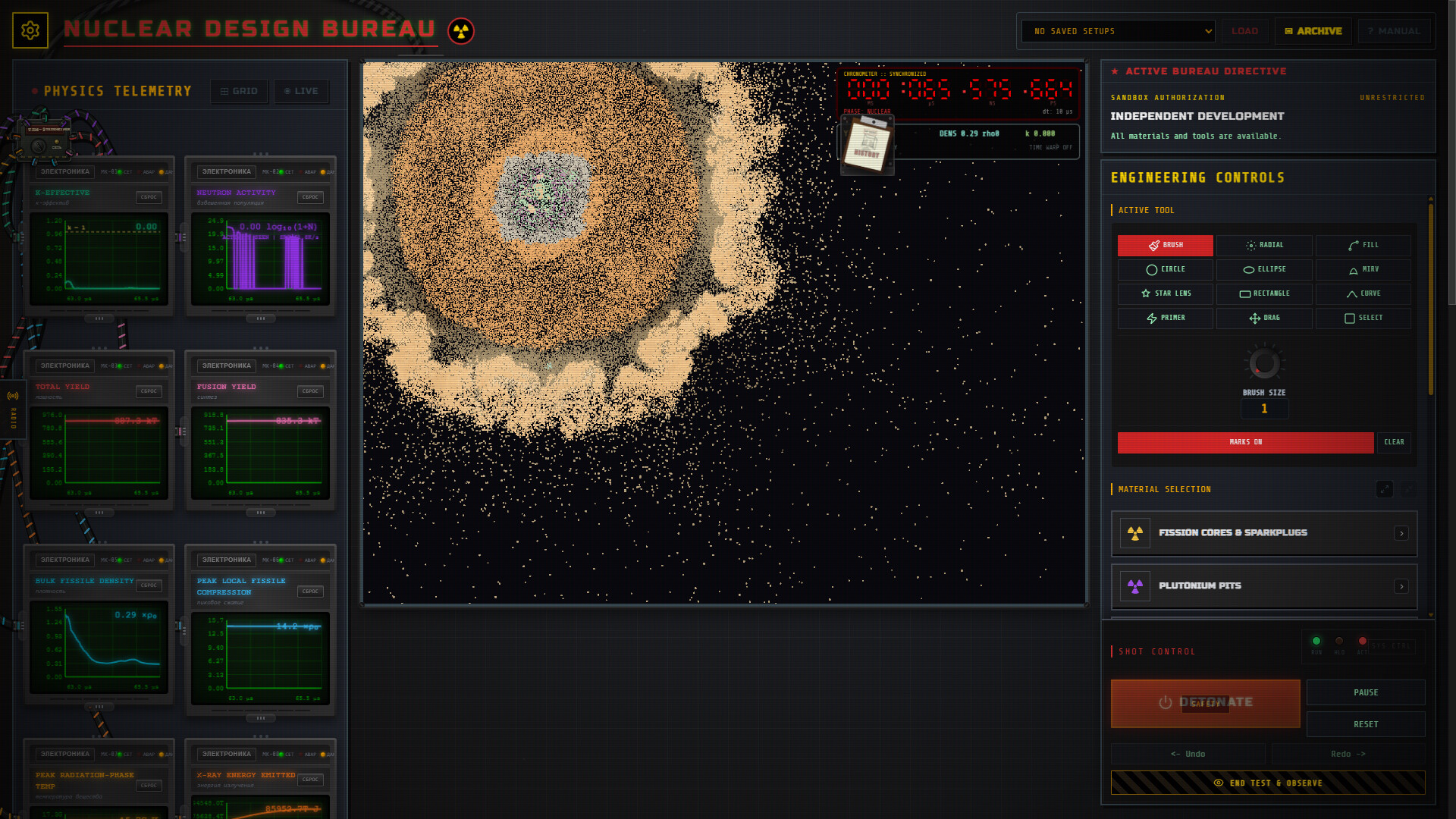
Detonating a device renders a pixel-simulated fireball alongside live physics telemetry for yield and neutron activityImage: Design Bureau KB-11 via Steam -
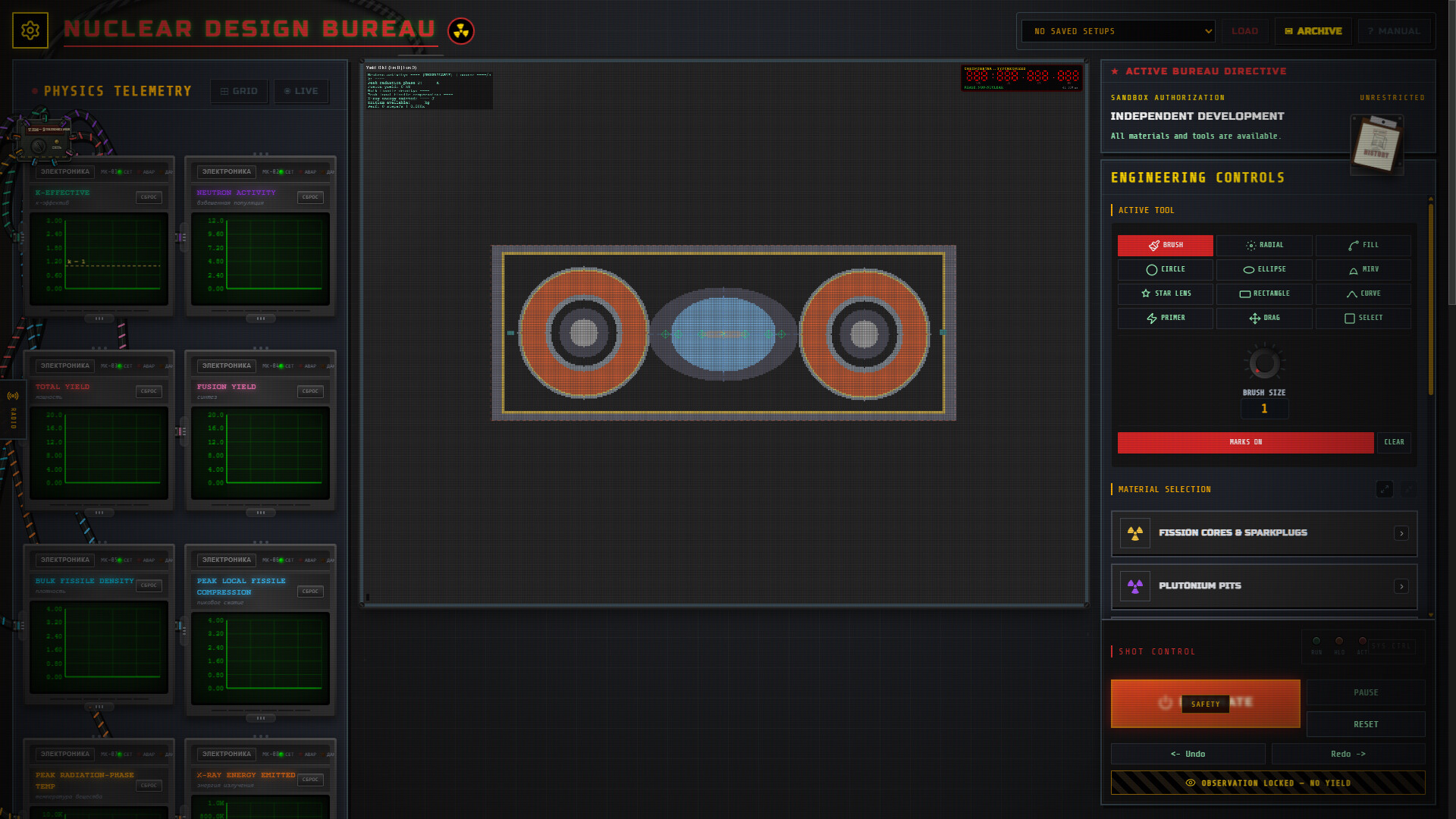
The design editor for building multi-stage thermonuclear devices from fission cores and fusion capsulesImage: Design Bureau KB-11 via Steam -
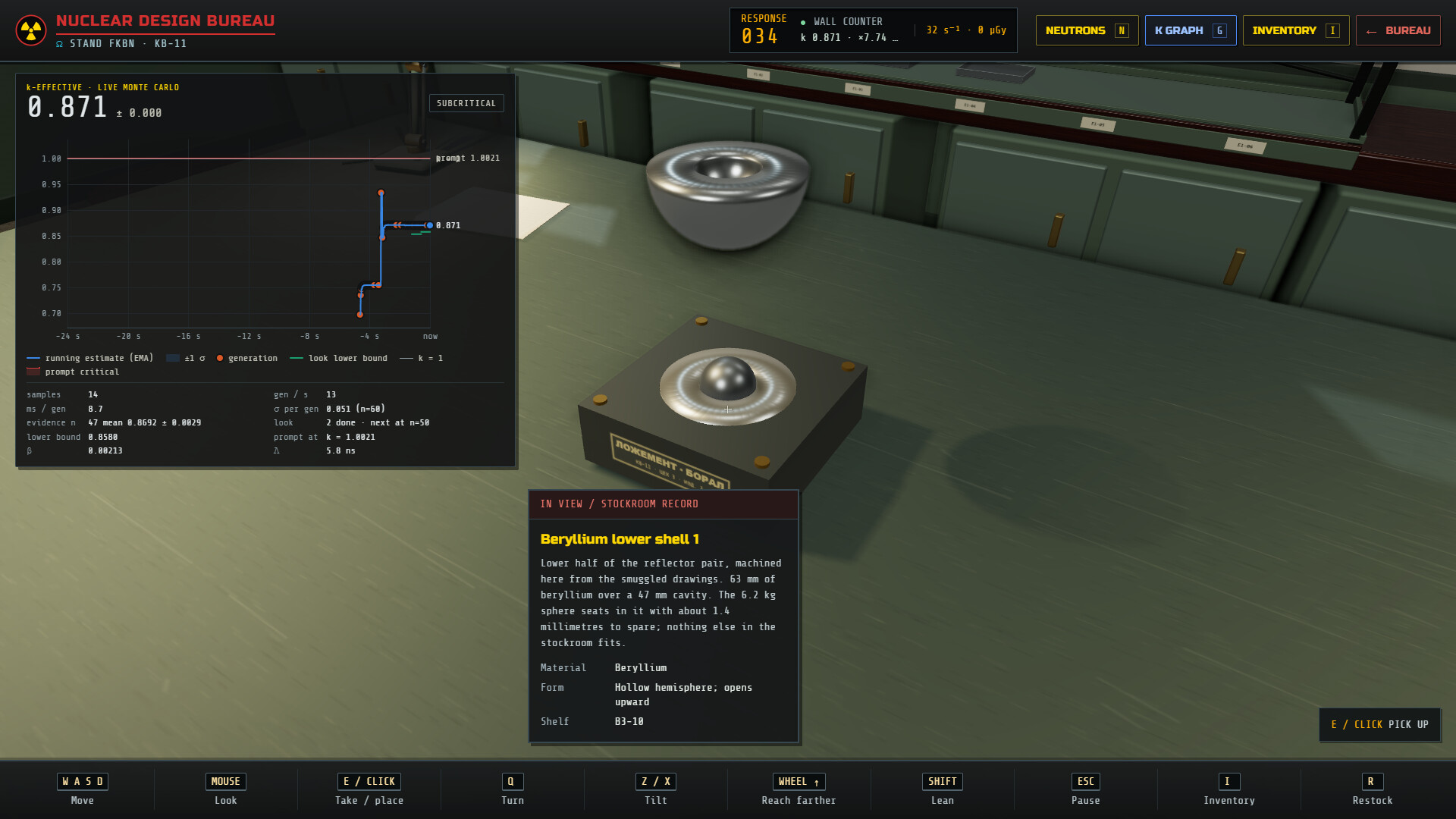
Assembling a subcritical core by hand in the first-person stockroom, with a live criticality graph tracking k-effectiveImage: Design Bureau KB-11 via Steam