Game review
Sword x Staff
7 / 10
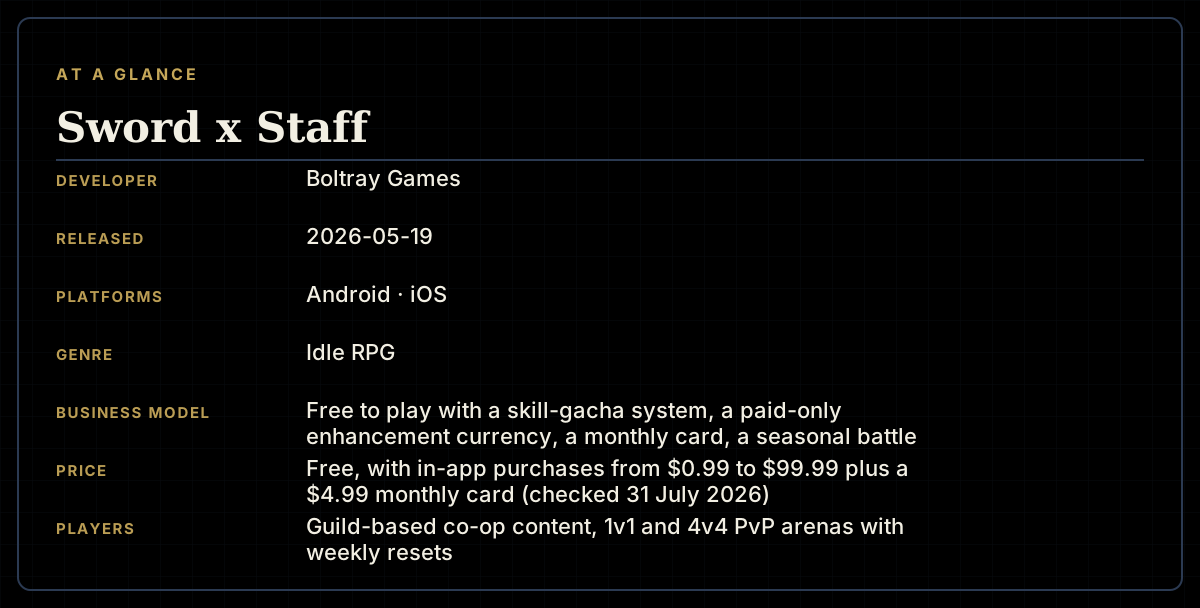
- Developer
- Boltray Games
- Publisher
- Boltray Games
- Released
- 19 May 2026
- Platforms
- Android, iOS
- Genre
- Idle RPG
- Monetisation
- Free to play with a skill-gacha system, a paid-only enhancement currency, a monthly card, a seasonal battle pass and a spend-tracked VIP ladder
- Players
- Guild-based co-op content, 1v1 and 4v4 PvP arenas with weekly resets
The short version
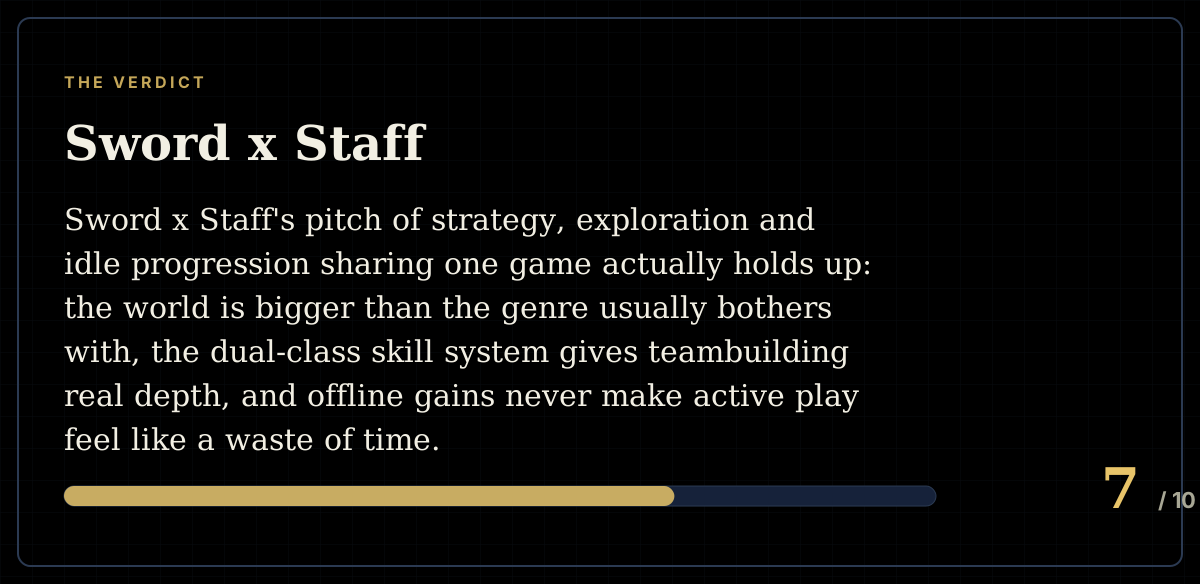
Sword x Staff's pitch of strategy, exploration and idle progression sharing one game actually holds up: the world is bigger than the genre usually bothers with, the dual-class skill system gives teambuilding real depth, and offline gains never make active play feel like a waste of time.
What keeps it from ranking among mobile's best is the same thing that funds all of it. A paid-only currency sits behind equipment enhancement, PvP rewards spenders directly, and the skill gacha's best rolls land at a 1% base rate. None of that is unusual for the genre, but it's applied thoroughly enough that free progression has a visible ceiling.
Biggest strengths
- The world map is treated as a real feature rather than idle-genre wallpaper, with four distinct regions worth actually walking through instead of tapping past
- The Warrior-and-Mage dual-class base branches into genuinely different skill combinations rather than reskinned stat variants
- Offline progression keeps resources, a traveling merchant and character growth moving without making the active game redundant
Biggest weaknesses
- Luminium, the equipment-enhancement currency, cannot be earned through play at all — it is a real-money-only lever on gear power, not a convenience purchase
- PvP arenas reward spending directly; free players can compete but not for the top of a weekly ladder against funded accounts
- The skill gacha's headline rarity sits at a 1% base rate per pull, with the other systems (VIP tiers, battle pass, monthly card) all layered on top of the same currency economy
Who it's for: Idle and gacha RPG players who want an actual world to walk through rather than a menu dressed up as one, and who are prepared to either spend with intent or accept a mid-table ranking once PvP and endgame gearing kick in.
Our recommendation: Free to download and worth the first few hours on curiosity alone. Decide early whether you're chasing the story and casual content or the competitive ladder — only one of those stays free.
7 / 10
Mobile RPGs promise hybrids constantly and deliver reskins just as constantly — a menu with a map screen bolted on, called "exploration." Sword x Staff, from Singapore-based Boltray Games, is one of the rarer ones that actually tries to make good on the claim. It calls itself a "Third Way RPG," insisting you don't have to choose between strategy, world exploration and idle progression. For the first several hours, at least, that isn't marketing copy. It's a reasonably accurate description of what you're doing.
Is Sword x Staff good?
Yes — Sword x Staff is a good idle RPG for players who want exploration and meaningful team-building alongside automatic progression. Its world and dual-class systems earn a 7 out of 10 here; the main caveat is an aggressive gacha economy that puts competitive and endgame power behind spending.
An idle game you can actually walk through
Most idle RPGs treat their world as a formality — a static backdrop behind a stack of progression menus. Sword x Staff's map of Kanstein is a genuine departure from that habit. You move your Chosen Adventurer avatar across four distinct regions with their own visual identity and environmental storytelling: the forested Verdantglade around the Auroradrasil tree, the clashing steel-and-instinct territory of Cinder Ridge, the mist-heavy waters of Aqualis, and the bronze ruins of Loong Haven. None of this is optional wallpaper you tap past on the way to the next battle screen — treasure, side content and story beats are tied to actually covering ground, and the game rewards poking into corners rather than holding a fast-forward button.
That's meaningfully different from the genre's default, where "exploration" usually means picking a destination from a list and watching a loading bar. Sword x Staff still lets you auto-path between objectives when you want to, so it isn't punishing players who'd rather not manually walk everywhere — but the option to actually look around is real, and the environments are distinct enough to make that worthwhile.
Two classes, two hundred ways to build them
Underneath the exploration is a dual-class system built on a Warrior-and-Mage foundation that branches, according to Boltray, into more than 200 skill combinations. In practice this means you aren't locked into a single archetype per character the way most gacha RPGs lock you into a hero's fixed kit. You mix skills, reorder cast sequences and swap elemental builds, and the resulting teams genuinely play differently from each other rather than just showing different numbers on the same rotation.
Four base roles sit under that system — Staff User for ranged support and control, Warrior for melee tanking and counters, Shield User for frontline blocking, and Mage for AoE burst — and the combinations between them are where the game's strategic depth actually lives. Auto-battle keeps fights hands-off during idle stretches, with AI-controlled characters repositioning and chasing targets rather than standing in a line trading blows, and battles read as more tactical than the "watch the numbers go up" combat a lot of the genre settles for.
Does Sword x Staff have offline progression?
Yes. Resources keep accumulating while you're away, characters keep growing, and a traveling merchant shows up with rotating stock whether you're logged in or not — the standard shape of idle-RPG offline systems, executed competently rather than innovatively. What matters more is that none of it makes active play feel pointless. Logging in to manually explore, fight and make build decisions is consistently more rewarding than leaving the game running, which is the balance idle RPGs most often get wrong in one direction or the other.
The opening hours, though, are slower than the "no pressure, jump in anywhere" framing in Boltray's own marketing suggests. The Verdantglade region functions as a soft filter — the pacing, system-gating and skill-experimentation options open up gradually rather than immediately, and players expecting an idle game's usual instant gratification may bounce before the more interesting systems around Cinder Ridge and beyond actually arrive. That's a defensible design choice for a game built around long-term investment, but it's a real cost against a first impression, not just a footnote.
Is Sword x Staff a gacha game?
Yes. Sword x Staff uses a skill gacha alongside a two-currency economy, and both are worth understanding before you get attached to a build. Dawnium, the primary currency, is earnable through daily missions and events at a reasonable clip and covers most of the skill-gacha pulls and shop purchases a free player will touch. Luminium is the other half, and it's the one that matters for this review's score: it cannot be earned through play at all. It's real-money-only, and it sits behind equipment enhancement, advanced crafting and several system unlocks — meaning the ceiling on your gear's raw power, not just your roster's variety, is gated by spending rather than time.
The skill gacha itself pulls from a system that's more honest than plenty of its competitors — Legendary skills land at a 1% base rate, Epic at roughly 7%, Rare at roughly 22%, with a documented pity ladder guaranteeing at least a Rare by the tenth pull, an Epic by the thirtieth and a Legendary by the seventieth. Publishing a hard pity ceiling at all puts Boltray ahead of a genre where plenty of studios still won't confirm one exists. It doesn't change the fact that a Legendary skill draw is still, on average, a one-in-a-hundred outcome you're meant to chase.
Layered on top of the gacha: a $4.99 monthly card that's a legitimately strong value purchase for anyone playing daily, a seasonal battle pass that rewards consistent logins and loses value fast if you miss days, and a VIP ladder that only advances when you actually spend real money — no stockpiling free currency to climb it. In-app purchases range from $0.99 up to $99.99. None of this is unusual by mobile-RPG standards. What's notable is how completely it's applied: currency, enhancement, gacha, battle pass, monthly card and VIP status are all separate systems pointed at the same wallet.
Is Sword x Staff pay-to-win?
In competitive play, yes: paid-only Luminium improves equipment, and the PvP ladder directly rewards the resulting power gap. The story, exploration and baseline guild content remain playable for free, so casual players can enjoy the game without paying, but they should not expect an even endgame ladder.
The PvP arenas make the practical consequence visible. Weekly 1v1 and 4v4 ladders reset every seven days, and free-to-play players can absolutely participate and earn baseline rewards — but climbing against funded accounts at the top of the ladder is a fair fight in name only. Guild content is friendlier ground: guild bosses, shops and guild wars unlocking at level 15 provide real passive value and don't carry the same direct pay-to-win pressure PvP does, and cooperating with a strong guild is genuinely one of the better ways to close the gap spending would otherwise create.
Presentation and the interface tax
Visually, Sword x Staff backs up its production budget — a roughly 1GB install, seven supported languages at launch and a deep avatar customisation system that pushes back against the "same face, different palette swap" look a lot of anime-adjacent gacha games settle for. It's landed well enough with players and licence holders alike to pick up a KONOSUBA crossover a few weeks after launch, which is a reasonable proxy for how the wider gacha audience has received it.
The interface is the one area where the ambition of the "Third Way" pitch works against it. Running exploration, dual-class skill management, a two-currency economy, a VIP track, a battle pass and a top-up shop through one set of mobile menus is a lot to organise clearly, and Sword x Staff doesn't fully solve that problem — new systems tend to arrive faster than the UI finds a clean place to put them, and figuring out which currency a given upgrade actually wants is more work than it should be in the first several hours.
How it's landing
The storefront numbers back up the idea that this is a well-made entry in its genre rather than a cash-grab with a hybrid label stapled on. As of late July 2026, Sword x Staff sits at 4.9 out of 5 across more than 31,000 App Store ratings and 4.7 out of 5 across more than 106,000 Google Play ratings — a scale of positive reception that's hard to fake and that puts it well ahead of the genre average, even accounting for how generously mobile gacha players tend to rate the games they're already invested in. No major games-press outlet has published a scored critical review yet, which is normal for a mobile-first launch that skipped Steam entirely, but the player-facing numbers are as strong a signal as this kind of game usually gets this early.
Is Sword x Staff worth playing in 2026?
Yes, if you want a mobile idle RPG with real exploration and can treat its competitive ladder as optional. Sword x Staff earns its "Third Way" framing more honestly than most games that reach for a hybrid pitch — the exploration is real, the skill system rewards actual experimentation, and the idle progression respects the time of players who do log in to play actively. That's a genuinely well-built idle RPG underneath everything else.
It settles at seven because "everything else" is a thorough, standard-issue gacha economy that puts a paid-only currency behind gear power and turns PvP into a spending contest at the top end. None of that is dishonest — Boltray publishes its pity rates and doesn't hide what Luminium does — but a game this competently designed didn't need to lean on quite so many separate systems pointed at the same purchase button. Free players will get a genuinely good few weeks out of it. Whether they stay past that point depends on how much the ladder and the gear ceiling matter to them personally.
Price and monetisation checked 31 July 2026.
Players who'd rather their progression stayed free at every tier, gear included, might find Wanderer a more relaxing place to put that same idle-RPG itch.
Pros and cons
Pros
- The world map is treated as a real feature rather than idle-genre wallpaper, with four distinct regions worth actually walking through instead of tapping past
- The Warrior-and-Mage dual-class base branches into genuinely different skill combinations rather than reskinned stat variants
- Offline progression keeps resources, a traveling merchant and character growth moving without making the active game redundant
- A documented pity system (guaranteed Rare by pull 10, Epic by 30, Legendary by 70) is more transparent than a lot of the genre gets credit for
- Extremely strong storefront reception at launch — 4.9 out of 5 across 31,000+ App Store ratings and 4.7 out of 5 across 106,000+ on Google Play as of late July 2026
Cons
- Luminium, the equipment-enhancement currency, cannot be earned through play at all — it is a real-money-only lever on gear power, not a convenience purchase
- PvP arenas reward spending directly; free players can compete but not for the top of a weekly ladder against funded accounts
- The skill gacha's headline rarity sits at a 1% base rate per pull, with the other systems (VIP tiers, battle pass, monthly card) all layered on top of the same currency economy
- The opening hours are noticeably slower and more gated than the marketing's "jump in anytime" framing suggests, which will cost the game some players before its better systems open up
- Menus stack dual currencies, a VIP track, a battle pass and a top-up shop on top of the core game, and the interface doesn't do much to make that economy easy to read at a glance
Screenshots
-
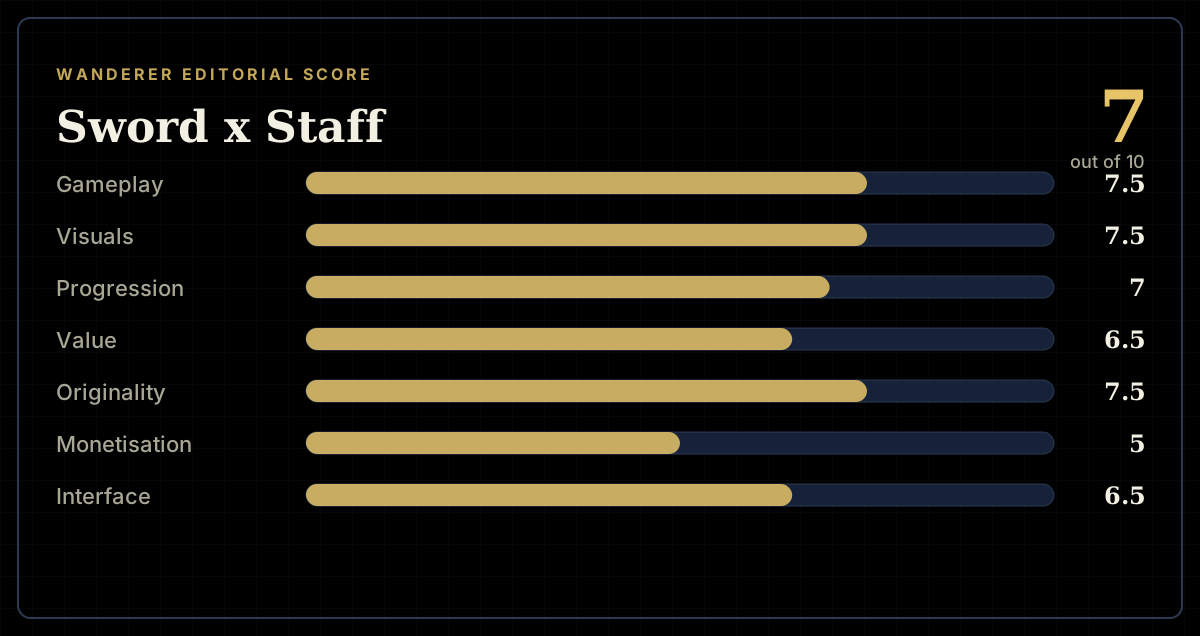
How the review scores each part of the gameWanderer Editorial -
The game at a glanceWanderer Editorial -
The short versionWanderer Editorial