
Game review
Survivors: Become an Immortal
6.5 / 10
- Developer
- 幺月星
- Publisher
- 幺月星
- Released
- 30 August 2026
- Platforms
- Windows
- Genre
- RPG
A Fifty-Fourth Consecutive Launch Without a Single Review
Survivors: Become an Immortal launched on Steam on 30 August 2026 from a solo credited developer, and at the time of writing it has zero user reviews. That's a real gap for a bullet-heaven survivors-like specifically, since the genre's crowded field means a new entry lives or dies on whether its one distinguishing mechanic actually changes how a run plays out, and that's precisely the kind of comparison a wave of genre-fluent players usually settles within the first week of release.
A Five-Elements Qi System Layered Onto the Auto-Battler Formula
The core loop is instantly familiar to anyone who's played a Vampire Survivors-style game: movement is the only direct input, weapons attack automatically, and the player spends a run dodging through escalating waves of monsters on a top-down arena map. What Survivors: Become an Immortal adds on top of that formula is a Wuxing Five Elements system borrowed from Chinese Xianxia fantasy — every weapon requires a specific type of Qi energy to activate, gathered by standing on matching map tiles, and the five Qi types counter and generate one another in a fixed elemental cycle. Attacking an enemy with the Qi type that counters its own is stated to meaningfully increase damage, which turns positioning from a simple "stand in the safe spot" decision into an active question of which elemental tile to path toward next. It's a reasonably clever reskin of the genre's core tension between offense and survival, translating a familiar cultural framework — the five-element cycle that underpins a huge amount of Xianxia and wuxia fiction — into a legible combat rule rather than just window dressing on the character select screen. A screenshot of an actual run confirms the system is fully implemented rather than a marketing simplification: a persistent gauge in the corner tracks all five elements — Metal, Water, Fire, and Wood values visible alongside labeled generate and overcome arrows — updating live as the fight against ice- and fire-themed enemies plays out on a hex-tiled arena split across visibly distinct biome zones.
Randomly Generated Maps and a Choice of Immortals
Each of the playable Immortals is stated to come with different abilities, and difficulty selection reshapes how the randomly generated arena tiles are laid out for that run, which gives the moment-to-moment Qi-tile positioning puzzle a different starting layout every time rather than memorizing one static map. Runs are pitched as short — each wave lasts roughly a minute, with a full run capped at around thirty minutes — which fits the bullet-heaven genre's usual rhythm of quick, replayable sessions over a long single sitting. A screenshot of a wave-twelve-of-twelve arena backs up the promised map variety, with the hex grid visibly split into at least three distinguishable terrain types across a single screen and a Spirit Stone currency counter climbing into the dozens as the run progresses, while a later-wave screenshot shows the same arena filled with a much larger cluster of enemies and stacked damage numbers, suggesting the escalation curve holds up visually as waves stack toward the stated twelve-wave finish line. Between waves, defeated enemies drop Money that can be spent at an in-run shop on weapons and items, giving players active control over which build they're steering toward rather than leaving loadout entirely to random pickups, which is the genre's standard build-crafting hook applied here through the elemental lens rather than reinvented from scratch. What the store page doesn't describe is any meta-progression layer carried between runs — no permanent unlocks, no persistent currency bank, no account-level talent tree are mentioned anywhere in the feature list, which if accurate would put this closer to a pure single-session roguelite than the meta-progression-heavy survivors-likes that have become common in the genre since Vampire Survivors popularized it. That's not necessarily a flaw, but it does mean the thirty-minute Qi-matching puzzle has to be compelling entirely on its own merits each time, without a long-term unlock treadmill to paper over a run that didn't click.
A Familiar Skeleton With One Genuine Point of Difference
Where the pitch is honest about its own limits is in how closely everything outside the Qi system hews to the established survivors-like template — automatic attacks, wave-based scaling, a currency-and-shop build loop, and short randomized runs are all present in dozens of other budget-priced entries in this genre on Steam. The Five Elements counter-and-generate cycle is the one mechanic doing real work to differentiate the game, and whether it's deep enough to carry repeat playthroughs once the novelty of tracking elemental matchups wears off is exactly the kind of long-tail question that a five-hundred-review community typically answers within a month of launch, and that this listing currently has no data on at all.
A Budget Price With English Support Despite a Chinese-Led Description
At NZ$9.59 with no discount, the price sits comfortably within the going rate for a single-developer bullet-heaven title, and English is listed as a supported language alongside Simplified Chinese despite the developer's own credited name and the game's cultural framing being rooted in Chinese Xianxia fantasy. There's no mention of any additional monetisation, DLC, or microtransactions on the store page, keeping the commercial pitch to a single flat purchase. Full controller support alongside the stated single-stick movement-only control scheme suggests the developer built the input model around console-style play from the outset rather than bolting on controller support as an afterthought to a keyboard-and-mouse design. Only two languages being supported at launch, against a genre where several of the best-known budget entries ship with a dozen or more localizations from day one, is a modest but real limitation on the size of the audience that can engage with the game's flavour text and elemental naming without leaning entirely on visual cues.
Verdict
Survivors: Become an Immortal takes the now-familiar Vampire Survivors auto-battler skeleton and layers a genuinely thoughtful Five Elements Qi system on top of it, turning elemental counter-and-generate relationships from Xianxia fantasy into an active positioning puzzle rather than cosmetic flavour text. Screenshots confirm the system is real and working — a live gauge tracking all five elements with generate and overcome arrows, a hex-tiled arena split into distinct biome zones, and a later wave showing the enemy count and damage numbers scaling up as promised. Everything else — automatic weapons, wave-based difficulty scaling, a shop-driven build loop, and short randomized runs — sticks closely to the genre's established formula, which makes the Qi system the entire case for picking this over its many budget-priced competitors. It launched on 30 August 2026 with zero user reviews so far, so whether that one point of difference has enough depth to sustain repeat runs once its novelty fades remains unverified by anyone outside the studio.
Screenshots
-
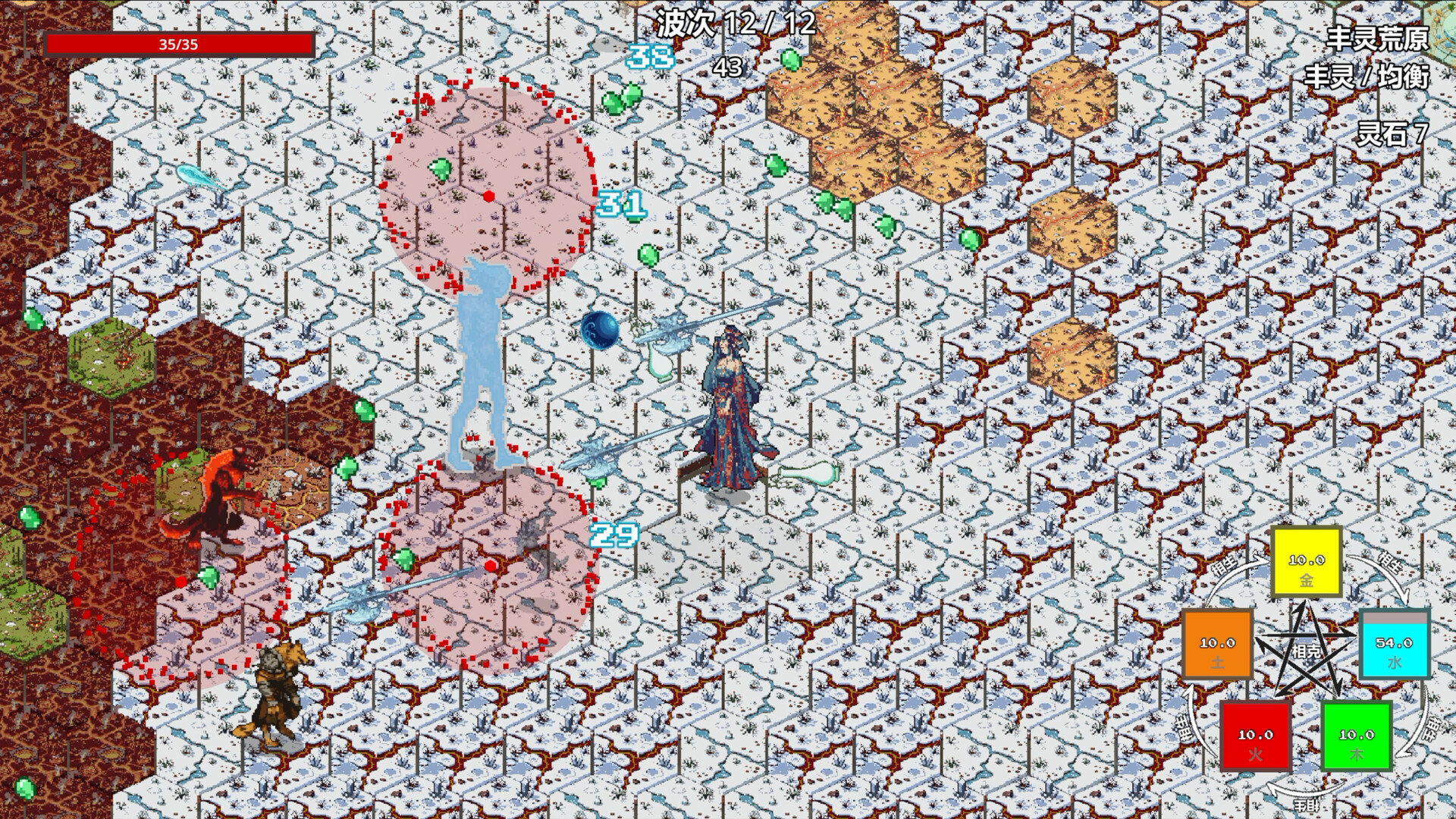
The Five Elements gauge in the corner tracks Metal, Water, Fire, and Wood values with generate and overcome arrows exactly as the store page describes.Steam store page -
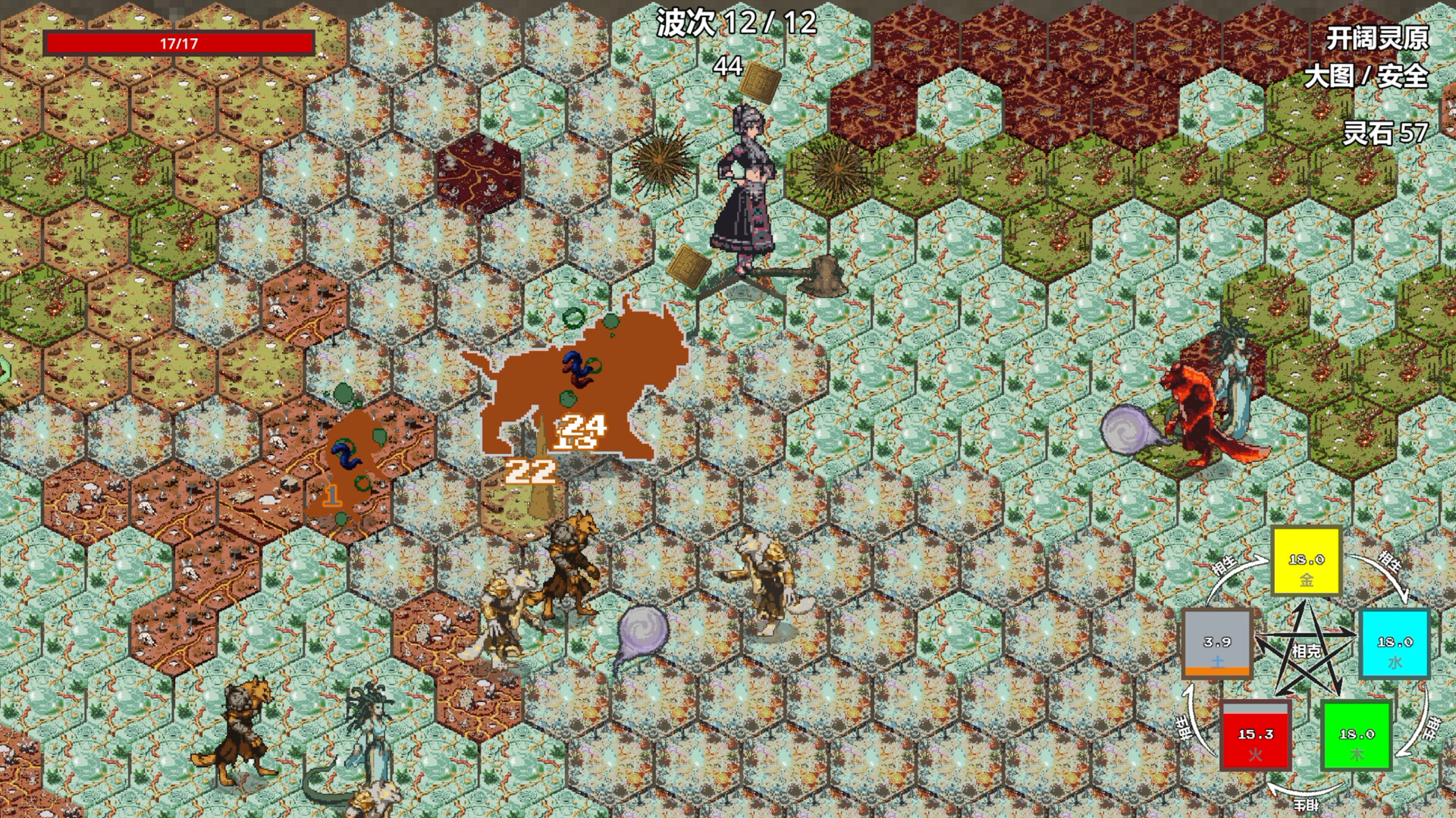
A wave-12 arena map spans several distinct biome tiles, with a Spirit Stone currency total tracked in the corner.Steam store page -
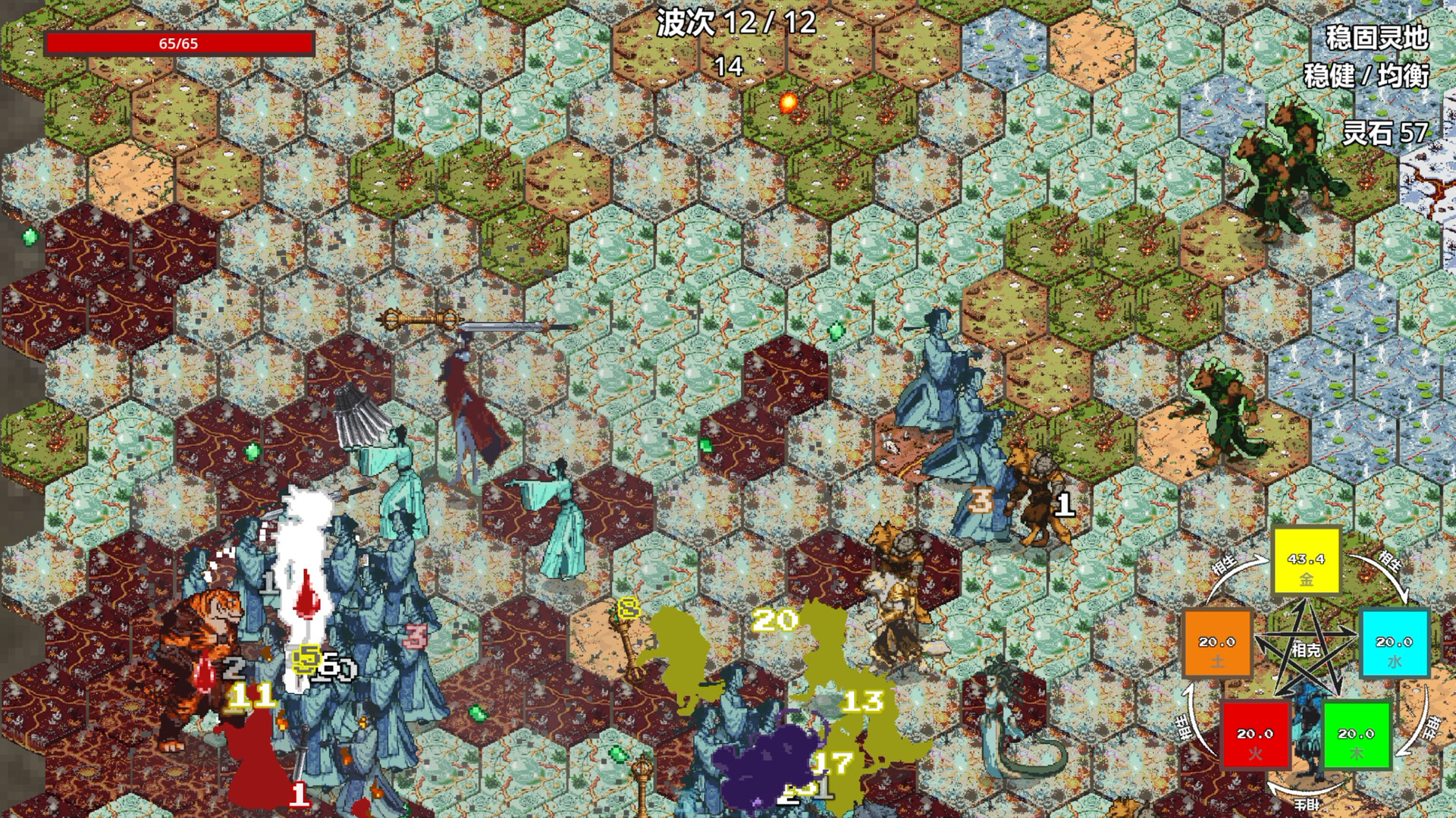
A late-wave battle shows the arena filled with enemies and stacked damage numbers as the Five Elements gauge fills out.Steam store page