
Game review
Eclipse Renegade
6.8 / 10
- Developer
- WhiteAge
- Publisher
- 妖精工房
- Released
- 21 August 2026
- Platforms
- Windows
- Genre
- RPG
No Reviews Yet for a Genuinely Distinctive Pitch
Eclipse Renegade launched on Steam on 21 August 2026 from developer WhiteAge, and at the time of writing it has zero user reviews. That's worth flagging up front, because the premise on offer here is considerably more specific than most entries in the crowded auto-battler-survivor space: you play Loxus, a god cast down into a hell built by the gods themselves, working through 30-minute runs toward the goal of killing three Goddesses of Fate and the highest god, Wodas. It's a strong enough hook that the absence of any player confirmation of how it actually plays feels like a real gap rather than a formality.
Auto-Firing Weapons and a Hard 30-Minute Clock
The core combat loop follows the now-familiar survivor-genre shape: weapons fire automatically at the nearest enemy, and player input is limited to movement and the build decisions made at level-up, where three skill card choices appear each time (occasionally including a companion instead of a skill). A level-up screen confirms exactly this format in practice — two stat cards (a flat Attack Up and a flat Speed Up) sitting alongside a Reroll-Skip-Auto control row, with rerolls apparently a limited resource rather than unlimited. What's distinctive is the explicit 30-minute hard stop per run — when the clock runs out, "the Eclipse" forcibly drags the player back, rather than the run continuing indefinitely until a death. Players can also end a run early and voluntarily convert their progress into permanent currency, giving the format a built-in escape valve for when a run isn't going well rather than forcing a fight to the death every time. The store page also states the game is engineered for over a thousand simultaneous enemies on screen using object pooling and spatial hashing; a mid-run screenshot at character level 37 shows a genuinely varied enemy roster on screen at once — golem-type, slime, ranged spellcaster, and a distinctly tagged elite variant — though nothing close to the thousand-enemy ceiling the store page describes, which a launch with no player reviews still can't confirm holds up at the claimed scale.
A Companion System With Real Narrative Weight
The most structurally unusual system here is how companions join the party. Eleven women, each betrayed and cast into hell for the same reason as the player, can be recruited in one of two explicitly named ways: "Resonance," which means talking them around by exposing the lie that condemned them, or "Dominion," which means defeating them in a duel and taking them by force. A companion recruited through Dominion joins inside a coffin, can't fight until revived at a church, is never permanently unlocked, and won't reappear in future runs — but in exchange, she doesn't count against the party size limit. Which of two methods the player leans on across a full playthrough determines which of three named endings is reached: "Gate of Merciful Light" for a party recruited entirely without force, "Throne of Black Chains" for one recruited entirely by force, and "Wandering the Eclipsed Moon" for anything in between. It's a morally pointed system that the developer has been unusually explicit about on the store page itself, and the achievement list backs up all three endings existing as real, separately tracked outcomes, alongside a fourth "Every Ending" achievement for completing all of them. A level-up screenshot shows this playing out at the individual-character level too: a companion card for a scholar named Alma carries its own short lore blurb ("silenced for uncovering forbidden knowledge of the gods") and a stated gameplay effect, an EXP bonus, rather than being an unlabelled generic recruit — suggesting each of the eleven companions is written with distinct backstory rather than reusing one template with a different portrait.
Four Independent Progress Tracks That Survive Death
Levels, skills, and companions all reset at the end of each run, but the store page describes four separate meta-progression currencies that persist regardless: Souls buy eleven permanent stat upgrades; Awakening Orbs drive per-character "job evolution," with the achievement and content lists confirming twelve characters each have four weapon-evolution tiers, meaning a fully awakened roster represents forty-eight distinct weapon forms; Unlocks mean any companion won over through dialogue stays available as a level-up option in future runs; and Vessels, found in field chests, raise the maximum party size up to twelve. Framing these four tracks as deliberately independent — falling short on one doesn't block progress on the others — is a sensible way to keep a bad run from feeling like a total loss, since a player still walks away having advanced at least one of four separate long-term goals.
Nineteen Connected Areas, Full Content Scope, and Price
Beyond straight combat, the game promises negotiation with merchants and clergy (with outcomes affected by which companion is present), a revival system for turning fallen companions' coffins back into fighters at a cost, "Trials" that reward Awakening Orbs for holding ground against endless spawns, and personal "Vendetta" boss fights tied to each companion's specific tormentor. All nineteen areas are stated to connect into one continuous hell rather than being selected from a menu, and beating the final boss unlocks a "deeper world" system that raises enemy difficulty and lifts the caps on permanent upgrades — an infinite-scaling endgame loop layered on top of the three-ending story structure. A boss encounter inside an ornate marble temple backs up the narrative ambition beyond the mechanical systems: a named figure, Urda, addresses the player directly by story context ("fallen god") mid-fight, while the arena itself is ringed with telegraphed cross-shaped hazard zones, a bullet-hell-adjacent layer of boss design that isn't mentioned anywhere in the store description and reads as a pleasant surprise for a genre that often treats bosses as reskinned regular enemies with bigger health bars. The full content tally is substantial for the NZ$9.59 asking price: 12 playable characters, 48 weapon forms, 27 bosses split across 23 mid-bosses and the four story targets, 19 areas, 3 endings, 30 achievements, and support for six languages with full controller compatibility.
Verdict
Eclipse Renegade pairs a familiar auto-battler-survivor combat shape with a genuinely distinctive narrative hook: a morally weighted recruitment system, backed up directly by the achievement list and by individually-written companion cards like Alma's, where how you treat eleven fallen companions determines which of three named endings you get. Screenshots of a telegraphed, bullet-hell-adjacent boss fight against a named story character add real weight to that ambition beyond the systems described on the store page. Four independent meta-progression currencies and an infinite post-game "deeper world" loop give it real long-term structure on top of that, and the NZ$9.59 price looks generous against a stated 12-character, 48-weapon, 27-boss content list. Whether the technical claim of handling over a thousand on-screen enemies holds up, and whether the Resonance-versus-Dominion system feels meaningfully different to play rather than just narratively labelled, remain open questions for a launch that hasn't yet collected a single player review.
Screenshots
-
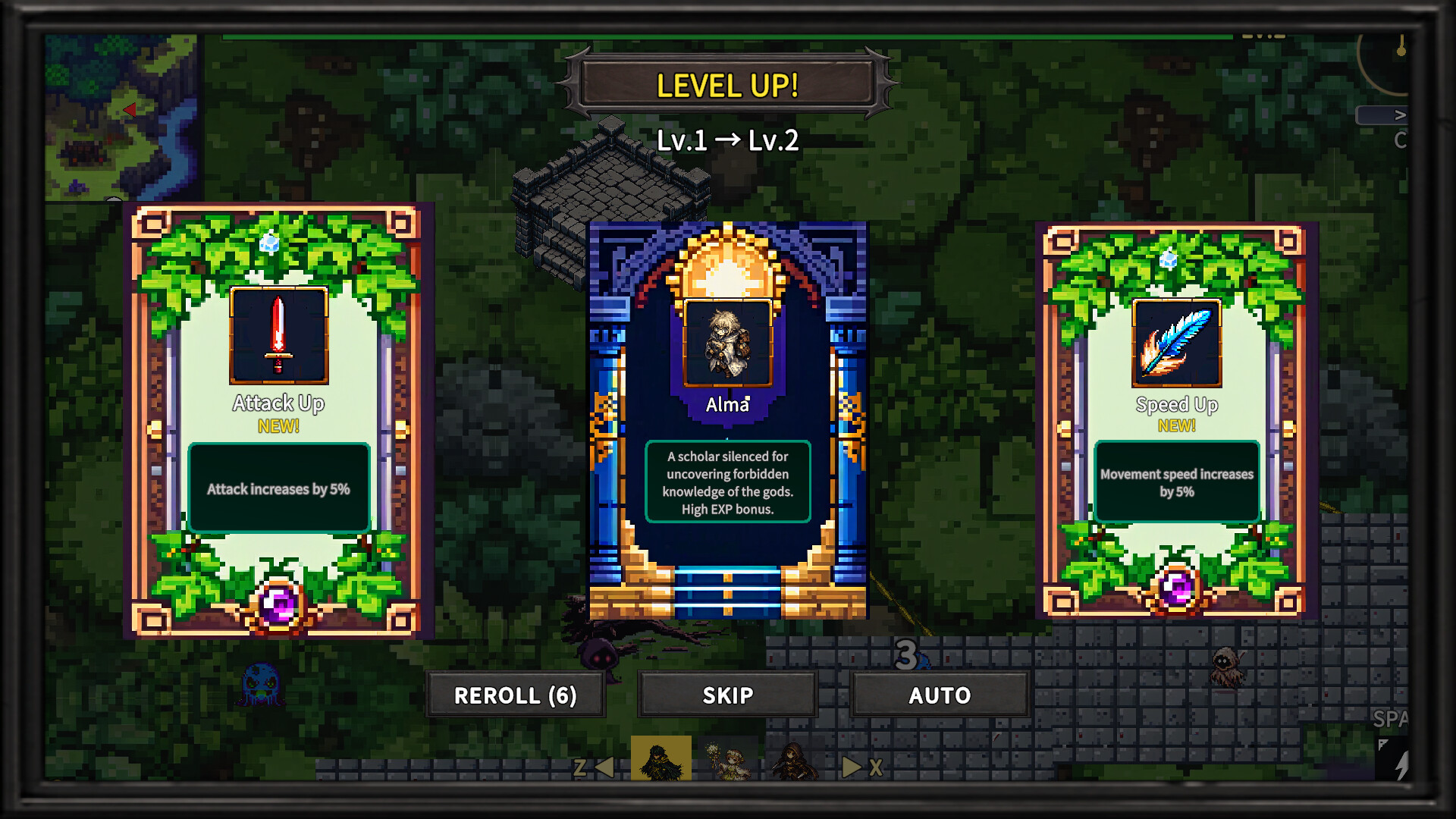
A level-up choice offering two stat cards and a companion card for Alma, a scholar with a lore blurb and an EXP bonus.Steam store page -
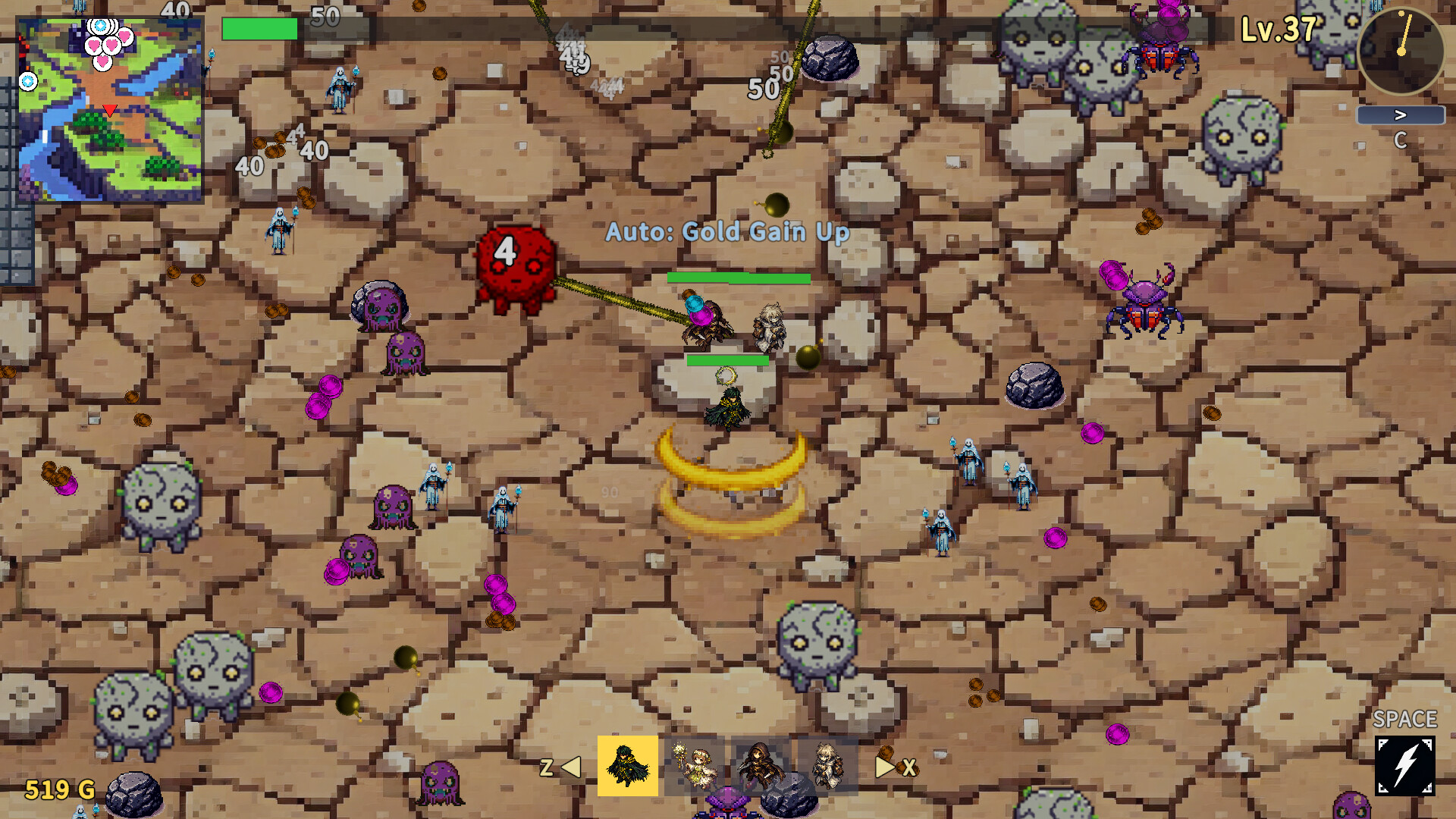
Overworld combat at Level 37, with a four-character party roster shown along the bottom and an auto-pickup gold bonus notification.Steam store page -
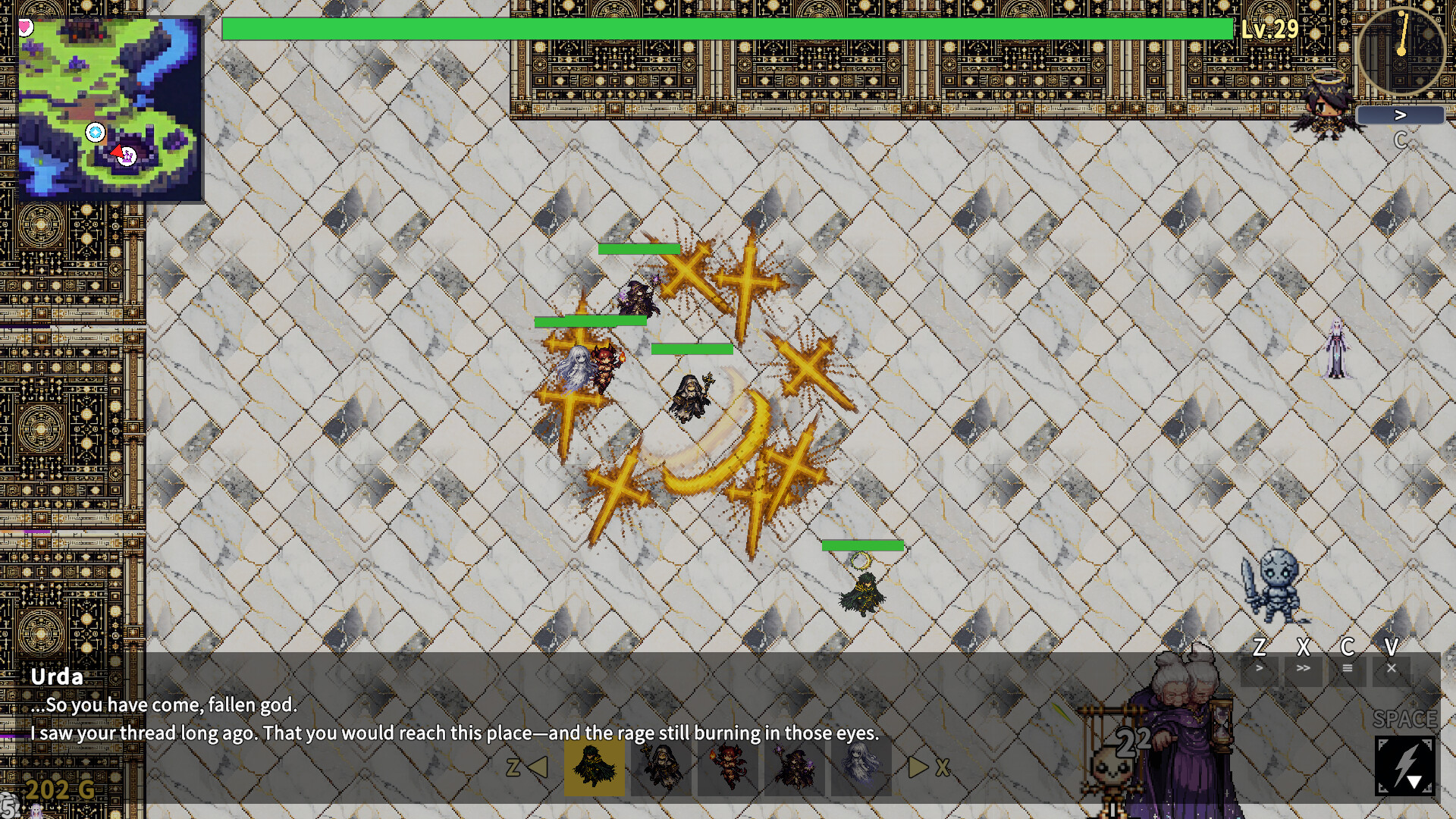
A named story NPC, Urda, delivers dialogue in a marble temple boss arena marked with telegraphed cross-shaped danger zones.Steam store page