
Game review
Stygian: Reign of the Old Ones
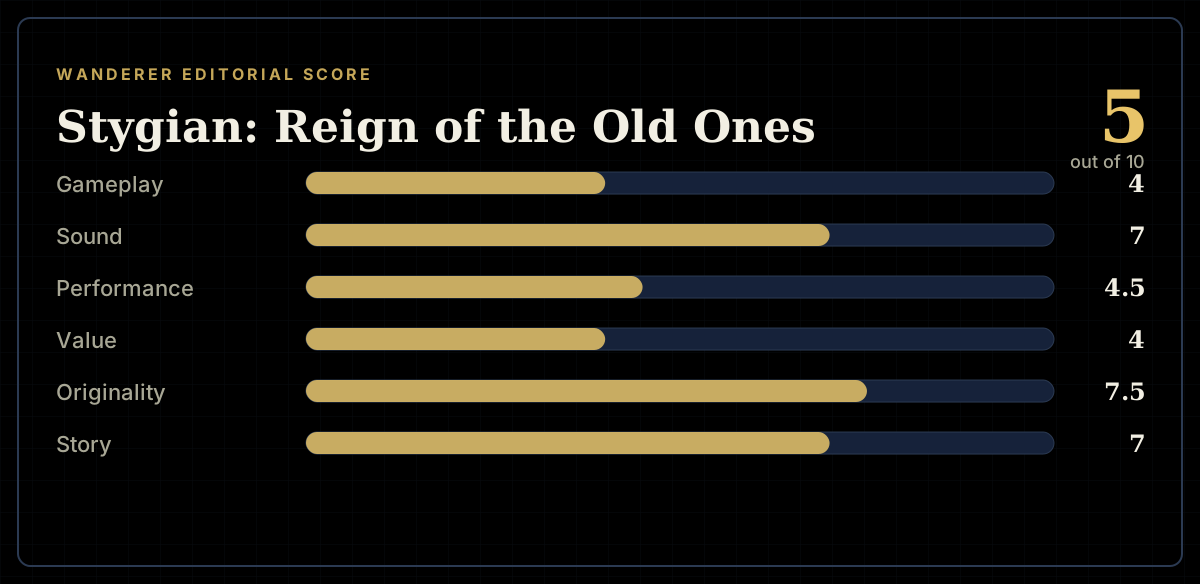
5 / 10
- Developer
- Cultic Games
- Publisher
- Fulqrum Publishing
- Released
- 26 September 2019
- Platforms
- Windows, macOS, Linux
- Genre
- Horror RPG
- Monetisation
- Paid, one-time purchase. No in-app purchases.
- Players
- Single-player only.
The short version
Stygian: Reign of the Old Ones sets its narrative RPG in an Arkham torn loose from reality after "the Black Day," building sanity, belief systems and eight distinct character archetypes into a genuinely ambitious Lovecraftian framework. Mixed across 575 reviews reflects a real split: reviewers consistently praise the writing, art direction and roleplaying systems, but a large, specific share describe the story ending abruptly partway through, well short of what the Kickstarter campaign promised, alongside clunky, dice-heavy turn-based combat that several reviewers say undermines the atmosphere the writing works hard to build.
Biggest strengths
- Genuinely strong, distinctive writing that builds meaningfully on Lovecraft's mythos rather than simply referencing it, consistently praised even by otherwise critical reviewers.
- A real belief-system mechanic tying sanity recovery and narrative consequence to staying true to a chosen worldview, giving roleplaying choices mechanical weight.
- Eight distinct starting archetypes, from Academics to Occultists, that meaningfully shape dialogue options and the opening hours.
Biggest weaknesses
- A large, specific share of reviews describe the story ending abruptly, with the developers having promised roughly 50 hours of content but delivering a fraction of that before the game concludes.
- Turn-based combat is repeatedly described as clunky and overly dice-reliant, with multiple reviewers saying only heavily combat-focused character builds are viable despite the game's roleplaying framing encouraging variety.
- Numerous reviews report bugs and crashes, including some tied to specific, progress-affecting moments.
Who it's for: Lovecraft and Call of Cthulhu fans who prioritise atmosphere, writing and roleplaying choice over polished combat, and who are prepared for a story that several reviewers say cuts off well before a natural conclusion.
Our recommendation: Worth it at a discount for the writing and setting alone; go in expecting the story to end abruptly and the combat to be a weak point rather than a highlight.
5 / 10
An ambitious Lovecraftian premise, built on real ideas rather than references
Stygian's setting hook is specific and effective: "after the Black Day, the city of Arkham was torn from the Earth and cast into an alien realm under unfamiliar stars," leaving behind "a city cut off from reality, where cults have risen openly, crime has filled the vacuum of power, and much of the population has already lost their minds." The store page makes a claim worth taking seriously: "Stygian draws heavily from the works of H.P. Lovecraft, but it doesn't stop at references. It builds on them." Reviewers largely bear that out. "The biggest highlight this game has is that it is well written and you can tell someone put a lot of love into it," reads a 2021 review from a player who finished the game. A 2019 review created a character it named "Tom Cruise" and still came away calling it "a very fun RPG with a bit of point and click examination involved. Well written stories and di[alogue]." The belief-system mechanic — tying sanity recovery to staying consistent with a chosen worldview, whether humanistic, nihilistic, religious or esoteric — gives that writing genuine mechanical weight rather than leaving it as flavour text, and eight distinct starting archetypes, from Academics and Aristocrats to Criminals and Occultists, shape dialogue options meaningfully from the opening hours.
A dominant, specific complaint: the story stops, not ends
What tempers that praise consistently and specifically is how the story concludes. "I loved this game. All the way up until the final (unknown to m[e at the time]) act, which felt incredibly rushed and abrupt," reads a January 2021 review. A March 2020 review, having finished it, is blunter: "it turns out the game is unfinished. The last part of the [story arrives with no warning]." An October 2025 review makes the same point in the fewest words: "It's unpolished and incomplete. The first half of the game has a lot of interactions, good writing, combats and exploration and then once you reach the point of no return, the game abruptly ends." A 2020 review adds a specific figure worth taking with appropriate caution since it's a single reviewer's claim rather than independently verified: "Developers promised 50 hrs of content, pu[t out roughly a fraction of that]." Checking a broad sample of negative reviews, a clear majority describe this same pattern — not a game that's simply short, but one that several reviewers frame as visibly cut off mid-arc, consistent with a Kickstarter-funded project that ran short on the budget needed to finish its original scope.
Combat as the game's clearest mechanical weak point
Separate from the truncated story, a recurring and specific complaint concerns the turn-based combat system itself. "Combat is atrocious and is basically a roll of the die to see if you hit or not," reads a 2025 review. Another review frames the build-variety problem directly: "only pure combat characters are worth anything, so if you wanted to try a character that was focused around s[ocial or investigative skills], combat becomes a serious liability." A 2020 review connects the two complaints: "the combat spikes out of nowhere, and it feels like there's really no sk[ill involved, just numbers]," describing a jarring shift in difficulty and design tone partway through. This is a specific, consistent complaint about one system rather than a vague "combat could be better" — reviewers generally credit the writing, exploration and dialogue systems while singling out combat specifically as the part that doesn't match the rest of the game's ambition.
Bugs, but not the dominant complaint
Bugs and crashes are reported by a meaningful minority of reviewers, though less consistently than the truncated-ending and combat complaints above. "This game is loaded with bugs, some of which come at really crucial and irritating moments," reads a 2019 review. A 2020 review reports a severe technical failure: "I just got a bad crash, for which I needed to restart my machine." This review also checked Steam's own global achievement statistics directly: the completion curve shows a gradual decline from roughly 45% at the earliest milestone down to around 1% at the latest, a pattern consistent with normal RPG attrition rather than a hard technical wall blocking most players early — unlike some other unfinished-feeling RPGs where a steep, front-loaded drop-off points to game-breaking bugs specifically. That's a meaningful distinction: Stygian's shortfall reads primarily as a story cut short by design or budget, not a game most players are mechanically prevented from finishing.
What happened to the studio afterward
This review checked the developer and publisher's own news feed directly rather than relying on player speculation about the game's future. Rather than substantial post-launch content patches, the news feed shows years of sale announcements before a genuinely new development: "Stygian: Outer Gods," a separate, newer Lovecraftian title from the same publisher, launched in April 2025. That confirms what several reviewers infer: "it is abandoned and only [received] minor patches," as a 2023 review puts it, with development effort evidently redirected toward a new, distinct project rather than expanding this game's truncated original scope. Worth being precise about what that does and doesn't mean for a buyer today — the version being sold now is very unlikely to receive the additional content some reviewers were still hoping for years after launch, but it also isn't riddled with unresolved game-breaking bugs the way some genuinely abandoned early access titles are.
Weighing the abrupt ending against what's actually there
It's worth being fair to what Stygian does deliver before it ends. Several reviewers who experienced the abrupt conclusion still describe real satisfaction with the hours that came before it. "Yes I know it ends abruptly but it's still worth playing. Great art style, writing, RPG elements, and a creepy Lovecraft 1920s vibe," reads a 2021 review. A 2019 review reaches a similar conclusion after finishing the game: "I really enjoyed the game that was made. It pays great homage to Lovecraftian tropes, has good writing and sound design, and for the most part feels like a rich rpg." The throughline across even critical reviews isn't that the delivered content is bad — it's specifically that there's less of it than the game's own marketing and Kickstarter campaign implied, which is a legitimate value complaint distinct from a quality complaint about what was actually shipped.
Final verdict
Stygian: Reign of the Old Ones delivers genuinely strong Lovecraftian writing, art direction and a belief-driven roleplaying system that gives player choice real mechanical consequence — the kind of ambitious design that's rare in a modestly-budgeted indie RPG. What keeps the score down is a specific, heavily corroborated pattern: a story that a clear majority of critical reviews describe as ending abruptly well short of its promised scope, paired with dice-heavy combat that undercuts rather than reinforces the atmosphere everything else builds. This is a reasonable pick at a discount for players who value narrative and setting over mechanical polish, and a fair skip for anyone expecting a complete, feature-full RPG experience matching the original Kickstarter's ambitions.
Pros and cons
Pros
- Genuinely strong, distinctive writing that builds meaningfully on Lovecraft's mythos rather than simply referencing it, consistently praised even by otherwise critical reviewers.
- A real belief-system mechanic tying sanity recovery and narrative consequence to staying true to a chosen worldview, giving roleplaying choices mechanical weight.
- Eight distinct starting archetypes, from Academics to Occultists, that meaningfully shape dialogue options and the opening hours.
- Striking, consistently praised illustrated art direction and sound design that reviewers credit as effectively conveying the game's cosmic-horror atmosphere.
Cons
- A large, specific share of reviews describe the story ending abruptly, with the developers having promised roughly 50 hours of content but delivering a fraction of that before the game concludes.
- Turn-based combat is repeatedly described as clunky and overly dice-reliant, with multiple reviewers saying only heavily combat-focused character builds are viable despite the game's roleplaying framing encouraging variety.
- Numerous reviews report bugs and crashes, including some tied to specific, progress-affecting moments.
- The developer appears to have moved on to a newer, separate Lovecraftian title rather than substantially patching this game's unfinished content in the years since release.
Screenshots
-

Stygian: Reign of the Old OnesImage: Fulqrum Publishing via Steam -

Stygian: Reign of the Old OnesImage: Fulqrum Publishing via Steam -

Stygian: Reign of the Old OnesImage: Fulqrum Publishing via Steam -
How the review scores each part of the gameWanderer Editorial -
The short versionWanderer Editorial