
Game review
Stationeers
6 / 10
- Developer
- RocketWerkz
- Publisher
- RocketWerkz
- Released
- 12 December 2017
- Platforms
- Windows
- Genre
- Space Engineering Simulation
- Monetisation
- Paid, one-time purchase, plus several cosmetic DLC packs sold during Early Access.
- Players
- Online co-op supported alongside single-player, though several reviewers report it as the less reliable of the two modes.
The short version
Stationeers puts players in charge of a space station's atmospherics, electrical grids, manufacturing and agriculture, and its Very Positive rating across nearly 6,000 reviews reflects genuine respect for the depth of its underlying systems from players willing to push through its learning curve. What keeps this review well short of full marks is the sheer consistency of one specific complaint: dozens of reviews, independently, describe the interface not as an unpolished Early Access rough edge but as a deliberate design choice the developer has repeatedly declined to soften, turning basic tasks like equipping a tool into a multi-step chore. Nearly nine years into Early Access, several originally anticipated systems remain unfinished, even as RocketWerkz continues shipping frequent, substantial content updates.
Biggest strengths
- Genuinely deep, well-simulated systems covering atmospheric pressure, gas chemistry, electrical grids and manufacturing, praised even by critical reviewers as a rare, serious attempt at hard engineering simulation.
- A distinctive niche within the survival-building genre, drawing favourable comparisons to Space Station 13, Oxygen Not Included and Kerbal Space Program for its systemic ambition.
- Frequent, substantial, actively continuing content updates as recently as August 2026, confirming the game is far from abandoned despite its long Early Access tenure.
Biggest weaknesses
- An extraordinarily consistent complaint, repeated independently across dozens of reviews spanning years, describes the interface as deliberately convoluted rather than merely unpolished, turning simple actions into multi-step chores.
- Nearly nine years into Early Access, several reviewers report originally anticipated systems — including more complex medical and gravity mechanics — still missing, alongside persistent, multi-year-old gamebreaking bugs.
- The developer sold cosmetic DLC packs during Early Access before addressing core complaints like inventory management and stable hosted multiplayer, a sequencing choice several reviewers criticise directly.
Who it's for: Engineering-minded simulation fans specifically drawn to hardcore systemic depth — atmospheric pressure, wiring, gas chemistry — who are prepared to fight through a genuinely difficult, deliberately unforgiving interface rather than expecting it to be smoothed over with more playtime.
Our recommendation: A genuinely deep simulation for players who specifically want that depth and can tolerate real interface friction; still Early Access after nine years, so temper expectations about promised systems arriving soon.
6 / 10
A genuinely serious simulation, respected even by critics
Stationeers' pitch is direct: control "the construction and management of a space station," where "complex atmospheric, electrical, manufacturing, agriculture, and gravitational systems require your thought and management at all times." Reviewers across the sample, including many who ultimately don't recommend the game, consistently credit it with delivering on that ambition more seriously than most genre peers. "This game has many interesting deeply developed mechanics and physics," reads a 2026 review, while a 2024 review frames the comparison directly: "It is quite 'science' oriented, a bit like [Oxygen Not Included] is for colony management games, and that's something I usually like." A 2025 review with more than 600 hours invested puts it plainly: "the core is exceptionally good," even while that same review goes on to detail serious reservations. This isn't faint praise — reviewers with deep backgrounds in similar simulation and engineering games consistently describe Stationeers' systems as unusually rigorous, even when the same reviewers can't recommend the overall package.
An extraordinarily consistent complaint: the interface isn't broken, it's deliberate
What separates Stationeers from an ordinary "rough Early Access UI" complaint is how consistently reviewers describe the interface as an intentional design choice rather than an oversight still being polished. "The developers have implemented a deliberately awful interface that totally ruins the game and have absolutely refused to even consider changing it. It's not an 'early access quirk,' the awful interface is a core part of [the intended difficulty]," reads a 2021 review. A 2019 review describes the specific mechanical friction: "Your hotbar has 2 slots simulating hands... so let's say you want to build a door. Open inventory, drag door kit into hand[s, then navigate several more menus just to place it]." A 2019 review reaches a similar conclusion independently: "the interface is intentionally awkward in the name of realism, [and that choice actively works against the game's own systemic depth]." Checking a broad sample of negative reviews, this specific complaint — not simply "the UI needs work" but "the UI is bad on purpose and the developer won't change it" — appears with remarkable consistency across years of reviews. That consistency matters: it suggests this is a genuine, stable design philosophy from RocketWerkz rather than a temporary Early Access rough patch that later updates might smooth over.
Nine years in Early Access, and what's still missing
This review checked RocketWerkz's own recent update history directly, and confirmed the game remains genuinely active: named content updates — "The Power Line Update," "The Sanitation Update," "The Gases Update" — shipped as recently as August 2026, alongside frequent hotfixes, more than eight and a half years after the game's December 2017 Early Access launch. That's real, sustained development, not abandonment. At the same time, several reviewers report specific, originally anticipated systems still missing after that long a development window: "After 7 years, there is still no complex medical or gravity systems," reads a 2024 review. A 2022 review reports frustration with a different category of problem: "developers are implementing new useless features instead of fixing 4-year old multiple times reported gamebreaking bugs." Both complaints can be true simultaneously with the active update history above — RocketWerkz is clearly still working on the game, but reviewers' specific complaint is about prioritisation and pace relative to nine years of paid Early Access access, not a lack of any development activity at all.
A specific, concrete complaint about Early Access DLC sequencing
A narrower but pointed complaint concerns commercial sequencing: "WARNING - They have started selling DLC for an Early Access game before working on more important things like inventory management or stable co-op," reads a 2019 review. A separate review raises the same concern independently: "i cant support devs who release DLC in early access. ppl paid you to develop the game not to make paid DLC." Checking Steam's own store listing directly confirms the underlying fact: multiple cosmetic DLC packs are indeed sold alongside the base Early Access game. Whether that specific sequencing choice is a reasonable way to fund ongoing development or a premature commercial move is a matter of reasonable disagreement, but the complaint itself is grounded in a directly verifiable fact, not speculation.
Documentation gaps compound the interface problem
A further, related complaint concerns tutorials and in-game reference material. "Frustrating experience with no tutorials for new users. Old tutorials are broken and with outdated mechanics. Without community guides and wiki, this game would be dead," reads a 2026 review. This compounds rather than stands apart from the interface complaint above — a genuinely difficult, deliberately unforgiving UI becomes considerably harder to learn without reliable in-game guidance, and multiple reviewers describe needing to consult external, community-maintained resources just to complete the game's own tutorial sequence.
A brief note on the game's multiplayer stability
One further detail worth flagging directly: this review checked RocketWerkz's own recent update log and found an entry dated January 2026 titled simply "Reverted 'The Multiplayer Update,'" following a multiplayer-focused update shipped earlier the same month. Rolling back a named feature update days after release is a notable, concrete data point corroborating reviewer complaints about co-op reliability specifically — "Do I recommend this game for Single Player? YES. Do I recommend this game for Multi Player? NO," reads a 2024 review — and it suggests that, even nine years in, multiplayer remains a genuinely less mature part of the experience than solo play, rather than a complaint rooted in outdated impressions from early in development.
Final verdict
Stationeers offers a genuinely rare, serious attempt at hard space-engineering simulation, and players willing to invest real effort into learning its systems consistently report deep satisfaction with what they find underneath. This review's score reflects two specific, well-corroborated concerns rather than a rejection of the underlying game: an interface that a remarkable number of independent reviewers describe as deliberately, not accidentally, obtuse, and nearly nine years of Early Access that has delivered active, ongoing development without yet completing several systems reviewers say were originally anticipated. This is a strong pick specifically for players who want serious engineering depth and can treat the interface as part of the challenge rather than an obstacle to it; less recommended for anyone hoping nine years of development means the rough edges have been smoothed away.
Pros and cons
Pros
- Genuinely deep, well-simulated systems covering atmospheric pressure, gas chemistry, electrical grids and manufacturing, praised even by critical reviewers as a rare, serious attempt at hard engineering simulation.
- A distinctive niche within the survival-building genre, drawing favourable comparisons to Space Station 13, Oxygen Not Included and Kerbal Space Program for its systemic ambition.
- Frequent, substantial, actively continuing content updates as recently as August 2026, confirming the game is far from abandoned despite its long Early Access tenure.
- Real, earned satisfaction reported by players who push through the learning curve, with a dedicated long-term community sustaining the game across nearly nine years of development.
Cons
- An extraordinarily consistent complaint, repeated independently across dozens of reviews spanning years, describes the interface as deliberately convoluted rather than merely unpolished, turning simple actions into multi-step chores.
- Nearly nine years into Early Access, several reviewers report originally anticipated systems — including more complex medical and gravity mechanics — still missing, alongside persistent, multi-year-old gamebreaking bugs.
- The developer sold cosmetic DLC packs during Early Access before addressing core complaints like inventory management and stable hosted multiplayer, a sequencing choice several reviewers criticise directly.
- Tutorials and in-game documentation are repeatedly described as outdated or incomplete, with reviewers reporting a reliance on community-maintained wikis just to understand basic mechanics.
Screenshots
-

StationeersImage: RocketWerkz via Steam -

StationeersImage: RocketWerkz via Steam -

StationeersImage: RocketWerkz via Steam -
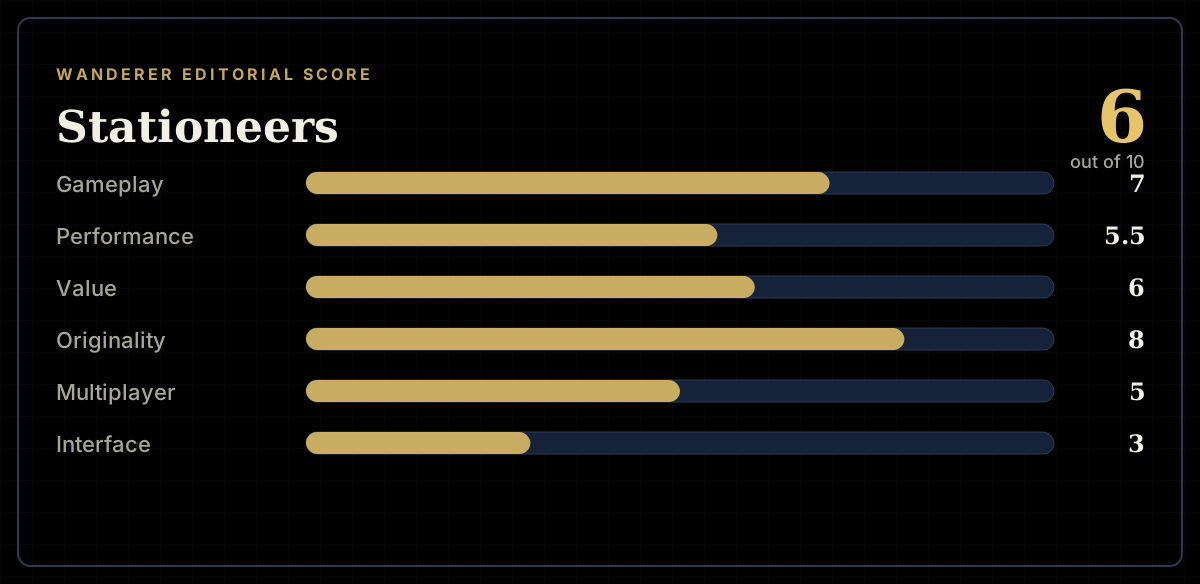
How the review scores each part of the gameWanderer Editorial -
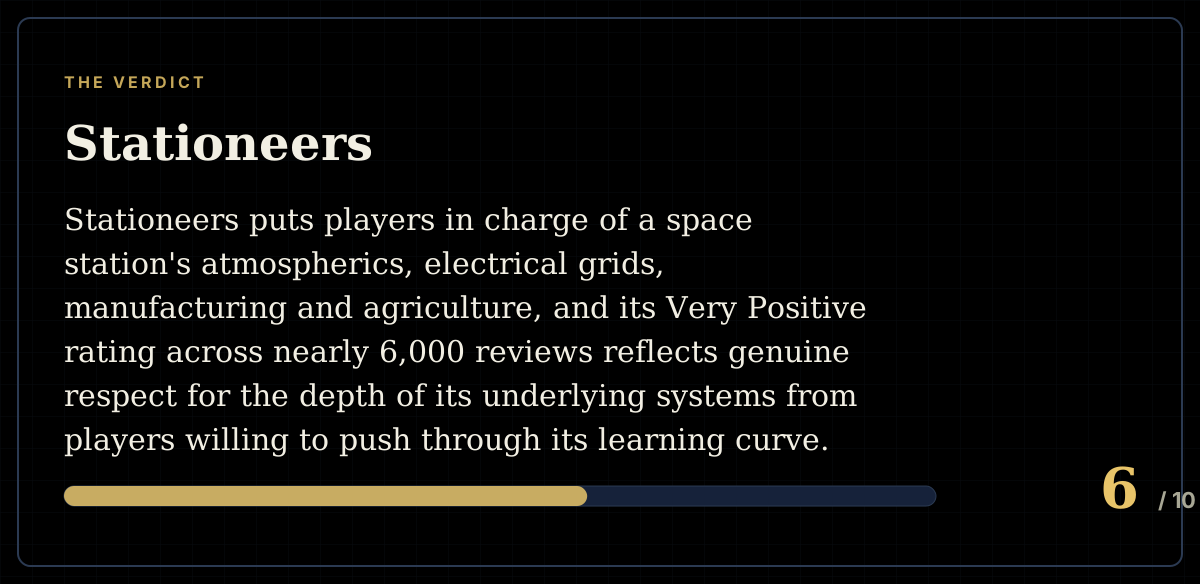
The short versionWanderer Editorial