
Game review
SolForge Fusion
5.5 / 10
- Developer
- Justin Gary, Richard Garfield
- Publisher
- Stone Blade Entertainment
- Released
- 16 April 2024
- Platforms
- Windows, macOS
- Genre
- Digital collectible card-battler
- Monetisation
- Free-to-play; decks assembled from randomly-generated paid "half-deck" purchases, no free deckbuilder
- Players
- Online PvP and single-player PvE campaign
The short version
SolForge Fusion is the free-to-play digital client for a physical trading card game designed by Magic: The Gathering's Richard Garfield and Ascension's Justin Gary, built around a distinctive lane-based, manaless combat system where cards level up as they're replayed. This review's sample confirms genuine, specific admiration for that core mechanic from card-game veterans, but a large negative-review contingent raises real, specific complaints about a monetisation model with no free deckbuilder, weak PvE opponent AI, and — most seriously — a dated, sharply documented backlash over an announced blockchain and NFT integration that badly damaged trust among the game's original Kickstarter-backing community.
Biggest strengths
- The lane-based, manaless combat system earns specific, detailed praise from experienced card-game players, with multiple reviewers highlighting the tension of choosing which two of five cards to play and in what order
- The single-player PvE campaign is repeatedly credited with delivering a substantial amount of genuinely enjoyable free content, with one reviewer estimating around 25 hours of solid entertainment before hitting the game's paywall
- Veterans of the original 2013 SolForge digital game and the physical SolForge Fusion card game consistently praise the card-upgrade mechanic and lane tension as faithfully carried over and well-implemented digitally
Biggest weaknesses
- A large, specific, and repeated negative-review theme criticizes the deck-acquisition system directly: decks are assembled from two randomly-generated "half-decks" that must be purchased, with no free deckbuilder available, a structural choice multiple reviewers call a dealbreaker regardless of the underlying mechanics' quality
- Multiple reviewers independently and specifically date an announced blockchain and NFT integration to around 29 April 2024, describing a significant, damaging breach of trust with the game's existing Kickstarter-backing community; this review's own check of Steam's partner-events feed found no post explicitly confirming or describing this announcement, and the game's subsequent two years of patches show no NFT-branded features, leaving the plan's ultimate fate unconfirmed by this outlet
- Several reviewers report weak, exploitable PvE opponent AI, describing repetitive, clearly suboptimal enemy decisions that undercut the single-player campaign's challenge
Who it's for: Card-game enthusiasts specifically curious about Garfield and Gary's manaless, lane-based combat system, and existing physical SolForge Fusion players wanting a digital companion for their decks; not a fit for players expecting a fully free-form deckbuilder or seeking a AAA-polished live PvP scene.
Our recommendation: Worth trying for the distinctive core mechanics and generous single-player campaign specifically, but go in with clear eyes about the deck-acquisition monetisation model and the unresolved blockchain controversy raised by a vocal, informed segment of reviewers.
5.5 / 10
SolForge Fusion brings designer Richard Garfield and Justin Gary's manaless, lane-based card game to a free-to-play digital client, letting players pick two of five cards per turn while managing which lane to commit them to and watching upgraded cards grow stronger the longer they survive. This review's sample finds real, specific enthusiasm for that core system from experienced card-game players — alongside serious, well-documented concerns about how the game is monetised and how its developer has handled its community's trust.
A distinctive core mechanic, praised by veterans
Reviewers with deep card-game backgrounds consistently single out the same strength. "SolForge Fusion offers the perfect balance I'm looking for between complexity and speed... You can only play 2 of the 5 cards in your hand per turn. The order in which those 2 cards are played allows/prevents opponent response," one detailed reviewer explains. Another, a self-described former competitive Yu-Gi-Oh player, writes: "This game reminds me of the Magic battles and tournaments I watched my older brother play... There's a balance of power between all of the decks I've used so far." That level of specific, mechanically literate praise from players with real comparative experience across the genre suggests the underlying combat system genuinely works.
A serious, specific monetisation complaint
Set against that praise, this review's negative sample raises a detailed, structural complaint about how decks are acquired. "This monetization system is awful... a deck is made up of two 'half-decks'. You can buy permanent half-decks with real money, or use in-game currency to buy Temporary half-decks that disappear after a week. Not only that, but every half-deck is randomly generated," one reviewer explains. Another states the consequence bluntly: "DOES NOT HAVE FREE DECKBUILDER!? Instead you combine deck halves... = I will never recommend a card game that doesn't have a free deckbuilder." One veteran player offers useful context missing from the store page itself: "this digital game is an EXTENSION of the physical one, not a standalone product — the physical versions have a QR Code, that lets you upload the deck into the digital game." That context helps explain the restrictive deckbuilding, though it doesn't resolve the complaint for buyers approaching the game fresh through Steam without that background.
A dated, specific blockchain controversy
The most serious complaint in this review's sample concerns a specific, dated announcement. "This morning, 4/29/2024, StoneBlade announced that NFTs are coming to the game... they also announced their web3 partners who are no doubt financing this venture," one reviewer wrote at the time, a complaint echoed independently by several others citing the same announcement and expressing similar frustration at what they describe as a significant breach of trust with the game's existing Kickstarter-backing community. This review's own check of Steam's partner-events feed found no post explicitly describing or confirming an NFT or blockchain integration, and none of the 66 documented posts since introduce any blockchain-branded feature — the patch history instead shows ordinary card-game content like new sets and seasonal systems. That leaves the ultimate fate of the announced plan genuinely unconfirmed by this outlet: it's possible the plan was quietly shelved following the backlash, but this review found no direct evidence either confirming or retracting it.
Weak AI and a thin live-multiplayer scene
Beyond the larger controversies, several reviewers raise a more conventional complaint about the single-player experience: "Playing against AI is worthless, it is too stupid, making obvious bad plays, especially replacing creatures over and over again," one reviewer reports, while separately noting suspicion that some "online" matches may actually be against bots without clear disclosure. Steam's own achievement data supports the broader picture of a thin live-PvP scene: only 9.9% of players have logged ten PvP matches, among the rarest achievements tracked, suggesting most engagement happens against AI in the single-player campaign rather than in head-to-head play.
What the update record shows
Steam's own partner-events feed confirms Stone Blade Entertainment has kept SolForge Fusion under genuinely sustained, active development, with 66 documented posts spanning new card sets, seasonal reward systems, and quality-of-life patches on a near-continuous basis from the April 2024 Early Access launch through mid-2026. That level of investment is real evidence against any suggestion the game has been abandoned, even as the unresolved blockchain question from early in its life remains a legitimate, unaddressed concern for players who experienced that specific controversy directly.
A sequel judged against its own history
Reviewers with history in the original 2013 SolForge digital game consistently frame their disappointment through direct comparison rather than judging this release in isolation. "Short version: Fusion pales in comparison to its almost 10 year old predecessor Solforge in practically every way," one reviewer writes, citing specific downgrades in artwork presentation and interface clarity. Another states it more personally: "I have 626 hours put into the original Solforge, so I was quite excited for this game. In its current state, I can't recommend it." That pattern — genuine, hours-deep investment in the franchise's history curdling into disappointment at specific, named regressions — gives these particular complaints more weight than a typical first-impression critique, since they're measuring the game against a standard the same studio already met once before.
A generous but time-limited free offering
Despite the monetisation criticism, it's worth stating clearly what reviewers agree the free tier actually delivers: a substantial single-player campaign. "It'll give you about 25 hours of fun F2P singleplayer content before you get bored of it," one reviewer estimates, framing that as genuinely good value for a curious player even while declining to spend further. That's a meaningfully different situation from free-to-play games that gate meaningful content behind a paywall almost immediately, and it's a point worth weighing alongside the more serious structural and trust complaints raised elsewhere in this review.
Final verdict
SolForge Fusion delivers a genuinely distinctive card-battling system that earns real, specific praise from experienced players, and this review's sample confirms its single-player campaign offers substantial free content before any paywall kicks in. But a restrictive, randomised deck-acquisition model with no free deckbuilder, a weak PvE AI, and a serious, still-unresolved trust concern stemming from a dated blockchain-integration announcement make this a harder recommendation than its mechanics alone would suggest. Card-game enthusiasts specifically curious about Garfield and Gary's design should try the free campaign; anyone put off by aggressive monetisation or unresolved NFT concerns should approach with real caution.
Pros and cons
Pros
- The lane-based, manaless combat system earns specific, detailed praise from experienced card-game players, with multiple reviewers highlighting the tension of choosing which two of five cards to play and in what order
- The single-player PvE campaign is repeatedly credited with delivering a substantial amount of genuinely enjoyable free content, with one reviewer estimating around 25 hours of solid entertainment before hitting the game's paywall
- Veterans of the original 2013 SolForge digital game and the physical SolForge Fusion card game consistently praise the card-upgrade mechanic and lane tension as faithfully carried over and well-implemented digitally
- Steam's own partner-events feed documents an extraordinarily dense, near-continuous patch and content cadence, with 66 posts spanning new card sets, seasonal systems, and quality-of-life fixes continuing steadily through mid-2026
- The game is entirely free to download and play a substantial campaign, removing upfront financial risk for players curious about the core mechanics before committing further
Cons
- A large, specific, and repeated negative-review theme criticizes the deck-acquisition system directly: decks are assembled from two randomly-generated "half-decks" that must be purchased, with no free deckbuilder available, a structural choice multiple reviewers call a dealbreaker regardless of the underlying mechanics' quality
- Multiple reviewers independently and specifically date an announced blockchain and NFT integration to around 29 April 2024, describing a significant, damaging breach of trust with the game's existing Kickstarter-backing community; this review's own check of Steam's partner-events feed found no post explicitly confirming or describing this announcement, and the game's subsequent two years of patches show no NFT-branded features, leaving the plan's ultimate fate unconfirmed by this outlet
- Several reviewers report weak, exploitable PvE opponent AI, describing repetitive, clearly suboptimal enemy decisions that undercut the single-player campaign's challenge
- Reviewers report real difficulty finding live PvP opponents, with at least one describing being matched against bots without clear disclosure, and global achievement data showing PvP-specific milestones among the rarest in the entire list
- At least one reviewer who owns the physical card game reports the digital deckbuilding restrictions stem directly from the game's design as a companion app tied to physical card sales rather than a standalone digital product, a distinction this review's sample found was not made clear to buyers coming to it fresh via the Steam store page alone
Screenshots
-

SolForge FusionImage: Stone Blade Entertainment via Steam -

SolForge FusionImage: Stone Blade Entertainment via Steam -

SolForge FusionImage: Stone Blade Entertainment via Steam -
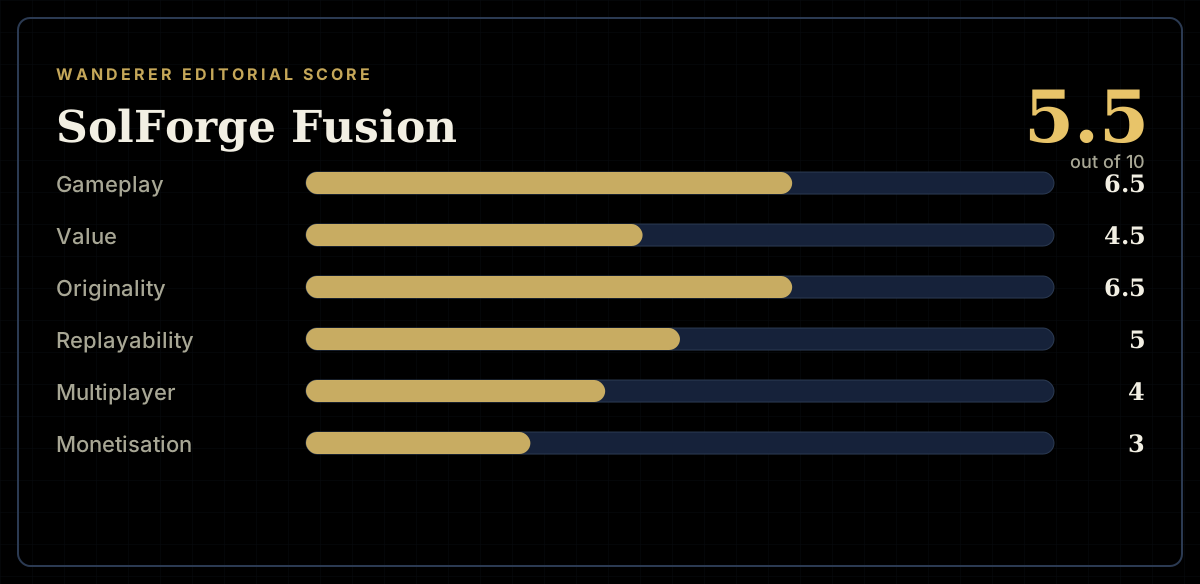
How the review scores each part of the gameWanderer Editorial -
The short versionWanderer Editorial