Game review
Skyformer
7 / 10
- Developer
- Weatherfused
- Publisher
- Weatherfused
- Released
- 10 November 2025
- Platforms
- Windows
- Genre
- Automation / Terraforming Survival
- Monetisation
- One-time purchase, no in-app purchases, no DLC. Listed at NZ$23.49 with a 35% 1.0 discount bringing it to NZ$15.27 — checked 3 August 2026.
- Players
- Online co-op alongside single-player
The short version
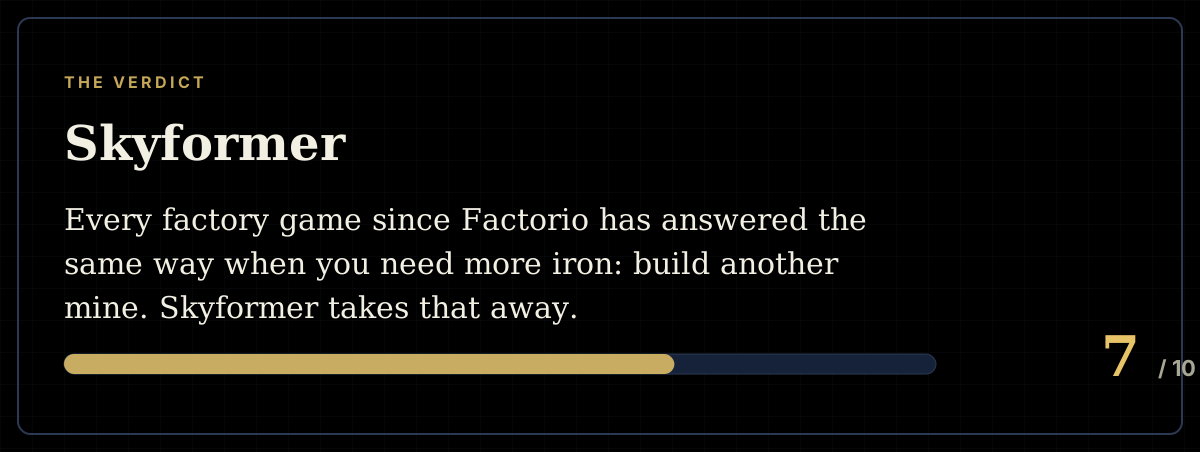
Every factory game since Factorio has answered the same way when you need more iron: build another mine. Skyformer takes that away. Deposits never run dry but their output is capped, so the entire game becomes a problem of ratios, routing and priorities across a fixed budget — and the drones that replace conveyor belts make the logistics feel different too. Layer on a weather system that gets more violent the more you terraform, and there's a genuinely original design here running in half a gigabyte at an excellent frame rate. What holds it back is everything around the ideas: thin tutorials, fiddly ergonomics, and a mid-game most players never reach.
Biggest strengths
- The throughput cap is a real design idea — you optimise ratios and placement instead of endlessly duplicating mines, which makes the mid-game a genuine puzzle
- Drone logistics instead of conveyor belts, with straightforward round-number rates that keep the maths legible
- The weather system is the standout: terraforming makes the planet more capable of producing storms, so your progress creates its own antagonist
Biggest weaknesses
- Tutorials are thin and in places actively confusing; several players report not understanding how to progress without outside help
- Ergonomics are fiddly — too many clicks and trips for basic building, and text that's too small to read comfortably at high resolutions
- Stabilising the atmosphere can destroy your high-altitude factories, and the save structure offers no way back from that mistake
Who it's for: Automation players who've exhausted the genre and want a constraint they haven't seen before, and anyone who liked Planet Crafter's terraforming arc but wanted more factory in it. Not for players who want Factorio's scale, or who need a game to explain itself.
Our recommendation: Worth the discounted price if the fixed-throughput idea sounds interesting rather than annoying — that single design choice determines whether you'll love or resent this game. Expect to consult the community for things the tutorial should cover, and be aware that terraforming can wreck your own high-altitude buildings with no way to undo it.
7 / 10
There is one iron deposit. There is one copper deposit. They will never run out, and they will never give you more per minute than they already do.
That single rule is what makes Skyformer worth writing about. Every factory game in the Factorio lineage answers scarcity the same way — find another patch, build another mine, run another belt — and the late game becomes an exercise in sprawl. Skyformer removes that option entirely. Your supply is infinite in total and fixed in rate, so the only way forward is to use what you have better: prioritise which production lines get fed, restructure when a new recipe demands throughput you're already spending, and treat the whole map as a budget rather than a frontier.
Players either find that a fascinating constraint or an arbitrary annoyance, and the review page splits almost exactly along that line. One reviewer with 62 hours calls it a test of material prioritisation instead of raw numbers. Another with 30 hours calls the ore limits ridiculous and says you can't really automate anything. They're describing the same system.
Drones, not belts
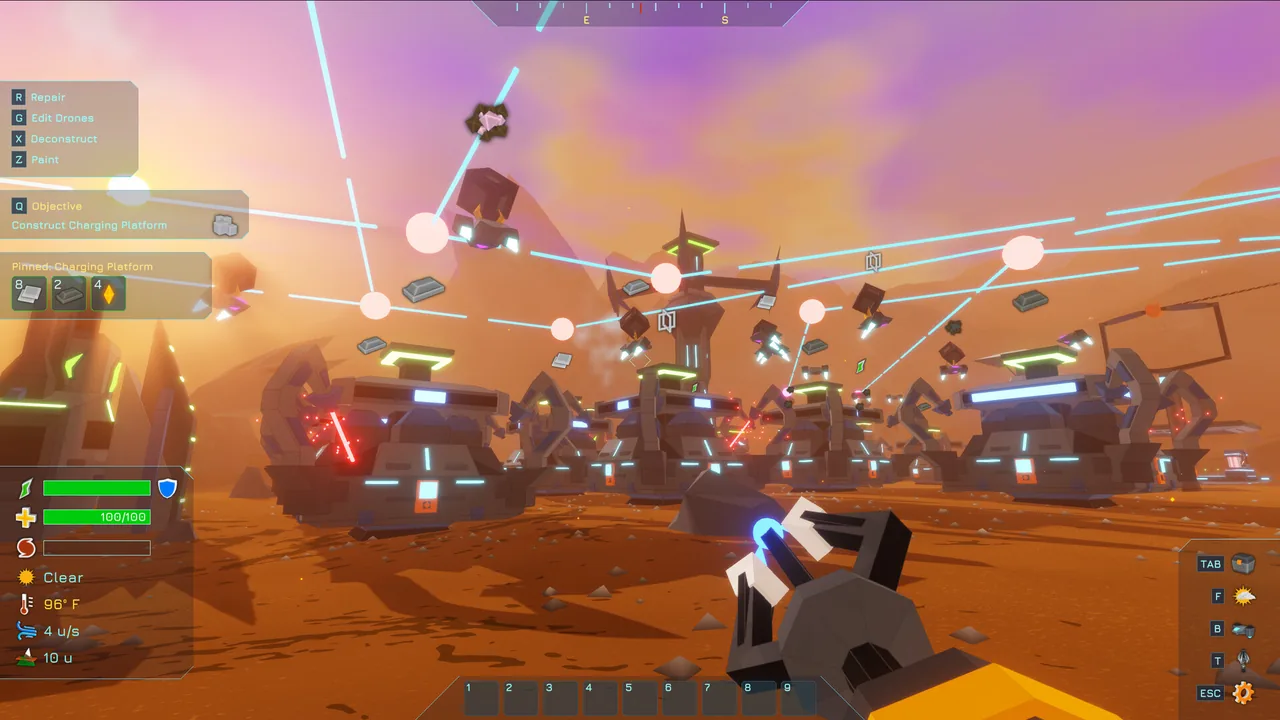
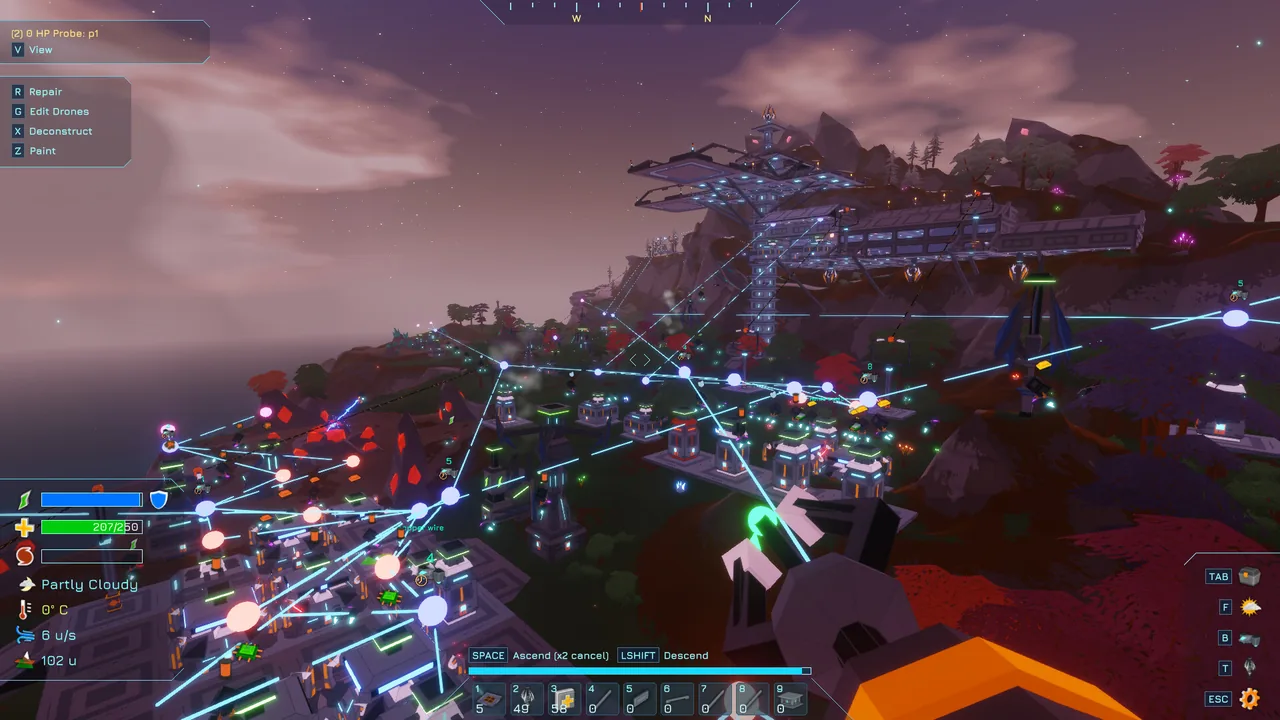
The other structural difference is that logistics run on drones rather than conveyors. You configure a drone to carry a given rate between two points — the interface deals in round numbers like forty items a minute — and the network you build is a set of point-to-point contracts instead of a web of belts. It keeps the mental maths simple and it means your factory reads as a set of relationships rather than a physical tangle.
It also removes the tactile pleasure some people play these games for, and the early game's requirement to physically travel between machines to set things up draws consistent complaints. This is a game about planning, not about building beautiful spaghetti.
The weather you made
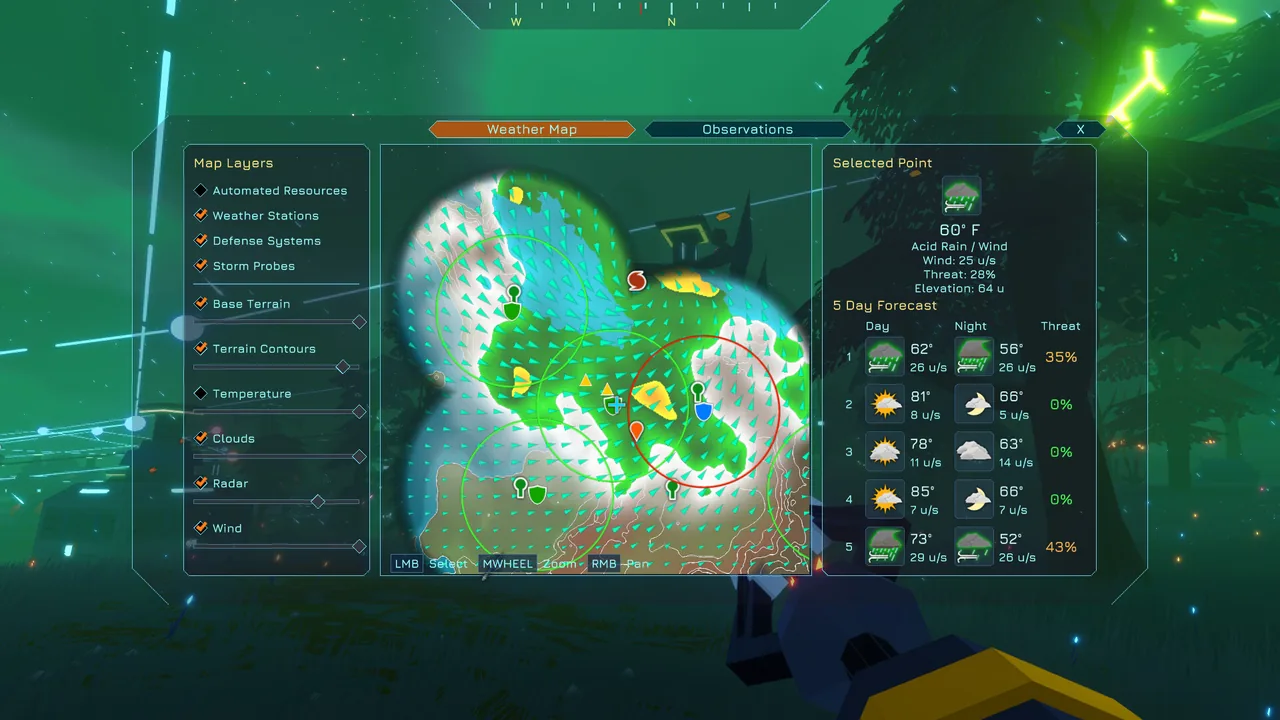
The best idea in Skyformer is that terraforming is not a straight upward line. As you stabilise the atmosphere and push the planet toward habitability, it becomes more capable of generating weather — and some of that weather is destructive. You end up building storm monitoring, forecasting where systems will hit, and deploying defences to protect the infrastructure in their path.
Progress creating its own antagonist is a lovely design loop, and it's what elevates this above a minor Planet Crafter variant. It also has teeth: one player describes stabilising the atmosphere too far and having their entire high-altitude factory destroyed, with no way to revert because the save system doesn't allow it. That's the risk being real rather than decorative, which is admirable design and thoroughly miserable when it happens to you.
The transformation is worth the trip, though. The planet visibly changes from barren rock to something green over a playthrough, and the reviews that stick with it consistently name that as the payoff.
Where it loses people
The completion data tells the story bluntly. 82% of players earn the weather-map achievement and 59% the expansion one — then it falls off a shelf: 23% for the ancient discovery, 20% for rockets, 16% for climate. Four out of five players never reach the stages the game's second half is built around.
The reasons are in the reviews and they're mostly not about the core design. Tutorials are thin, and several players — including ones recommending the game — say they couldn't work out how to progress without outside help. Ergonomics are fiddly, with too many clicks and too much walking for routine tasks. Text is too small to read comfortably at high resolution. A new player can die to the charge meter before understanding it exists.
And there's a fair criticism of depth: production chains here are two or three inputs deep, on a single hand-authored map. If you want the escalating complexity of FOUNDRY or the sprawl of a Factorio save, this is a smaller proposition — closer in spirit to Nova Lands than to the genre's monsters.
What it does have going for it technically is remarkable. The whole game is around half a gigabyte, runs at high frame rates on modest hardware, and still produces genuinely attractive skies and sunsets. In a year of hundred-gigabyte installs that deserves saying out loud.
A note on the reviews
Skyformer left Early Access on 30 July 2026 after nearly nine months, which is why its store page looks like a new release. It isn't. Forty of its sixty-five positive reviews were written in November 2025, about the Early Access build — so the 84% is largely a verdict on an earlier version, and the handful of post-1.0 reviews are too few to draw conclusions from yet.
The negative reviews, by contrast, are spread evenly across the whole period, which suggests the friction points — tutorials, ergonomics, progression clarity — persisted through development rather than being launch-week teething.
Verdict
Skyformer is the rare small automation game with an idea rather than a theme. Capping throughput instead of exhausting deposits changes what the genre asks of you, drones-not-belts changes how it feels, and weather-as-consequence ties the two halves together. For fifteen dollars, and half a gigabyte, that's a lot of originality.
It needs a better tutorial, kinder ergonomics and a readable interface before it can convert the four fifths of players who currently stop before the rockets. Buy it if the constraint intrigues you; skip it if you were hoping to build another mine.
Players who like watching a world change through steady accumulated work — without the risk of their own progress levelling the factory — may also enjoy Wanderer.
Pros and cons
Pros
- The throughput cap is a real design idea — you optimise ratios and placement instead of endlessly duplicating mines, which makes the mid-game a genuine puzzle
- Drone logistics instead of conveyor belts, with straightforward round-number rates that keep the maths legible
- The weather system is the standout: terraforming makes the planet more capable of producing storms, so your progress creates its own antagonist
- Remarkably light and well optimised — roughly half a gigabyte, strong frame rates, and pretty skies for a game this small
- Watching a barren planet visibly become lush over a playthrough is a payoff the genre rarely delivers this legibly
Cons
- Tutorials are thin and in places actively confusing; several players report not understanding how to progress without outside help
- Ergonomics are fiddly — too many clicks and trips for basic building, and text that's too small to read comfortably at high resolutions
- Stabilising the atmosphere can destroy your high-altitude factories, and the save structure offers no way back from that mistake
- Shallower than the genre's giants; production chains run two or three inputs deep, and there's one hand-made map rather than generated worlds
- The completion curve falls off a cliff early — only about a fifth of players reach the rocket and climate stages
Screenshots
-
SkyformerImage: Weatherfused via Steam -
SkyformerImage: Weatherfused via Steam -
SkyformerImage: Weatherfused via Steam -
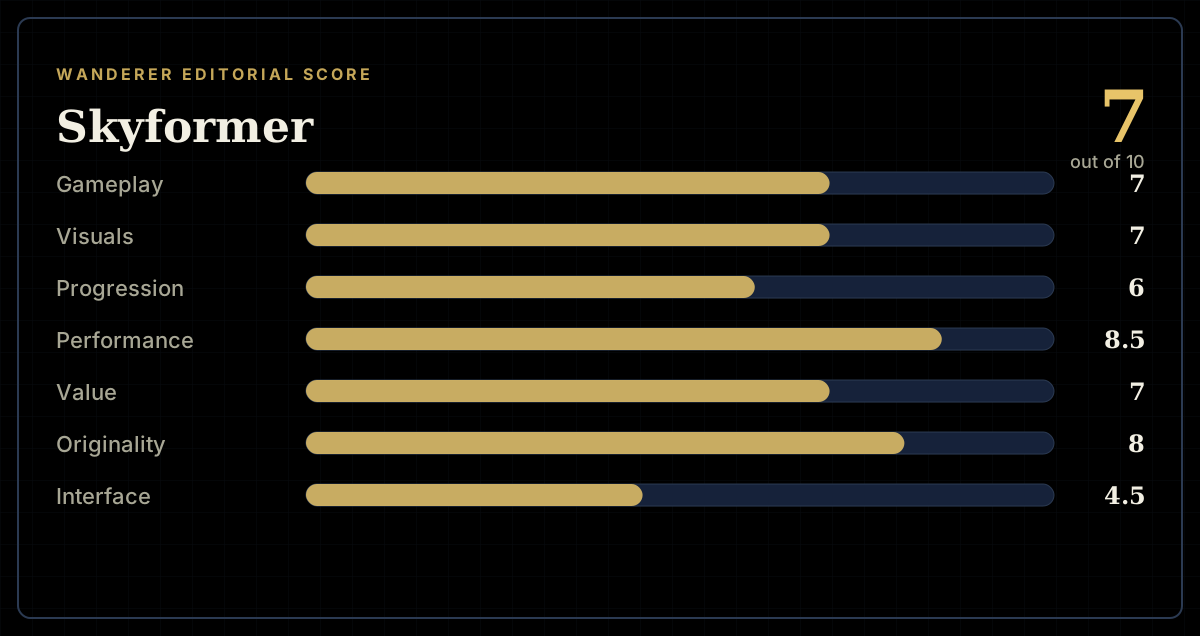
How the review scores each part of the gameWanderer Editorial -
The short versionWanderer Editorial