
Game review
Sky Realm Idle
6.3 / 10
- Developer
- 323Game
- Publisher
- Star Seeker Ltd
- Released
- 12 February 2026
- Platforms
- PC
- Genre
- Idle Xianxia RPG
Sky Realm Idle is a Xianxia-themed idle RPG from Chinese developer 323Game, published by Star Seeker Ltd, that released out of the gate as a full release on 12 February 2026 rather than through Early Access. It sits at the crossroads of two very different traditions: the stat-crunching, browser-gacha structure of games like Granblue Fantasy, and the "numbers go up while you're away" comfort of an idle clicker. Reviewers repeatedly draw the Granblue comparison, and it's an accurate one — recruit a roster of elemental heroes, slot them into a party, and watch turn-based auto-battles resolve against named bosses while a separate estate-management layer quietly produces Spirit Stones and Jade in the background.
Cultivation dressing over an idle-management core
The "cultivation" framing is mostly cosmetic. There's no meditation minigame or qi-circulation system at the centre of play; instead, the loop is built from familiar idle-RPG parts relabelled with Xianxia vocabulary — Spirit Array grids stand in for gear boards, Tribulation stages stand in for prestige resets, and pill refinement stands in for crafting. One reviewer put this bluntly: "It feels like a normal idle game was reskinned at the last minute and cultivation terms were thrown in to replace whatever existed before. It doesn't have any form of actual cultivation." That's a fair criticism if you're coming to the game expecting a cultivation simulator in the vein of Amazing Cultivation Simulator, but taken on its own terms as a management-heavy idle RPG, the systems underneath are genuinely dense: a Team tab for party composition, an Artifacts tab for gear, an Estate tab for passive-income buildings, a Gathering tab, a Spirit Garden for planting, a Tiangong crafting bench, and an Alchemy screen for consumables, all visible from the persistent left-hand navigation rail shown on the profile screen.
Combat itself is a straightforward four-character turn-based auto-battler. Damage numbers escalate quickly — the reviewed session's screenshots show a mid-run ultimate hitting for over nine million against a Gale Cliff boss — and named encounters like the Storm Elemental and Hurricane Eagle pack shown fighting at Gale Cliff track elemental affinities and a "BREAK" stagger state rather than resolving as an undifferentiated idle tick. Loot drops per fight, listed in a Session Drops panel, are itemised rather than abstracted into a single currency, which gives even auto-piloted fights some texture. An "Ougi On" toggle alongside the usual Auto and Manual buttons suggests players can gate how aggressively ultimate skills fire, though the interplay between that setting and damage output isn't something this review can verify beyond what's visible on screen.
Depth that outpaces its own explanations
Several reviewers praised the sheer amount of build depth on offer — many recruitable characters, multiple elements to specialise around, and Steam Workshop-backed modding tools that let players rewrite character kits, add new opponents, or rebalance numbers outright. "Modding tools are AMAZING, can literally change anything," one reviewer wrote, and another called the mod support "what makes this game great." That same depth, though, comes with a documented cost in clarity. Multiple negative reviews describe skills and stat systems that go unexplained: "Most skills have no hotlinks. I got 0 clue what they do. What is 'Ice Prison'?" Others flag a damage-cap system that isn't well telegraphed — one reviewer reported grinding fifteen hours toward a fully upgraded fire team only to discover ultimate damage was hard-capped regardless of stacked crit and attack bonuses, and another described a healer's percentage-based heals being flattened by a fixed heal cap that stops scaling with HP growth. These aren't cosmetic UI gripes; they're systems that actively undercut the build-crafting the game otherwise encourages.
Progression pacing draws the most consistent complaint. One reviewer called it "absurdly slow grind, even for an idle game," citing 0.1% drop rates on stages that already take 30 minutes to an hour to clear, particularly early on when those materials matter most — the kind of gate that pushes a nominally idle game toward requiring the client to run around the clock for marginal gains. Others are more forgiving of the pace, framing the game as something with a genuine "finish line" rather than infinite grind, and noting it lacks microtransactions entirely, which is unusual for the genre and was called out approvingly more than once. Whether the grind reads as "meditative" or "punishing" seems to depend heavily on whether a player treats Sky Realm Idle as a background task or something to actively optimise.
A rocky patch history
Reliability took a real hit partway through the review period covered by the available feedback. Multiple reviewers describe a specific patch that wiped substantial player progress — one lost an entire team of maxed-out UR-rarity characters and had their earned achievement count regress, and another reported losing roughly 60% of accumulated artifacts, undoing hours spent farming and upgrading a specific build. Both are described as one-off incidents tied to a named update rather than a recurring pattern, and the developer is repeatedly described elsewhere in the review pool as responsive and quick to push near-daily bug and balance fixes, so this reads as a rough patch rather than a chronic stability problem. Still, for a genre where players routinely invest hundreds of idle hours before checking back in, a patch capable of erasing that progress is a serious risk to flag plainly rather than downplay.
Accessibility options above the genre norm
One area where Sky Realm Idle stands out is accessibility. The Steam store page lists custom volume controls, a mouse-only control option, and support for play without timed input — all relevant to an idle RPG's core audience — and reviewers independently confirm adjustable UI and text scaling in-game. One reviewer with vision issues specifically called this out: "I have vision issues, this game lets you adjust UI size and text size!!! Cons: None yet that I have found." That's a meaningfully higher bar than most idle games clear, and it's reflected in a generally well-organised interface: a persistent sidebar, clearly labelled resource counters along the top bar, and tutorial pop-ups that trigger the first time a new tab is opened.
Art, translation and an unresolved AI-art question
The English localisation shows visible seams — reviewers point to specific mistranslated menu labels — and several reviews note that both artwork and translation were produced with AI assistance, which is disclosed on the store page as a toggleable setting rather than hidden. One reviewer who tried switching AI art off reported seeing no discernible visual difference despite the option existing, an inconsistency this review cannot independently verify but is worth flagging as unresolved player feedback rather than confirmed fact. Reactions to the AI-assisted content split roughly along expected lines: some treat it as a minor curiosity given the price point, others as a dealbreaker in principle, and the discourse doesn't appear to have meaningfully affected the review score distribution, which sits at 30 positive against 8 negative.
Verdict
Sky Realm Idle earns its "Mostly Positive" standing by being a genuinely deep, actively supported idle RPG at a low price with no microtransactions and unusually strong accessibility and modding support for the genre — but the Xianxia dressing is thin, several core combat systems (damage caps, heal caps, unexplained skills) are under-communicated to the player, and the progression curve can tip from "relaxing" into "punishing" once drop rates and time gates start compounding. A patch that erased progress for at least two reviewed players is the clearest red flag in an otherwise well-supported release, and prospective buyers should weigh that risk against the genuinely committed post-launch patch cadence described elsewhere in the review pool.
Screenshots
-

The Profile tab consolidates every idle-income stream and long-run progress counter in one dashboard, reflecting hours of accumulated offline output.Image: 323Game via Steam -

Combat plays out as an auto-battler with escalating burst numbers, though most players let the Auto toggle handle individual turns.Image: 323Game via Steam -
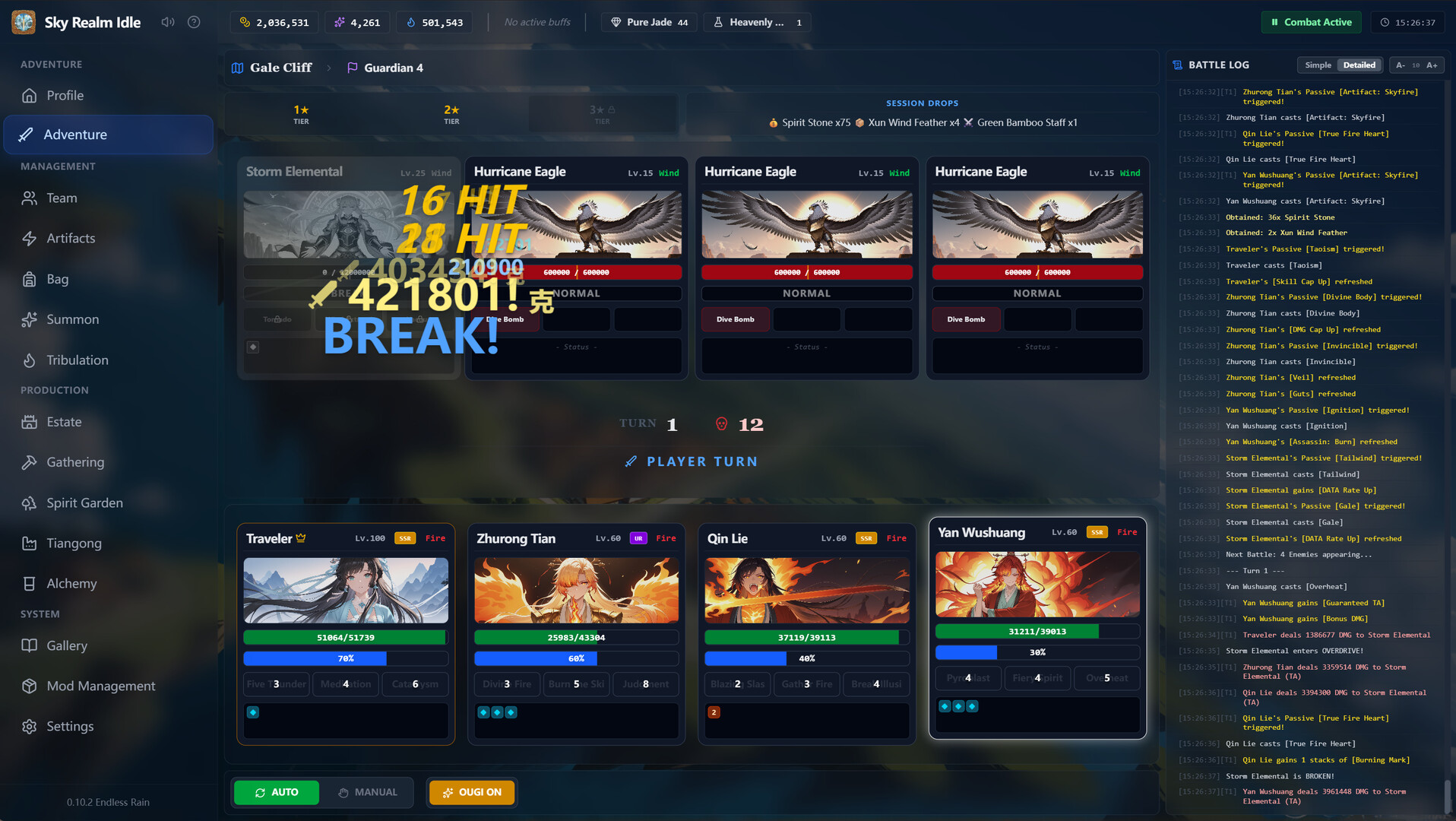
Named boss fights track elemental weaknesses, break states and itemised loot drops rather than resolving as a single idle tick.Image: 323Game via Steam