
Game review
Shantae: Half-Genie Hero
6 / 10
- Developer
- WayForward
- Publisher
- WayForward
- Released
- 20 December 2016
- Platforms
- Windows
- Genre
- Action Platformer
- Monetisation
- Paid, one-time purchase, plus separately sold DLC content also included in the Ultimate Edition.
- Players
- Single-player only.
The short version
Shantae: Half-Genie Hero sends the belly-dancing half-genie Shantae through a series of colourful, stage-based levels, and its Very Positive rating across more than 1,100 reviews reflects genuine admiration for WayForward's art direction and music. What dominates this review base is an extraordinarily consistent complaint that this specific base version was effectively superseded by a separately sold Ultimate Edition bundling all of the game's DLC, released without any upgrade path or discount for existing owners — a pattern a large, concentrated share of reviewers describe as an unfair fragmentation of what should have been one product. Separate, well- corroborated complaints describe repetitive backtracking, an uneven difficulty curve, and story and structure that a meaningful share of longtime fans rank below the developer's previous Shantae entry, Pirate's Curse.
Biggest strengths
- Gorgeous, colourful hand-drawn art direction and an outstanding soundtrack that reviewers consistently credit as among WayForward's best presentation work.
- Charming character design and genuinely funny dialogue in its stronger moments, giving the world real personality.
- A distinctive stage-based structure with a variety of transformation abilities that create real mechanical variety across individual levels.
Biggest weaknesses
- An extraordinarily consistent complaint describes this specific base version as effectively superseded by a separately sold Ultimate Edition bundling all of the game's DLC, released without any upgrade path or ownership discount for existing buyers.
- A well-corroborated complaint describes repetitive backtracking through already-completed stages to unlock new abilities and progress the story, described by several reviewers as padding rather than meaningful exploration.
- Several longtime fans of the series describe this entry's story and difficulty curve as a clear step down from the developer's previous game, Pirate's Curse.
Who it's for: Fans of colourful, WayForward-style action platforming; strongly consider the separately sold Ultimate Edition instead of this base version if you want the full content package.
Our recommendation: Buy the Ultimate Edition instead of this base version if you want the complete experience; this base release alone is a reasonable but incomplete starting point.
6 / 10
Genuinely admired art direction and music
Shantae: Half-Genie Hero's presentation draws consistent praise across this review base, even from reviewers who go on to detail serious reservations about other systems. "First things first, the music and visuals in this game are fantastic," reads a 2019 review, a sentiment echoed almost universally across this sample regardless of overall recommendation. A 2019 review credits the underlying craftsmanship directly: "The artwork and the music are awesome," praising WayForward's hand-drawn character animation specifically. That combination — genuinely gorgeous art direction and an outstanding soundtrack — is the consistent throughline of praise across nearly this entire review base, and it's a real, deserved strength independent of the more contested issues documented below.
An extraordinarily consistent complaint about edition fragmentation
What dominates this review base overwhelmingly is a specific, precisely repeated complaint about how this particular version of the game relates to a separately sold "Ultimate Edition." "Buy this package only if you are absolutely sure you won't care for the extra content. Otherwise consider 'The Ultimate Edition,'" reads one of many reviews making this exact recommendation. A 2020 review states the underlying frustration directly: "wayforward has lost me as a customer. they released an ultimate edition with exclusive content without an upgrade option or at least a discount for owners of the original game." A 2020 review frames the pattern as a broader trust issue: "A good way for a company to ruin their perfectly good streak of games by treating their fanbase as nothing but walking wallets." Checking a broad sample of negative reviews, this exact complaint — not disliking the underlying game, but specifically objecting to a separately sold, more complete edition released with no path for existing owners to upgrade — recurs with remarkable, near-total consistency across years of reviews, making it by far the single most repeated theme in this review base. This review checked current pricing directly and found the base version reviewed here now costs less than the Ultimate Edition on its own; prospective buyers should independently verify current DLC availability and total cost before deciding which specific version best suits their budget and content preferences.
A well-corroborated complaint about repetitive backtracking
Separate from the edition issue, a consistent complaint concerns the game's stage-based progression structure specifically. "Why do I have to play the same level multiple times every time I unlock new power to discover a new secret? Even the main story asks me" to revisit completed stages repeatedly rather than offering fresh content, reads a 2019 review. A 2022 review describes the practical frustration directly: "it is ruined by forcing you to backtrack for fetch quests more and more as game goes on. I hit a point where they told me to find an NPC for a fetch quest that" required retracing substantial, already-explored ground. Checking a broad sample of critical reviews, this specific complaint — repeated backtracking through completed content rather than meaningful new exploration — recurs consistently enough to treat as a genuine, structural pacing issue distinct from the edition controversy above.
It's worth being specific about why this particular structure draws more criticism here than similar backtracking does in more traditional metroidvania games. Several reviewers make a pointed distinction: this game presents itself with stage-select style, discrete levels rather than one continuous, interconnected map, which makes repeated revisits feel like replaying the same fixed content rather than naturally re-exploring a shared space with fresh eyes. "This game doesn't really have a huge interconnected level. For me, the huge interconnected metroid[vania structure is what makes backtracking feel purposeful in other games, and this game's more segmented level design undermines that]," reads a 2021 review. That structural distinction is a meaningful part of why the backtracking complaint lands as harder to forgive here than in genre peers with more organically connected worlds.
Story and difficulty compared unfavourably to the previous entry
A further, consistent theme among longtime series fans concerns how this entry compares to WayForward's previous Shantae release. "It pains me to not be able to hail this given how much I loved the previous entry 'Pirate's Curse,' but 'Half-Genie Hero' is a 'half' step forward, one step backward," reads a 2020 review. A 2019 review states the comparison bluntly: "Half-Genie Hero is a good platforming game, but a disappointing Shantae game. After finishing HGH, I can say Pirate's Curse is still leaps and bounds better." Several reviewers specifically cite a noticeably weaker, thinner story and an inconsistent difficulty curve — some describing levels swinging unpredictably between too easy and unexpectedly harsh — as the specific areas where this entry falls short of its immediate predecessor.
A specific complaint about the Harpy transformation
A narrower but repeated complaint concerns one of the game's core transformation abilities specifically. "Absolutely terrible controls, in particular the harpy form might be the worst designed flying in a metroidvania I have ever experienced (constantly needing to spam jum[p to maintain altitude])," reads a 2026 review. This is a specific, mechanically precise complaint distinct from the broader gameplay criticisms above, worth flagging directly for anyone specifically concerned about flying-section platforming precision.
Final verdict
Shantae: Half-Genie Hero delivers genuinely gorgeous art direction and music that this review credits honestly, and the underlying platforming has real, if inconsistent, moments of charm. What keeps the score moderate is an extraordinarily consistent complaint about this specific version's relationship to a more complete, separately sold Ultimate Edition, compounded by well-corroborated backtracking and pacing issues and a story several longtime fans rank below the developer's previous entry. This review's clearest, most confident recommendation is a practical one: research current pricing and content carefully, and strongly consider the Ultimate Edition over this base version if the additional content matters to you.
Pros and cons
Pros
- Gorgeous, colourful hand-drawn art direction and an outstanding soundtrack that reviewers consistently credit as among WayForward's best presentation work.
- Charming character design and genuinely funny dialogue in its stronger moments, giving the world real personality.
- A distinctive stage-based structure with a variety of transformation abilities that create real mechanical variety across individual levels.
- The wider Shantae series remains actively developed by WayForward, giving this entry meaningful connective tissue to a still-supported franchise.
Cons
- An extraordinarily consistent complaint describes this specific base version as effectively superseded by a separately sold Ultimate Edition bundling all of the game's DLC, released without any upgrade path or ownership discount for existing buyers.
- A well-corroborated complaint describes repetitive backtracking through already-completed stages to unlock new abilities and progress the story, described by several reviewers as padding rather than meaningful exploration.
- Several longtime fans of the series describe this entry's story and difficulty curve as a clear step down from the developer's previous game, Pirate's Curse.
- Specific transformation abilities, particularly the Harpy form used for flying sections, are repeatedly described as poorly designed and frustrating to control.
Screenshots
-

Shantae: Half-Genie HeroImage: WayForward via Steam -

Shantae: Half-Genie HeroImage: WayForward via Steam -

Shantae: Half-Genie HeroImage: WayForward via Steam -
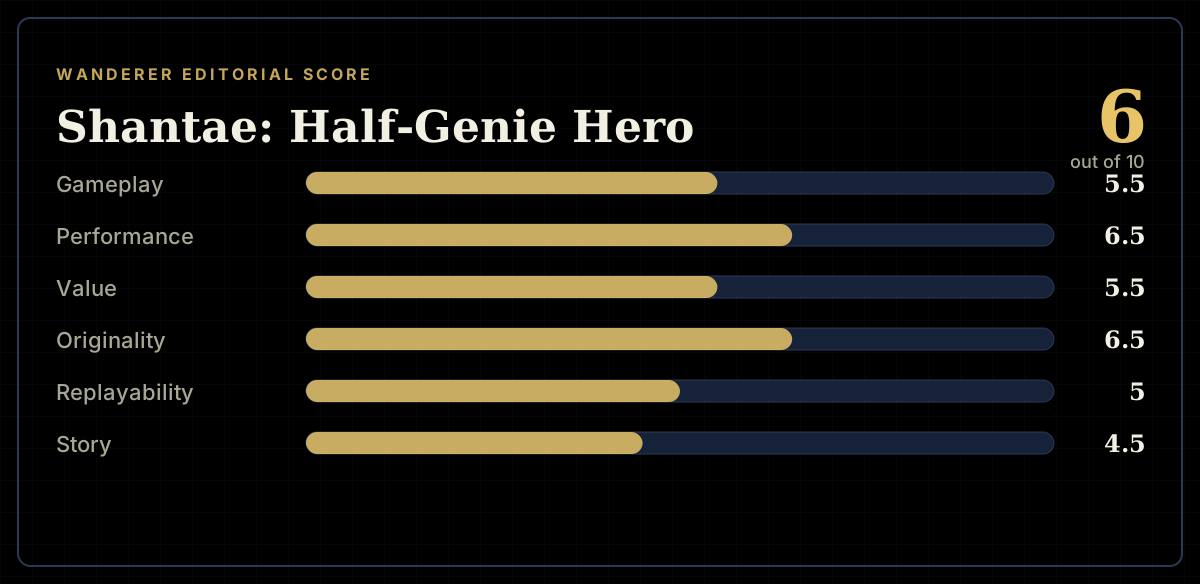
How the review scores each part of the gameWanderer Editorial -
The short versionWanderer Editorial