
Game review
Owlboy
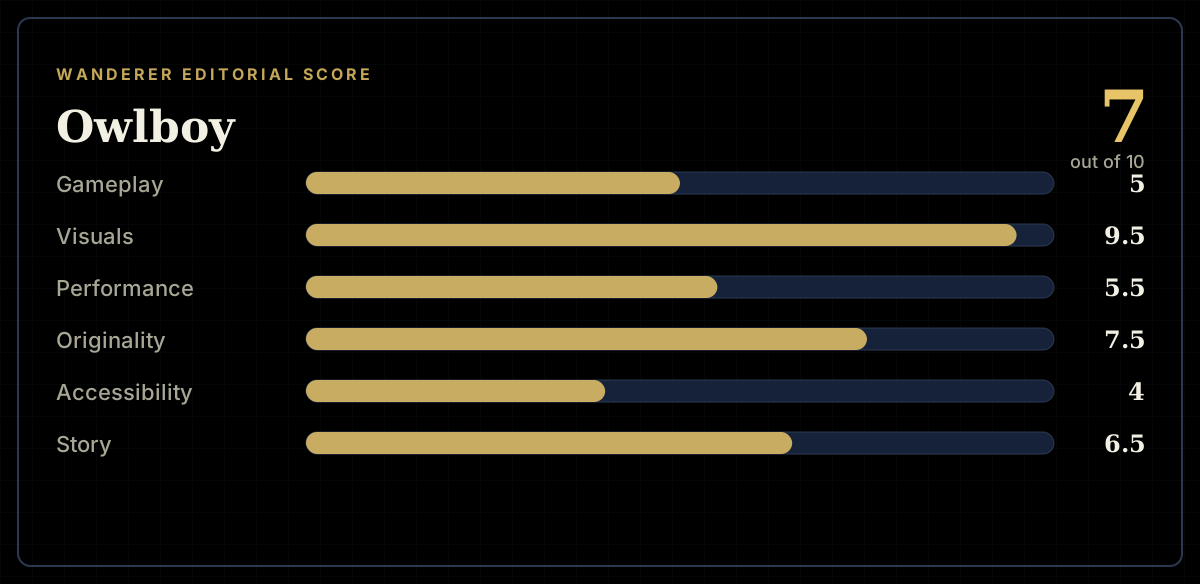
7 / 10
- Developer
- D-Pad Studio
- Publisher
- D-Pad Studio
- Released
- 1 November 2016
- Platforms
- Windows, macOS, Linux
- Genre
- Pixel-Art Action-Platformer
- Monetisation
- Paid, one-time purchase. No in-app purchases.
- Players
- Single-player only.
The short version
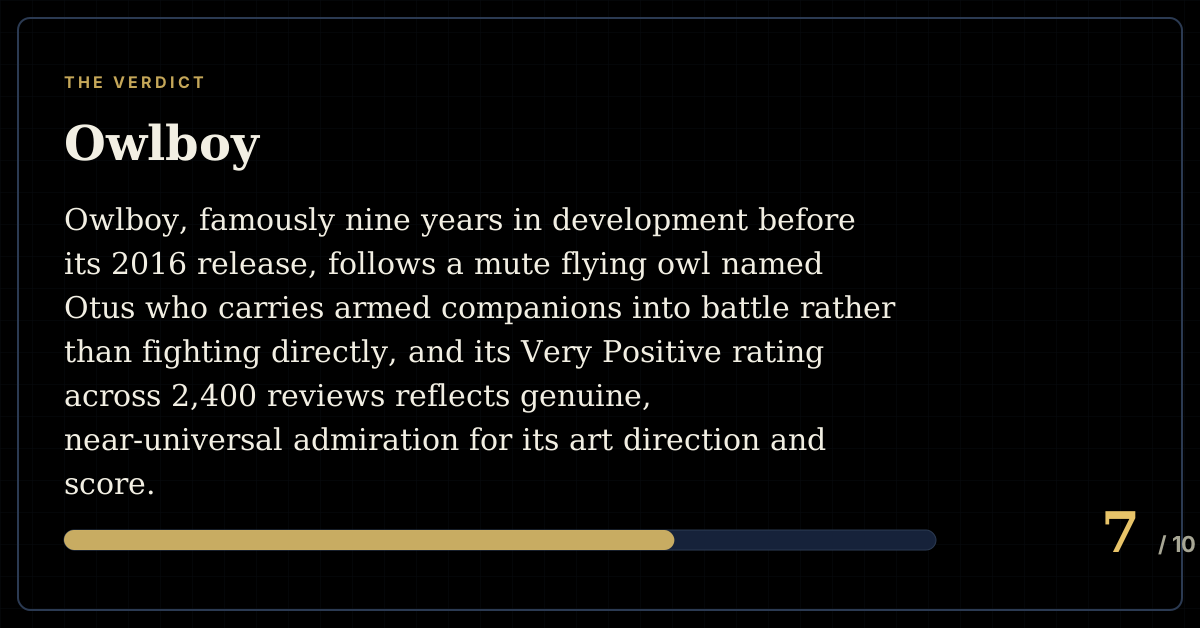
Owlboy, famously nine years in development before its 2016 release, follows a mute flying owl named Otus who carries armed companions into battle rather than fighting directly, and its Very Positive rating across 2,400 reviews reflects genuine, near-universal admiration for its art direction and score. What holds this review back is an extraordinarily consistent complaint, appearing in nearly every critical review in this sample, that the underlying combat and platforming feel clumsy and imprecise, with disproportionately punishing boss fights that many reviewers say clash with the otherwise gentle tone. A separate, well-corroborated complaint describes a specific softlock bug, and several reviewers report screen-shake and flashing-light effects with no in-game option to reduce them.
Biggest strengths
- Genuinely exceptional, widely admired pixel art and animation that reviewers consistently describe as among the best examples of the style in any indie game.
- A distinctive, atmospheric orchestral soundtrack that reviewers credit as elevating scenes well beyond what the visuals alone achieve.
- A genuinely inventive core premise — a mute protagonist who flies and carries armed companions rather than fighting directly — that stands out mechanically within the platformer genre.
Biggest weaknesses
- An extraordinarily consistent complaint, appearing in nearly every critical review in this sample, describes the carry-and-throw combat and platforming as clumsy and imprecise relative to the game's polished presentation.
- Boss fights are repeatedly described as disproportionately difficult and frustrating compared to the otherwise gentle, exploration-focused pacing of the rest of the game.
- A specific, named softlock bug is reported in the jungle level, with at least one reviewer unable to find a workaround.
Who it's for: Players who prioritise art direction, music and atmosphere above precise, responsive combat, and who are prepared for a marketed "metroidvania" experience that plays out in practice as a much more linear platformer.
Our recommendation: A genuinely gorgeous, worthwhile experience for the presentation alone; go in with tempered expectations for the combat, and be aware of a reported softlock risk in one specific level.
7 / 10
Genuinely exceptional art and music, near-universally praised
Owlboy's reputation for outstanding presentation is close to unanimous across this entire review base, including from reviewers who ultimately can't recommend the gameplay built around it. "The artwork, animation, and soundtrack are all top notch," reads a 2017 review, a combination of praise echoed in some form across the overwhelming majority of this sample regardless of overall recommendation. A 2020 review frames the achievement specifically: "Every building, every shrub, every cloud is detailed and unique. Every level has its own color scheme with some unique character designs." That consistency matters: when reviewers explicitly not recommending the game still open with genuine, specific praise for its art and music, it's a meaningful signal that the presentation is a real, exceptional achievement worth the nine years of development time it famously took — one substantial enough to have earned the game a lasting reputation and an upcoming tenth-anniversary celebration from the developer.
An extraordinarily consistent complaint about the underlying gameplay
What tempers that praise, with a consistency this review rarely finds even among its most well- corroborated findings, is a specific complaint about how the game actually plays. "Looks and sounds gorgeous. Plays like garbage. What should have been an enjoyable little light platformer with an excellent story and characters is ruined by some astoundingly bad design decisions," reads a 2022 review. A 2022 review reaches an almost identical conclusion independently: "Great art, great music. Really sucks you in. Then it becomes tedious. So very tedious. Bullet sponges, trial and error, clumsy controls, inconsistent game mechanics." A 2021 review summarises the split most memorably: "Wide as a puddle, deep as a puddle. But it's a really pretty puddle." Checking a broad sample of negative reviews, this exact "beautiful but poorly playing" framing appears with remarkable consistency across nearly the entire critical portion of this review base, suggesting a genuine, stable gap between the game's presentation and its underlying mechanical execution rather than a matter of individual player skill.
Disproportionately punishing boss fights
A specific, recurring version of the gameplay complaint concerns boss encounters. "The boss fights. They can get so obnoxious that they almost ruin the game for me," reads a 2026 review, a sentiment echoed by several other reviewers who otherwise praise the game's characters and world. A 2023 review frames the tonal mismatch directly: "This game is the sailing parts of Wind Waker... Boring combat, (that suddenly has incredibly difficult combat for one boss?)" Several reviewers make the same point this review treats as the clearest, most specific version of the complaint: the difficulty curve isn't gradual, but spikes sharply and specifically at boss encounters, clashing with an otherwise gentle, exploration-focused tone the rest of the game establishes.
A reported softlock bug and unaddressed accessibility concerns
This review found two further, more concrete technical complaints worth flagging directly. "It's possible to soft-lock the game in the jungle level, which I did. I tried" multiple workarounds without success, reads a 2022 review — a specific, named location worth being aware of before playing. Separately, a 2023 review reports: "The visuals are gorgeous, but the game buries them behind a barrage of screen effects like screen shake and flashing lights. It's to the point where it hurts one's eyes, and I had to put the game down. There are no options" to reduce or disable these effects. This review checked the developer's own patch history and found a genuine update in May 2022, but no specific reference to added accessibility options for screen effects, consistent with this remaining an unaddressed concern for players sensitive to that kind of visual intensity.
A further, related complaint concerns enemy placement rather than screen effects specifically: "the biggest issue is that there are enemies right on the border of screens," reads a 2026 review, describing attacks arriving from off-screen with little warning. Combined with the boss-difficulty spikes described above, this contributes to a broader pattern several reviewers describe: individual moments of difficulty that feel less like a fair test of skill and more like the game working against the player's ability to react in time, which is a distinct, more specific criticism than general difficulty complaints.
A misleading "metroidvania" framing
A further, more specific complaint concerns how the game is marketed relative to how it actually plays. "My problem is that it isn't worth the price. Most especially due to the fact that it is being touted as a metroidvania, when in fact the game is extremely linear," reads a 2016 review posted shortly after launch. This is a legitimate, specific expectation-management issue distinct from the broader gameplay complaints — players specifically drawn to the genre's typical exploration-and-backtracking structure should know Owlboy is considerably more linear than that label commonly implies.
Weighing the carry-and-throw mechanic fairly
It's worth being fair to the underlying design idea, since several reviewers who share the broader gameplay complaint still credit Otus's core carry-and-throw mechanic as genuinely clever in concept — switching between armed companions to solve different combat and puzzle situations is a distinctive system with real creative potential. The consistent complaint isn't that the idea itself is flawed, but that its execution feels imprecise and clumsy in the moment, a distinction several reviewers draw explicitly when explaining why they can admire the concept while still finding the actual play experience frustrating.
Final verdict
Owlboy remains a genuinely exceptional achievement in pixel art and music, and this review credits its nine years of visual and audio craftsmanship without reservation. What keeps the score short of higher praise is an extraordinarily consistent complaint about clumsy, imprecise combat and disproportionately punishing boss encounters, compounded by a reported softlock bug and unaddressed screen-effect accessibility concerns. This is a worthwhile, genuinely beautiful experience for players who prioritise atmosphere and presentation; go in with tempered expectations for the combat, and be cautious in the jungle level specifically given the reported softlock risk.
Pros and cons
Pros
- Genuinely exceptional, widely admired pixel art and animation that reviewers consistently describe as among the best examples of the style in any indie game.
- A distinctive, atmospheric orchestral soundtrack that reviewers credit as elevating scenes well beyond what the visuals alone achieve.
- A genuinely inventive core premise — a mute protagonist who flies and carries armed companions rather than fighting directly — that stands out mechanically within the platformer genre.
- Charming, well-voiced character writing that gives Owlboy's found-family cast real personality despite the protagonist himself never speaking.
Cons
- An extraordinarily consistent complaint, appearing in nearly every critical review in this sample, describes the carry-and-throw combat and platforming as clumsy and imprecise relative to the game's polished presentation.
- Boss fights are repeatedly described as disproportionately difficult and frustrating compared to the otherwise gentle, exploration-focused pacing of the rest of the game.
- A specific, named softlock bug is reported in the jungle level, with at least one reviewer unable to find a workaround.
- Screen shake and flashing-light effects are reported by multiple reviewers as causing genuine visual discomfort, with no in-game option found to reduce or disable them.
- The game is marketed with "metroidvania" framing that several reviewers say oversells its actual structure, which plays out as considerably more linear than that label typically implies.
Screenshots
-

OwlboyImage: D-Pad Studio via Steam -

OwlboyImage: D-Pad Studio via Steam -

OwlboyImage: D-Pad Studio via Steam -
How the review scores each part of the gameWanderer Editorial -
The short versionWanderer Editorial