
Game review
SAND LAND
7 / 10
- Developer
- ILCA, Inc.
- Publisher
- Bandai Namco Entertainment
- Released
- 25 April 2024
- Platforms
- Windows, PlayStation 4, PlayStation 5, Xbox Series X|S
- Genre
- Action RPG
- Monetisation
- One-time purchase, no in-game currency
- Players
- Single-player
The short version
SAND LAND adapts Akira Toriyama's post-apocalyptic desert manga into an open-world action RPG starring Beelzebub, a fiend prince who teams up with a retired human soldier and a sympathetic desert bandit to find water for a dying village. It's Very Positive on Steam at 87% across just over 1,000 reviews, and the reasons for that score and the reasons for its remaining 13% are unusually clear-cut and specific rather than scattered: vehicle and tank customisation is genuinely excellent and consistently praised, and Toriyama's art style translates beautifully into 3D, but a huge, specific share of the negative reviews are about one thing — companion characters narrating the obvious every few seconds, on a loop, with no way to disable it. The game released roughly two months after Toriyama's death in March 2024, one of the last projects he was directly involved with, which gives an already faithful adaptation a weight beyond its own mechanics.
Biggest strengths
- Vehicle and tank customisation is deep and genuinely fun to tinker with, with real variation between vehicle types that multiple reviewers single out as the game's best system
- Toriyama's distinctive linework and desert-punk art style translate into 3D with real fidelity, drawing praise even from the game's harshest critics
- The adapted story stays close to the source manga and captures its tone well, giving the game a real identity beyond being "another anime action RPG"
Biggest weaknesses
- Companion characters narrate what's already visually obvious on screen almost constantly, with lines repeating on a loop every 10-20 seconds and no setting to disable or reduce it — the single most common, most-upvoted complaint across the negative review sample
- On-foot combat as Beelzebub lacks a lock-on system, and vehicle combat is criticised by multiple reviewers as a simple circle-strafe pattern that doesn't evolve much across the campaign
- Cutscenes and dialogue can only be advanced manually or left to auto-advance after a fixed delay, with no way to turn off forced subtitles or streamline conversations that reviewers describe as unnaturally slow
Who it's for: Toriyama fans and players who enjoy vehicle-building and customisation systems are the best audience — the tank workshop here is a genuine highlight worth the price on its own for players who like that kind of tinkering. Players sensitive to hand-holding narration, or who prioritise precise on-foot combat, should read the specific dialogue complaints below before buying, since they're echoed independently by dozens of otherwise-positive reviewers.
Our recommendation: Recommended, with one specific caveat: the constant, repeating companion dialogue is a real, widely-reported problem that no patch has apparently addressed, and it's worth confirming you can tolerate it (or muting voice lines, which several reviewers use as a workaround) before committing to the full 30-40 hour campaign. Everything else — the art, the tone, the vehicle systems — earns its price.
7 / 10
Toriyama's other world, built faithfully and a little too talkatively
Sand Land began as a manga Akira Toriyama wrote between his more famous Dragon Ball serials, a post-apocalyptic story about a desert world starved of water where a fiend prince, a retired human soldier and a wanted desert bandit team up out of shared necessity rather than any grand alliance. ILCA's video game adaptation, developed under Bandai Namco, keeps that premise and tone largely intact, and it released in April 2024, about two months after Toriyama's death — one of the last projects he was directly and personally involved with, down to a message he wrote to fans ahead of launch. None of that context changes what the game mechanically is, but it's worth knowing going in: this is as close as players will get to a new, finished Toriyama story told with his direct input, and it shows in how carefully the adaptation handles his specific sense of humour and design sensibility.
A genuinely excellent tank workshop wrapped in a talkative open world
The strongest, most consistently praised system in Sand Land is its vehicle customisation. Beelzebub and company build and modify tanks and other vehicles from parts scavenged across the desert, and reviewers across the spectrum — including several who otherwise can't recommend the game — single this system out as a genuine highlight, with real mechanical variety between vehicle builds rather than a cosmetic-only customisation loop. It's the kind of system that rewards the player who likes tinkering for its own sake, independent of how the rest of the game around it holds up.
Combat itself is more mixed. On foot, Beelzebub's moveset lacks a lock-on system, which multiple reviewers flag as a real problem in a 3D action game with enemies that move unpredictably around the player. Vehicle combat fares a little better in reception but still draws a specific, repeated complaint: several detailed reviews describe it as a simple circle-strafe pattern around enemies that doesn't meaningfully change or escalate across the 30-to-40-hour campaign. None of this makes combat bad exactly — it's serviceable enough that most positive reviews don't dwell on it — but it's clearly the vehicle customisation menu doing the game's heavy lifting rather than the fights themselves.
The dialogue problem, and why it dominates the negative reviews
If there's one specific, fixable-sounding issue that towers over everything else in Sand Land's negative review sample, it's the companion dialogue system. The single most-upvoted negative review on Steam opens with an example that dozens of other reviewers independently echo almost word for word: the party encounters an obstacle, a character states the completely obvious solution out loud, the game has already given the player the tool for that solution many hours earlier, and the same or a near-identical line repeats the next time a similar obstacle appears — sometimes within the same play session. Several reviewers describe conversations that trigger automatically every ten to twenty seconds regardless of what's actually happening on screen, with characters narrating simple visual details ("look, a big tree, we can't walk through it") as though the player couldn't see the screen themselves. Making it worse, there's no setting to disable forced subtitles, reduce dialogue frequency, or meaningfully speed through conversations beyond manually clicking past each line — and cutscenes will auto-advance after a fixed delay whether or not the player is ready, which several reviewers find just as irritating as the repetition itself. This is a genuinely unusual thing to see dominate a review base this consistently: it isn't a matter of taste the way pacing or difficulty complaints often are, it's a specific, describable design choice that a large, otherwise-satisfied audience independently identifies as the game's biggest flaw.
Performance issues compound the frustration for some players. Multiple detailed reviews, including from players running high-end hardware, report real frame stuttering specifically during vehicle combat sequences — the moments the game is otherwise selling hardest. At least one reviewer notes the same stutter was present in the pre-release demo months earlier and was never addressed for the retail launch, which is a worse look than a stutter appearing for the first time on release day. The opening hours don't do the game any favours either: one detailed review clocks almost three hours of introduction and tutorial before the player can even open the tank customisation menu for the first time, an unusually long on-ramp for a game whose single best system is exactly that customisation menu, and one that will test the patience of anyone who bought the game specifically for it.
Verdict
SAND LAND is a faithful, visually distinctive adaptation of a Toriyama story that deserved a careful treatment, and on the systems that matter most to that adaptation — art direction, tone, and a genuinely deep vehicle-building system — it delivers exactly what fans wanted. Where it falls short is almost entirely containable to one specific, well-documented problem: a companion dialogue system so repetitive and inflexible that it's the headline complaint across a huge share of an otherwise Very Positive review base, compounded by combat that leans more on vehicle tinkering than tight on-foot design and stuttering that shows up even on strong hardware. None of that erases what the game gets right, and for players who go in knowing what to expect from the dialogue, there's a genuinely charming 30-to-40-hour campaign here — one that carries some extra weight as one of the last stories its creator had a direct hand in telling.
Pros and cons
Pros
- Vehicle and tank customisation is deep and genuinely fun to tinker with, with real variation between vehicle types that multiple reviewers single out as the game's best system
- Toriyama's distinctive linework and desert-punk art style translate into 3D with real fidelity, drawing praise even from the game's harshest critics
- The adapted story stays close to the source manga and captures its tone well, giving the game a real identity beyond being "another anime action RPG"
- A hub town the player rebuilds over the course of the story gives the campaign's slower stretches a tangible sense of progress
- Released only weeks after Akira Toriyama's death, it stands as one of the last projects he was directly involved with, including a message he wrote to fans ahead of its launch
Cons
- Companion characters narrate what's already visually obvious on screen almost constantly, with lines repeating on a loop every 10-20 seconds and no setting to disable or reduce it — the single most common, most-upvoted complaint across the negative review sample
- On-foot combat as Beelzebub lacks a lock-on system, and vehicle combat is criticised by multiple reviewers as a simple circle-strafe pattern that doesn't evolve much across the campaign
- Cutscenes and dialogue can only be advanced manually or left to auto-advance after a fixed delay, with no way to turn off forced subtitles or streamline conversations that reviewers describe as unnaturally slow
- Multiple detailed reviews report significant frame stuttering during vehicle combat, including on high-end hardware, a problem some reviewers say was already present in the pre-release demo and never fixed for launch
- The opening hours are unusually slow even by JRPG standards, with one reviewer clocking almost three hours before reaching the point where the first tank can be customised
Screenshots
-

SAND LANDImage: Bandai Namco Entertainment Inc. via Steam -

SAND LANDImage: Bandai Namco Entertainment Inc. via Steam -

SAND LANDImage: Bandai Namco Entertainment Inc. via Steam -
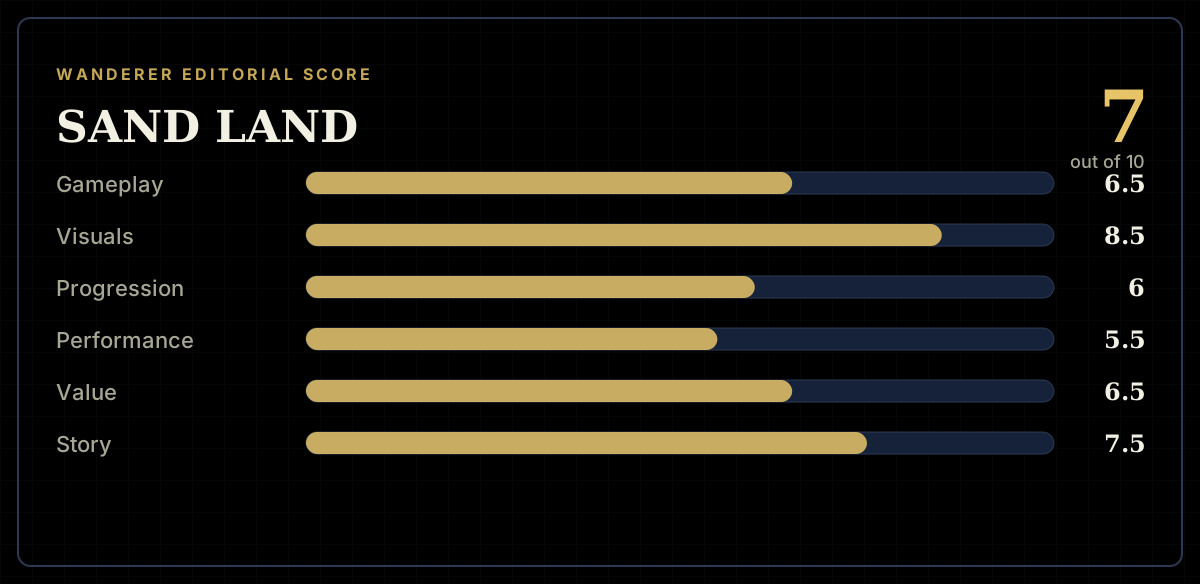
How the review scores each part of the gameWanderer Editorial -
The short versionWanderer Editorial