Game review
Rogue Legacy
7.5 / 10
- Developer
- Cellar Door Games
- Publisher
- Cellar Door Games
- Released
- 27 June 2013
- Platforms
- Windows, macOS, Linux
- Genre
- Roguelite Platformer
- Monetisation
- One-time purchase at NZ$21.99. No DLC, no microtransactions. Checked 4 August 2026.
- Players
- Single-player only
The short version
Every time you die in Rogue Legacy, one of your children takes over — a randomly generated heir with a class, a spell and usually a genetic quirk. You might be colourblind, or a dwarf, or unable to see the room you're standing in. The gold you brought home buys permanent upgrades to the bloodline, so the family gets stronger even when you don't. That idea became the entire roguelite genre. The execution shows its age: the castle economy takes all your remaining gold each run, most classes aren't worth playing, and the platforming has never felt precise. Historically essential, mechanically superseded by its own sequel.
Biggest strengths
- The inheritance system is a genuine invention — heirs with classes, spells and randomised traits made permanent progression feel like a story rather than a menu
- Traits are frequently very funny, and occasionally reshape a run entirely
- Combat is fluid and immediate, and the moment-to-moment fighting is the part that has aged best
Biggest weaknesses
- Re-entering the castle costs you all remaining gold, so experimentation and saving are both punished
- Each upgrade raises the price of the others, which makes broad investment expensive and narrow investment mandatory
- Most classes are widely considered non-viable, so runs converge on a few strong ones
Who it's for: Players curious about where roguelite meta-progression came from, and anyone who wants a bite-sized action platformer with permanent upgrades. Not for players who want tight platforming, and probably not the version to buy if you just want the best game.
Our recommendation: Buy it on sale, and consider Rogue Legacy 2 instead if you only want one — recent reviewers who've played both say the sequel improves on it substantially, and they're right. If you do play the original, take the Charon toll seriously: spend every coin before you re-enter, because the game takes what you're carrying. And don't chase the perfect heir; the traits are flavour far more often than they're strategy.
7.5 / 10
In 2013, a review of Rogue Legacy appeared with 669 helpful votes. It wasn't hostile — it opens by saying this isn't a bad game. Its complaint was that "pretty much all character progression happens in between sessions, not during", and that the result felt more like an RPG hybrid than a roguelike one. It used The Binding of Isaac as the contrast.
Thirteen years later, that is still the central argument of the entire roguelite genre, and Rogue Legacy is the game that started it.
The invention
You enter a procedurally generated castle. You die — you will always die. And then one of your children takes over.
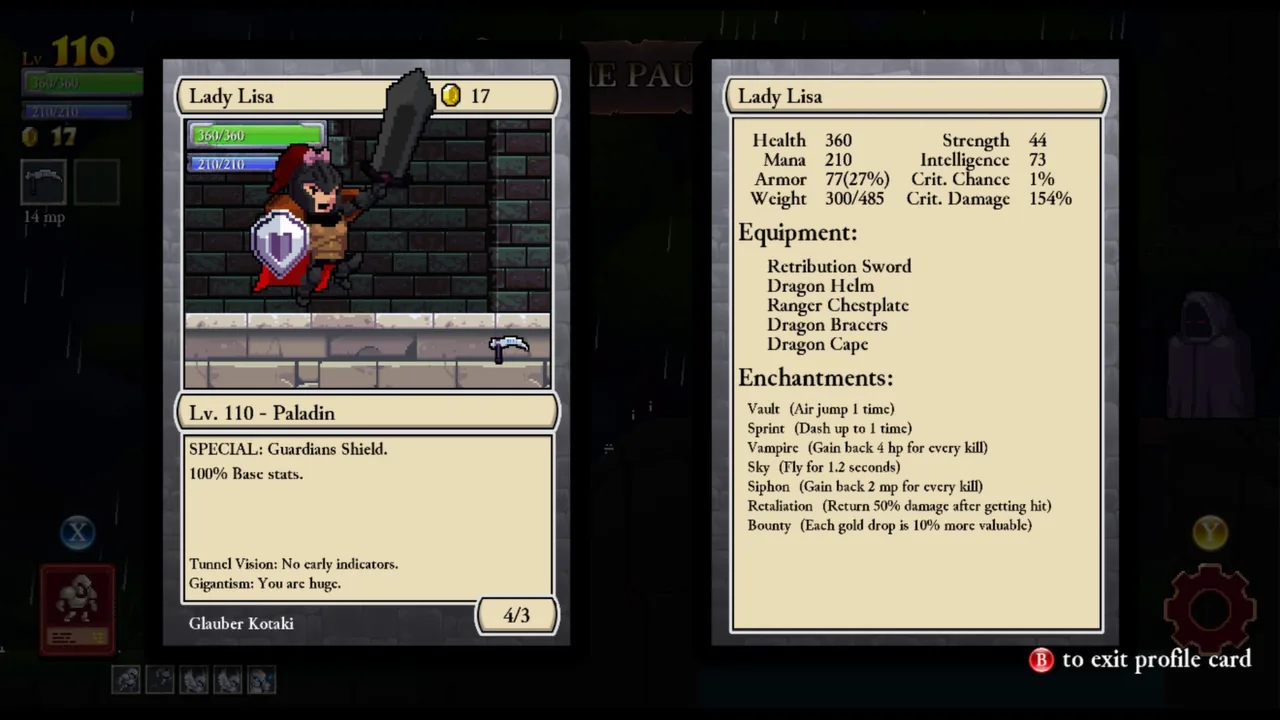
Each heir is randomly generated: a class, a spell, a set of stats, and usually one or two genetic traits. You might be a dwarf, which makes you small enough to fit through gaps. You might have vertigo, which flips the screen. You might be colourblind, or have IBS, or be unable to see anything outside a small circle. Most are jokes; a few genuinely change how a run plays.
Meanwhile the gold you carried home buys permanent upgrades to the bloodline — health, damage, new classes, more equipment slots. So the family advances even when the individual fails, and failure becomes deposit rather than loss.
That combination — randomised character + permanent lineage progression — is the template. Dead Cells, Hades, Returnal, a thousand smaller games and most of the roguelites in this library run on some version of it. Before Rogue Legacy, dying meant starting over. After it, dying meant banking.
The immediate feel holds up too. Combat is quick and readable, runs are short, and the loop is famously difficult to stop — the median recent reviewer has 25 hours in a thirteen-year-old game.
Where it shows its age
The Charon toll. Re-enter the castle and the ferryman takes every coin you're still carrying. The intent is to force commitment, and the effect is that saving for anything expensive is impossible — you must spend everything, every run, or lose it. Worse, each upgrade you buy raises the cost of all the others. Reviewers describe the combined result accurately: broad experimentation becomes punishing, and you're pushed toward narrow, grinding investment in whatever you can afford now.
Most classes aren't worth it. A criticism that recurs from 2014 to the present is that the class roster is badly unbalanced, so a run's quality is largely decided by whether the game offered you one of the few strong options. That inverts the intent: the heir screen is supposed to be a choice, and it frequently isn't.
The platforming isn't precise. Hitboxes and control feel draw complaints across the entire review history, which matters in a game built on jumping between spikes.
And the rooms can be unfair. Multiple reviewers note that procedural generation can put an impossible opening in front of you, and contrast it with older roguelikes where caution was rewarded rather than punished. A recent player describes walking into a fresh castle and being overwhelmed in the first room.
The Isaac comparison, thirteen years on
That original 2013 review has aged into something genuinely interesting, because the two games it compared have become the poles of the genre's design space.
The Binding of Isaac puts nearly all progression inside the run — you begin equal every time, and what makes a run great is what you find in it. Rogue Legacy puts nearly all progression outside the run — you begin stronger each time, and what makes a run great is what you bought before it started.
Neither is correct. They ask for different things: Isaac wants you to get better at the game; Rogue Legacy is willing to let you grind until the numbers carry you. The former respects skill more; the latter is far more forgiving of players who don't have it, which is a real virtue and a large part of why the genre went Rogue Legacy's way commercially.
The problem is that Rogue Legacy sits at the extreme end of its own axis. When the meta-progression is the primary source of power and the economy punishes saving and the class roster is unbalanced, a bad run isn't a lesson — it's an unproductive shift. That's the grind its critics identify, and it's real.
7.5 out of 10. Rated 7.5 out of 10.
Rogue Legacy earns its place in any serious library. It invented a structure that reshaped a genre, it's still fun in short bursts, and at twenty-two dollars with no DLC and no nonsense it's an honest purchase.
It doesn't score higher because thirteen years of refinement happened, most of it elsewhere, and some of it in this game's own sequel — which recent reviewers who've played both consistently say improves on it substantially. Buy this one to understand where the genre came from. Buy Rogue Legacy 2 if you want the version that learned from it.
Pros and cons
Pros
- The inheritance system is a genuine invention — heirs with classes, spells and randomised traits made permanent progression feel like a story rather than a menu
- Traits are frequently very funny, and occasionally reshape a run entirely
- Combat is fluid and immediate, and the moment-to-moment fighting is the part that has aged best
- Runs are short and the loop is famously hard to put down, with a 25-hour median among recent reviewers
- Complete as sold at a modest price, with no DLC and no monetisation
- Still 92% positive across nearly nineteen thousand reviews after thirteen years
Cons
- Re-entering the castle costs you all remaining gold, so experimentation and saving are both punished
- Each upgrade raises the price of the others, which makes broad investment expensive and narrow investment mandatory
- Most classes are widely considered non-viable, so runs converge on a few strong ones
- Hitboxes and platforming precision draw persistent criticism across the whole review history
- Procedural rooms can produce genuinely unfair openings, which reviewers contrast unfavourably with older roguelikes
- Its own sequel does nearly all of this better, and recent reviewers say so
Screenshots
-
Rogue LegacyImage: Cellar Door Games via Steam -
Rogue LegacyImage: Cellar Door Games via Steam -
Rogue LegacyImage: Cellar Door Games via Steam -
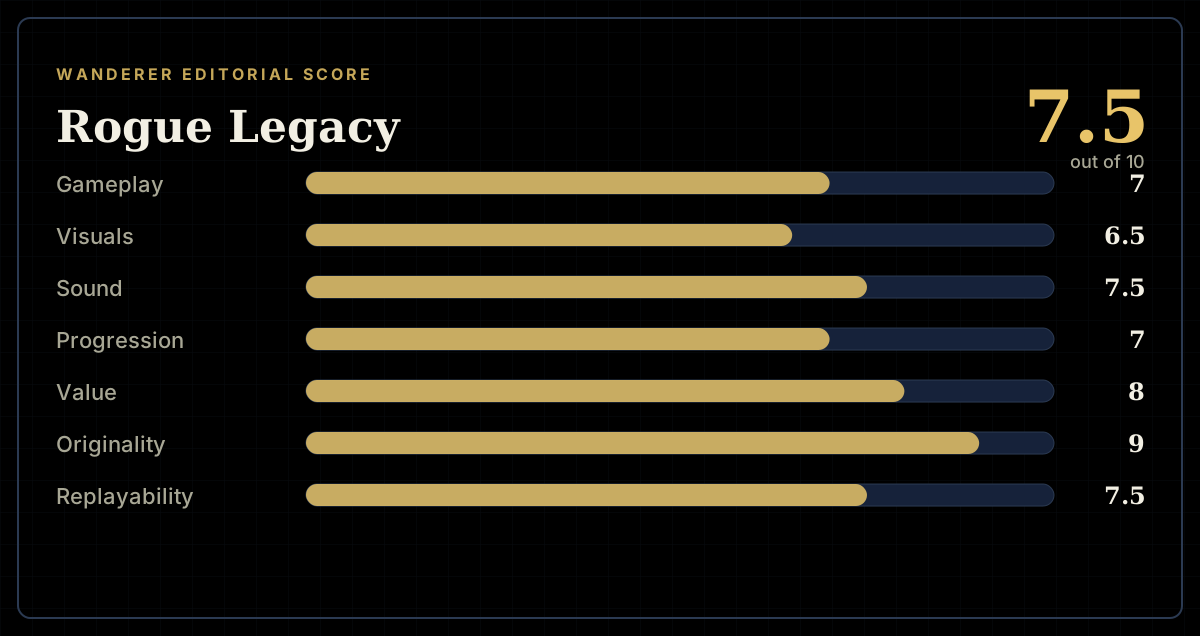
How the review scores each part of the gameWanderer Editorial -
The short versionWanderer Editorial