
Game review
Retro Clicker
5.7 / 10
- Developer
- Reloop Games
- Publisher
- Reloop Games
- Released
- 17 June 2026
- Platforms
- Windows
- Genre
- RPG
Three Reviews, All Positive, All Agreeing on Exactly What Kind of Game This Is
Retro Clicker launched on Steam on 17 June 2026 from developer Reloop Games, and at the time of writing has three user reviews, all positive — a small sample, but a notably consistent one in terms of what it says about the game. Every reviewer frames Retro Clicker not as a hidden gem with unexpected depth, but as a game that does exactly one narrow thing and does it without apology. A Turkish-language reviewer with over 15 hours logged puts it most bluntly, warning that "if you're not obsessed with this style of game, it won't grab you" — a positive review that doubles as a fair warning to anyone outside the incremental-clicker audience. An English-language reviewer with over 5 hours logged frames the appeal in similarly self-aware terms: "if I want to rapidly click on pixelated goober monsters and occasionally upgrade to defeat them faster and faster, I buy Retro Clicker," calling it "a strong recommend" precisely because "it is what it is." A German-language reviewer with over 27 hours logged — the longest session of the three — sums it up as "nice, old school clicker, no stupid talent tree, just click." Taken together, these three reviews describe a game whose appeal is its lack of ambition rather than despite it, which is worth keeping firmly in mind heading into the rest of this review.
Click, Upgrade, Prestige: A Loop the Store Page Doesn't Pretend Is More Than It Is
The core loop is exactly what the store page's own tagline promises: "Click. Upgrade. Prestige. Repeat." Enemies can be destroyed either by manual clicking for faster progression or through idle automation for a more hands-off pace, with 150 individually pixel-art enemies to work through toward what the store page calls a "global goal." Base stat upgrades sit alongside a prestige system that resets progress in exchange for permanent power-ups, following the well-worn incremental shape of getting stronger with each reset rather than starting over from scratch. What's notable, and consistent with the German reviewer's specific comment about there being "no stupid talent tree," is that the store page's own description doesn't oversell this as a complex systems game — it explicitly brands itself "Minimalist Retro Design," asking players to "focus entirely on numbers, progression, and satisfying pixelated combat" rather than layering on the branching skill trees, gear rarity tiers, or companion-collection systems that have become common even in budget-priced clickers. That's a genuinely different pitch from most of the idle-RPGs in this genre, which increasingly compete by piling on systems; Retro Clicker's positioning is closer to a return to the genre's Cookie Clicker-era roots than an attempt to out-feature its competition. That said, a screenshot of the Upgrades panel shows "just click" undersells things slightly: alongside a basic click-damage stat sit separate Super Hit, Crit Chance, Crit Multiplier, Combo Power, and Combo Duration lines, plus six distinct idle-currency generators each running on its own timer — a genuinely multi-stat system, just one laid out as flat, unbranching purchase lines rather than the tree structure the German reviewer specifically praised its absence of. The game's greyscale, scanline-style pixel art — skeletons, wolves, and other monochrome monster sprites rather than the colourful palettes typical of the genre — also gives the "retro" branding a distinct visual identity beyond just being a generic label.
Achievements Confirm a Ten-Tier Structure, But Offer Little Beyond That
The game's 12 Steam achievements are almost entirely built around numbered progression tiers, with ten of them simply labelled "Tier 1" through "Tier 10" — a naming pattern that at minimum confirms the game's core loop is structured around at least ten distinct difficulty or content stages, giving a concrete shape to what the store page otherwise describes only in general terms as "infinite perks and evolving systems." As with similarly tier-named achievement lists in other clickers, though, the names themselves don't add any narrative or mechanical texture beyond confirming that structure exists — there's no hint here of specific milestones, secret unlocks, or flavour text that might reward a completionist's curiosity the way a more creatively-named achievement list can. For a three-review sample this small, the achievement list is one of the only pieces of independently-verifiable information available about how deep the "150 unique pixel enemies" and prestige progression actually run.
A Narrow, Honest Pitch Rather Than a Broad One
What stands out most in reviewing Retro Clicker with only three data points to work from is how unanimously those three reviews agree on what the game is and isn't. None of them describe unexpected depth, surprising systems, or a game that outgrew its initial pitch — and crucially, none of them seem to want that either. That's a meaningfully different profile from most of the negative reviews seen across other titles in this genre, which tend to complain about a mismatch between an ambitious-sounding store page and a thinner delivered experience. Retro Clicker's store page doesn't oversell itself, and its available reviewers don't feel undersold either; the risk here isn't disappointment from a broken promise, but simply that the promise itself — "click on pixelated goober monsters," in one reviewer's own words — may be too narrow to hold most players' attention for long, which is precisely the caveat the Turkish-language review states outright.
Price, Platform, and a Straightforward Single-Purchase Structure
At NZ$4.79, Windows-only, and English-only, Retro Clicker sits at the budget end of the incremental genre's pricing, in line with its own minimalist positioning. There's no DLC listed on the store page, and nothing in the available description or the three player reviews suggests any secondary monetisation layered on top of the single upfront price — no energy timers, no gacha currency, no premium prestige boosts — which, credited directly, is a consumer-friendly structure that matches the game's overall "just click" ethos rather than trying to monetise the compulsion loop further. It ships with Steam Achievements, Steam Cloud, and Family Sharing support, giving it reasonable basic feature coverage for a budget-priced solo release, even without any of the broader social, co-op, or platform-reach ambitions seen in some of its pricier genre neighbours.
Verdict
Retro Clicker is exactly what its three available reviewers say it is: a narrow, unpretentious idle clicker that clicks, upgrades, and prestiges without dressing itself up in talent trees, gear systems, or narrative framing it doesn't need. That's a genuine point in its favour for players who specifically want the genre's purest form back, and the achievement list's confirmed ten-tier structure suggests there's a reasonable amount of grind on offer at this price. But with only three reviews to draw on — all positive, but all also explicitly warning that this style of game isn't for everyone — there's real uncertainty about how the loop holds up over dozens of hours beyond what a 27-hour German reviewer and a 15-hour Turkish reviewer have already reported enjoying. At NZ$4.79 with no signs of secondary monetisation, it's a low-risk pickup specifically for players who already know they like this exact kind of game, and a skip for anyone hoping for more than what's advertised.
Screenshots
-
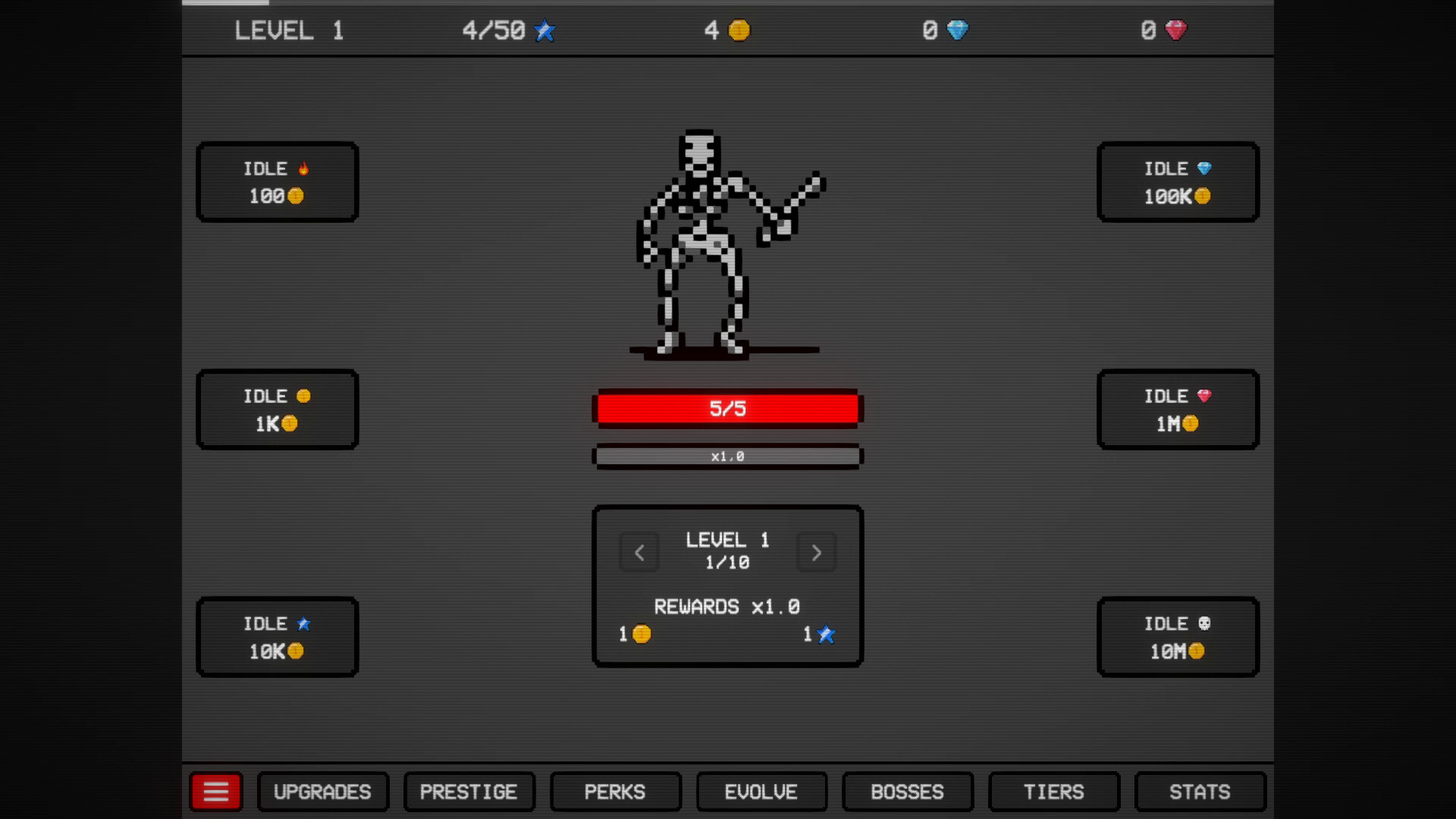
The opening battle screen against a greyscale skeleton enemy, with six locked idle-currency generators already visible and a seven-tab bottom toolbar hinting at more systems than the opening moments let on.Steam store page -
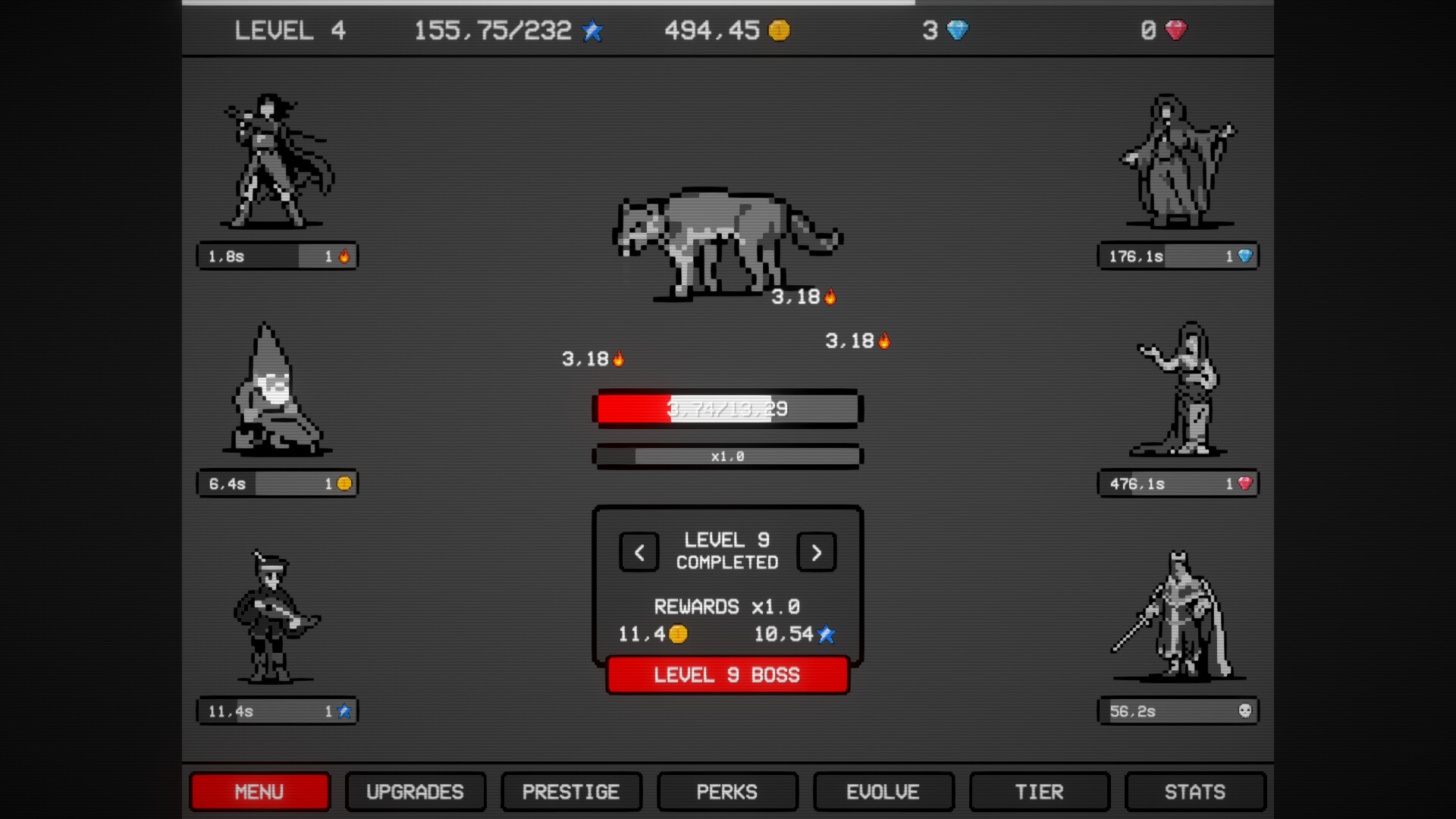
A boss fight against a wolf with a health bar in the millions, with six separate idle-currency generators running on independent timers in the background.Steam store page -
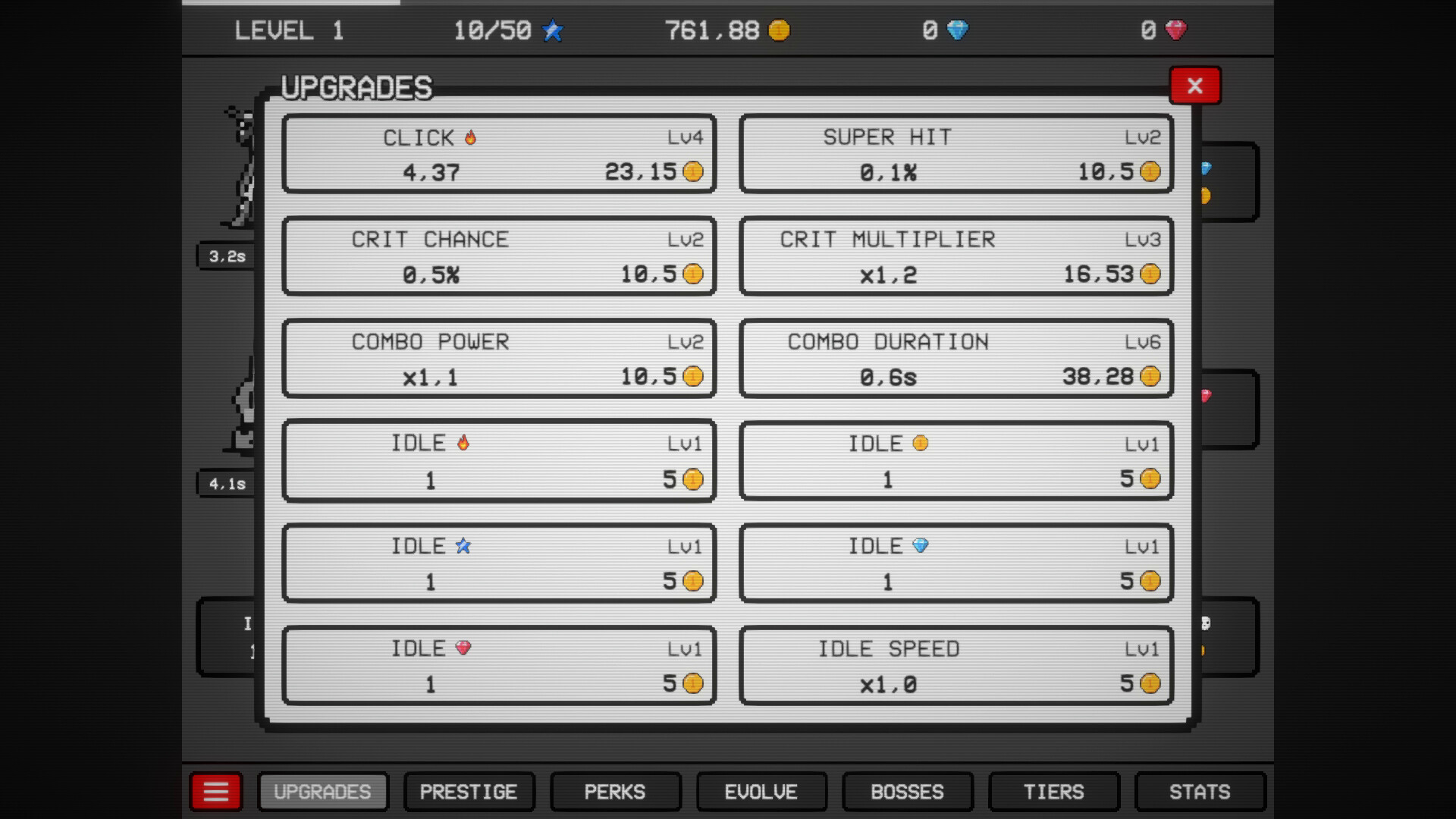
The full Upgrades panel, showing a genuinely multi-stat system — combo mechanics, crit stats, and six idle generators — laid out as flat purchase lines rather than a branching talent tree.Steam store page