
Game review
Idle Turrets Pixel Defense
6.4 / 10
- Developer
- Idle Tricks Games
- Publisher
- Idle Tricks Games
- Released
- 20 July 2026
- Platforms
- Windows
- Genre
- RPG
Zero Player Reviews at Launch: A Store-Page Read of a Brand-New Idle Defense Game
Idle Turrets Pixel Defense launched on Steam on 20 July 2026 from solo-scale developer Idle Tricks Games, and at the time of writing it has no user reviews at all — not a mixed score, not a handful of early impressions, but a completely blank slate. That leaves nothing to weigh against the store page's own pitch: an idle tower-defense game built around what the developer calls "dual progression," where the player upgrades their turrets for firepower while separately upgrading the enemies attacking them so that those tougher enemies drop more cash and experience in return. It's a neat inversion of the usual idle-defense formula, where enemies are normally just an obstacle to out-scale rather than a resource to deliberately buff, and on paper it gives the genre's familiar "number goes up" loop an actual balancing decision to make rather than a single upgrade path to dump currency into. With no player base yet to confirm how that balance holds up in practice, everything here is necessarily a read of the developer's own claims and of what's directly visible in the game's screenshots, rather than a verdict built on lived player experience.
Turrets, Evolutions, and an Auto-Buy System Meant to Keep the Idle Loop Honest
The core loop follows the tower-defense-meets-incremental shape the genre has settled into: turrets fire automatically at waves of enemies while the player can also jump in to deal manual damage, buy upgrades, and push further during active sessions, with progress continuing to tick over passively while away. Both turrets and enemies can be evolved into "advanced forms with incredible new abilities" according to the store page, which — if it holds up — would give the mid-and-late game more texture than simply re-skinning the same units with bigger numbers attached. An "Auto-Buy System" is pitched as a direct answer to one of idle gaming's most common friction points: rather than returning to a wall of available-but-unpurchased upgrades after time away, the system can be upgraded itself to automatically buy new turrets and enemy tiers as they unlock, explicitly framed by the developer as keeping "progression seamless while you idle." That's a sensible design response to a real complaint that shows up constantly in reviews of other idle games in this genre, though without a single player review to confirm it, it's worth treating as an intended solution rather than a proven one. The store page also promises "dozens of pixel-art turrets and enemy types" and periodic boss fights that drop "super rewards and rare loot," giving the moment-to-moment loop discrete goals to interrupt the passive number-climbing with. A screenshot of the Enemies management screen makes the "dual progression" pitch concrete rather than abstract: six named enemy slots are each individually upgradeable across four separate stats — reward, experience, spawn speed, and end reward — with their own prestige multiplier and base-level tracks layered on top, and two further enemy slots still locked behind steep 3.2K and 6.4K gold costs, confirming the roster of buffable enemies keeps expanding well past the opening handful. A separate early-game battlefield screenshot shows the pace this loop runs at in practice: at level 1, less than a minute in, dozens of slime, chest-mimic, and crab-like enemies are already spawning and dying across an open field with a bank of 7.81K gold and small per-kill reward pop-ups ticking upward continuously.
A Prestige Reset, Permanent Perks, and Tiered Difficulty for Long-Term Structure
Above the core turret-versus-enemy loop sits a prestige system that lets the player sacrifice accumulated progress for a dedicated prestige currency, which then unlocks what the store page calls "game-changing permanent upgrades" rather than a single flat multiplier. That currency feeds into a described "massive perk upgrades" system of global bonuses that persist across both prestige resets and difficulty tiers, meaning a player's long-term investment is meant to compound across resets rather than being wiped clean each time. Sitting alongside that is a tiered-difficulty structure where each successive tier is pitched as harder than the last, paired with the store page's claim of "infinite scaling" and "endless waves" so that, in the developer's words, "there is no ceiling — just how far your strategy can take you." The game's 15 Steam achievements are almost entirely built around this tiered structure, with ten of them simply named "Tier 1" through "Tier 10," a naming convention that at minimum confirms the tiered-difficulty system runs at least ten layers deep and gives a concrete, checkable shape to what would otherwise be a vague "infinite scaling" claim. A screenshot of the Evolution screen reveals a detail the store page doesn't spell out at all: rather than simply spending currency to evolve a turret or enemy, evolution is gated behind explicit objectives tracked toward a 10-star meter — one enemy/turret pairing shown sitting at 17 of 100 enemies defeated and 3 of 100 upgrades purchased toward its next star — and turret evolution specifically grants named combat bonuses, "Multishot" and "One Hit Kill" chance percentages, giving the "advanced forms with incredible new abilities" line from the store page a concrete, checkable meaning rather than leaving it as marketing language.
Steam Achievements Confirm at Least Ten Difficulty Tiers, But the Achievement Names Themselves Offer No Texture
Beyond confirming the tier system's depth, the achievement list is notably uninformative as a source of extra detail: unlike many idle and incremental games where achievement names hint at specific milestones, secret systems, or joke references that add flavour beyond the store description, "Tier 1" through "Tier 10" are exactly what they say and nothing more, offering no additional insight into pacing, difficulty spikes, or how long a typical playthrough takes to reach later tiers. That's a minor point on its own, but it's consistent with a broader pattern across the available material: everything about how Idle Turrets Pixel Defense actually plays over dozens of hours — whether the dual-progression balance between turret and enemy upgrades stays meaningful at higher tiers, whether the promised turret and enemy evolutions arrive at a reasonable pace, and whether the auto-buy system genuinely eliminates idle-game busywork or just delays it — remains entirely unverified by anyone outside the developer at the time of writing.
Price, Platform Support, and a Single Upfront Purchase With No Listed DLC
At NZ$7.89, Idle Turrets Pixel Defense sits toward the upper end of pricing for a solo-developed idle game, and it's Windows-only with no Mac or Linux build listed. There's no DLC on the store page and nothing in the available description suggesting any secondary monetisation layered on top of the upfront price — no energy timers, no gacha-style currency purchases, no premium prestige boosts mentioned anywhere — which, for a genre that frequently leans on exactly those mechanics, is worth crediting directly as a consumer-friendly starting position, on the assumption that structure holds as the game receives updates. It ships with Steam Achievements, Steam Cloud, and Family Sharing support, and is listed as single-player only, with no co-op or multiplayer claims to complicate that straightforward structure. English is the only supported language listed, a real limitation for a solo-developed release aiming for a broad idle-game audience that skews heavily toward non-English-speaking regions on Steam.
Verdict
Idle Turrets Pixel Defense pitches a genuinely interesting twist on the idle tower-defense formula — upgrading enemies alongside turrets so that a harder fight is also a better payday — wrapped in a familiar but sound long-term structure of prestige resets, persistent perks, and at least ten confirmed difficulty tiers. The trouble is that, at the time of writing, absolutely nothing here has been tested against a real player base: zero Steam reviews means every claim about balance, pacing, and whether the auto-buy system actually delivers on its promise of seamless idling comes from the developer alone. At NZ$7.89, English-only, and Windows-only, it's a reasonable, low-monetisation-risk pickup for idle-defense fans specifically curious about the dual-progression hook, but anyone reading this should treat it as a preview of the pitch rather than a verdict on the experience, given how completely untested it remains in the wider community.
Screenshots
-
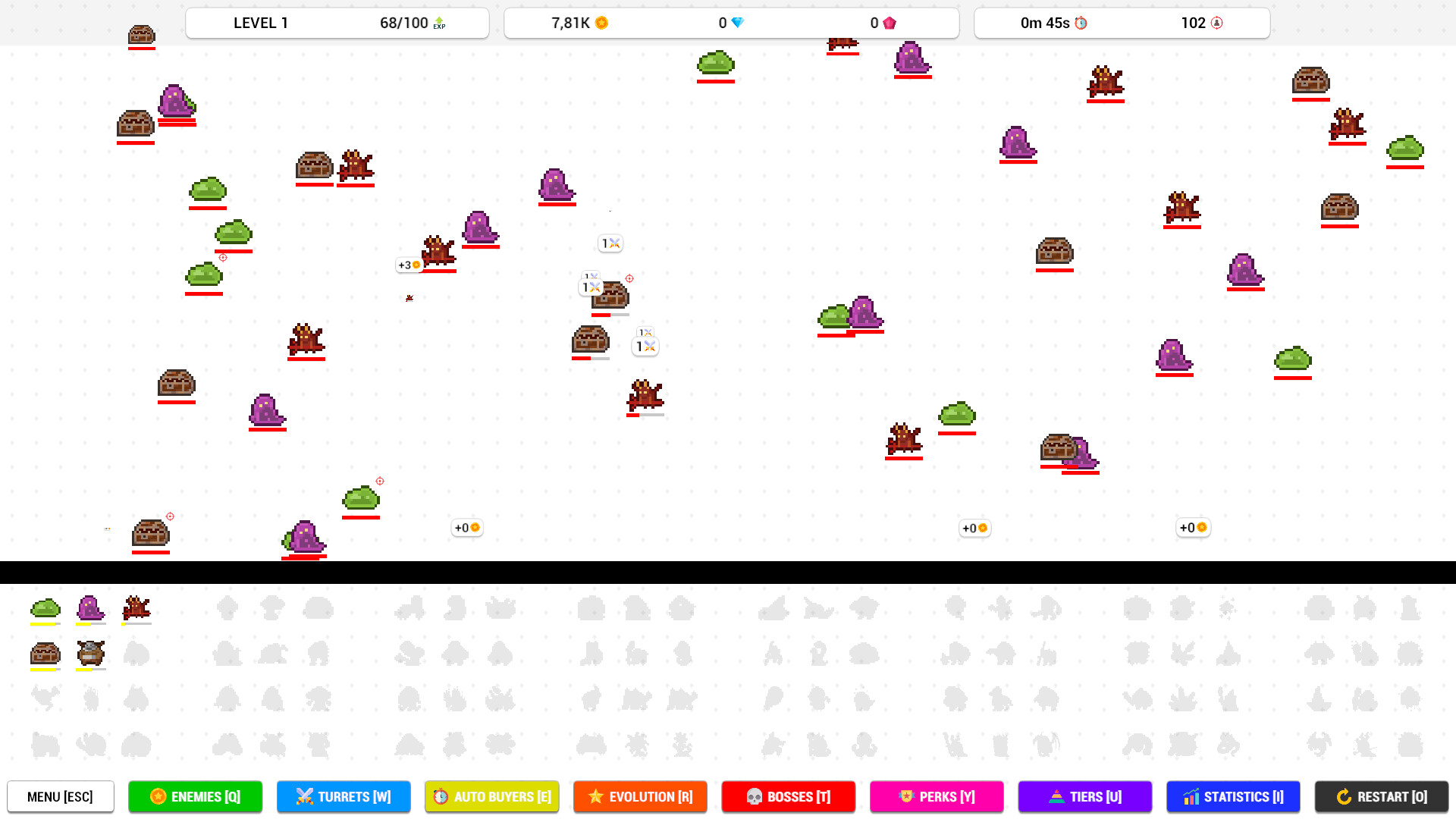
The main battlefield view early on, with dozens of enemies spawning and dying across an open field and small per-kill reward pop-ups tracking the pace of the grind.Steam store page -
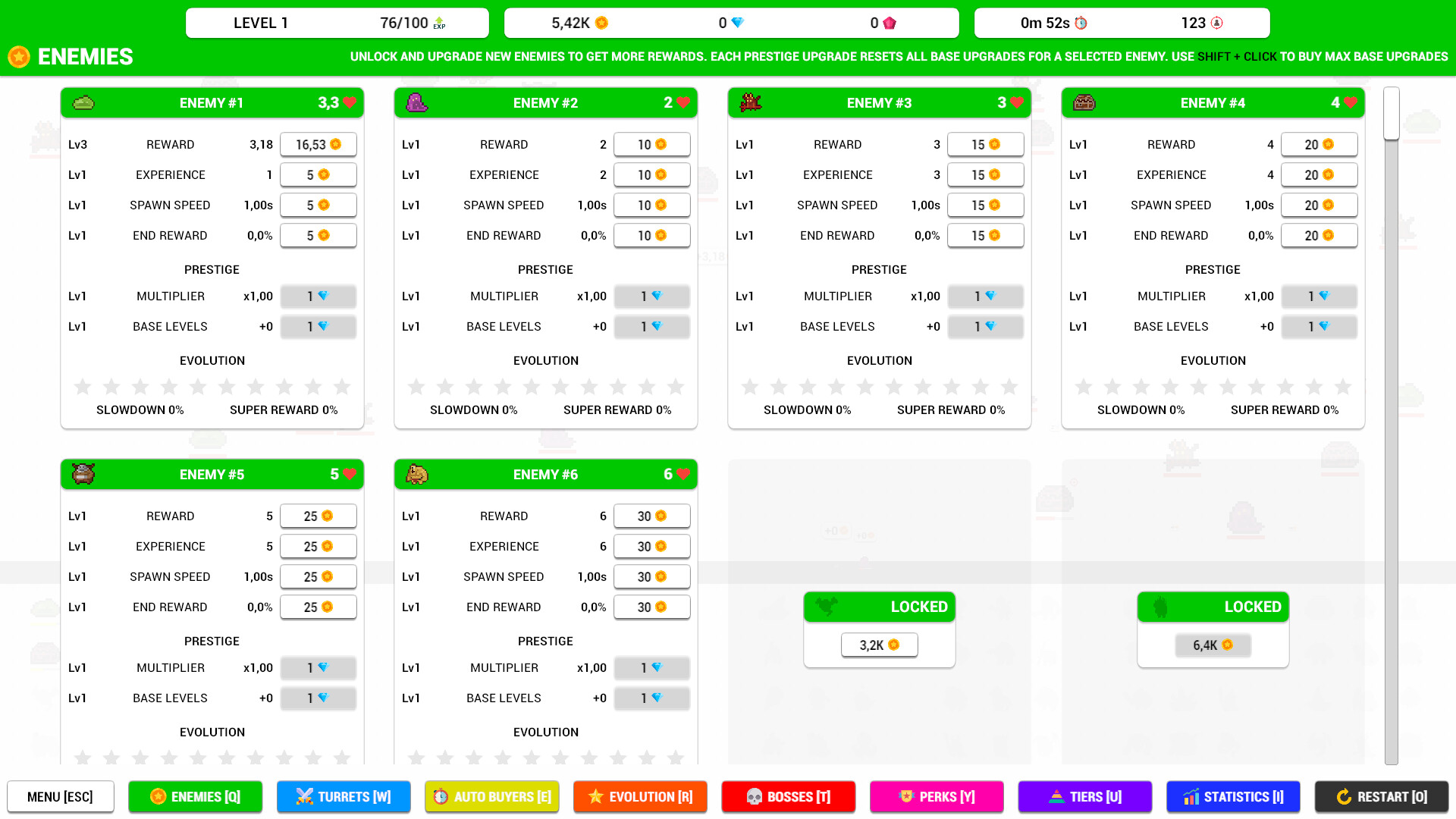
The Enemies tab, confirming the dual-progression pitch literally lets you buy up each enemy type's own reward value, with further enemy slots still locked behind steep gold costs.Steam store page -

The Evolution tab, revealing that turret and enemy evolution is unlocked through defeat and upgrade-purchase objectives rather than currency alone, and grants specifically named combat bonuses like Multishot and One Hit Kill chance.Steam store page