
Game review
Idle Polygon
6.3 / 10
- Developer
- Suupia
- Publisher
- Suupia
- Released
- 20 August 2026
- Platforms
- Windows, Mac
- Genre
- RPG
Zero Reviews for a Minimalist Idle-RPG Hybrid
Idle Polygon entered Steam Early Access on 20 August 2026 from solo developer Suupia, and at the time of writing it has no user reviews at all. That makes it a genuine unknown quantity rather than a game with a settled reputation, which is worth stating plainly before anything else here: everything below is drawn from the store page and the game's own published achievement list, not from a body of player testimony that doesn't yet exist. The pitch itself is a fairly standard one for the genre on paper — a minimalist geometric incremental game with "RPG depth" layered on top — but the achievement list hints at more structural ambition underneath the numbers-go-up surface than the two-paragraph store description lets on.
Geoms, Territory, and Infinite Numbers
The core loop, per the store page, revolves around expanding territory and upgrading a resource called Geoms, with income speeds and production scaling toward "astronomical levels" through prestige mechanics. This is the familiar shape of the incremental genre — watch a number grow, spend it on multipliers, watch the number grow faster — wrapped in a stated "clean, crisp" geometric art style rather than the pixel-art or cartoon aesthetics more common in this space. The store page leans hard on the visual pitch, describing the experience as "zen-like," which for a genre that lives or dies on how satisfying its numbers feel to watch tick over is a reasonable thing to foreground. A screenshot of the main idle screen bears this out in practice: a single large nested triangular Geom sits centred against a dark background with a currency counter and one "upgrades" button, a genuinely clean and uncluttered starting point rather than the number-soup interface that idle games often collapse into once systems start stacking.
Automated RPG Battles Layered on the Numbers
Where Idle Polygon tries to distinguish itself from a pure number-clicker is in the "Strategic RPG Battles" it advertises: automated combat encounters against opponents where, per the store page, "your upgrade strategy determines the victor" rather than any direct input during the fight itself. That's a meaningful design choice worth naming clearly — this isn't a game where the player controls a character in real time, it's one where the incremental upgrade choices made outside of combat are themselves the entire skill expression, and battles function as a periodic scorecard for how well those choices are paying off. It's a structure that lives or dies on whether losing a battle gives the player legible information about what to upgrade next, and a battle screenshot suggests the answer is largely yes: a "Global Stats" panel lists HP, Attack, Defence, Attack Speed, Crit Rate, and Crit Damage in plain figures, sitting directly alongside a live fight between a three-member team and five enemies, with the current Dimension, Layer, and Wave all labelled at the top. That's a more legible stat sheet than the store page's vague "upgrade your Geoms" language implies, and it also confirms combat isn't fought by a single Geom but by an assembled team — closer to a lightweight creature-collector squad than a single number climbing against a single opponent.
Two Prestige Tracks and Multiple Dimensions
The game's own achievement list, 44 entries in total, fills in some genuine structural detail the store description skips over. There are two separate prestige progressions tracked as distinct achievement families — "Prism Prestige" (with at least four tiers, I through IV) and "Spectrum Prestige" (with at least three tiers, I through III) — which suggests the incremental math here isn't a single reset-and-multiply loop but two parallel prestige currencies that likely interact or gate each other. Separately, achievements named "First Dimension Clear," "Dimension 1 Conqueror," and "Dimension 3 Conqueror" point to a staged progression through multiple distinct "dimensions," each apparently cleared and then fully "conquered" as a harder follow-up milestone, implying at least three dimensions exist at launch with room to add more. None of this two-track, multi-dimension structure is mentioned anywhere in the store page's own feature list, so it's worth flagging as evidence of more mechanical depth than the marketing copy suggests, sourced directly from the game's own published achievement data rather than from any outside claim. A Geom Inventory screenshot fills in the collection side of that structure: distinct shapes — a triangle, a square, a pentagon, a hexagon, each levelled independently — occupy a mostly-locked grid of inventory slots, with a "Level Up All" shortcut and a separate "Edit Team" panel for slotting a handful of levelled Geoms into an active squad. That locked-slot design gives the collection layer its own visible sense of long-term unlock progression, distinct from both the prestige tracks and the dimension-clearing ladder.
Free to Play, Early Access, and What's Unverified
Idle Polygon is free to play with no listed price, and its Steam category tags show no "In-App Purchases" flag, which — if it holds through the Early Access period — would put it in the more player-friendly end of the free incremental-game spectrum rather than the monetisation-heavy norm for the genre. It's single-player only, with Steam Achievements and Steam Cloud support but no other listed multiplayer or social features. The game supports nine languages including English, French, German, Spanish, Portuguese, Japanese, and both Chinese variants, and runs on Windows and Mac with modest stated system requirements. As an Early Access release, the scope described here — the Geom-and-territory loop, the automated battle layer, the dual prestige tracks, the multi-dimension structure implied by the achievements — should be read as a snapshot of a game still being built out rather than a finished product, and whether the monetisation stays IAP-free as it develops, whether the battle system's feedback loop is legible in practice, and how the two prestige tracks actually interact are all things a zero-review launch simply can't confirm yet.
Verdict
Idle Polygon pitches a fairly conventional minimalist incremental loop on its store page, but both its own achievement list and its actual screens reveal more underlying structure than the marketing copy admits to — two parallel prestige tracks, a staged multi-dimension battle ladder with a legible stat sheet, and a team-based Geom collection system with its own locked-slot unlock curve, together suggesting a more considered design than "watch geometric shapes grow." Free to play with no flagged in-app purchases and modest system requirements make it an easy, low-risk Early Access pickup for idle-RPG fans willing to accept that nothing here has been tested by a single outside player yet. Whether the automated battle system gives clear enough feedback to feel like a real strategic layer rather than a passive number check, and whether the free-to-play model holds its shape as the game leaves Early Access, remain the two biggest open questions.
Screenshots
-
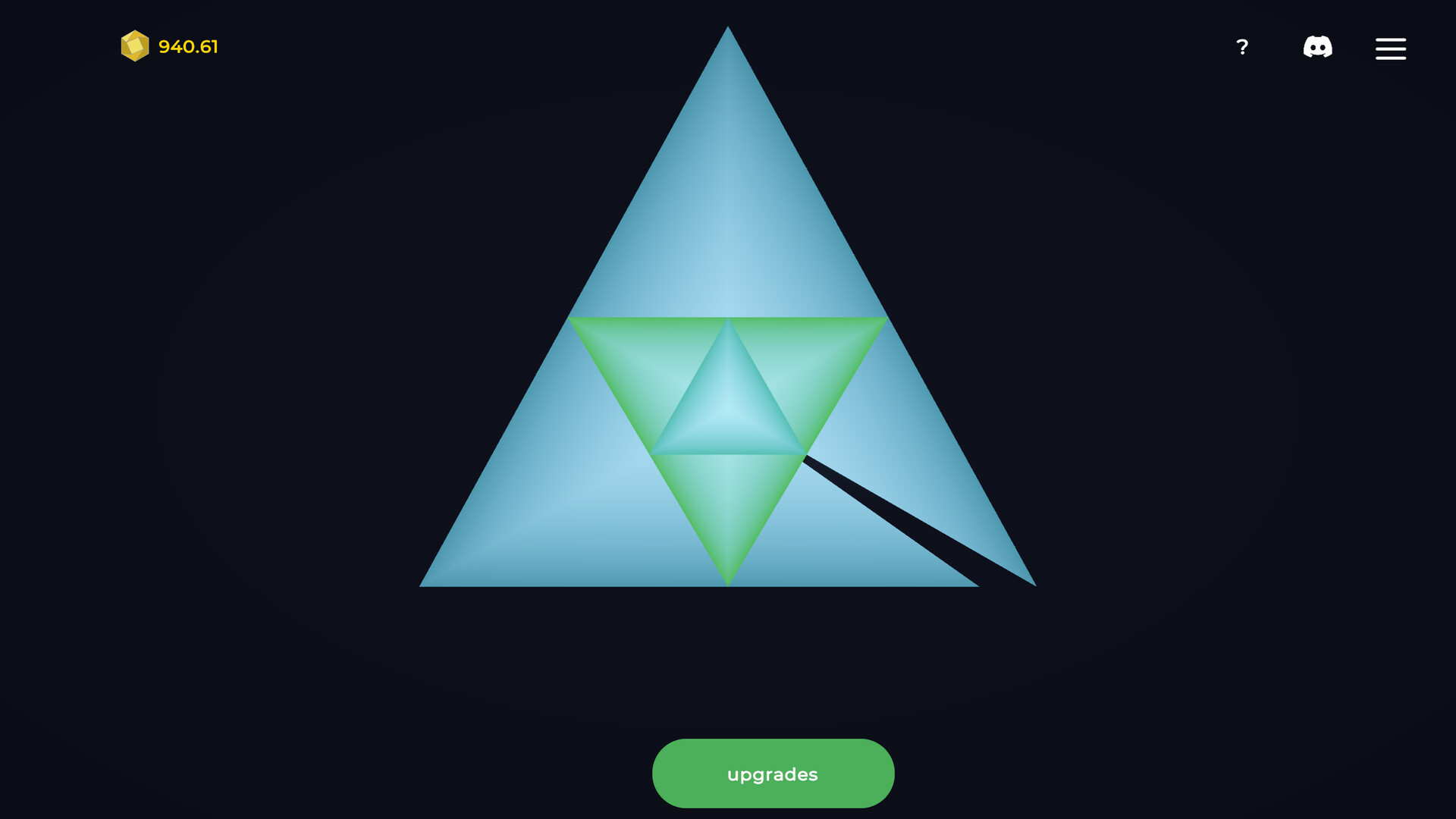
The core idle screen: a growing nested-triangle Geom, a currency counter, and a single upgrades button.Steam store page -
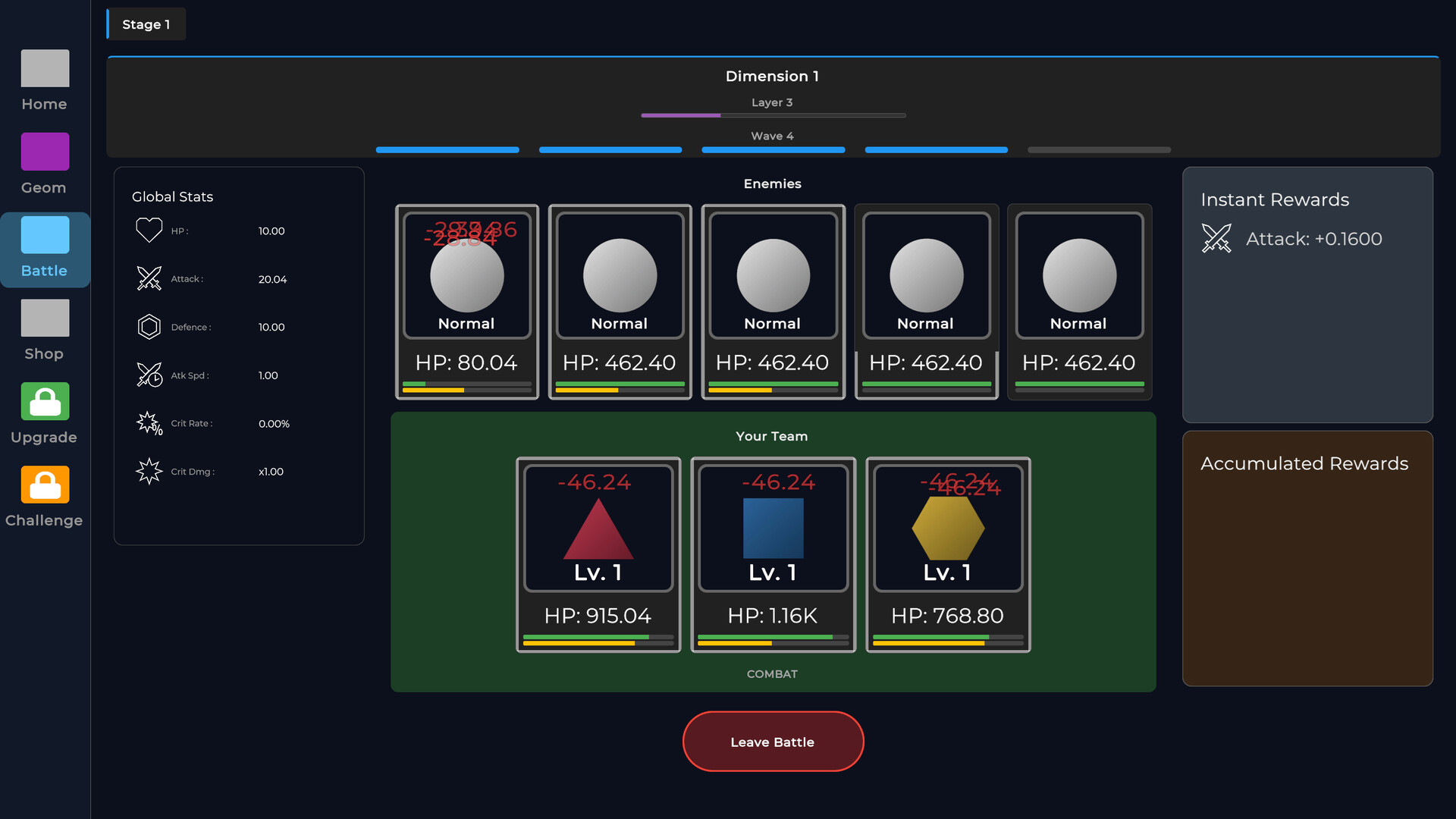
A battle in Dimension 1, Layer 3, Wave 4, with a three-Geom team fighting five enemies under a detailed Global Stats panel.Steam store page -
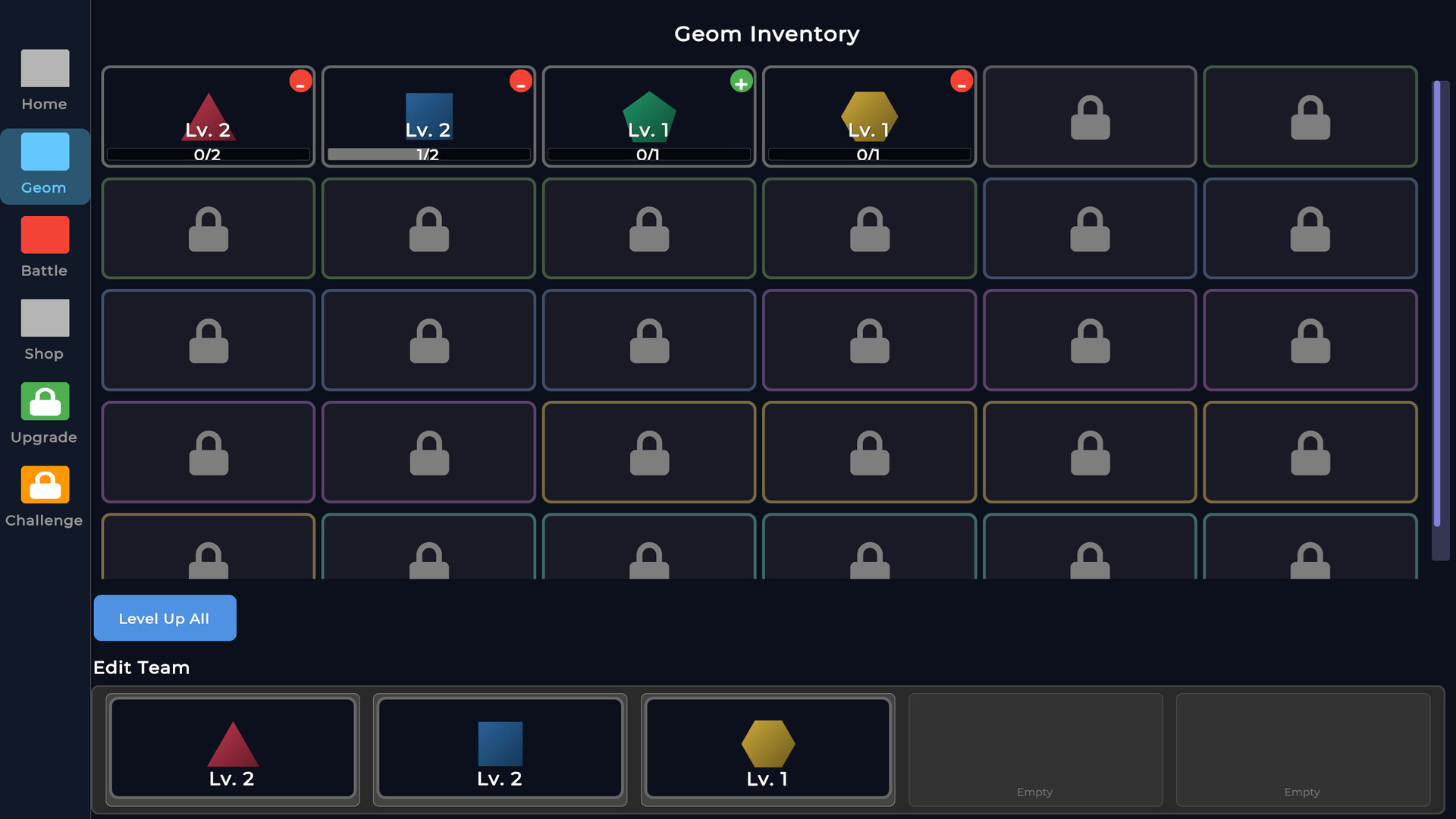
The Geom Inventory screen, where collected shapes are leveled individually and assembled into a team via mostly-locked inventory slots.Steam store page