
Game review
Idle Civilization
4 / 10
- Developer
- Very Simple Idea Studios
- Publisher
- Very Simple Idea Studios
- Released
- 24 November 2015
- Platforms
- Windows, macOS, Linux
- Genre
- Idle Strategy
- Monetisation
- One-time purchase, no DLC or in-game currency
- Players
- Single-player
The short version
Idle Civilization asks you to run five separate resource chains — wood, stone, food, culture and a mercenary economy on top — where most idle games of its 2015 generation asked for one or two, and that extra structural ambition is the reason its Mixed 130-review Steam page still has defenders a decade later. It just never finished being built: Early Access since November 2015, its last substantive patch shipped in July 2016, and reviewers dated from 2017 clear through August 2026 independently use the same word — abandoned — to describe bugs (most seriously, broken offline production, the one thing an idle game cannot afford to get wrong) that were never fixed.
Biggest strengths
- Five distinct resource chains (wood, stone, food, culture, mercenary upkeep) give the early game more shape than the single-currency clickers it launched alongside
- The Covinari mercenary system layers ten recruitable classes with distinct traits onto the base building loop, adding a light RPG squad-building layer most idle games of its era didn't attempt
- Early reviewers who compare it to Travian, Tribalwars and Adventure Communist consistently credit it with translating a persistent-world city-builder's structure into a genuine idle format
Biggest weaknesses
- Offline production — the single mechanic an idle game exists to deliver — is reported broken by multiple reviewers across multiple years, with resources and villagers vanishing after a reload
- The developer's own May 2016 "apology" post promised the finish line was close after a "two months became six" Early Access slip; the last real patch followed two months after that, and nothing has shipped since
- Negative reviews calling the game abandoned are dated 2017, 2018, 2021, 2023 and August 2026 — this isn't a launch-week complaint that aged out, it's the same finding independently repeated for a decade
Who it's for: Genre historians curious what a more ambitious 2015 idle-strategy hybrid looked like before the Cookie Clicker formula calcified, and players who only want a few dollars of casual background clicking and don't mind an unfinished game, will get something out of this. Anyone expecting an active, supported idle RPG — or anyone who cares whether the "idle" part of an idle game actually works while they're away — should look elsewhere.
Our recommendation: Hard to recommend at any price while the core offline-production loop is reported broken and the developer has been silent for the better part of a decade. Worth a look only for players specifically interested in the genre's history, bought with full knowledge of what they're getting.
4 / 10
The idea that almost got finished
Idle Civilization launched into Steam Early Access on 24 November 2015, arriving from the same browser-game world as Kongregate, at a moment when the idle genre was still mostly defined by a single rising number and one prestige reset. Its pitch was structurally more ambitious than that: instead of one resource and one currency, a colony here runs wood, stone and food simultaneously, layers a culture-and-enthusiasm system for bonus effects on top, and eventually opens a mercenary economy — the Covinari, ten recruitable classes with their own traits — that turns idle number-watching into something closer to a light squad-management game. Early reviewers noticed the difference immediately, comparing it favourably to Travian and Tribalwars for translating a persistent-world city-builder's texture into an idle format, rather than to the Cookie Clicker lineage it was nominally competing with.
That's the review this game earned in its first year. It is not the review it has earned since.
What actually shipped
The core loop is straightforward on paper: two starting villagers gather, buildings unlock as population grows, research and religion trees open new production multipliers, and a war layer lets you send Covinari mercenaries out to expand territory and collect relics through periodic "Pilgrimages." Reviewers who played it in 2015 and 2016 describe real depth underneath the clicking — enough that more than one draws a direct line to tabletop-adjacent city-builders rather than to arcade clickers, and the achievement data backs that framing up to a point: the earliest unlocks sit at 96%, which is normal for any game's tutorial-adjacent goals, but completion falls to 64% by the third achievement and to under a third by the fourth. That's a real difficulty curve, not just a long game — early-game hooks work, and the mid-game asks more of the player than the genre typically does.
Where the design falls over is in the one job an idle game cannot skip: keeping track of what happened while you weren't looking. Multiple reviewers, across multiple years, report that offline production — the entire premise of leaving a colony running and coming back to progress — either credits the wrong amount or, in the more serious complaints, loses villagers and production outright after a save reload. A game built around five resource chains and a mercenary payroll has more moving parts to get wrong here than a single-currency clicker does, and by every account in the review corpus, it did.
A decade of the same complaint
Very Simple Idea Studios' own May 2016 community post — titled, tellingly, "The Update and the Apology" — is worth reading for what it says about what came next. The developer acknowledges an Early Access estimate of "two months" had already stretched to six, apologises for a long silence, and promises the game is close to finished, alongside a genuinely substantial patch adding the Covinari system, Archons, Pilgrimages and dozens of new items. Two months after that post, in July 2016, one more update landed. Then nothing. No further patch, no further community post, ever, as far as the game's own Steam news feed and its review corpus can establish.
What makes this worth stating plainly rather than treating as ancient history is how the negative reviews are dated: 2017, 2018, 2021, 2023, and — as recently as August 2026 — players are still arriving, still hitting the same broken offline production and the same silence, and still independently reaching for the word "abandoned" to describe it. That's not a fossilised launch complaint the way an old MMO's Steam reviews sometimes are; it's the same finding, rediscovered by new players, for ten straight years, on a store page that to this day still carries the Early Access tag as though development were ongoing.
What NZ$5.99 actually buys
The monetisation model is the one part of this game that has aged well: a single upfront price, no premium currency, no energy timers, no cosmetic store, no battle pass. Whatever else is wrong with Idle Civilization, nobody is being pressured to spend past the initial NZ$5.99, and the Steam Trading Cards and Cloud saves that ship alongside it are the ordinary furniture of a mid-2010s premium indie release rather than a monetisation layer in disguise. Set against 2026's idle-RPG landscape, where energy systems and paywalled prestige resets are common enough that Wanderer's own coverage flags them constantly, that restraint is worth crediting on its own terms — it just isn't enough to carry a game whose central mechanic doesn't reliably work.
It's also worth being specific about what "idle" means here, because the genre has drifted since 2015. Idle Civilization isn't a game you leave running in a browser tab for a Cookie Clicker-style number to climb; it's closer to a persistent-world colony sim that happens to keep simulating while the window is closed, which is precisely why broken offline production is such a structural wound rather than a minor bug. A modern idle RPG that mishandles an offline-progression edge case loses you a few hours of banked resources. This one, per its own reviewers, has lost entire colonies of villagers on reload — the equivalent of a save-corruption bug in a genre built around never actively watching the save file.
Value and verdict
At NZ$5.99, price was never where this game lost its audience — even its most negative reviews rarely call it a ripoff on cost alone, and its 59-of-130 positive split on Steam (Mixed) reads less like outright rejection and more like a genuinely divided verdict between players who found a few good hours in the early game and players who hit the broken parts. The problem is structural rather than financial: a five-resource idle strategy game with real ideas in it, whose single most important system — the one the entire genre is named for — has been reported broken since at least 2017, by a developer who stopped responding at almost exactly the point those reports started arriving.
Judged as the ambitious 2015 idle hybrid it clearly wanted to be, there's a genuinely interesting design buried in here, and the reviewers who found it in year one weren't wrong. Judged as a product you can buy today, in 2026, it is a decade-abandoned Early Access game with a core mechanic that doesn't reliably work, and no reasonable expectation that will change.
Pros and cons
Pros
- Five distinct resource chains (wood, stone, food, culture, mercenary upkeep) give the early game more shape than the single-currency clickers it launched alongside
- The Covinari mercenary system layers ten recruitable classes with distinct traits onto the base building loop, adding a light RPG squad-building layer most idle games of its era didn't attempt
- Early reviewers who compare it to Travian, Tribalwars and Adventure Communist consistently credit it with translating a persistent-world city-builder's structure into a genuine idle format
- At NZ$5.99 the asking price was never the complaint even from its harshest critics
Cons
- Offline production — the single mechanic an idle game exists to deliver — is reported broken by multiple reviewers across multiple years, with resources and villagers vanishing after a reload
- The developer's own May 2016 "apology" post promised the finish line was close after a "two months became six" Early Access slip; the last real patch followed two months after that, and nothing has shipped since
- Negative reviews calling the game abandoned are dated 2017, 2018, 2021, 2023 and August 2026 — this isn't a launch-week complaint that aged out, it's the same finding independently repeated for a decade
- The Linux build is called unplayable by at least one reviewer, and a persistent resolution bug traps some players in a tiny window with misaligned click targets
- Achievement completion falls from 96% on the earliest unlocks to under 1% on six of the seventeen available, a steeper and more total drop-off than a merely long game explains
Screenshots
-

Idle CivilizationImage: Very Simple Idea Studios via Steam -

Idle CivilizationImage: Very Simple Idea Studios via Steam -

Idle CivilizationImage: Very Simple Idea Studios via Steam -
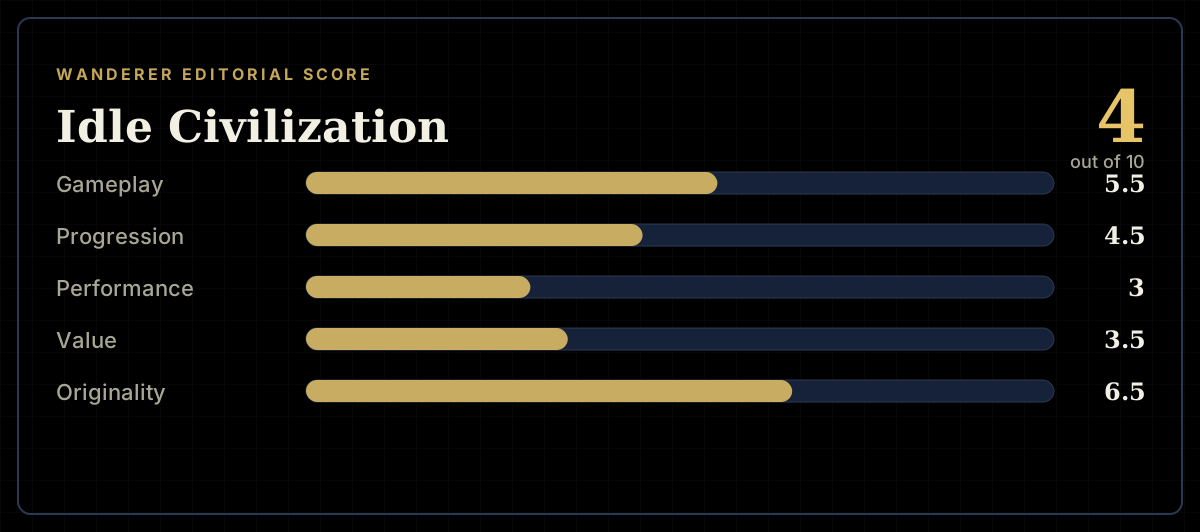
How the review scores each part of the gameWanderer Editorial -
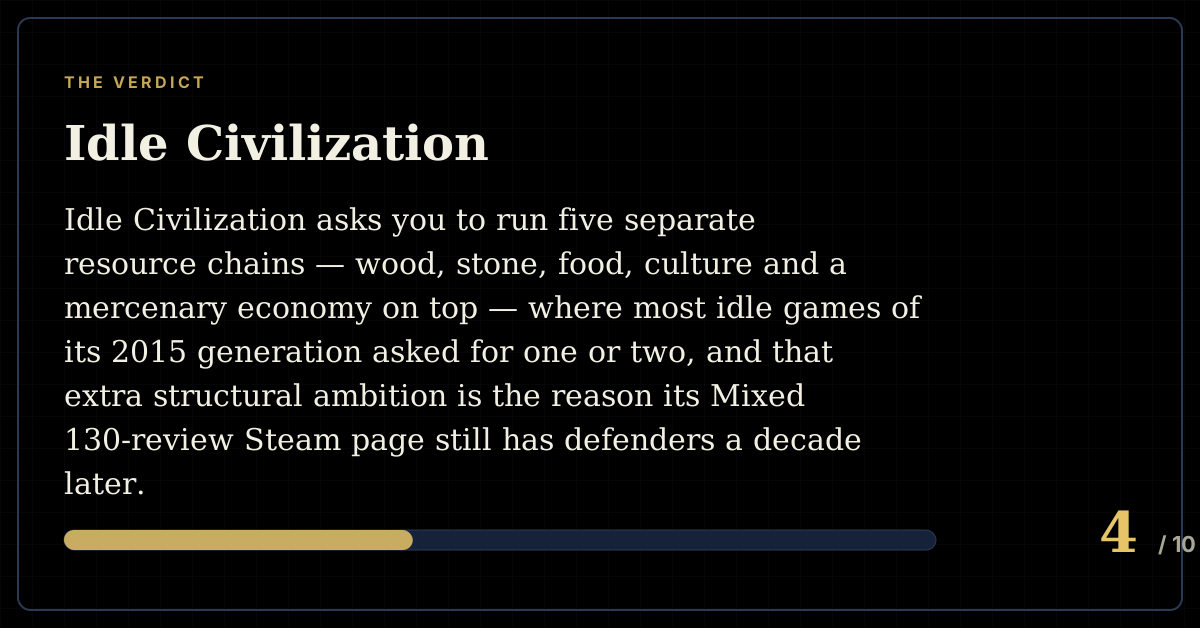
The short versionWanderer Editorial