
Game review
Multiverse Loot Hunter
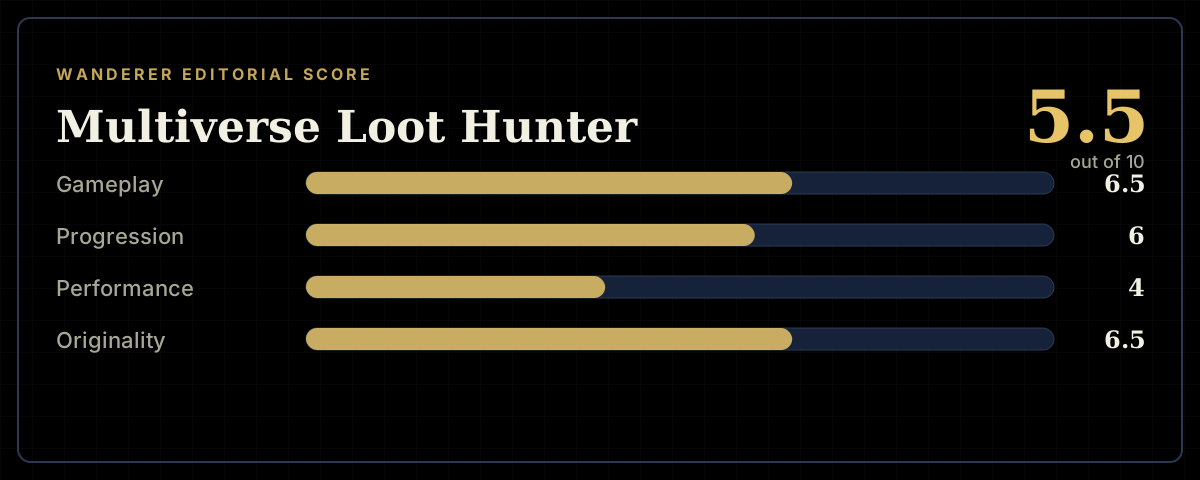
5.5 / 10
- Developer
- 游戏养家工作室
- Publisher
- 游戏养家工作室
- Released
- 15 August 2025
- Platforms
- Windows
- Genre
- Idle RPG, Loot, Collector
- Monetisation
- One-time purchase, no reported in-game currency
- Players
- Single-player
The short version
Multiverse Loot Hunter sends a fairy-empowered protagonist looting across parallel timelines — cultivation fantasy, historical wuxia, magic and a science-fiction future — recruiting characters, farming gear, and layering class, talent, prestige and technology systems on top of each other into what several long-term reviewers call the deepest idle game they've played, with some logging well over a thousand hours. That depth is real and specifically documented. So, unfortunately, is a more troubling pattern: two entirely independent reviewers — one writing a negative review, one a positive one, with no apparent connection between them — separately report the game consuming far more CPU and network resources than its simple 2D presentation should require, and each independently speculates the game may be running an unauthorised background process, invoking cryptocurrency mining as a possible explanation. One of the two reports a specific, detailed technical symptom: their internet connection was rerouted to Taiwanese servers while the game ran, a problem that only resolved after a full PC restart. Neither account is proof, and this review found no further corroboration in the wider sample or independent way to verify the claim — but both are specific and serious enough to report in full rather than omit.
Biggest strengths
- The core progression is described by multiple long-term players as exceptionally deep, layering character classes, subclasses, talent trees, prestige systems and gear farming into a scope one reviewer with over 1,700 hours logged calls the best idle game they've played
- The multiverse-hopping premise — cultivation, history, wuxia, magic and future settings all in one game — draws specific praise for variety, with reviewers enjoying the tonal shift between planes rather than finding it disjointed
- A large and varied character roster mixing historical and fantasy figures gives the collection layer real breadth, and the job/skill customisation system lets each recruited character be built differently
Biggest weaknesses
- Two independent reviewers, one negative and one positive, separately report the game consuming disproportionate CPU, RAM or network resources relative to its simple 2D presentation, and both independently speculate — without confirming — that this may involve unauthorised background activity such as cryptocurrency mining; this review could not verify either claim directly and found no further corroboration in the wider review sample, but is reporting both accounts in full given their specificity and independence from one another
- The more detailed of those two accounts describes a specific technical symptom: while the game was running, an unrelated online game's connection was rerouted to Taiwanese servers and could not be switched back until the reviewer restarted their entire PC — a concrete, described-in-detail incident rather than vague suspicion
- Machine-translated English localisation is an overwhelming and near-universal complaint across the review corpus, with multiple reviewers describing key UI elements as left completely untranslated, making basic navigation a matter of guesswork
Who it's for: Idle-RPG players specifically drawn to deep, multi-layered progression systems and character collection, who are willing to tolerate a rough machine-translated English localisation. Given the unverified but specific performance and network concerns below, cautious buyers may want to monitor their system's resource and network activity closely after installing, or wait for the situation to be independently clarified.
Our recommendation: The progression systems genuinely earn their enthusiastic fanbase, but the unverified background-process concerns raised independently by two separate reviewers are serious enough that this review can't recommend buying without flagging them clearly first — read the full account below, and make your own judgment about the risk before installing.
5.5 / 10
Looting across the multiverse
Multiverse Loot Hunter's premise is expansive by idle-genre standards: your character gains the power to travel freely between cultivation-fantasy, historical wuxia, magical and futuristic planes, looting treasure, recruiting recruits from each timeline, and bringing the spoils back to fund further expeditions. On top of that core loop sits genuinely extensive systems — character classes and subclasses, talent trees, a prestige structure, technology research, companion pets, and gear farming with real stat variance — that reviewers with serious time invested describe as some of the deepest they've encountered in the genre. One reviewer with over 1,700 hours logged calls it, without qualification, the best idle game they've played; several others in the 30-to-120-hour range independently describe feeling like they're "barely scratching the surface" of the available progression layers. That kind of sustained, specific enthusiasm from long-term players is hard to manufacture and is worth taking seriously as a genuine strength.
Two separate, unverified, serious concerns
Set against that is something this review needs to report carefully and in full rather than gloss over. A detailed, 103-vote negative review titled "NETWORK MANIPULATION WARNING" describes the game consuming an alarming amount of CPU and RAM — more than its simple presentation should reasonably need — and then describes a specific technical incident: while the game was running, the reviewer's attempt to log into an unrelated online game was rerouted to Taiwanese servers and could not be switched back, even after closing and uninstalling Multiverse Loot Hunter, until they restarted their entire PC. The reviewer explicitly says they can't confirm what caused this, but references having seen another review raise the possibility of cryptocurrency mining running in the background.
This review could not locate that referenced second account directly in either the English or wider multi-language negative review samples checked. It did, however, find a separate, independent positive review — different author, unconnected to the first — that raises the same underlying suspicion from a different angle: "This game has a lot of slowdown for something that should use little to no processing power for these graphics. This makes me about 80% sure this game is mining bitcoin in the background." That reviewer still recommends the game overall, framing it as "a good time waster" despite the concern, but the fact that two reviewers arrived independently at the same crypto-mining suspicion, from different angles (one via a specific network-routing incident, one via general performance disproportion) is a stronger signal than either account alone would be.
To be precise about what this review can and can't establish: neither account constitutes confirmed proof of malicious software, this review has not independently run or inspected the game, and no further corroborating reports turned up in a broader search of the negative review sample. But two independent, detailed, specific accounts converging on the same unusual suspicion is not nothing, and readers deserve to know about it before installing rather than discovering it themselves afterward. Anyone who owns or is considering this game should feel free to monitor their own system's resource and network activity and draw their own conclusions.
A rough localisation on top of everything else
Independent of the performance question, the English localisation draws overwhelming, near-universal complaint. Multiple reviewers describe the translation as machine-generated and difficult to parse, with some UI elements left entirely untranslated, forcing players to guess at basic menu functions. One reviewer notes a related access problem: English-language bug reports and feedback appear to get little traction with the developer, summarising bluntly that "unless you speak Chinese, no dev will ever hear you." A separate, more mechanical complaint concerns an early rent/property system with a reported payoff period of roughly 88 hours of real playtime before recouping its own construction cost — a specific, calculated figure from one detailed reviewer rather than a vague pacing complaint.
What the achievement data suggests
Steam's own global achievement percentages offer a small additional data point, though they don't speak directly to the performance question. The top-tier progress achievements — measuring things like the number of planes cleared and characters recruited at their highest ranks — sit at roughly 32-34% of the playerbase, a healthy completion rate for a genre where the deepest content is usually reserved for a smaller, more dedicated minority. That's broadly consistent with the picture painted by the corpus's most enthusiastic reviewers: a meaningful share of buyers are engaging deeply and repeatedly with the multi-layered progression systems rather than bouncing off early, even with the translation and performance concerns sitting alongside that engagement.
The verdict
Multiverse Loot Hunter's progression systems have won real, substantial devotion from players willing to invest serious time, and that's a genuine credit to its design. But this review cannot in good conscience recommend a purchase without giving equal weight to two independent, detailed and unverified reports of unusual resource consumption and network behaviour that a simple idle game has no obvious reason to exhibit. Combined with a near-universally criticised translation and a developer reportedly hard to reach in English, the honest recommendation is caution: read the specific accounts above, decide for yourself how much weight to give them, and — if you already own the game — consider checking your own system's activity rather than assuming the concern doesn't apply to you. A game this deep deserves a fair hearing on its mechanics alone, but not at the cost of leaving a genuine safety question unmentioned.
Pros and cons
Pros
- The core progression is described by multiple long-term players as exceptionally deep, layering character classes, subclasses, talent trees, prestige systems and gear farming into a scope one reviewer with over 1,700 hours logged calls the best idle game they've played
- The multiverse-hopping premise — cultivation, history, wuxia, magic and future settings all in one game — draws specific praise for variety, with reviewers enjoying the tonal shift between planes rather than finding it disjointed
- A large and varied character roster mixing historical and fantasy figures gives the collection layer real breadth, and the job/skill customisation system lets each recruited character be built differently
- Multiple reviewers with playtimes well past 100 hours, including one past 1,700 hours, describe sustained long-term engagement rather than early burnout, suggesting the depth holds up over serious time investment for players who click with it
- One-time purchase with no reported in-game currency or microtransactions, which several reviewers explicitly credit given how heavily monetised games with this much gacha-adjacent character-collecting typically are
Cons
- Two independent reviewers, one negative and one positive, separately report the game consuming disproportionate CPU, RAM or network resources relative to its simple 2D presentation, and both independently speculate — without confirming — that this may involve unauthorised background activity such as cryptocurrency mining; this review could not verify either claim directly and found no further corroboration in the wider review sample, but is reporting both accounts in full given their specificity and independence from one another
- The more detailed of those two accounts describes a specific technical symptom: while the game was running, an unrelated online game's connection was rerouted to Taiwanese servers and could not be switched back until the reviewer restarted their entire PC — a concrete, described-in-detail incident rather than vague suspicion
- Machine-translated English localisation is an overwhelming and near-universal complaint across the review corpus, with multiple reviewers describing key UI elements as left completely untranslated, making basic navigation a matter of guesswork
- Reviewers describe a rent/property system with an extremely poor time-to-payoff ratio at launch, with one calculating roughly 88 hours of real playtime needed just to recoup a building's construction cost before any multipliers are applied
- Reviewers report limited responsiveness from the developer to English-language bug reports and feedback, with one bluntly noting that "unless you speak Chinese, no dev will ever hear you," a real support-access gap for the game's English-speaking audience
Screenshots
-

Multiverse Loot HunterImage: 游戏养家工作室 via Steam -

Multiverse Loot HunterImage: 游戏养家工作室 via Steam -

Multiverse Loot HunterImage: 游戏养家工作室 via Steam -
How the review scores each part of the gameWanderer Editorial -
The short versionWanderer Editorial