
Game review
Cultivation Road
5.5 / 10
- Developer
- Fengling Studio
- Publisher
- Fengling Studio
- Released
- 19 August 2026
- Platforms
- Windows, Linux
- Genre
- RPG
Two Reviews, Both Negative, Both Pointing at the Same Flaw
Cultivation Road launched on Steam on 19 August 2026 from developer Fengling Studio, and at the time of writing it has exactly two user reviews, both negative. That's worth taking seriously rather than dismissing for its small sample size, because both reviewers, writing independently and in different languages, land on the same specific complaint: the game's rebirth (prestige) system provides no meaningful bonus. The English-language review, at over three hours logged, states bluntly that they've "never seen a rebirth system do literally nothing," while the Simplified Chinese review, from a player with more than 100 hours logged, describes discovering there was no way to return to earlier, already-cleared stages to farm resources faster after progress stalled, and separately confirms the cycle bonus sat at zero — closing with the line, in translation, that this made the time spent feel wasted. For a genre built almost entirely around the promise that a prestige reset makes the next cycle meaningfully faster, two independent reports of a non-functional rebirth bonus is a serious, structural complaint rather than a matter of taste. A screenshot of the game's own rebirth ("Lunhui") confirmation dialog backs both reviewers up in plain text: for a cost of 10 trillion Spirit Stones, the reset wipes distance progress, Spirit Stones, the protagonist's level and realm, all allies, and the Sect and Spells, keeping only relics, the bestiary, lifetime distance, and unlocked scenes — and the sole explicit reward listed for that full reset is a 3% increase to extra relic chance. Seeing the mechanic's own terms laid out this plainly makes the "did literally nothing" complaint easy to understand rather than an exaggeration: a 3% relic-chance bump is a genuinely thin trade for resetting a character's entire level, realm, ally roster, and Sect progress.
An Automatic Journey Along the Immortal Path
The core loop, per the store page, is a 2D side-scrolling idle cultivation game — a sequel of sorts, styled as "2.0," to the developer's earlier "Cultivation Tower." The player's party travels continuously along a road, encountering enemies and bosses stationed at fixed distances; once a fight starts, the protagonist, allies, and enemies all act on independent attack timers, and clearing the encounter lets the journey resume automatically. The player's active decisions are about resource allocation rather than direct combat input: where to spend Spirit Stones, which Spells to prioritize, whether to grind a already-cleared distance for resources or push toward the frontier, and when to hold the battlefield to speed up allied attack and revival timers. That's a reasonably clean articulation of the "guide the journey, not every strike" idle design philosophy the store page explicitly names, and on paper it's a coherent structure for the genre.
Twelve Allies and a Thirteen-Stage Ascension
Where the game tries to add texture to a fairly standard idle-cultivation shell is its party system: the protagonist can fight alongside all twelve unlockable allies simultaneously, each with independently tracked attack, health, movement, and revival timing, so a fight keeps moving even while one character is down and recovering. The protagonist separately advances through thirteen named realm stages, each bringing a new appearance and further stat growth — a reasonably granular power curve on top of the party-wide progression. The game's 87-entry achievement list reinforces a long, floor-climbing structure specifically, with named milestones like "Fifty Floors High," "Five Hundred Floors," "Thousand-Floor Ascension," and "Beyond Two Thousand" marking distinct depth tiers well past what the store page's own text spells out, alongside separate "First Rebirth" and "Five Cycles" achievements confirming the rebirth loop is meant to be repeated multiple times over a full playthrough — which makes the two existing reviews' complaint about that exact system not working as advertised even more pointed. A battle screenshot in the "Crimson Sealed Ruins" area shows this twelve-ally structure in practice: individual stat cards for named allies like Han Feiyu, Yun Zhi, Qiao Qian, and Xuan Er list separate attack, HP, and speed values and independent upgrade costs, alongside a Sect income readout of "+145.68K/s" and x1/x10/x100 speed-multiplier toggles plus a "Loop Off" switch for automating repeated runs — a reasonably deep and legible set of controls for an idle game at this price.
Building a Sect, One Spirit Stone at a Time
Alongside combat, the player also grows a Sect from "a dilapidated and small sect into a magnificent and powerful prestigious" one, with fifty distinct sect levels and five unlockable leadership roles — Supreme Elder, Grand Elder, Second Elder, Sect Master, and Vice Master — that the protagonist or an ally can be assigned to in order to keep Spirit Stones flowing. It's a secondary management layer bolted onto the primary idle-combat loop, giving the resource-allocation decisions the store page emphasizes a second outlet beyond direct combat upgrades. Six Spells and thirty-one relics round out the customisation options, with relics explicitly described as persisting permanently across rebirth cycles — which is precisely the mechanic the Simplified Chinese reviewer flagged as delivering a bonus of zero in practice, a discrepancy between what the store page promises and what at least one long-session player actually experienced. A relic detail popup for the "Great Void Dao-Seeking Sword," described simply as something that "greatly raises player attack," confirms the relics are individually named with plain-language effect text rather than being an undifferentiated stat-bonus list, which is a genuinely nice presentation touch even if the broader rebirth loop those relics are meant to support is the system under fire in both existing reviews.
Price, Scope, and Localisation
At NZ$9.59, Cultivation Road is priced modestly for the genre, and it supports full controller play alongside a mouse-only option, along with accessibility-relevant tags for playing at your own pace, without timed input, and without vision — a broader accessibility footprint than many of its idle-genre peers bother to list. Localisation is a genuine strength on paper: interface, subtitles, and full character voice acting are all provided in English, Japanese, Simplified Chinese, and Traditional Chinese, a wider language spread than most single-developer idle games manage. Twenty layered visual environments and an extended late-game boss route past "8,100 li" suggest real effort was put into visual variety across what could otherwise be a repetitive side-scrolling loop. None of that changes the fact that the specific mechanic most idle-cultivation fans return to a game for — a rebirth that meaningfully accelerates the next cycle — is the exact system both existing reviewers report as non-functional.
Verdict
Cultivation Road has the shape of a reasonably ambitious idle-cultivation game: a twelve-ally automatic-combat system with legible per-character stat cards, a thirteen-stage realm-ascension curve, named relics with plain-language effects, a fifty-level Sect-management layer, and unusually thorough four-language localisation for a game at this price. But its two existing reviews, written independently in different languages, both converge on the same specific and serious complaint — that the rebirth/cycle system, the mechanic the genre depends on to keep repeat playthroughs feeling worthwhile, delivers no discernible bonus in practice — and the game's own rebirth confirmation screen backs that complaint up directly, offering only a 3% extra relic chance in exchange for wiping a character's level, realm, allies, and Sect progress entirely. Until that trade is rebalanced, or until a larger review base either confirms or complicates the picture, it's hard to recommend Cultivation Road over its many idle-cultivation competitors, however polished its presentation otherwise is.
Screenshots
-
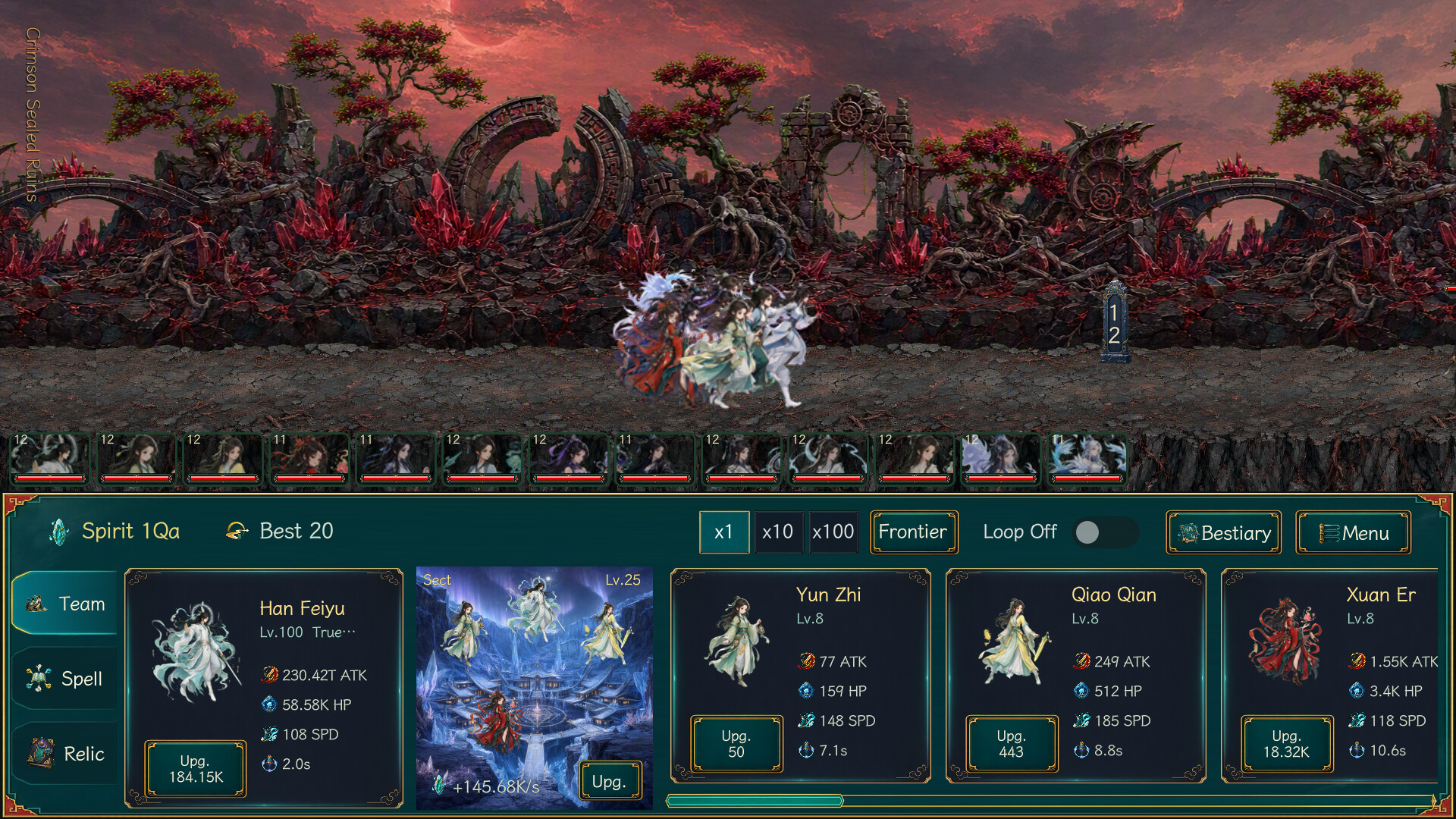
A twelve-ally battle in the Crimson Sealed Ruins, with per-ally stat cards, Sect income, and speed-multiplier toggles.Steam store page -

A named relic, the Great Void Dao-Seeking Sword, with a plain-language description of its bonus.Steam store page -
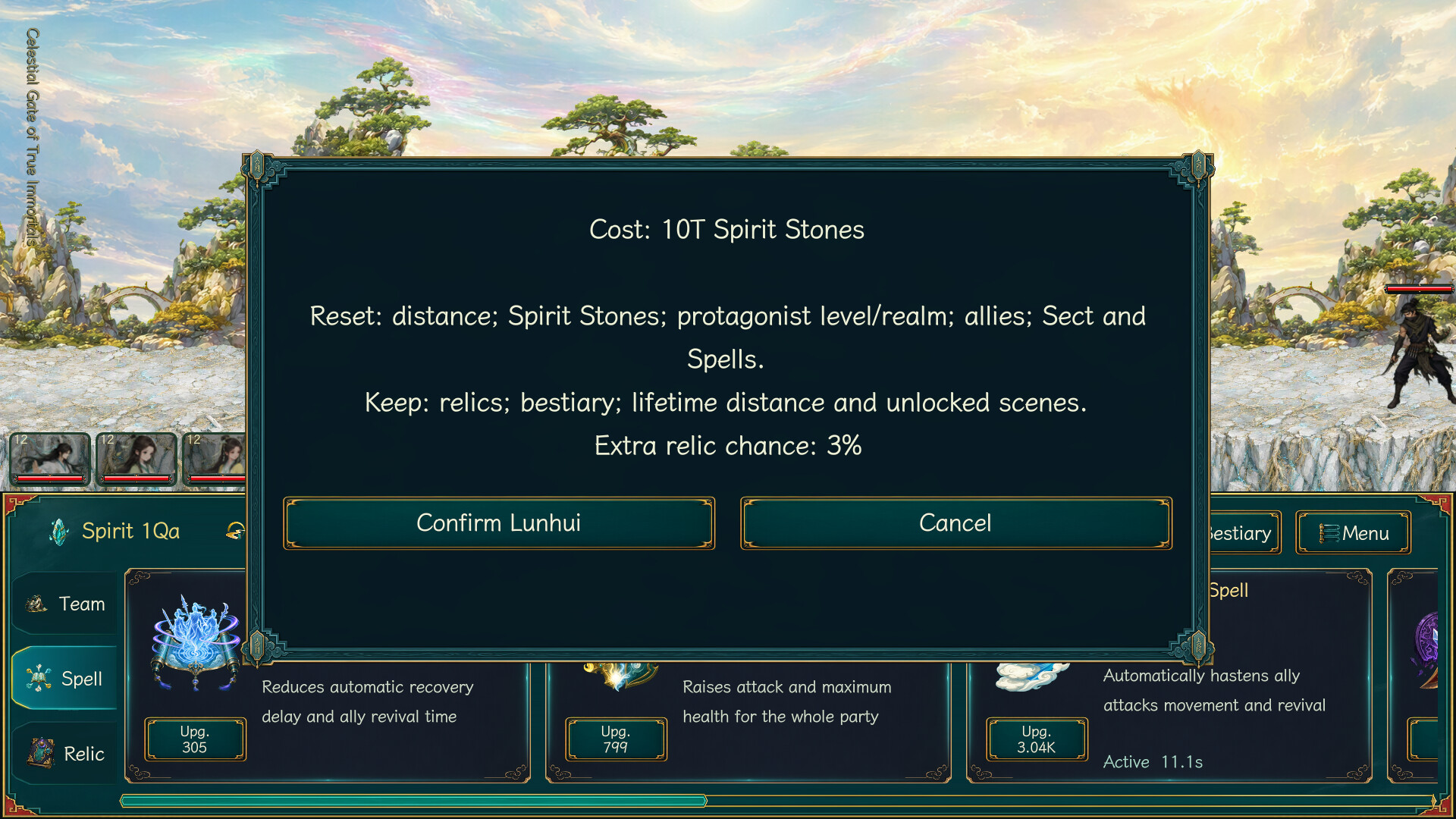
The rebirth (Lunhui) confirmation screen: a full reset of levels, allies, Sect, and Spells in exchange for a 3% extra relic chance.Steam store page