Game review
Razor Trail Survivors Review
5.5 / 10
- Developer
- RH Portugal
- Publisher
- RH Portugal
- Released
- 24 July 2026
- Platforms
- ["Windows"]
- Genre
- RPG
A Persistent Wasteland That Never Pauses
Razor Trail Survivors is a free-to-play, semi-idle survival strategy game from the small studio RH Portugal, set in a post-apocalyptic wasteland that keeps running whether anyone is watching or not. The pitch is close kin to the idle RPGs that make up most of this site's coverage, but the execution leans harder into persistent-world MMO territory: a shared, always-on server, a player-driven market, factions, and a chat channel full of real people rather than scripted flavour text. Players compare it, fairly, to the social sprawl of old-school RuneScape and the Facebook-era Mafia Wars/Mobsters genre it clearly descends from, filtered through a modern semi-idle incremental's numbers-go-up structure.
That lineage shows in both the good and the bad. The good: a genuine player economy, a community the developer is visibly present in, and a game that rewards planning over reflexes. The bad: the rough edges of a small, ongoing live build, and a moderation and balance layer that several of its own fans admit still needs work.
Survivors, Crafting, and a Gear Ladder With a Catch
The core loop is recruiting and levelling a roster of survivors, sending them out to gather resources across the map, and crafting equipment back at base. Crafted gear comes with semi-random quality, levels, and mods, which is the part of the loop reviewers describe as genuinely deep — the kind of system that rewards spreadsheet-minded players who enjoy planning stat lines rather than just watching a number climb. Several reviewers say this is exactly the appeal: one calls it "a sophisticated and deep incremental game with a budding player-based market economy," another says it's "addictively fun" specifically because survivor builds are flexible between crafting, gathering, and combat.
The catch, according to one detailed negative review, is a balance problem between weapon and ammunition crafting: making usable ammunition for a given weapon tier requires a crafting skill several levels higher than the weapon itself needs, so by the time a player can actually supply their own gear, that gear is close to obsolete. That's a specific, credible complaint about progression pacing rather than a vague "it's grindy" gripe, and it's worth taking seriously if the reviewed period reflects the game's current tuning — long-term progression systems live or die on exactly this kind of cross-skill dependency being paced sensibly.
Territory, Factions, and Combat You Can Opt Out Of
Beyond the crafting bench, players claim territory in tiers and expand a base with named buildings — Garden, Warehouse, Barracks, Logistics among them — while factions, bounties, and server-wide world events give the persistent world some shared structure. Combat is real-time-driven, against both wasteland enemies and other players, and Steam's own listing is explicit that PvP is optional. Reviewers who focus on the peaceful side of the game back that up: one specifically praises that "the PVP system is helpful but not mandatory, which is a nice change from many games out there now."
The friction point here is faction assignment. One reviewer describes being placed into a faction automatically, with no option to remain unaffiliated, and points to that as a source of unwanted drama in a game that otherwise lets players opt out of conflict. The same review raises a more serious concern: in-game moderation is limited to a developer-level chat mute, with no player-side block or report tool for handling harassment. That's a gap worth flagging plainly, since a shared social space without basic blocking tools is a real usability problem for a game built around player interaction, not just a nitpick.
One Account, Three Screens
Razor Trail Survivors runs on a single persistent account across Steam, a browser client, and mobile, and several of the most positive reviews specifically credit that flexibility: one player reports "100 hours already logged" despite Steam showing six minutes of playtime, because they mainly play on their phone. Multiple reviewers also mention using the browser version for weeks or months before the game arrived on Steam — which matters for context, since this is a persistent live-service world with one shared account rather than a separate game being ported in after a finished, closed development cycle. The Steam release reads as this project's console-equivalent storefront entry into an existing, ongoing service, not a belated arrival of an already-finished product.
That said, "semi-idle" comes with real limits. One negative review argues the game actively penalises players who try to treat it as a true idle/AFK title, and that losing window focus can stall progress rather than simply pausing it gracefully — a meaningful distinction from the offline-progress systems idle RPG readers are used to, where time away is explicitly rewarded rather than tolerated.
A Mostly Fair Subscription, Undercut by CAPTCHAs
The monetisation model is a roughly $7/month premium subscription pitched as quality-of-life rather than power: faster auto-mode, easier travel handling, and better market filters, with several reviewers explicitly stating the game is "0% pay to win." That's a genuinely good structure for a free-to-play persistent-world game, and it lines up with the "great in-game guides" and active developer feedback loop other players describe.
It's not unanimous, though. One reviewer calls the same system a "dark pattern," specifically criticising the premium currency's tiered conversion rate — buying more tokens at once makes each one cheaper, a structure they compare to a casino's chip economy — and notes that even paying subscribers still see CAPTCHAs, just fewer of them. The same review flags a real performance concern: the client reportedly keeps rendering at high frame rates even when it's out of focus in the background, burning resources unnecessarily for a game explicitly designed to be left running alongside other work. That's not a universal complaint in this review sample, but it's specific enough, and plausible enough for a smaller studio's live-service client, to weigh seriously rather than dismiss.
Verdict
Razor Trail Survivors earns its Mostly Positive standing honestly: the crafting and territory systems have real depth, the market economy sounds like it's doing what player-driven economies are supposed to do, and the developer's visible presence in the community is the kind of thing this site's readers consistently value in ongoing live-service games. But it's still a small studio's persistent world mid-development, and the complaints that surface — forced factions with no block tool, a crafting/ammo pacing problem, background performance concerns, and a premium currency structure that at least one player reads as manipulative — are specific enough to matter, not just background noise. Worth a look for players who already enjoy market-driven incrementals and don't mind a work-in-progress; less so for anyone who wants a fully idle, walk-away-from-it experience.
Screenshots
-
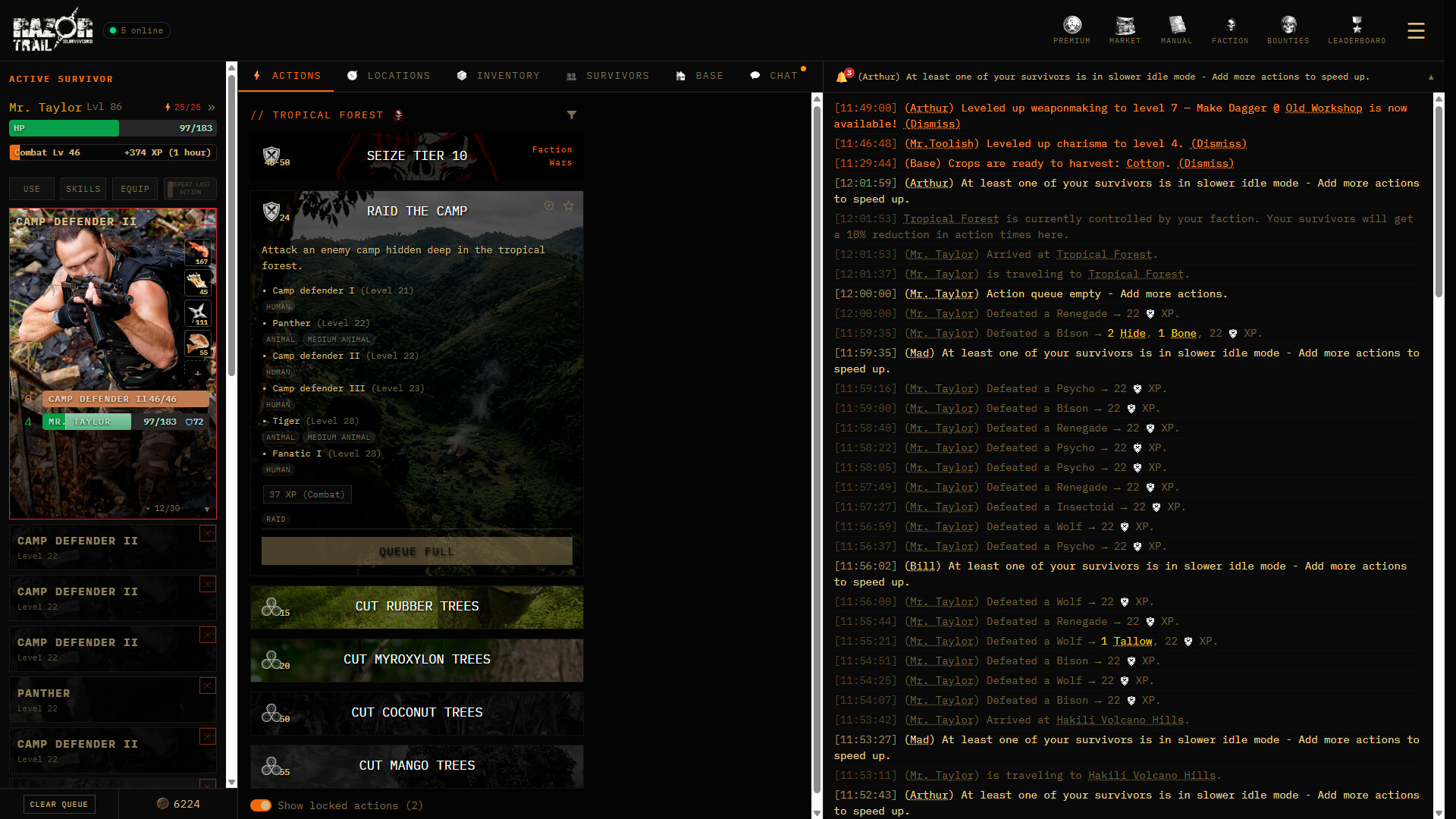
The action screen for a single survivor, queuing raids and resource runs while the log tracks every automated outcomeImage: RH Portugal via Steam -
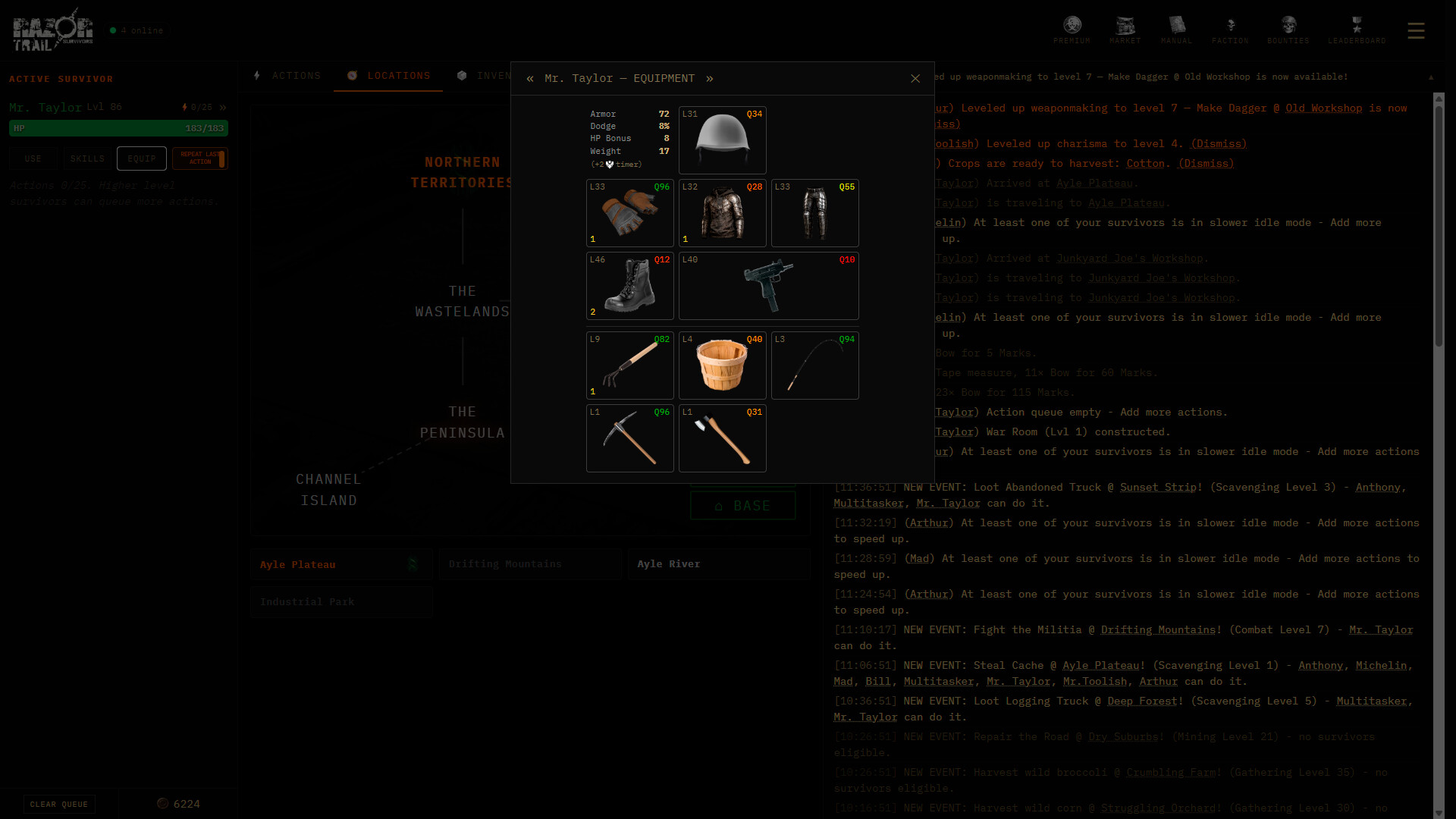
Gear is quality- and level-tagged per item, spanning combat armor alongside gathering tools like pickaxes and fishing rodsImage: RH Portugal via Steam -

The materials inventory, reflecting the wide crafting web spanning combat gear, tools, and trade goodsImage: RH Portugal via Steam