
Game review
Rack and Slay
6 / 10
- Developer
- Ludokultur
- Publisher
- 2 Left Thumbs
- Released
- 27 May 2024
- Platforms
- Windows, macOS
- Genre
- Physics-based billiards roguelike
- Monetisation
- One-time purchase, no in-game store or additional currency purchases
- Players
- Single-player only
The short version
Rack and Slay takes the "real-world thing but we pasted on a roguelike" wave that produced Balatro and Peglin and applies it to billiards: you're a cue ball knocking monster balls into holes across procedurally generated tables, drafting from over 100 stackable items between levels to build increasingly chaotic runs. It's a genuinely fresh combination executed with real physics polish that reviewers consistently praise, and a two-person team has kept it supported for well over two years since launch. Set against that praise, a real and specific complaint runs through a meaningful share of the sample: unlike most billiards games, there's no reliable way to control where the cue ball ends up after a shot, which several reviewers argue undermines the precision the sport is built around exactly when the game's own hazard-filled tables demand it most. A related complaint concerns build variety plateauing quickly, with several reviewers describing the full extent of a run's strategic decisions becoming apparent well before a typical session ends.
Biggest strengths
- The core concept of billiards reimagined as a roguelike is repeatedly praised as a genuinely fresh combination, with reviewers specifically comparing it to the wave of successful genre hybrids like Balatro, Peglin, and Luck Be a Landlord
- Physics and overall polish draw consistent, specific praise, with reviewers describing the game as smooth and well-executed even by players who are otherwise critical of its balance
- The item-drafting system with 100-plus stackable effects gives real, if front-loaded, build variety, and the explicit design choice to avoid a "meta progression grind" is specifically praised by reviewers who dislike that pattern in other roguelites
Biggest weaknesses
- The single most repeated complaint concerns a lack of control over the cue ball after a shot, with multiple reviewers arguing this undermines the precision-based tension the sport is normally built around, especially on tables filled with hazardous holes and obstacles
- Several reviewers describe build variety and strategic depth plateauing quickly, with the full range of a typical run's meaningful decisions becoming apparent well before a session's natural end point
- At least one reviewer directly and specifically unfavourably compares the game to "Flick Shot Rogues," a similar billiards-roguelike hybrid they consider executed better in every respect
Who it's for: Fans of the "familiar real-world game plus roguelite structure" trend who want a short, cheap, chaotic new entry in that space, and who don't mind sacrificing precise physical control for hazard-filled chaos. Less suited to players who specifically want the tactical precision of traditional cue sports translated faithfully into a roguelike format.
Our recommendation: A cheap, easy recommendation for fans of physics roguelites looking for a short, low-stakes new entry in the genre. Go in aware that cue-ball control is deliberately loose and unpredictable rather than a faithful billiards simulation, and that runs plateau in strategic depth faster than the genre's biggest hits.
6 / 10
Rack and Slay arrives squarely inside a genre trend that's produced some of the last few years' biggest indie hits: take a familiar, well-understood real-world game and rebuild it as a roguelike. "Balatro did it for Poker, Luck Be A Landlord did it for a slot machine, Dungeons & Degenerate Gamblers did it for blackjack, Peglin did it for pachinko. Now comes Rack & Slay, which does it for pool/billiards," one reviewer writes, capturing exactly the lineage this game is stepping into. That's a genuinely clever premise, and this review's sample confirms the two-person team behind it executed the core idea with real craft — while also documenting a specific, recurring complaint about exactly what makes billiards billiards in the first place.
A fresh combination, well-crafted
The core loop of knocking monster balls into holes across hazard-filled, procedurally generated tables earns consistent praise for its polish. "Polish and physics are really impressive, even for a 'basic' game. Everything works exactly how I would expect it to, and it is very smooth," one reviewer writes, while another frames the design philosophy approvingly: "a famous game design tip is to let your core mechanic play like a toy, which this does in spades." The item-drafting system, offering over 100 stackable effects across a run, gives reviewers real appreciation for build variety, and the developer's explicit choice to avoid a grindy meta-progression treadmill draws its own specific praise from players tired of that pattern elsewhere in the genre.
The complaint that strikes at the genre's own name
Set against that praise, the most repeated and pointed criticism concerns something specific to billiards as a sport: control after the shot. "The game has a serious problem with agency, Most pool games have a way to control the cue ball. This game doesn't and it actually needs it MORE than other games as there are many holes and obstacles to avoid," one reviewer with over 1,000 minutes logged writes. Another puts it more bluntly: "Cue sports are games of control and precision, whereas this game's mechanics only create disorder on the table, namely more explosions and more balls running around the table." This is a specific, well-reasoned critique rather than a vague balance complaint — it argues the game's central conceit works against the very source material it's built on, since real billiards strategy depends heavily on predicting and controlling where the cue ball settles after contact.
Build variety that plateaus for some players faster than others
A second, related complaint concerns how quickly a run's strategic ceiling becomes visible. "Gameplay stays the same throughout the entire run. There is no creativity in this game. Everything works, but it's far from exciting," one reviewer writes, and another separately describes each session as "so ridiculously short that by the time you get any sort of 'build' going, the game is already over." This isn't a universal reaction — several positive reviewers specifically praise finding meaningful synergies among the 100-plus items — but it's a real, recurring pattern among reviewers who otherwise enjoy roguelite deckbuilders and expected a comparable depth of build-crafting here.
A direct competitor comparison worth naming
At least one reviewer makes a specific, pointed comparison worth including directly: "This game is decent, but Flick Shot Rogues is the same concept executed better in every way, so I can't recommend this one." This review hasn't independently evaluated that competing title, but the specificity of the comparison — naming an exact alternative rather than simply expressing general dissatisfaction — is a useful data point for prospective buyers deciding between similar options in this small, specific niche.
A defense worth taking seriously from an extremely long-session player
Set against the critical voices, at least one reviewer with an extraordinary 33,466 minutes logged — well over 550 hours — writes specifically to "defend this addicting little game," describing genuine, sustained enjoyment despite not being drawn in by the art style initially. That kind of extreme, sustained engagement is hard to dismiss as a fluke, and it suggests the game's appeal, while clearly not universal, runs genuinely deep for a real share of its audience once its specific rhythm clicks.
A well-supported small release
To its credit, this review can confirm the two-person team behind Rack and Slay maintained an unusually dense support record for a budget-priced release: a thorough pre-launch demo period stretching back to November 2023, followed by frequent patches through the first several months after the May 2024 launch, an Endless Mode and content boost added mid-2024, a Nintendo Switch port, and continued multi-language localisation support running well into 2025 and 2026.
What the achievement data says about the "too easy" complaint
Steam's own completion figures add useful context to reviewer complaints about certain runs feeling unloseable. Early achievements sit comfortably above 65-90%, confirming most buyers succeed at the game's basic goals without much difficulty, and the curve falls off toward the specific challenge-mode achievements — several sitting around 4-5% — rather than toward the base game's standard difficulty tiers. That pattern suggests the core campaign genuinely is approachable for most players, exactly as some reviewers complain, while real challenge exists specifically in optional harder modes that a smaller, more dedicated share of the audience engages with. That's a reasonable design choice for a game explicitly marketed around short, low-stakes sessions rather than punishing mastery, even if it leaves some genre veterans wanting more baseline tension.
A value case that holds up regardless of the depth debate
Whatever the disagreement over build variety, value draws little serious dispute. At under nine New Zealand dollars, reviewers on both sides of the recommendation line tend to frame the purchase as low-risk, with even critical reviewers describing their time with the game as a reasonable trade for the price rather than money wasted. That's worth weighing directly: a complaint about strategic depth plateauing after a few hours lands very differently against a budget price tag explicitly designed around short sessions than it would against a premium-priced game promising dozens of hours of evolving content.
Final verdict
Rack and Slay succeeds at a genuinely clever premise — billiards reimagined with roguelike structure — with real physics polish and a generous, well-supported item pool, backed by an unusually active small development team. Its specific, recurring complaint about a lack of cue-ball control cuts at something structurally important to the sport it's riffing on, and build variety plateaus faster for some players than the genre's biggest hits. Worth its low price for fans of the physics-roguelite trend looking for a short, chaotic new entry; go in expecting controlled chaos rather than a faithful, precision-focused billiards experience.
Pros and cons
Pros
- The core concept of billiards reimagined as a roguelike is repeatedly praised as a genuinely fresh combination, with reviewers specifically comparing it to the wave of successful genre hybrids like Balatro, Peglin, and Luck Be a Landlord
- Physics and overall polish draw consistent, specific praise, with reviewers describing the game as smooth and well-executed even by players who are otherwise critical of its balance
- The item-drafting system with 100-plus stackable effects gives real, if front-loaded, build variety, and the explicit design choice to avoid a "meta progression grind" is specifically praised by reviewers who dislike that pattern in other roguelites
- Runs are short by design, typically 20-30 minutes for a full dungeon or shorter in the condensed Delve Mode, making the game an easy pick-up-and-play option that several reviewers specifically appreciate
- The two-person development team has sustained an unusually long and active support record, with numbered patches and content updates running from the May 2024 launch through translation additions and content boosts well into 2026
Cons
- The single most repeated complaint concerns a lack of control over the cue ball after a shot, with multiple reviewers arguing this undermines the precision-based tension the sport is normally built around, especially on tables filled with hazardous holes and obstacles
- Several reviewers describe build variety and strategic depth plateauing quickly, with the full range of a typical run's meaningful decisions becoming apparent well before a session's natural end point
- At least one reviewer directly and specifically unfavourably compares the game to "Flick Shot Rogues," a similar billiards-roguelike hybrid they consider executed better in every respect
- Difficulty balance draws specific criticism, with some reviewers describing certain runs as effectively unloseable and others describing a steep, frustrating power gap between the strongest and weakest available items
- Steam Deck players report specific control friction, with at least one reviewer describing aiming and menu navigation as considerably rougher on a controller than with a mouse
Screenshots
-

Rack and SlayImage: 2 Left Thumbs via Steam -

Rack and SlayImage: 2 Left Thumbs via Steam -

Rack and SlayImage: 2 Left Thumbs via Steam -
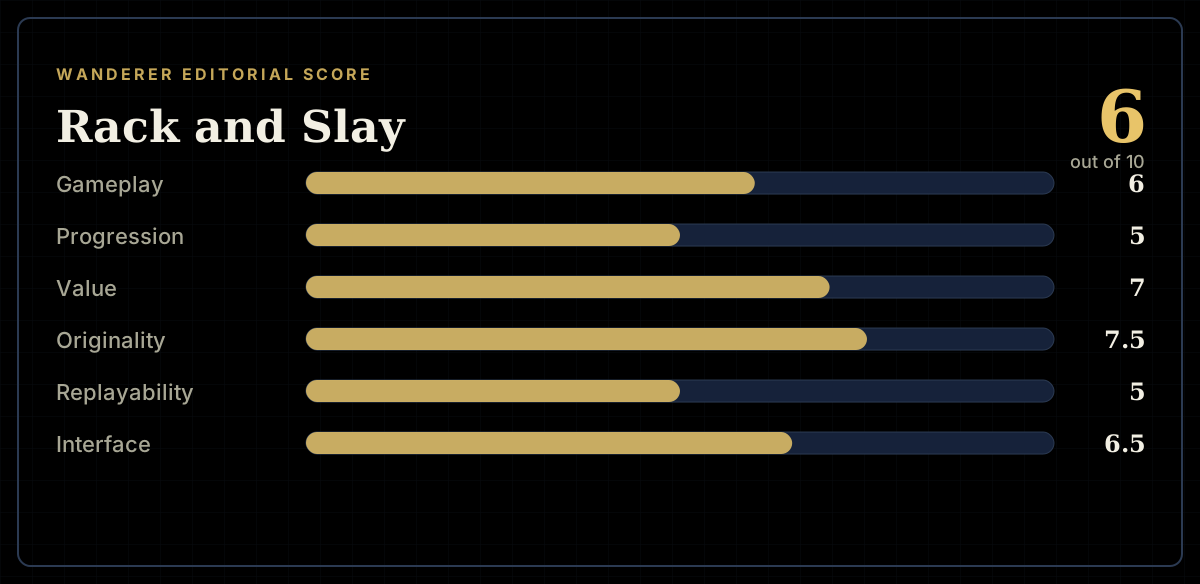
How the review scores each part of the gameWanderer Editorial -
The short versionWanderer Editorial