
Game review
Pegs X Stickers Review
7.5 / 10
- Developer
- Mister Morris Games, Tyler Ray Games
- Publisher
- Mister Morris Games
- Released
- 14 August 2026
- Platforms
- ["Windows"]
- Genre
- Strategy
Balatro Meets Peggle, And Everyone Noticed
Pegs X Stickers, released August 14, 2026 from Mister Morris Games and Tyler Ray Games, wears its influences on its sleeve: launch a ball down a customizable pegboard, rack up points and multipliers by hitting the right pegs in the right order, and slot in stickers and charms between rounds to build increasingly absurd scoring combinations across a run. Before it ever hit Steam as a full release, it existed as a well-traveled itch.io jam project and then a Steam demo that built up a small but devoted following. At $5.99, the English review pool is 60 reviews, 54 positive and 6 negative ("Very Positive"), small enough to read in full rather than sample. The single most repeated sentence structure in this pool, in one form or another, is some variation of "it's Balatro meets Peggle" or "Balatro meets Peglin," and the developers clearly aren't shy about that comparison; multiple reviewers who logged demo hours before launch describe watching the game visibly improve across that jam-to-demo-to-full-release pipeline.
A Genuinely Satisfying Physical-Meets-Strategic Hybrid
What keeps this pool overwhelmingly positive is that the pachinko-roguelite hybrid actually delivers on its premise rather than just borrowing two popular games' aesthetics. Reviewers consistently praised the tactile satisfaction of the ball physics combined with the theorycrafting depth of choosing pegs, stickers, and charms between shots. "I love that my partner also comes up with some ideas and combinations, so we can test out who is the best strategyzer," wrote one reviewer with over 10,000 minutes logged, easily the pool's most dedicated player. Another called it "the love child of Peglin and Balatro," while a more skeptical reviewer who didn't expect to enjoy it wrote, "I could immediately tell this was based off the Balatro formula... Very fun, especially considering the cheap price as well, steal of a deal." Presentation earned near-universal praise too: clean, polished visuals, satisfying peg-pop sound design, and performance reviewers specifically noted was gentle on older hardware. Several reviewers also praised the progression structure, unlocking new peg types and stickers after a win rather than gradually throughout a run, as a meaningful reward that opens up new strategic depth rather than just padding playtime.
A Real, Specific Complaint: The Round-15 Difficulty Wall
The most consistent criticism in this pool isn't vague, it's a specific, named difficulty spike that recurs across a striking number of separate reviews. "Once you hit round 15 or so, you hit a ceiling where if you do not have a completely insane, broken build, you're screwed," read one review, echoed almost identically by another: "the difficulty spike in round 16+ is insane, each jump is so unreasonable." A third reviewer reported six hours and zero wins, calling the spike "pretty wild for what this game is," and a fourth called the first level's difficulty "absurd" and declined to recommend the game outright over it, one of only three negative reviews to center on difficulty rather than a bug. This complaint is corroborated closely enough, and specifically enough by round number, across independent reviewers that it reads as a real balance issue with the game's mid-run scaling rather than a skill gap on any one player's part.
An Exploit That Breaks The Game, According To Multiple Reviewers
A second specific, recurring complaint describes ways to break the run structure entirely through unintended combinations. One reviewer described discovering "a very very easy and reproducible way to win every time on every board if you know what items to get for the setup that skips most of the game's content," while another wrote about "ghost pegs" that "completely break the game," describing deliberately building a "perpetual winning machine" that let them push past round 50 purely to see how far the exploit would go before losing interest. A third reviewer noted the developers have already patched at least one variant of this, "a recent patch being released to prevent never ending rounds from constantly getting new balls," which suggests active post-launch attention to the problem rather than neglect. Smaller complaints recur too: one reviewer reported a wiped Steam Deck save, several flagged imprecise mouse-aiming sensitivity with no way to fine-tune it, and a couple wanted the ability to lock in and repeat a specific successful shot rather than having to re-aim by hand each time.
A Short, Cheap Game That Still Racks Up Absurd Playtime
One more pattern worth flagging: despite costing under six dollars and offering a fairly small, contained loop, this pool is full of reviewers reporting wildly disproportionate playtime. The pool's top-voted review comes from a player with over 10,000 minutes, north of 170 hours, and several other reviews cite four-figure minute counts without a hint of buyer's remorse. That kind of stickiness for a five-dollar game says something the numeric score alone doesn't capture: reviewers repeatedly describe getting "carried away," losing entire evenings, or, in one reviewer's words, being "infected... with the 'just one more' curse." A handful of shorter, joke-length reviews (plenty of puns on the word "pegging," one entirely in flame emoji) round out the low end of the pool's effort level, but even those are thumbs-up, which suggests the game's hooks land even with reviewers who can't be bothered to write more than a sentence about it. One reviewer's review is written entirely in French, praising the game as "super satisfaisant de A à Z," a small reminder that a comparison-heavy, mechanically-driven genre like this travels well across language barriers even without much text to translate.
Verdict
Pegs X Stickers earns its Very Positive reception the straightforward way: it takes two beloved formulas, pachinko-style physical aiming and Balatro-style scoring theorycraft, and actually makes the combination click, backed by clean art, satisfying sound, and a progression system reviewers found genuinely rewarding to chip away at. Its problems are specific enough to name rather than vague grumbling: a hard difficulty wall around round 15 that several reviewers found disproportionate, and at least one game-breaking scoring exploit the developers appear to be actively patching rather than ignoring. Neither is severe enough to have tanked the overall reception, but both are worth going in aware of. At $5.99, this is an easy recommendation for anyone who likes either of its two obvious influences, just don't expect a smooth difficulty curve once the early rounds give way to the real test.
Screenshots
-
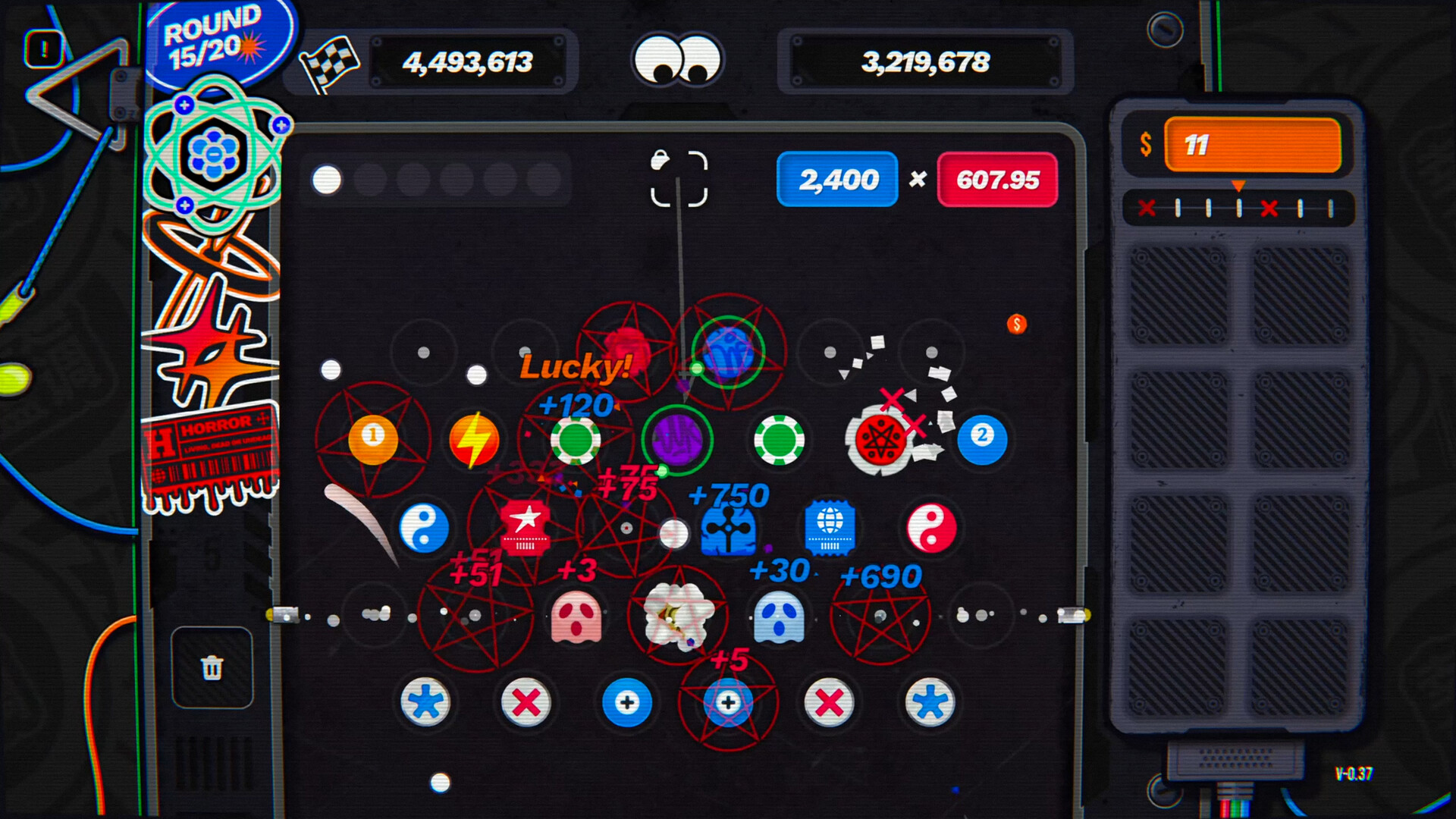
Round 15 of a run, exactly the point where several reviewers say the game's difficulty spikes hard.Image: Mister Morris Games via Steam -
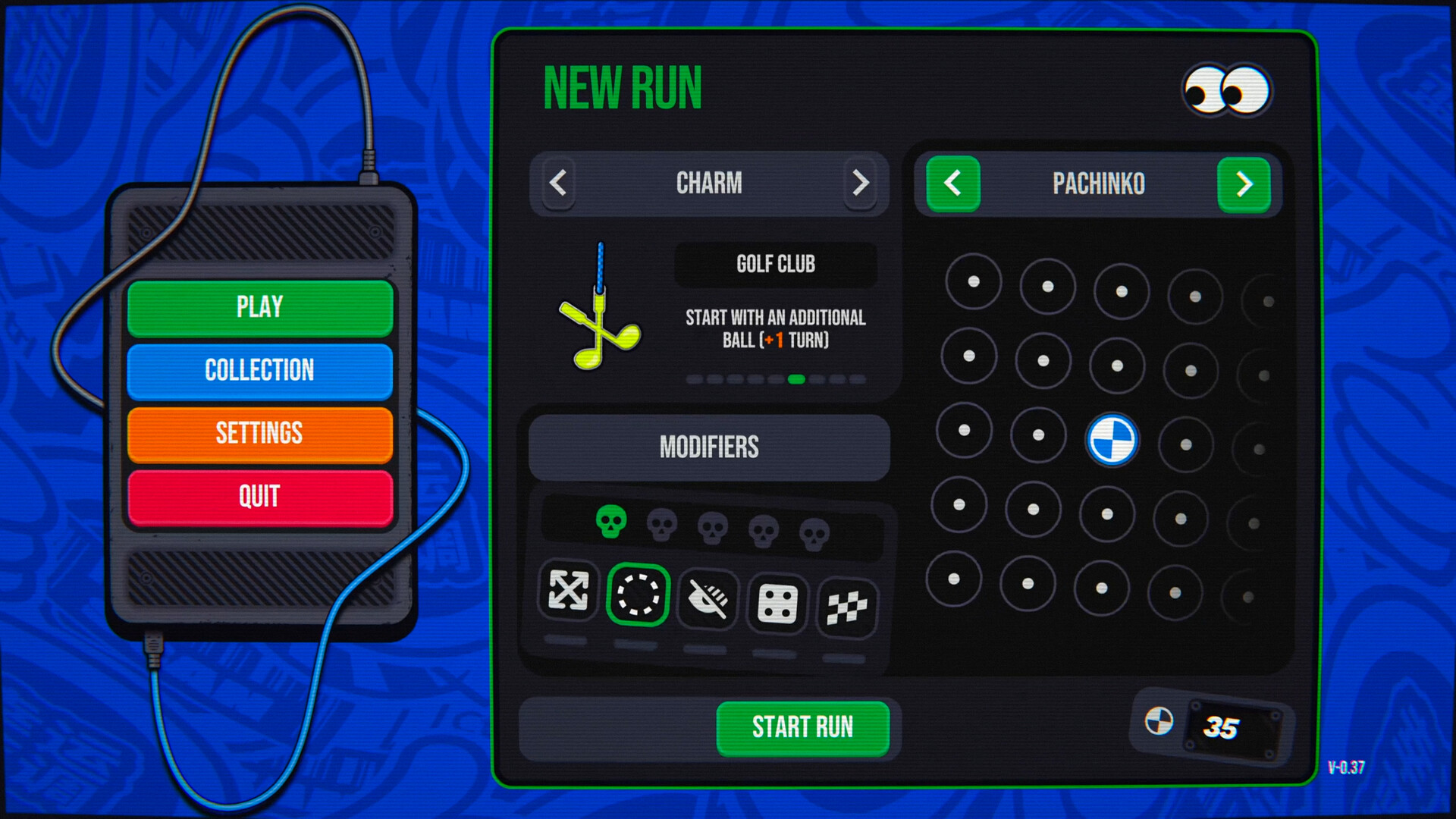
The pre-run setup screen, where charms, modifiers, and the starting pegboard layout are all chosen before the ball ever drops.Image: Mister Morris Games via Steam -
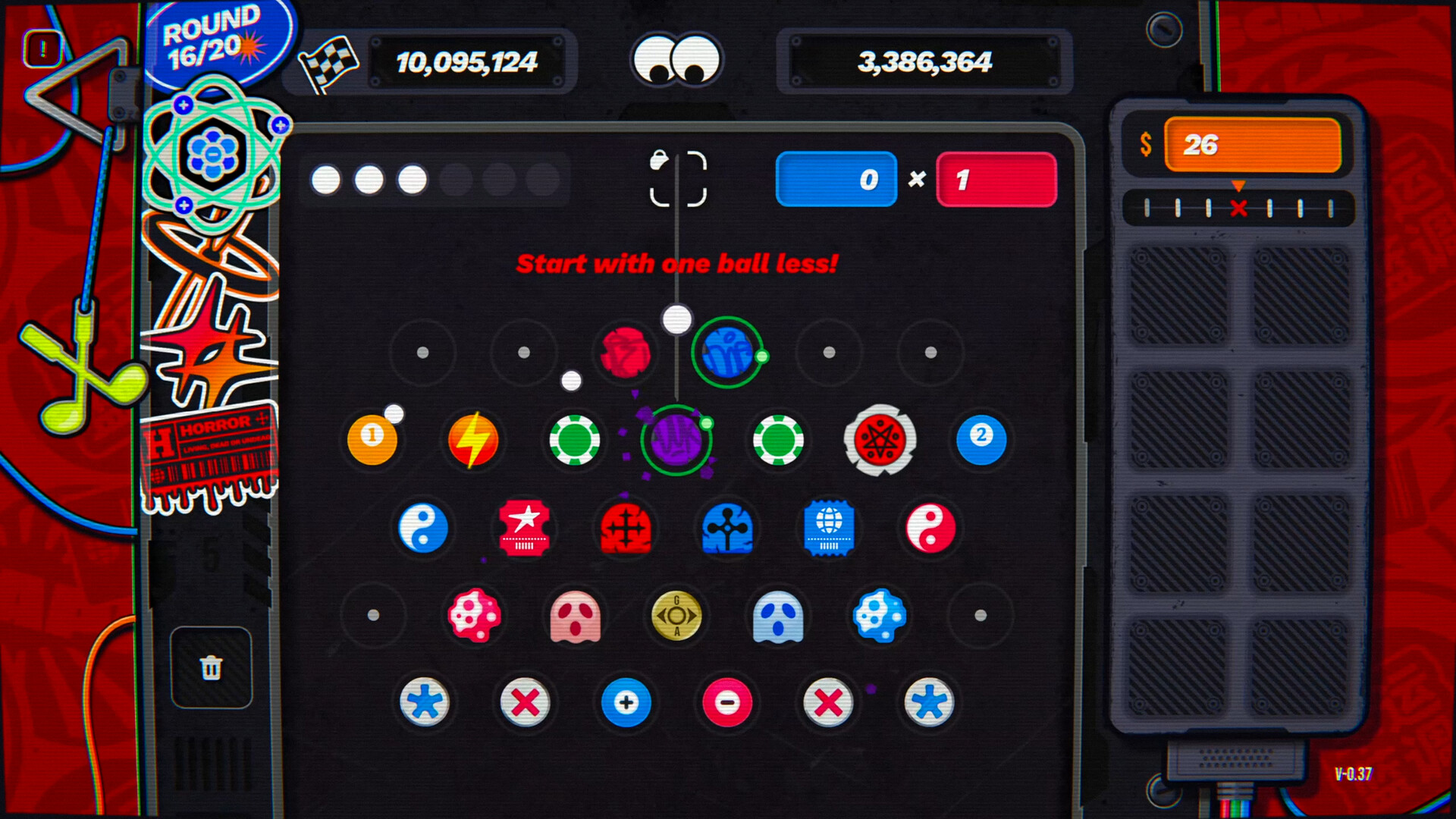
A round-16 run-ending penalty screen, illustrating the escalating handicaps the later rounds throw at the player.Image: Mister Morris Games via Steam