
Game review
Pairs & Perils
5.5 / 10
- Developer
- Little Horror Studios
- Publisher
- Rogue Duck Interactive, Gamersky Games
- Released
- 20 January 2025
- Platforms
- Windows
- Genre
- Casual, Indie, RPG, Strategy
- Players
- Single-player
The short version
Biggest strengths
- A genuinely clever, elegant core hook — building a roguelite deckbuilder around a childhood memory-matching game rather than typical combo-chasing card mechanics
- Charming art direction and music that reviewers consistently enjoy regardless of their overall verdict
- A meaningfully harder top difficulty tier that deals cards face-down rather than showing them during the deal, genuinely changing the memory challenge rather than just scaling numbers
Biggest weaknesses
- Widely reported as trivially easy to break once players learn that simply matching any two cards, regardless of which cards they are, guarantees success and makes engaging with enemies almost optional
- Very short, with many reviewers reporting a full clear across multiple difficulties in well under three hours
- Surface-level variety in characters, items, and cards doesn't translate into runs that meaningfully play differently, a specific complaint echoed by multiple reviewers independently
5.5 / 10
A childhood memory game, rebuilt as a roguelite
Pairs & Perils takes a genuinely distinctive approach to the roguelite deckbuilder formula: rather than chaining combos through typical card synergies, combat is resolved by flipping face-down cards and matching pairs, with successful matches activating effects and failed attempts advancing the enemy's attack timer. One reviewer's summary captures the mechanic precisely: "Pairs & Perils is a roguelite deckbuilder where the player must defeat monsters by matching pairs of cards which are shown face down. Successfully matching a pair will activate the card, but picking two different cards will cause the monsters' turn counter to reduce." Based on the available English-language review sample of 58 reviews — 42 positive, 16 negative, landing at an overall Mostly Positive rating — that central idea draws real, specific admiration even from reviewers who ultimately have significant reservations about everything built around it.
"I love memo and I love when somebody takes a game with simple rules and builds something bigger on top of it without destroying the base premise. Pairs & Perils is a perfect example of things I love. It's simple, elegant and quick," one reviewer writes, praising exactly the kind of restraint that keeps a clever hook from being buried under unnecessary complexity. A separate reviewer frames the game's low cost of entry as a genuine strength for what's on offer: "for $7.99 I think I got my money's worth, there is a good bit of replayability if you want to get all the achievements as well since there's a decent amount of characters at the moment."
A game that's too easy to break
The single most consistent, most damaging criticism across the negative review sample concerns how quickly the core memory-matching challenge collapses once players discover a specific, simple exploit: matching literally any two cards, regardless of what they actually do, guarantees a successful turn and starves the enemy's attack timer. "This game is easier than the children's game it's based on. There is basically no point in this being a roguelike, since you can just ignore the enemies entirely and win every time," one reviewer writes, describing a genuinely serious design failure rather than ordinary low difficulty. A separate reviewer reaches the identical practical conclusion from direct play experience: "Soooo... it might be me... but I couldn't find a reason to keep more than 5 cards in a deck. When they get re-dealt, all you have to memorize is 3 matches... The concept is new, but it's not that fun or interesting. It doesn't matter what cards you choose, as long as they match. Keep matching, and insta-win every battle."
That exploit has a direct, measurable consequence on run variety, and multiple reviewers independently identify the same underlying problem in almost identical terms. "In the best roguelikes, no two runs feel the same. In this game, no two runs feel different. It's not a lack of content — I've had multiple runs with completely different characters, items, and cards. The issue is that none of this changes how the game plays in any meaningful way," one detailed reviewer writes, pointing directly at the achievement data and playtime statistics as supporting evidence: "Just scroll through these reviews and look at the playtime - even the people recommending this game aren't finding a reason to keep playing for long." The achievement data bears this out directly: the base victory achievement sits at exactly 50% completion, meaning half of all players who engaged enough with the achievement system to register any progress have already beaten the core game — an unusually fast clear rate that corroborates the "too easy to sustain engagement" complaint rather than contradicting it.
A short game that gets called out for it directly
Several reviewers report finishing the bulk of available content in a single extended session. "I have unlocked a considerable portion of the unlockables in the game during my first run in 30 minutes. The game is nowhere near being endlessly replayable and is rather an early-access product," the most heavily upvoted negative review states, going on to specifically flag the game's own roadmap as a marketing concern: "The Pairs & Perils game page includes a roadmap that says they will do their best to keep their update promises, but players should not make purchasing decisions based on them." That's a specific, pointed warning about buying based on promised future content rather than what currently exists — worth taking seriously given how consistently other reviewers independently report a similarly fast clear pace. A separate reviewer with a full playthrough video available reports a comparable timeline: "it's a bit easy when you figure out the tricks to it and a bit short as well to beat all the difficulties."
Where the difficulty curve actually works
It's worth noting directly that not every reviewer experienced the same trivializing exploit, and the game's hardest difficulty tier draws specific, genuine praise for changing the fundamental challenge rather than simply inflating enemy stats. "I enjoyed it most once I got to the highest level - on the lower difficulties you are shown the cards while being dealt and are tasked with remembering as many as you can. On the hardest difficulty they are dealt face down, so, technically it is harder but it was more satisfying not having a bunch of information thrown in your face to recall," one reviewer writes, describing a meaningful mechanical shift rather than a numbers-only difficulty spike. A separate enthusiastic reviewer confirms real difficulty at the top tier specifically: "I beat the game with the five characters so far and beat it on hard mode — right now I'm getting painfully slaughtered on dungeon master mode." That contrast between reviewers finding the base game trivial and finding the hardest tier genuinely punishing suggests the difficulty curve, while uneven, isn't uniformly broken — the "always guaranteed win" exploit that dominates the negative sample appears to be substantially less reliable once face-down dealing removes the information advantage that makes it work in the first place.
Where this leaves it
Pairs & Perils builds a genuinely inventive roguelite deckbuilder around a memory-matching hook that draws consistent, specific praise for its elegance and charm, undercut by a core exploit that a large share of the negative review sample independently identifies: simply matching any two cards, rather than thoughtfully choosing which cards to keep, is often enough to guarantee victory on the game's easier difficulties. That flaw compounds a genuinely short base campaign, and the achievement data's 50% base-completion rate supports reviewer accounts of a fast, easily-exhausted core loop. The hardest difficulty tier offers real evidence the underlying idea can work as intended when the exploit is removed. Worth a look at a discount for fans of the memory-matching concept specifically, with realistic expectations about how quickly the lower difficulties can be broken; a harder recommendation at full price for anyone expecting sustained roguelite replayability.
Pros and cons
Pros
- A genuinely clever, elegant core hook — building a roguelite deckbuilder around a childhood memory-matching game rather than typical combo-chasing card mechanics
- Charming art direction and music that reviewers consistently enjoy regardless of their overall verdict
- A meaningfully harder top difficulty tier that deals cards face-down rather than showing them during the deal, genuinely changing the memory challenge rather than just scaling numbers
- Reasonably priced for what it offers, with several reviewers specifically noting they felt they got their money's worth despite other reservations
Cons
- Widely reported as trivially easy to break once players learn that simply matching any two cards, regardless of which cards they are, guarantees success and makes engaging with enemies almost optional
- Very short, with many reviewers reporting a full clear across multiple difficulties in well under three hours
- Surface-level variety in characters, items, and cards doesn't translate into runs that meaningfully play differently, a specific complaint echoed by multiple reviewers independently
- At least one detailed reviewer argues the game currently resembles an early-access product mischaracterized as a finished release, citing an unlockable-completion pace far faster than the roadmap and marketing suggest
Screenshots
-

Pairs & PerilsImage: Rogue Duck Interactive via Steam -

Pairs & PerilsImage: Rogue Duck Interactive via Steam -

Pairs & PerilsImage: Rogue Duck Interactive via Steam -
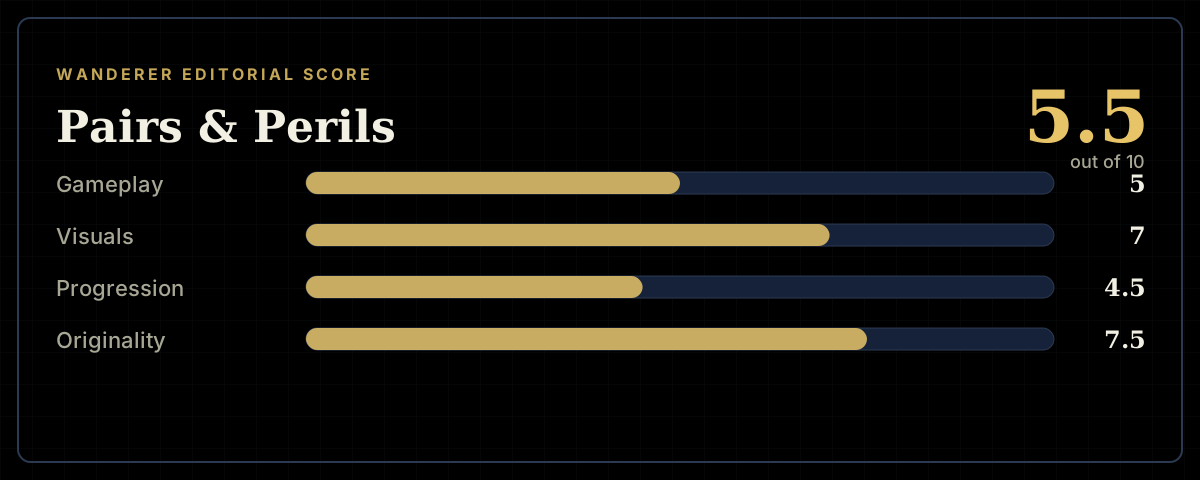
How the review scores each part of the gameWanderer Editorial -
The short versionWanderer Editorial