
Game review
Nothing
3 / 10
- Developer
- Pixelatto
- Publisher
- Pixelatto
- Released
- 10 January 2024
- Platforms
- Windows
- Genre
- Minimalist idle/patience game
- Monetisation
- One-time purchase, no in-game store or additional currency purchases
- Players
- Single-player only
The short version
Nothing is exactly what its name promises: open the game, do not press a key or move the mouse, and watch a timer climb until you inevitably twitch and lose. It is a genuinely funny concept, and the nearly ten thousand reviews it has accumulated are proof the joke landed with a real audience. But the joke is also the entire product. There is no leaderboard to chase, no achievement to unlock, no second mechanic layered on top of the first, and reviewers openly admit their five-figure "playtime" totals reflect leaving the game running in the background rather than anything resembling engaged play. Once you know the bit, there is nothing left to discover, and that emptiness is a much harder sell now that it costs money than it was when the game was free.
Biggest strengths
- The core concept is genuinely funny on its own terms, and the game commits fully to the bit rather than undercutting it with unnecessary extra systems
- At NZD 1.49, the financial risk of trying the joke for yourself is close to zero, and a large majority of reviewers say that price felt fair for what they got
- The review section has become an entertaining destination in its own right, with reviewers extending the joke through elaborate mock "graphics/gameplay/audio" scorecards and deadpan five-figure-hour playtime claims, adding a genuine community layer the game itself doesn't provide
Biggest weaknesses
- There is no progression system, no unlockable content, no leaderboard, and no achievements of any kind, despite Steam achievements being trivial to implement and an obvious fit for a game built entirely around "how long can you last"
- Multiple reviewers explicitly describe reporting playtime figures in the tens of thousands of minutes that reflect leaving the game open and unattended, not active engagement, undermining any claim that the game offers real replay value
- Several reviewers specifically note the game was originally free and later began charging money, framing that change as the point where an appealing throwaway joke stopped feeling like a fair trade
Who it's for: Anyone who wants a five-minute laugh and doesn't mind paying pocket change for it, or who specifically collects joke and meme games as a category. Not for anyone expecting a real progression system, a competitive hook, or any reason to open the game a second time.
Our recommendation: Buy it if the premise alone makes you smile and you're happy to pay less than the price of a coffee for that smile — but go in knowing the entire experience is the store page description. There is no deeper game waiting underneath the joke.
3 / 10
Nothing does not hide its premise behind a marketing pitch. The store page says it outright: do Nothing as the timer goes up, and if you do Something, you lose. That's the whole design document, and to its credit, the game never pretends otherwise. There's no tutorial to sit through, no menu maze, no onboarding — you launch it, a timer starts, and your job is to not touch your mouse or keyboard for as long as your nerves will allow. It is, by design, the smallest possible game that can still technically be called a game, and nearly ten thousand people have reviewed it, the overwhelming majority positively. The question worth asking isn't whether the joke works — it clearly does — but whether a joke is enough to build a purchasable product around, and what happens to that joke once a price tag gets attached to it.
The single idea, and how far it actually goes
There is exactly one interaction in Nothing: withhold input. There's no secondary system, no unlockable mode, no difficulty curve, no narrative beat waiting at some milestone. The entire experience is the tension of resisting the urge to move, which is a real and briefly interesting sensation — plenty of people underestimate how quickly an idle hand starts to itch once a countdown is watching it — but it's a sensation with a short half-life. Once you understand the joke, which takes about as long as reading this paragraph, there is nothing further the game can show you. That's not a criticism of execution; the execution is flawless, in the sense that a single light switch is flawlessly executed. It's a criticism of scope, and scope is the entire product here.
What the review sample actually reveals
The review sample is worth reading closely, because it tells you more about the game's real substance than the store page does. A striking number of positive reviews report absurd playtime totals — one claims over 538,000 minutes, another over 822,000 — and every one of them is explicit, in the same breath, that this reflects leaving the application open in the background rather than sitting and actively resisting the urge to move for that entire stretch. That's an honest and funny bit from the reviewers, but it also quietly confirms there is no active engagement loop here worth measuring in the way a real idle or incremental game would want you to measure it. A genuine incremental game gives you something to check on when you come back — resources accumulated, a shop to spend them in, a next tier to unlock. Nothing gives you a number that went up while you weren't looking, and nothing to do with that number once you see it.
A joke that used to be free
The most substantive complaint running through the negative review sample isn't about difficulty or bugs — it's about money. Multiple reviewers independently describe the game as having been free at some point before it began charging, and frame that shift as the moment an appealing throwaway curiosity stopped feeling like a fair exchange. "It used to be free, and was a funny joke, but now it's completely ruined by that one fact," one writes, going on to suggest the price only makes sense as commentary rather than a genuine value proposition. This review cannot independently confirm a specific date the game began charging, since no partner-events post documents a pricing change, but the pattern across multiple independent reviewers describing the same experience is consistent enough to treat as a real and repeated player reaction, not an isolated complaint. At NZD 1.49 the actual financial stakes are close to nothing — appropriately enough — but the complaint isn't really about the dollar amount. It's about the tonal shift from "free thing someone made as a bit" to "purchasable product," and reviewers are right that those two framings invite very different expectations.
Missing the features a joke like this practically writes itself
What's genuinely puzzling, rather than merely thin, is the complete absence of the features that would cost little to add and fit the premise perfectly. There's no leaderboard, despite the entire mechanic being a single measurable number — time survived — that begs to be compared against other players. There are no Steam achievements at all, confirmed by an empty response from Steam's own achievement-percentage data, despite achievements being one of the cheapest ways to give a one-joke game a second and third joke ("survive one minute," "survive one hour," "give up and do Something on purpose"). There's no trading card support, and no controller input detection, despite a controller sitting untouched being just as valid a way to "do Nothing" as an untouched mouse and keyboard. None of these are hard problems. Their absence isn't a dealbreaker on its own, but stacked together it reads as a product that stopped exactly at the punchline and never asked what a second beat might look like.
Scored on what it actually offers
Judged purely as a joke, Nothing succeeds, and that's reflected in a genuinely high originality score here — there aren't many games willing to make "the absence of a game" the entire pitch and commit to it this cleanly. But nearly every other category a review normally weighs — gameplay depth, progression, replayability, interface polish beyond the bare minimum — has essentially nothing to grade, because the game offers essentially nothing beyond the premise itself. That's the honest tension in reviewing something like this: praising it too highly rewards a five-minute idea as though it were a sustained piece of design, and scoring it too low ignores that it's doing exactly and only what it says on the tin, cheaply, without bugs, and without pretending to be more than it is.
Final verdict
Nothing is a good joke wearing the minimum possible amount of game around it. It's worth the price of admission if the premise alone gets a genuine laugh out of you and you don't expect anything past that laugh — the joke really is the whole product, delivered cleanly and without technical complaint. But there's no reason to return to it a second time, no system rewarding the enormous "playtimes" reviewers report in jest, and no evidence the developer built in even the cheapest possible hooks, like achievements or a leaderboard, that might have given the bit somewhere to go. Buy it for the smile, not for the game.
Pros and cons
Pros
- The core concept is genuinely funny on its own terms, and the game commits fully to the bit rather than undercutting it with unnecessary extra systems
- At NZD 1.49, the financial risk of trying the joke for yourself is close to zero, and a large majority of reviewers say that price felt fair for what they got
- The review section has become an entertaining destination in its own right, with reviewers extending the joke through elaborate mock "graphics/gameplay/audio" scorecards and deadpan five-figure-hour playtime claims, adding a genuine community layer the game itself doesn't provide
- Reviewers report the single mechanic works exactly as described with no bugs or technical issues to speak of, which is a low bar but one the game clears cleanly
Cons
- There is no progression system, no unlockable content, no leaderboard, and no achievements of any kind, despite Steam achievements being trivial to implement and an obvious fit for a game built entirely around "how long can you last"
- Multiple reviewers explicitly describe reporting playtime figures in the tens of thousands of minutes that reflect leaving the game open and unattended, not active engagement, undermining any claim that the game offers real replay value
- Several reviewers specifically note the game was originally free and later began charging money, framing that change as the point where an appealing throwaway joke stopped feeling like a fair trade
- No controller support is offered despite the game's own core mechanic being entirely about detecting input, an odd omission for a game this mechanically simple
- There is exactly one idea in the entire package, and nothing revealed in the store description, the review sample, or the game's minimal file size suggests any hidden depth beyond that single idea
Screenshots
-

NothingImage: Pixelatto via Steam -

NothingImage: Pixelatto via Steam -

NothingImage: Pixelatto via Steam -
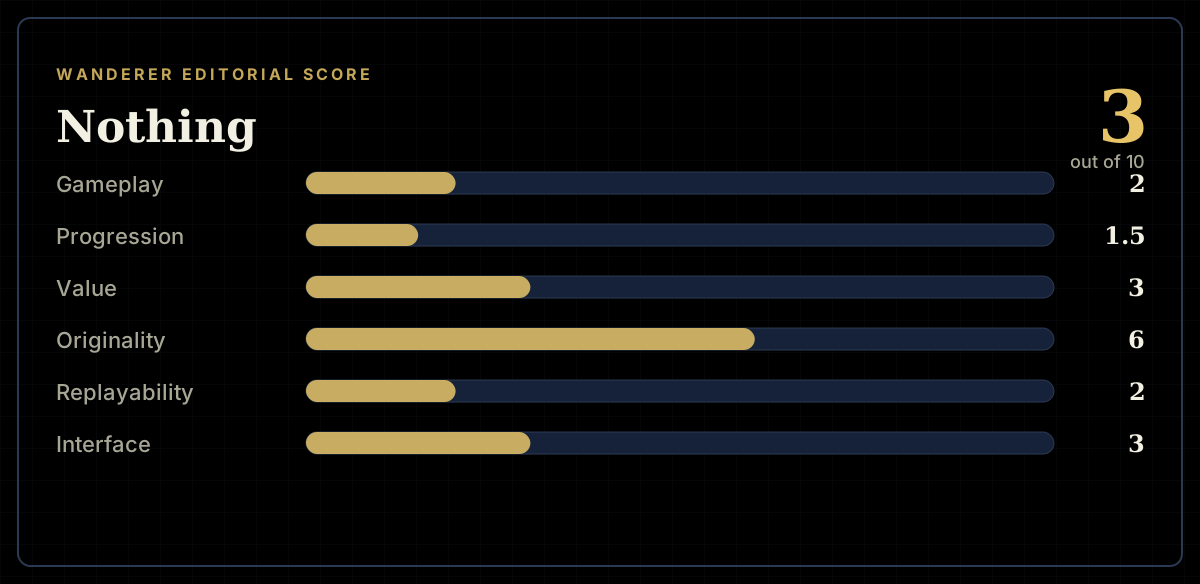
How the review scores each part of the gameWanderer Editorial -
The short versionWanderer Editorial