
Game review
Ni no Kuni Wrath of the White Witch Remastered
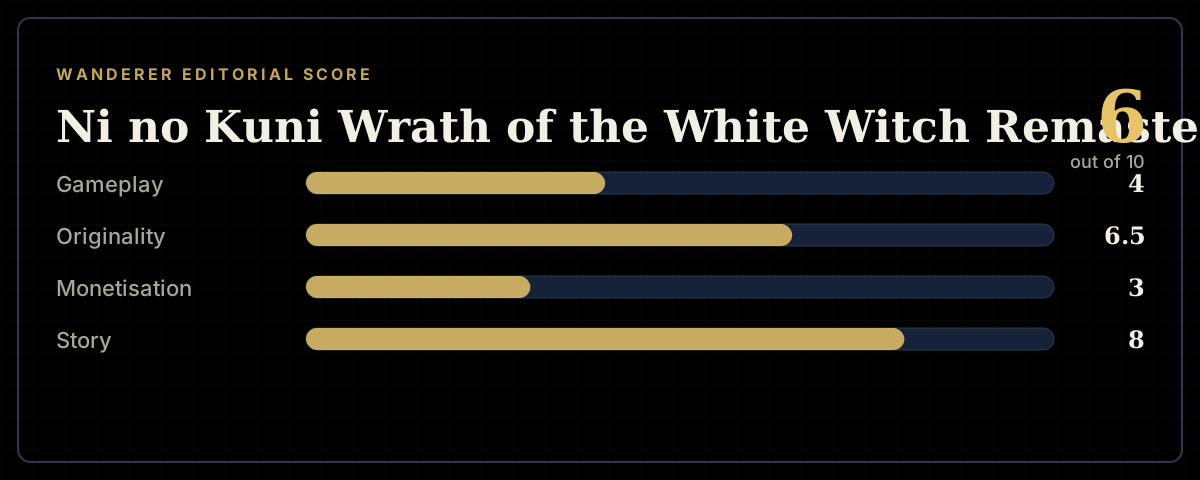
6 / 10
- Developer
- LEVEL5 Inc., QLOC
- Publisher
- BANDAI NAMCO Entertainment
- Released
- 19 September 2019
- Platforms
- Windows
- Genre
- RPG
- Monetisation
- Paid, no in-app purchases found
- Players
- false
The short version
Ni no Kuni Wrath of the White Witch Remastered brings Level-5's collaboration with Studio Ghibli to modern PCs: animated cutscenes indistinguishable from a real Ghibli film, a Joe Hisaishi score, and a gentle, emotionally resonant fairy-tale story about a boy trying to bring his mother back from the dead. Nearly every reviewer, positive or negative, agrees on that much. Where the corpus splits sharply is the actual combat system underneath that presentation, which a large and detailed share of reviewers call genuinely broken — and a separate, long-documented review alleges Bandai Namco tried to suppress a specific complaint about the game's privacy policy.
Biggest strengths
- Genuinely stunning Studio Ghibli-animated cutscenes and a Joe Hisaishi soundtrack that draw essentially universal praise across the entire review corpus, including from the game's harshest critics
- A gentle, emotionally resonant fairy-tale story that multiple reviewers describe as personally meaningful, with at least one crediting the game with helping them through a genuinely difficult period in their life
- A distinctive creature-collector layer blending familiar Pokemon-style mechanics into a classic JRPG structure, refining established ideas rather than reinventing them
Biggest weaknesses
- A dominant, extensively detailed complaint that the real-time-meets-turn-based combat system is "atrocious," with party members and familiars sharing a single HP and magic pool, meaning one careless hit can drain the whole team's resources at once
- Multiple reviewers independently describe familiar AI as poor and largely unresponsive beyond broad presets like "attack my target," offering little real tactical control during fights
- A specific, serious, long-documented allegation: a heavily-upvoted review with edits spanning 2019 to 2024 states Bandai Namco's in-game privacy policy collects unusually extensive personal and demographic data for a single-player game, and that the publisher filed a complaint attempting to have the review removed, which Steam support subsequently reinstated
Who it's for: Studio Ghibli fans and JRPG players who can tolerate, or actively enjoy, an old-school 2011-era turn-based/real-time hybrid combat system with real rough edges.
Our recommendation: Play it for the story and presentation on easy difficulty, skip every optional fight you can, and read the game's actual privacy policy before installing given the specific allegations documented below.
6 / 10
What it is
Ni no Kuni Wrath of the White Witch Remastered brings Level-5's acclaimed 2011 collaboration with Studio Ghibli to modern PC, following young Oliver into a fantastical parallel world after the death of his mother, accompanied by an eccentric fairy guide and a growing roster of collectible "familiars" fought alongside him in battle. The presentation is the game's calling card: cutscenes animated directly by Studio Ghibli sit alongside a Joe Hisaishi orchestral score, giving the whole experience the unmistakable look and sound of a real Ghibli film rather than a game merely inspired by one. It released on Steam on 19 September 2019 at NZD 79.95, developed by Level-5 with porting work by QLOC, and published by Bandai Namco.
Its review corpus, 2,484 in English, sits at a strong Very Positive 83.4% (2,072 to 412), but reading through both the positive and critical sides in depth reveals a game whose reputation rests almost entirely on one half of its identity while carrying real, well-documented problems in the other.
Presentation that silences almost every critic
It's genuinely rare to find a review corpus this consistent on a single point regardless of overall verdict. "It's Studio Ghibli Poke-DragonQuest. And it's kind of a modern classic," writes one reviewer, praising art design, music and animated cutscenes as "just what you'd expect: charming and gorgeous." Even the corpus's most scathing critics agree: "This is one of the most beautiful, charming games in existence. It looks gorgeous, it sounds gorgeous, and the Ghibli charm functions perfectly," writes one reviewer immediately before pivoting to call the combat "not just bad: absolutely atrocious." Several reviewers describe genuine emotional impact from the story specifically — one credits the game, played during "a pretty dark place" in their life, with providing hope when they were "about ready to give up," language that goes well beyond typical praise for a video game's narrative.
A combat system a large, detailed contingent calls broken
Set against that presentation, this corpus contains an unusually large and specific volume of combat criticism, repeated independently across dozens of reviews using strikingly similar language. "The battle system is janky, you have almost no control over your party members' behavior aside from very general preset patterns," writes one detailed reviewer, adding that "the AI of your party is really bad and hardly any help." A separate, especially detailed account goes further: the game's own store page "describes it as an exciting battle system that combines real time and turn based tactical elements," but this reviewer argues "combat is precisely what this game fails at," citing a shared HP and magic pool across the whole party as a specific structural flaw — a careless hit against one familiar drains resources the whole team depends on. A third reviewer, who played on easy difficulty specifically hoping to "focus on the story," reports feeling "severely behind and weak" regardless, describing menu navigation during fights as taking "10 minutes scrolling through a menu to get to the defend button," and noting no fast travel unlocks for "almost 20+ hours" into a game whose default movement speed is already, in their words, "excruciatingly slow." That reviewer's closing advice is blunt: "don't play this game, watch it."
A serious, long-documented privacy allegation
Beyond gameplay, this review needs to flag a specific, unusually persistent claim on its own merits. One review, carrying nearly 3,000 upvotes and edited repeatedly across five years (2019 through 2024), states that the game's in-game privacy policy collects data the reviewer calls "nothing short of Orwellian" for a single-player title, comparing it unfavourably to both Steam's own data practices and Bandai Namco's disclosure for a separate title, Code Vein. The same review documents contacting Bandai Namco directly for clarification and receiving no response, then states that "Bandai Namco complained and got my Steam review taken down" before Steam support restored it, "since... there was never anything against it in the first place." This review cannot independently verify Bandai Namco's internal actions beyond the reviewer's own account, but the specificity, persistence across half a decade of edits, and the review's high vote count make it a serious allegation worth reading directly and weighing carefully — anyone considering this purchase should examine the game's actual privacy policy for themselves before installing.
What the achievement data adds
Ni no Kuni's achievement completion curve shows a real, if fairly typical, drop-off shape: early milestones sit at 79.6% and 64.9%, before a meaningful cluster of mid-game achievements settles around 26-27%, and the hardest late-game and completionist achievements fall to 1.7-2.8%. That's a smoother, more gradual decline than some of the "genuinely broken" complaints above might suggest — if the combat system were universally unplayable, a much steeper, earlier cliff would be more likely. Instead, the shape is consistent with a real split reception: a meaningful share of players push well into the game's midgame content despite the combat friction documented above, while a smaller, dedicated group completes it fully. That's a useful counterweight to the loudest complaints without dismissing them — the combat system clearly frustrates a substantial and vocal portion of the playerbase, but it doesn't appear to stop the majority from engaging with a meaningful chunk of the game's content regardless.
Weighing the privacy allegation responsibly
It's worth being explicit about how this review is handling the privacy and review-removal allegation, since it's a serious claim resting on one detailed account rather than something this review independently confirmed through Bandai Namco or Steam directly. The claim is treated here as exactly that — a specific, persistent, high-visibility allegation from a named reviewer's own documented account, edited and reaffirmed across five years, rather than as an established fact this outlet has verified through its own investigation. That distinction matters for how a reader should weigh it: the persistence and detail lend real credibility, and the underlying advice — read the actual privacy policy yourself before installing — is sound regardless of how the review-removal claim specifically is ultimately judged. Readers concerned about data collection in single-player games should treat this as a strong prompt to investigate directly rather than as a settled verdict against the publisher.
Verdict
Ni no Kuni Wrath of the White Witch Remastered delivers presentation and storytelling that earns its reputation as a genuine visual and emotional achievement, agreed upon almost unanimously across its own review corpus. But an extensively documented, structurally specific combat problem, real padding concerns, and a serious, still-unresolved allegation about the publisher's data practices and conduct toward a critical reviewer are not footnotes — they're central to an honest account of what buying this game actually involves. Worth it for the story and world on easy mode with patience for the fighting; worth real caution around everything else documented here.
Pros and cons
Pros
- Genuinely stunning Studio Ghibli-animated cutscenes and a Joe Hisaishi soundtrack that draw essentially universal praise across the entire review corpus, including from the game's harshest critics
- A gentle, emotionally resonant fairy-tale story that multiple reviewers describe as personally meaningful, with at least one crediting the game with helping them through a genuinely difficult period in their life
- A distinctive creature-collector layer blending familiar Pokemon-style mechanics into a classic JRPG structure, refining established ideas rather than reinventing them
- Reported strong PC port performance, with at least one reviewer specifically noting the remaster runs smoothly even on aging hardware
Cons
- A dominant, extensively detailed complaint that the real-time-meets-turn-based combat system is "atrocious," with party members and familiars sharing a single HP and magic pool, meaning one careless hit can drain the whole team's resources at once
- Multiple reviewers independently describe familiar AI as poor and largely unresponsive beyond broad presets like "attack my target," offering little real tactical control during fights
- A specific, serious, long-documented allegation: a heavily-upvoted review with edits spanning 2019 to 2024 states Bandai Namco's in-game privacy policy collects unusually extensive personal and demographic data for a single-player game, and that the publisher filed a complaint attempting to have the review removed, which Steam support subsequently reinstated
- A padding complaint that only roughly 10 hours of unique story content exist within a much longer runtime, with the rest filled by repetitive side quests and grinding
- No fast travel unlocked for 20-plus hours according to multiple reviewers, compounding an already slow default movement speed across a large open world
- A documented post-launch update introduced a bug causing button inputs to register as multiple presses, with a community-made workaround required since no official fix has been confirmed
Screenshots
-

Ni no Kuni Wrath of the White Witch™ RemasteredImage: BANDAI NAMCO Entertainment via Steam -

Ni no Kuni Wrath of the White Witch™ RemasteredImage: BANDAI NAMCO Entertainment via Steam -

Ni no Kuni Wrath of the White Witch™ RemasteredImage: BANDAI NAMCO Entertainment via Steam -
How the review scores each part of the gameWanderer Editorial -
The short versionWanderer Editorial