
Game review
Nelke & the Legendary Alchemists ~Ateliers of the New World~
5 / 10
- Developer
- KOEI TECMO GAMES CO., LTD.
- Publisher
- KOEI TECMO GAMES CO., LTD.
- Released
- 25 March 2019
- Platforms
- Windows
- Genre
- RPG
- Monetisation
- Paid, no in-app purchases found
- Players
- false
The short version
Nelke & the Legendary Alchemists gathers protagonists from across the Atelier series into a single crossover story, but builds that story around a town-management and resource-production sim rather than the alchemy-crafting loop the series is actually known for. That structural swap is the single dominant conversation in its own review corpus, argued in detail by its two most-upvoted reviews, and it's compounded by a genuinely punishing failure mechanic, a poorly optimised PC port, and over an hour of low-interactivity intro before the actual game opens up.
Biggest strengths
- A genuine, extensive crossover cast pulling protagonists from across the Atelier series into one story, which existing fans consistently describe as the game's real draw
- A management loop that several reviewers describe as genuinely addictive once its systems click, assigning characters to production, crafting, selling or resource-gathering roles based on individual strengths
- Distinctive, well-liked art and character writing consistent with the wider Atelier series' reputation
Biggest weaknesses
- The two most-upvoted reviews in the entire corpus both warn, in different words, that this "has nothing to do with being an alchemist" despite the Atelier branding, disappointing players expecting the series' core loop
- A genuinely punishing failure mechanic: miscalculating resource chains (for example, insufficient wool feeding into cloth production) can trigger a city-damaging disaster event with "insurmountable repair costs," costing hours of progress over what one detailed reviewer calls "a slight miscalculation"
- Documented PC port quality issues, including poor optimisation requiring a high-power GPU setting for consistent frame rates, and a fullscreen mode that stretches the image incorrectly on non-16:9 monitors — the same specific bug found in this lane's review of the same publisher's Atelier Lulua
Who it's for: Existing Atelier fans specifically curious about the character crossover, who are prepared for a management sim rather than another alchemy RPG, and newcomers who enjoy town-builders with heavy visual-novel text.
Our recommendation: Skip it if you're hoping for a proper Atelier alchemy game; consider it only as a management-sim curiosity for series fans who know exactly what they're getting into first.
5 / 10
What it is
Nelke & the Legendary Alchemists positions itself as a celebration of the Atelier series' history, gathering protagonists from across multiple prior games into a single crossover story centered on Nelke, a determined young noblewoman tasked with building a thriving frontier town. Where the choice gets structurally significant is in what kind of game that premise actually becomes: rather than the alchemy-crafting RPG loop the Atelier series is built around, Nelke runs as a turn-based town- management sim, assigning recruited characters to production, crafting, selling or resource-gathering roles across day-by-day cycles, with an overarching goal of growing the settlement's population and economy. It released on 25 March 2019 at NZD 76.49, developed and published by Koei Tecmo.
Its review corpus, thin but real at 75 English-language reviews, sits at a genuinely divided Mixed 69.3% (52 to 23). Reading through it in depth reveals a corpus dominated by one specific, structural disagreement, argued in unusual detail by its most-read reviews.
The genre swap that defines the conversation
The two highest-voted reviews in the entire corpus, by a wide margin over everything else, both make essentially the same argument from different angles. The top review opens with a direct warning to anyone hoping for "a relaxing way to pass your after work hours" getting "warm and cozy with the cute anime girls from the Atelier series," advising them to "turn around and walk away from this game right now" if that's the appeal they're after. The second-highest, a self-described longtime Atelier fan, states the complaint even more bluntly: "an Atelier game that has nothing to do with being an alchemist." That's a remarkably consistent, specific critique to see dominate a corpus this size, and it points to something more substantial than ordinary taste disagreement — a real mismatch between what the Atelier branding leads buyers to expect and what the game structurally delivers. Several other reviewers independently reach the same conclusion in their own words: "really different from the other atelier games," "not an atelier game rather a town building/management game," "a mediocre city building game that has nothing to do with being an alchemist."
A genuinely severe punishment for small mistakes
Beyond the genre question, one specific, detailed complaint deserves attention on its own merits: the game's resource-management systems can produce catastrophic consequences from comparatively minor miscalculations. One reviewer, a self-identified "huge Atelier fan," describes losing "hours of progress" because "a slight miscalculation" in wool production left insufficient cloth to prevent "an arbitrary disaster" that demolished half their city, leaving "insurmountable repair costs" behind. That's a severity mismatch between cause and consequence that goes beyond typical management-game difficulty — a single supply-chain oversight erasing substantial accumulated progress is the kind of design choice that punishes experimentation and learning-by-doing far more harshly than the genre generally expects.
A rough port on top of a contested game
Technical quality draws its own specific, documented complaints. One detailed reviewer flags the game as "badly optimized," requiring a high TDP power setting to maintain consistent frame rates even on capable hardware, and separately notes the in-game fullscreen option "stretch[es] the image on non 16:9 screens," recommending the third-party tool Lossless Scaling as a workaround. That's the identical specific bug this lane documented in the same publisher's Atelier Lulua, suggesting a shared, unaddressed technical shortfall across Koei Tecmo's PC ports from this era rather than an isolated incident. A separate complaint concerns the opening experience specifically: "a long, more than 1 hour long intro of not being able to do anything except for click on the indicated button," with no option to skip through it, before the actual management gameplay opens up.
What its defenders find here
None of this means the game lacks real defenders. Several reviewers describe the management loop as genuinely addictive once its systems are understood, with one calling it "simple but addictive" once past an initially overwhelming learning curve, and another crediting Koei Tecmo's subsidiary Gust with successfully "translat[ing] their alchemy games to a town management sim" despite acknowledged shallowness in both the combat and management depth individually. For existing fans specifically drawn to seeing characters from across the wider Atelier series interact in one crossover story, that appeal is real and repeatedly cited — the disagreement in this corpus isn't about whether the crossover concept has value, only about whether the town-management structure built around it delivers what most buyers actually came for.
What the achievement data suggests about the drop-off
The completion curve across Nelke's 50 achievements shows a genuinely steep divide worth reading alongside the genre-mismatch complaint above. A cluster of achievements sits in a relatively healthy 56-68% range, suggesting a solid majority of buyers engage with the game's basic early systems. But the drop to the harder tier is severe: most remaining achievements cluster in single digits, from roughly 4% to 6%. That's a steeper collapse than a typical management game's difficulty curve alone would produce, and it's consistent with a specific, plausible reading: players who came in expecting an Atelier alchemy game, per the corpus's dominant complaint, may disengage relatively early once the town-management structure becomes clear, rather than sticking around to master its deeper systems the way a genre fan going in with accurate expectations might. As with similar patterns in other reviews this lane has covered, this is a coherent, evidence-consistent explanation rather than a proven one — the achievement data alone can't distinguish disappointed early quitters from players who simply found the mid-game less engaging for unrelated reasons.
A fair comparison point within the same publisher's catalogue
It's worth directly connecting this game's reception to this lane's separate review of Atelier Lulua, published by the same studio in the same year. Where Lulua's review corpus focused almost entirely on DLC and season-pass structure as its central complaint against an otherwise beloved core game, Nelke's corpus is preoccupied with something more fundamental — whether the game is the kind of Atelier experience its branding promises in the first place. That's a meaningfully different, more serious category of disappointment: a pricing structure complaint doesn't undermine enjoyment of the base game itself, but a structural genre mismatch can undermine the entire premise a buyer purchased the game for. Prospective buyers already familiar with the wider Atelier catalogue should weigh that distinction directly rather than assuming consistent quality or design philosophy across every entry released under the same umbrella in the same year.
Verdict
Nelke & the Legendary Alchemists asks Atelier fans to accept a genuine structural swap — a management sim wearing the series' crossover cast rather than another entry in its actual gameplay identity — and its own review corpus's most-read voices are clear that this swap disappointed a meaningful share of buyers. A severely punishing failure mechanic and documented PC port issues compound the risk further. Worth considering only for series devotees specifically drawn to the character crossover who go in with accurate, adjusted expectations about what kind of game they're actually buying.
Pros and cons
Pros
- A genuine, extensive crossover cast pulling protagonists from across the Atelier series into one story, which existing fans consistently describe as the game's real draw
- A management loop that several reviewers describe as genuinely addictive once its systems click, assigning characters to production, crafting, selling or resource-gathering roles based on individual strengths
- Distinctive, well-liked art and character writing consistent with the wider Atelier series' reputation
- A reasonable, low-pressure entry point for series newcomers according to some reviewers, once the confusing opening hours are past
Cons
- The two most-upvoted reviews in the entire corpus both warn, in different words, that this "has nothing to do with being an alchemist" despite the Atelier branding, disappointing players expecting the series' core loop
- A genuinely punishing failure mechanic: miscalculating resource chains (for example, insufficient wool feeding into cloth production) can trigger a city-damaging disaster event with "insurmountable repair costs," costing hours of progress over what one detailed reviewer calls "a slight miscalculation"
- Documented PC port quality issues, including poor optimisation requiring a high-power GPU setting for consistent frame rates, and a fullscreen mode that stretches the image incorrectly on non-16:9 monitors — the same specific bug found in this lane's review of the same publisher's Atelier Lulua
- An intro sequence running over an hour with minimal player interaction beyond clicking indicated prompts, and no way to skip through it
- A recurring "staying busy simulator" complaint from reviewers who found meeting the game's constant task requirements repetitive rather than genuinely rewarding
Screenshots
-

Nelke & the Legendary Alchemists ~Ateliers of the New World~Image: KOEI TECMO GAMES CO., LTD. via Steam -

Nelke & the Legendary Alchemists ~Ateliers of the New World~Image: KOEI TECMO GAMES CO., LTD. via Steam -

Nelke & the Legendary Alchemists ~Ateliers of the New World~Image: KOEI TECMO GAMES CO., LTD. via Steam -
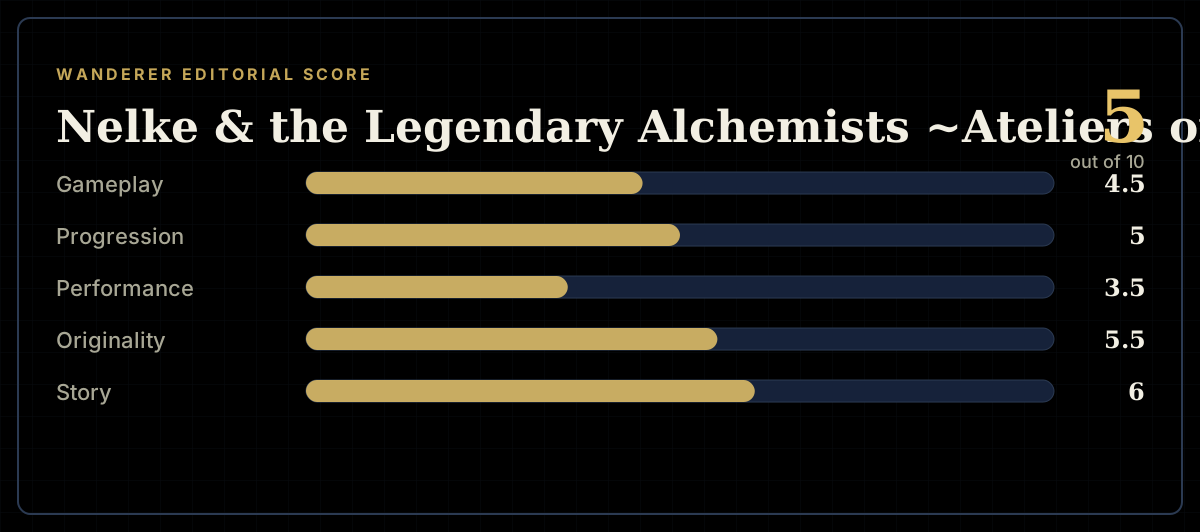
How the review scores each part of the gameWanderer Editorial -
The short versionWanderer Editorial