
Game review
Mutazione
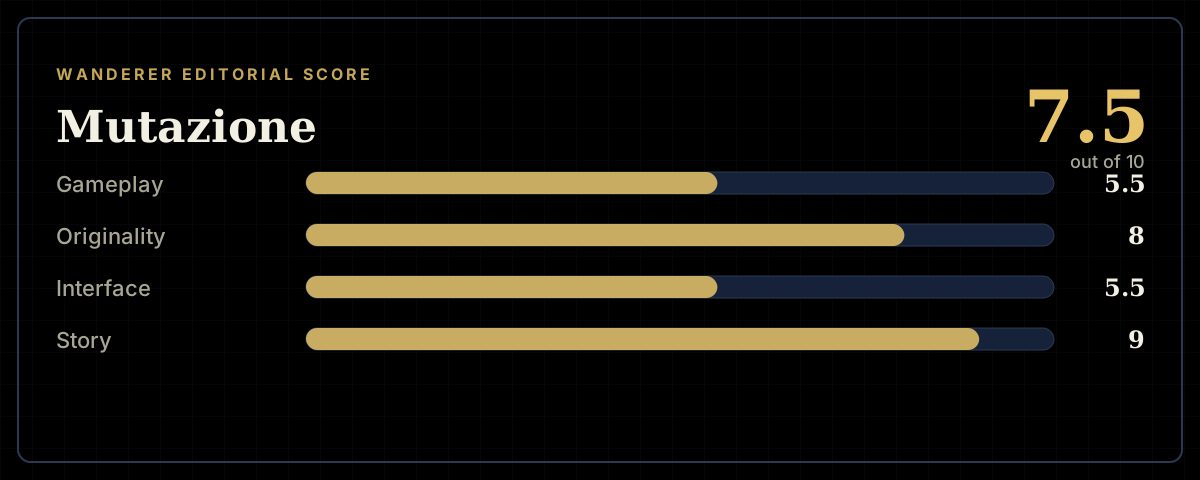
7.5 / 10
- Developer
- Die Gute Fabrik
- Publisher
- Akupara Games
- Released
- 19 September 2019
- Platforms
- Windows
- Genre
- Adventure
- Monetisation
- Paid, no in-app purchases found
- Players
- false
The short version
Mutazione casts players as Kai, travelling to the island of Mutazione to be with her ailing grandfather and finding herself drawn into the lives of its ensemble cast of mutated, deeply human residents. The developer's own description — a 'mutant soap opera' — is exactly right: this is a slow, character-driven story about community, tended gardens, and long conversations, and its 95.9% positive rating reflects a review corpus full of genuinely personal, sometimes soul-touched testimonials. A smaller, detailed minority argues the game's pacing and unclear objectives undercut that experience with real tedium.
Biggest strengths
- Exceptional, widely and specifically praised writing and ensemble cast, with reviewers describing individual characters as feeling fully alive rather than functional NPCs
- A distinctive, colourful art style and sound direction that reviewers consistently single out as immediately striking
- A genuinely rare sense of community and belonging that builds gradually across the story, drawing direct and favourable comparisons to Oxenfree and Night in the Woods
Biggest weaknesses
- A specific, detailed complaint about unclear objective sequencing, leading to long, unrewarding backtracking walks across the island when the game doesn't clearly signal who to talk to next
- The central gardening mechanic's purpose and payoff are, by at least one detailed account, never made clear, leaving some players unsure why they're harvesting or what long-term value it provides
- Dialogue options can feel narrow, a natural consequence of Kai being a fully-written, specific character rather than a blank player-insert, though this reads as a deliberate trade-off some players simply don't prefer
Who it's for: Fans of slow, dialogue-heavy narrative games (Oxenfree, Night in the Woods) who value a strong ensemble cast and sense of place over clear mechanical goals or fast pacing.
Our recommendation: A near-essential pick for narrative-adventure fans who value writing and atmosphere above all else — just be prepared for some genuinely unclear objective design along the way.
7.5 / 10
What it is
Mutazione follows Kai, granddaughter of an elderly scientist who has fallen ill on his island home, as she travels to be by his side and finds herself gradually drawn into the daily lives of the island's residents — a community of mutated but deeply human characters navigating relationships, grudges, grief and small joys. Developer Die Gute Fabrik describes it themselves as a "mutant soap opera," and reviewers consistently agree that's exactly the right frame: this is a slow, dialogue- driven experience built around returning to the same handful of locations and characters repeatedly, tending a garden, and watching an ensemble cast's interconnected stories unfold in something closer to episodic television pacing than a traditional game structure.
It released on 19 September 2019 at NZD 28.99, published by Akupara Games. Its review corpus, while modest at 686 English-language reviews, sits at an exceptionally lopsided 95.9% positive — one of the more consistently glowing ratios this lane has documented — and reading through it reveals writing this outlet rarely sees applied to a game review: reviewers describing Mutazione as something that "wormed its way into my very soul" or became "a daily companion."
What earns that devotion
The praise here is remarkably specific and personal rather than generically positive. One reviewer opens with a piece of early dialogue — "I've never seen someone die before." "I've never died before! It'll be an adventure for both of us." — calling it representative of a tone that's "beautiful, melancholy, hopeful, very real." Another states plainly, "the real treasure was the friends we made along the way," describing every character as someone "you seek out to talk to every chance you get." A detailed comparison to Oxenfree specifically credits Mutazione with capturing that game's "slow, investigate-y, story-telling" quality without needing horror or dread to sustain tension, while another reviewer frames it as "a less sad version of A Night in the Woods." Multiple reviewers independently describe a genuine, rare sense of yearning for community that the game builds gradually and earns rather than states outright — exactly the kind of specific, hard-to-fake emotional resonance that distinguishes a truly well-written narrative game from a merely competent one.
Where the pacing loses some players
Set against that near-unanimous devotion is a smaller, detailed critical thread worth taking seriously precisely because it comes from reviewers who clearly wanted to love the game and didn't quite get there. One writes bluntly: "I really wanted to love this game, but I feel disappointed," crediting the art and design as "wonderful" while describing "everything" else as "so tedious" — specifically citing long walks across multiple screens to meet a character who turns out not to be there, requiring a journal check and a full walk back once the actual next objective becomes clear. That same reviewer raises a second, more structural complaint: the gardening mechanic never reveals its own purpose clearly enough to feel motivated, leaving them "waiting for that game mechanic to fully reveal itself" without ever getting a satisfying answer to why harvesting mattered beyond producing "more seeds." They also note that dialogue options felt narrow, attributing this specifically to Kai being written as a complete, specific character rather than a more neutral player-insert — a fair observation about a genuine design trade-off, even if it reads to other players as a deliberate strength rather than a limitation.
A game that knows it's niche
Notably, several of the game's most enthusiastic defenders are candid about its narrow appeal rather than claiming universal greatness. "It would absolutely have an incredibly dedicated fanbase if it wasn't so niche," writes one, framing the game's slow pace and dialogue-heavy structure as a real, specific taste rather than something that should appeal broadly. That kind of self-aware, honest enthusiasm — loving something specifically for what it is rather than overselling it as a mass-market must-play — lends real credibility to the praise throughout this corpus, and it's worth reading the tedium complaints above with that context in mind: the pacing and structure the critical reviewer found frustrating are, for the game's core audience, exactly the deliberate rhythm that makes its slower, more contemplative approach to storytelling work.
What the achievement data shows about the garden's role
The completion curve across Mutazione's 20 achievements offers a useful, if partial, answer to the gardening-purpose complaint above. Early gardening-related achievements — "GreenFingers," "ApprenticeBotanist" — sit around 38-45%, roughly in line with general story-progression milestones like the first chapter (75.1%), suggesting most players do engage with the mechanic at a basic level without it being an optional system many skip entirely. But more specific gardening achievements — "RebelGardener" at 5.7%, "Vegan" at 4.0% — sit right alongside the game's rarest completion-based achievements, indicating that whatever deeper payoff the gardening system offers exists but is pursued by only a small, dedicated fraction of the playerbase. That's consistent with a system that functions adequately as background texture for most players without ever becoming a system worth mastering for its own sake — plausible support for the critical reviewer's specific complaint that its purpose never becomes fully clear, even if a modest number of more dedicated players do find something to chase within it.
The visual-novel-versus-adventure-game framing
One detailed review offers a useful reframing worth passing along directly: describing Mutazione as "a soap opera presented in the form of a fusion of visual novel and walking simulator," explicitly citing soap opera as a defined genre term — "long-running, character-driven, ensemble-cast, slices of life" — rather than a dismissive comparison. That framing helps explain why some players bounce off the pacing that others find so rewarding: judged as a traditional adventure game with puzzles and clear objectives, the loose, wandering structure reads as underdeveloped; judged as an interactive soap opera whose whole point is spending unstructured time with a cast you come to care about, the same structure reads as exactly right. Prospective buyers unfamiliar with either genre comparison point (Oxenfree, Night in the Woods) might use this soap-opera framing as the more accurate expectation-setter before deciding whether the game's specific rhythm sounds appealing.
Verdict
Mutazione is a genuinely distinctive, deeply loved narrative game that succeeds at something very few games attempt seriously: building a believable, lived-in community and making a player care about its residents' small, ongoing dramas. A real, specific pacing and objective-clarity problem holds it back from being flawless, and the gardening mechanic in particular could use clearer payoff — but for the audience this game is built for, those rough edges are a small price for one of 2019's most emotionally resonant narrative experiences.
Pros and cons
Pros
- Exceptional, widely and specifically praised writing and ensemble cast, with reviewers describing individual characters as feeling fully alive rather than functional NPCs
- A distinctive, colourful art style and sound direction that reviewers consistently single out as immediately striking
- A genuinely rare sense of community and belonging that builds gradually across the story, drawing direct and favourable comparisons to Oxenfree and Night in the Woods
- Real thematic ambition, tackling mature and adult topics with care within an otherwise gentle, colourful presentation
Cons
- A specific, detailed complaint about unclear objective sequencing, leading to long, unrewarding backtracking walks across the island when the game doesn't clearly signal who to talk to next
- The central gardening mechanic's purpose and payoff are, by at least one detailed account, never made clear, leaving some players unsure why they're harvesting or what long-term value it provides
- Dialogue options can feel narrow, a natural consequence of Kai being a fully-written, specific character rather than a blank player-insert, though this reads as a deliberate trade-off some players simply don't prefer
- A niche, specific tone and pace that reviewers themselves acknowledge won't appeal to everyone, even among people who generally enjoy narrative-driven games
Screenshots
-

MutazioneImage: Akupara Games via Steam -

MutazioneImage: Akupara Games via Steam -

MutazioneImage: Akupara Games via Steam -
How the review scores each part of the gameWanderer Editorial -
The short versionWanderer Editorial