
Game review
The Shell Part III: Paradiso
6.5 / 10
- Developer
- Innocent Grey
- Publisher
- Shiravune
- Released
- 21 January 2025
- Platforms
- Windows
- Genre
- Adventure, Indie
- Players
- Single-player
The short version
Biggest strengths
- A genuinely emotional, well-crafted conclusion to a long-running, beloved murder-mystery visual novel trilogy, with reviewers describing a satisfying, tear-inducing wrap-up for returning fans
- Gorgeous, distinctive art direction, even where reviewers note a tonal shift in style from earlier entries
- Strong character payoffs for the protagonist and supporting cast built up across the full trilogy, rewarding long-term investment in the series
Biggest weaknesses
- An extensively and specifically documented translation controversy, with numerous detailed reviews comparing the new publisher's English localization unfavourably against the previous two entries' well-regarded translations, citing specific altered lines and anachronistic joke insertions that change character voice and tone
- Several reviewers argue the central mystery in this final entry is the weakest and most underwritten of the trilogy, despite a strong emotional conclusion
- No honorifics and altered name ordering compared to prior entries, a smaller but specific localization consistency complaint from series veterans
6.5 / 10
The final chapter of a long-beloved mystery trilogy
The Shell Part III: Paradiso closes out a murder-mystery visual novel trilogy following Detective Reiji Tokisaka, whose obsession with an old, unresolved case has haunted him across two prior acclaimed entries. Based on the available English-language review sample, the emotional weight of finally concluding a story fans have followed across multiple games comes through clearly and repeatedly. "Absolute cinema. I was already crying during the grand ending, true ending made me bawl. Whatever Innocent Grey is cooking in the future, I will lap it like a hungry dog," one reviewer writes, and a separate, more measured reviewer frames the achievement in more structural terms: "10/10. It's been a while since an ending has truly left me speechless. This game was a fantastic way to cap off the trilogy, and I couldn't imagine it ending any other way. The art was gorgeous, the music was lovely, the cast of characters — both new and returning — were stellar."
One especially thoughtful reviewer, clearly a long-time series fan, frames the game's climax as the payoff for the entire trilogy's build-up: "Kara no Shoujo 3, the stunning, torturously good conclusion to one of the most uniquely compelling stories out there. Like a twisted obsession, much like Reiji and many of the other afflicted characters, it was almost impossible to stop reading. To see the fruit of the massive buildup in this series, presented so spectacularly in this game, was one of the greatest joys for me."
A translation controversy that dominates the discussion
Set against that emotional praise, the single most consistent, most heavily documented complaint in this review sample concerns the English localization itself, and it's raised with unusual specificity by multiple reviewers independently. "A shame that Shiravune now own the rights to publish KnS in english, I miss MangaGamer and their good translations for the two previous games. This translation as awful as it can be - every minute there is a dialogue with completely different meaning while compared to original text and replacement for OG is usually some millennial style joke," one reviewer writes, providing a direct side-by-side example: where the original Japanese has a character simply cursing in frustration, the new translation replaces it with a crude, out-of-character joke entirely absent from the source text. The same reviewer notes additional consistency complaints specific to long-time series readers: no honorifics preserved, and Japanese names reordered inconsistently with the prior two entries' conventions.
A separate, more measured reviewer corroborates the substance of the complaint while framing it less harshly: "The translation does take its liberties, but is fine in most parts, though it can be a little too transformative for some — there are moments where the phrase(s) are completely altered to accommodate a joke that isn't in the original text." A third reviewer describes a similar frustration built up gradually over a full playthrough: "Enjoying this so far but some of the localized dialogue is terrible... at 8 hours: it's honestly worse than I thought. At one point a character was described as 'all decked out' in a jacket rather than just saying they're 'wearing a jacket.' There is stuff like this every couple of minutes." That degree of independent, specific, example-backed agreement across multiple separate reviews is a much stronger signal than an isolated translation complaint would be — this reads as a genuine, well-documented shift in translation philosophy between publishers rather than a matter of individual taste.
It's worth including the pushback directly, since this review sample isn't unanimous on the point. "First off, the hate on the translation is undeserved, and straight up some JP supremacist garbage. I like the personality both the Chinese and English translation imbued into the prose. Translation is an art in and of itself," one reviewer argues, defending the new localization's creative choices as a legitimate artistic approach rather than a failure — though notably, that same reviewer goes on to criticize the game's story on entirely separate grounds, meaning even this translation-defending review doesn't land as an uncomplicated endorsement overall.
A weaker mystery than its predecessors, by some accounts
Beyond the translation debate, a separate and more measured critical thread concerns the strength of the central mystery itself relative to the trilogy's earlier entries. One detailed review, written by a video reviewer with a dedicated curator page, frames its overall assessment precisely: "Beautiful, heartfelt, and underwritten: The Shell's fantastic finale is also its most underwhelming mystery." That's a specific, considered critical position distinct from the translation controversy entirely — an argument that the emotional and artistic elements land well while the actual detective-fiction plotting underperforms relative to what came before. A separate reviewer frames a similar disappointment more personally: "I came in fully prepared; it would've never met my expectations as the last title of the series, and I was going to accept it. I felt ready to simply admire good art, enjoy a powerful ride through memory lane with Reiji, and call it a day."
One reviewer notes a genuine tonal and stylistic shift specifically tied to a change in the game's artistic presentation: "As a whole, the tone of this episode felt quite different, maybe partially due to the artstyle change, but the entire presentation has a peculiar vibe, feeling very grand and ethereal on one hand" while still landing on an overall positive, if measured, verdict — describing a satisfying but imperfect conclusion rather than either an unqualified triumph or a disappointment.
Where this leaves it
The Shell Part III: Paradiso delivers a genuinely emotional, visually striking conclusion to a long-running, well-regarded mystery visual novel trilogy, rewarding series veterans with real character payoff after a substantial build-up across two prior games. Its most significant, most extensively documented problem is a translation approach under new publisher Shiravune that a large share of detailed reviewers say meaningfully alters character voice and tone from the series' previously well-regarded English localization, backed by specific, side-by-side textual examples rather than vague dissatisfaction — a real, credible concern rather than an isolated complaint, even accounting for reviewers who defend the new approach. Recommended for existing fans of the trilogy specifically invested in seeing Reiji's story through to its end, with a clear-eyed expectation that the translation quality has genuinely shifted from what earlier entries delivered, and that the mystery plotting itself may not match the series' earlier peaks.
Pros and cons
Pros
- A genuinely emotional, well-crafted conclusion to a long-running, beloved murder-mystery visual novel trilogy, with reviewers describing a satisfying, tear-inducing wrap-up for returning fans
- Gorgeous, distinctive art direction, even where reviewers note a tonal shift in style from earlier entries
- Strong character payoffs for the protagonist and supporting cast built up across the full trilogy, rewarding long-term investment in the series
- A defensible, if contested, creative translation approach that at least some reviewers specifically praise for injecting genuine personality into the English script
Cons
- An extensively and specifically documented translation controversy, with numerous detailed reviews comparing the new publisher's English localization unfavourably against the previous two entries' well-regarded translations, citing specific altered lines and anachronistic joke insertions that change character voice and tone
- Several reviewers argue the central mystery in this final entry is the weakest and most underwritten of the trilogy, despite a strong emotional conclusion
- No honorifics and altered name ordering compared to prior entries, a smaller but specific localization consistency complaint from series veterans
- No Steam achievement system exists at all, leaving no structural markers of the game's content scope
Screenshots
-

The Shell Part III: ParadisoImage: Shiravune via Steam -

The Shell Part III: ParadisoImage: Shiravune via Steam -

The Shell Part III: ParadisoImage: Shiravune via Steam -
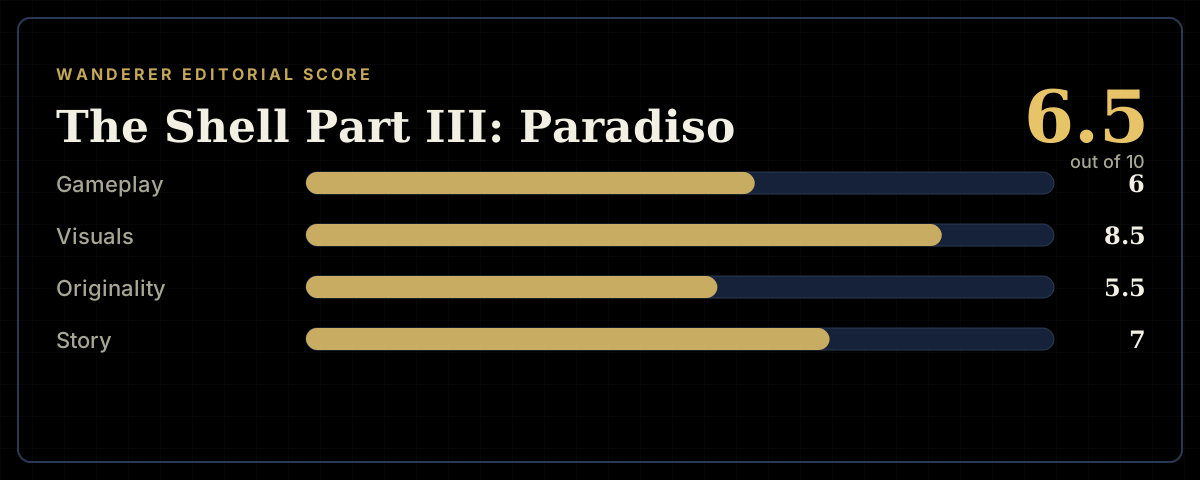
How the review scores each part of the gameWanderer Editorial -
The short versionWanderer Editorial