
Game review
Staffer Reborn
6 / 10
- Developer
- Team Tetrapod
- Publisher
- Team Tetrapod
- Released
- 26 April 2024
- Platforms
- Windows
- Genre
- Supernatural detective visual novel
- Monetisation
- One-time purchase, no in-game store or additional currency purchases
- Players
- Single-player only
The short version
Staffer Reborn is a short, standalone spin-off set in the same 1960s supernatural-conspiracy universe as the developer's earlier Staffer Case, following a man trapped in a cycle of death and resurrection while you piece together the truth through Phoenix Wright-style investigation and deduction. This review's sample is consistently warm toward its striking monochromatic visual style and its supernatural noir premise, but nearly every review — positive and negative alike — frames the game primarily by its length, describing a compact one-to-four-hour experience best understood as a modest bonus case for existing fans rather than a substantial entry point in its own right.
Biggest strengths
- The monochromatic visual style with red accents draws specific, consistent praise for its striking aesthetic and thematic fit with the story's noir sensibilities
- The supernatural premise, involving a character caught in a cycle of death and resurrection, is credited by multiple reviewers as a genuinely intriguing hook that elevates the investigation format beyond a straightforward detective story
- Voice acting is specifically praised even by reviewers otherwise critical of the game's value, with one reviewer noting its quality even in a language they didn't understand
Biggest weaknesses
- The single most repeated theme across nearly every review, positive and negative alike, is that the game is very short, with multiple reviewers reporting full completion including achievement hunting in well under four hours
- Several reviewers directly compare it unfavorably to the original Staffer Case, describing the story and gameplay here as less impressive and recommending buyers play the first game instead if choosing between the two
- At least two reviewers argue the content-to-price ratio doesn't hold up even at its modest cost, with one describing it as feeling like it "should have been a demo" or a free release rather than a paid standalone title
Who it's for: Existing fans of Staffer Case looking for a short continuation in the same universe, and newcomers to Phoenix Wright-style investigation games curious to sample the format in a brief, low-cost package before committing to a longer entry in the genre.
Our recommendation: A pleasant, well-made but genuinely brief detective story best purchased on sale, ideally after playing the original Staffer Case first — go in expecting a couple of hours of content rather than a full-length mystery game.
6 / 10
Staffer Reborn drops you into a 1960s America where a renowned military figure cannot seem to die, and a supernatural conspiracy simmers beneath the surface of an otherwise straightforward investigation. Built as a standalone spin-off to the developer's earlier Staffer Case, it follows the same Phoenix Wright-style structure of gathering evidence and pressing testimony to unravel the truth, dressed in a striking monochromatic visual style. This review's sample is warm toward almost everything the game does — with one significant, near-universal caveat about how much of it there actually is.
A distinctive style wrapped around a compelling hook
The visual presentation earns specific, consistent credit. "A succinct visual novel experience that delivers a number of very satisfying reveals. I also appreciate the monochromatic visuals, making the red accents stand out," one reviewer writes, a sentiment echoed across nearly every review in the sample regardless of length complaints. The supernatural premise itself draws real intrigue too: "Excellent but short story in the Staffer universe, a crime story set in the 60s but with magic and supernatural abilities is a pretty cool premise. Like the first game, it's a Phoenix Wright-like visual novel with some investigation puzzles," another reviewer notes. A third, clearly invested in the wider series, offers a considered rating: "Staffer Reborn is a compact but deeply engaging supernatural mystery in the same universe as Staffer Case. Set in 1960s America, you play a" character navigating both the investigation and the strange rules governing the central character's inability to stay dead.
The theme nearly everyone returns to
What's most striking about this review's sample is how consistently reviewers frame their assessment around runtime, whether they ultimately recommend the game or not. "Though the game was very simple, it was still good. It was a relatively quick playthrough," one positive reviewer writes, going on to note they wished for more given how much they'd enjoyed the original Staffer Case. Another positive review is even more direct about managing expectations: "One case in the world of the series... it works, but I'd recommend getting this on a sale. It's short and not very difficult (Max 2-4 hours if you achievement hunt)." On the more critical end, one reviewer writes plainly: "This should have been a demo. There is simply not enough content to warrant the price tag, even at $5." That range — from "short but satisfying" to "should have been free" — captures the real spread of opinion in this sample, but the underlying observation about length is remarkably uncontested either way.
A direct, informed comparison to the original
Several reviewers explicitly measure Staffer Reborn against its predecessor, and the comparison isn't always favorable. "Compared to the original Staffer Case, Staffer Reborn is somewhat disappointing. The story is less impressive, and so is the game play. Almost feels like a tech demo or a game that should have been free," one reviewer writes — a genuinely informed critique from someone clearly familiar with the developer's stronger earlier work. Multiple other reviewers echo a gentler version of the same advice, recommending newcomers play Staffer Case first both to avoid mild spoilers and because it represents the stronger overall experience. That's useful, specific guidance for anyone deciding where to start with this small series rather than a vague "it's fine I guess" shrug.
A thin sample worth acknowledging directly
This review found only 75 total English-language reviews for Staffer Reborn, with just 5 of those negative — a considerably thinner sample than most titles in this review series, and one this review flags directly rather than treating the resulting picture as fully representative of the broader playerbase's views. The consistency across that small sample — nearly everyone agreeing on both the game's charm and its brevity — offers some confidence in the pattern, but readers should weigh this review's conclusions with that limited sample size in mind.
What the achievement data confirms about scope
Steam's own completion figures back up the "short main story, modest optional content" picture directly. The two primary story-progression achievements sit at a strong 89.9% and 91.6%, confirming nearly everyone who starts the game finishes its main narrative. Four optional sub-achievements, by contrast, sit considerably lower at 35.3% to 42.5% — not a severe cliff, but a real gap suggesting a meaningful minority of players don't chase every optional thread once the central mystery concludes, consistent with a game whose main content is genuinely brief.
A small franchise that's quietly thriving
Whatever this review's length-related criticisms, they shouldn't be read as evidence of a neglected release. Staffer Reborn's partner-events feed tells a genuinely encouraging story: a clean April 2024 launch followed by several bug-fix and translation patches, a 2024 BIC award win, a console distribution deal for both Staffer titles, and — extending well into 2025 and 2026 — an entirely new card-game spinoff (Dice Eater) and a retro prequel title (Staffer Retro). Team Tetrapod has clearly built a small, sustainable franchise around this universe rather than moving on after one release.
Final verdict
Staffer Reborn is a stylish, well-crafted, and genuinely brief supernatural detective story that delivers real atmosphere and a compelling premise without ever quite escaping the shadow of its stronger predecessor. Buy it on sale as a pleasant follow-up if you've played and enjoyed Staffer Case, or as a low-cost taste of the format if you're new to Phoenix Wright-style mysteries — just set your expectations for a couple of hours, not a full-length mystery game.
Pros and cons
Pros
- The monochromatic visual style with red accents draws specific, consistent praise for its striking aesthetic and thematic fit with the story's noir sensibilities
- The supernatural premise, involving a character caught in a cycle of death and resurrection, is credited by multiple reviewers as a genuinely intriguing hook that elevates the investigation format beyond a straightforward detective story
- Voice acting is specifically praised even by reviewers otherwise critical of the game's value, with one reviewer noting its quality even in a language they didn't understand
- Steam's own partner-events feed documents an exceptionally active, thriving small franchise around this title, including a spinoff card game, a retro prequel, a console distribution deal, and a genre award, confirming genuine ongoing investment rather than a one-off release
- The standalone structure allows newcomers to sample the Staffer universe's tone and investigation mechanics without a large time commitment, serving as a reasonable low-risk entry point into the series
Cons
- The single most repeated theme across nearly every review, positive and negative alike, is that the game is very short, with multiple reviewers reporting full completion including achievement hunting in well under four hours
- Several reviewers directly compare it unfavorably to the original Staffer Case, describing the story and gameplay here as less impressive and recommending buyers play the first game instead if choosing between the two
- At least two reviewers argue the content-to-price ratio doesn't hold up even at its modest cost, with one describing it as feeling like it "should have been a demo" or a free release rather than a paid standalone title
- The English-language review sample for this title is notably thin at only 75 reviews total, a limitation this review flags directly rather than treating the resulting picture as fully representative
- Achievement data shows a fairly steep falloff between the two main-story achievements (89.9-91.6%) and four optional sub-achievements (35.3-42.5%), consistent with reviewer reports that most players finish the short main story but don't feel compelled to fully explore every optional branch
Screenshots
-

Staffer RebornImage: Team Tetrapod via Steam -

Staffer RebornImage: Team Tetrapod via Steam -

Staffer RebornImage: Team Tetrapod via Steam -
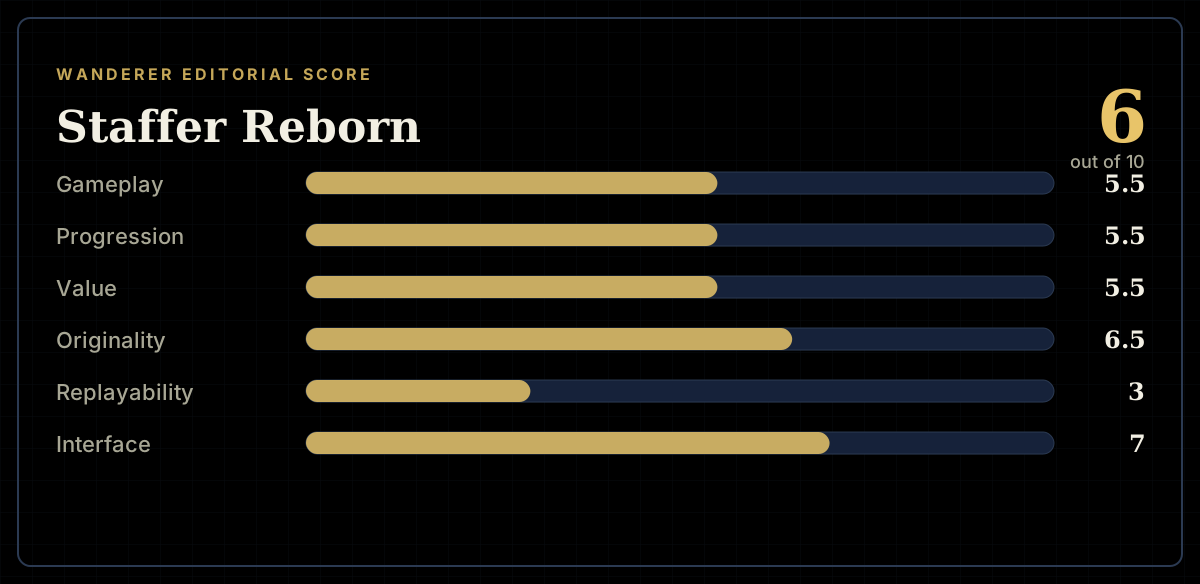
How the review scores each part of the gameWanderer Editorial -
The short versionWanderer Editorial