
Game review
Moonstone Island
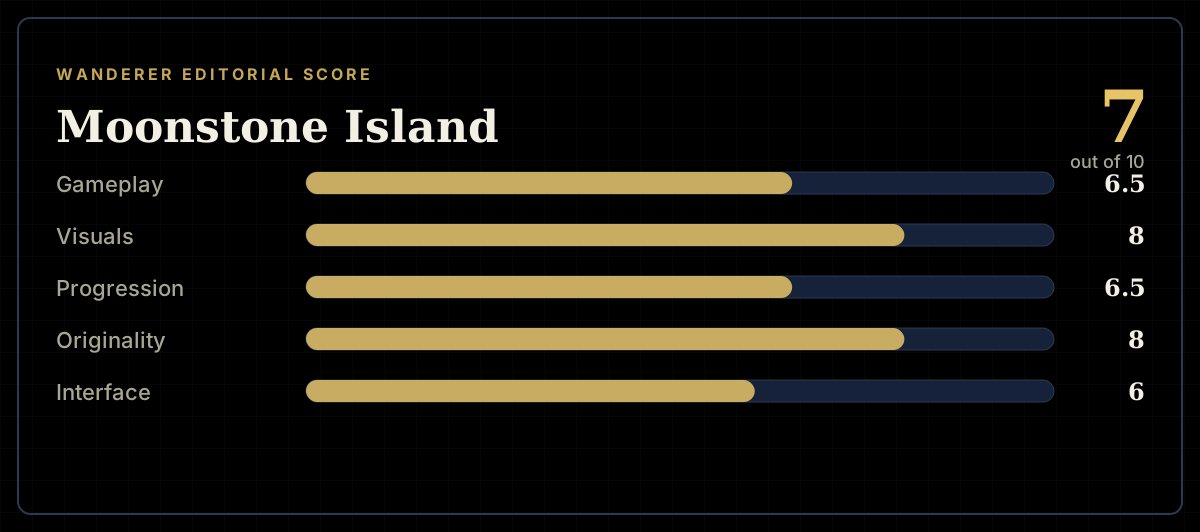
7 / 10
- Developer
- Studio Supersoft
- Publisher
- Raw Fury
- Released
- 20 September 2023
- Platforms
- Windows, macOS
- Genre
- Farming-Sim Creature Collector
- Monetisation
- One-time premium purchase plus several optional paid DLC packs; base game is complete without them, and major content additions have shipped as free updates
- Players
- Single-player only; no online, co-op or PvP modes
The short version
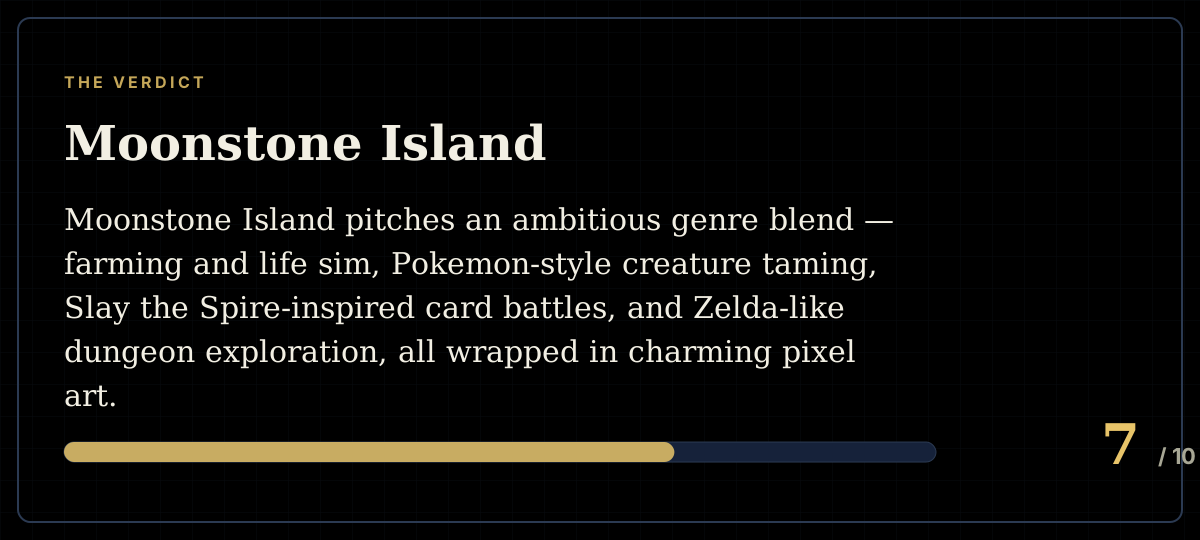
Moonstone Island pitches an ambitious genre blend — farming and life sim, Pokemon-style creature taming, Slay the Spire-inspired card battles, and Zelda-like dungeon exploration, all wrapped in charming pixel art. Reviewers consistently praise the concept and presentation, and players who sink hundreds of hours in describe it as a genuinely compelling combination once its systems click together.
A substantial and detailed share of reviewers found the launch version spread thin across all of those systems at once: farming offered little real incentive, dungeons repeated the same encounters, captured creatures couldn't evolve, and depleted resource nodes never respawned. What distinguishes Moonstone Island from many similarly-launched genre-blending indies is the scale of the response since: more than two years of continuous, substantial free updates have directly answered nearly every one of those specific complaints, including a full creature evolution system added in 2025 and repeated quality-of-life and resource passes addressing the exact issues reviewers raised at launch.
Biggest strengths
- A genuinely ambitious, well-executed blend of farming sim, creature collecting, deckbuilding combat and dungeon exploration that reviewers say works better together than any individual system might suggest alone
- Charming, distinctive pixel art and music that draws consistent, warm praise across nearly the entire review base regardless of other complaints
- An exceptionally sustained free content record spanning more than two years, including a full creature evolution system, a cooking update, character customization, and dozens of smaller quality-of-life passes
Biggest weaknesses
- At launch, farming offered little real economic incentive, dungeons repeated similar layouts and mini-bosses, and captured creatures lacked meaningful differentiation beyond a small set of elemental types — complaints multiple reviewers raised independently
- Depleted resource nodes, including cut trees and mined-out rock, were widely reported as never respawning at launch, undercutting the game's cozy framing with an unintentionally stripmining-encouraged loop
- NPCs and the main story are described by several reviewers as flat and under-motivated, giving players little narrative reason to pursue quests beyond the game simply prompting them to
Who it's for: Fans of cozy life sims and creature collectors willing to invest real time exploring several interconnected systems, especially those buying today to benefit from years of expansion. Less suited to anyone judging the game purely by its thinner launch-era state.
Our recommendation: A genuinely worthwhile, ambitious cozy game today, with most of its launch-era depth complaints substantially addressed by ongoing free content — a much stronger package now than what many reviews from 2023 describe.
7 / 10
Imagine Stardew Valley, Pokemon and Slay the Spire had a baby, and you're most of the way to understanding Moonstone Island's pitch. Reviewers reach for that exact comparison repeatedly, and the ambition is real: farming and life-sim elements sit alongside creature taming, deckbuilding card combat, and Zelda-style dungeon exploration across a series of procedurally-generated sky islands, all wrapped in genuinely charming pixel art. It's the kind of genre-blending concept that could easily collapse under its own scope — and at launch, a substantial, detailed share of reviewers argued it did exactly that, even while loving the idea.
A concept reviewers love, even when critical
Almost no reviewer disputes the appeal of Moonstone Island's premise or presentation. Art direction and music draw consistent, warm praise across nearly the entire review base, including from reviewers otherwise sharply critical of specific systems, and players who click with the combination describe sinking hundreds of hours into exploring its islands, taming creatures and building card decks. A relaxed, no-hard-deadline approach to quests lets players engage with whichever system appeals to them most without external pressure, a real point in its favour for the cozy-game audience it's built for.
A launch spread thin across too many systems
Where the criticism gets specific is depth. A substantial share of detailed reviews describe each individual system as underdeveloped at launch: farming offered little real economic incentive since gold had few meaningful uses, dungeons were criticized as repetitive RNG-generated spaces sharing the same handful of mini-bosses, and creature combat was described as shallow, with roughly seven elemental types and passives that didn't meaningfully differentiate one creature from another. One particularly pointed complaint concerned creature evolution specifically — its complete absence at launch, despite being a natural expectation for a Pokemon-inspired system, left captured creatures feeling static across an entire playthrough. A related, widely-reported complaint concerned resource depletion: cut trees, mined-out rock and harvested grass simply never respawned, turning exploration into permanent stripmining rather than the sustainable cozy loop the genre usually promises.
A response that answers nearly every specific complaint
What sets Moonstone Island apart from many similarly-launched genre-blending indies is the sheer scale and specificity of what followed. A full Evolutions Update, arriving roughly two years after launch, directly answers the missing-evolution complaint in detail: creatures reaching level 32 can now be evolved using items found on specific islands, gaining new abilities, a second elemental type, and expanded card options — precisely the kind of mechanical depth reviewers said was missing. Earlier updates specifically targeted resource and quality-of-life complaints too, including a patch explicitly described as "closing old mine-holes" alongside greenhouse expansion and inventory management improvements within the game's first major post-launch update. A later Cooking Update added an entirely new crafting and recipe system with its own questline, and a Rotating Gates update added bulk buying and selling, pattern-copying for decoration, and an adjustable fishing difficulty option directly responding to community feedback.
Real friction that remained a fair concern
Not every complaint maps as cleanly onto a confirmed fix. NPCs and the main story continued to draw criticism for feeling flat and under-motivated in reviews written well after several of the updates above, and the combination of a fast-moving clock and a limiting stamina system was a real point of friction until an adjustable day length option was added. Some reviewers also report technical issues, including crashes and lag, with at least one detailed account describing problems that seemed to worsen rather than improve on a later return to the game — a reminder that even an unusually active patch cadence doesn't guarantee every player's experience stays smooth throughout.
What the achievement data suggests
Global achievement figures show a fairly typical, gradual decline for a game with this much system breadth, from around 41% of the playerbase taming ten creatures down into the low double digits for the more demanding late-game milestones. That's consistent with a game where a meaningful share of players engage seriously with its systems without necessarily exhausting every one of them, in line with reviewer accounts of a game whose individual pieces reward investment without requiring mastery of all of them at once.
A developer visibly invested in the community
Beyond the substance of specific fixes, the tone and cadence of Studio Supersoft's communication is itself worth noting as a positive signal. Patch notes are written in a warm, personal voice by the game's community manager, regularly acknowledging specific community requests by name and explaining the reasoning behind design changes rather than issuing terse changelogs. Combined with the sheer frequency of updates — dozens of smaller bug-fix passes interspersed with major content drops across more than two years — it paints a picture of a small team genuinely engaged with its playerbase rather than treating launch as the finish line. That kind of visible investment doesn't retroactively fix every launch-era review, but it's a meaningful signal for anyone weighing whether to trust that remaining rough edges are likely to see continued attention.
Where it lands
Moonstone Island's launch-era reputation as an ambitious jack-of-all-trades came from real, specific gaps reviewers documented clearly — no creature evolution, permanently depleted resources, thin farming incentives. What's remarkable is how directly and specifically Studio Supersoft's more than two years of continuous free updates have answered nearly all of those complaints by name, while the core charm and genre-blending ambition that always drew people in remains fully intact. For cozy game and creature collector fans buying today, this is a considerably deeper, more complete experience than the one many 2023 reviews describe.
Pros and cons
Pros
- A genuinely ambitious, well-executed blend of farming sim, creature collecting, deckbuilding combat and dungeon exploration that reviewers say works better together than any individual system might suggest alone
- Charming, distinctive pixel art and music that draws consistent, warm praise across nearly the entire review base regardless of other complaints
- An exceptionally sustained free content record spanning more than two years, including a full creature evolution system, a cooking update, character customization, and dozens of smaller quality-of-life passes
- A relaxed, no-time-limit approach to quests that lets players engage with the game's many systems at their own pace rather than under constant pressure
- Confirmed, dated fixes for several of the most substantive launch complaints, including creature evolution and repeated resource and inventory management improvements
Cons
- At launch, farming offered little real economic incentive, dungeons repeated similar layouts and mini-bosses, and captured creatures lacked meaningful differentiation beyond a small set of elemental types — complaints multiple reviewers raised independently
- Depleted resource nodes, including cut trees and mined-out rock, were widely reported as never respawning at launch, undercutting the game's cozy framing with an unintentionally stripmining-encouraged loop
- NPCs and the main story are described by several reviewers as flat and under-motivated, giving players little narrative reason to pursue quests beyond the game simply prompting them to
- A combination of a relatively fast in-game clock and a limiting stamina system drew complaints for undercutting the intended relaxed pace, especially before later updates added adjustable day length
- Several reviewers report crashes, lag and glitching, with at least one detailed account describing worsening technical issues on a return visit sometime after launch
Screenshots
-

Moonstone IslandImage: Raw Fury via Steam -

Moonstone IslandImage: Raw Fury via Steam -

Moonstone IslandImage: Raw Fury via Steam -
How the review scores each part of the gameWanderer Editorial -
The short versionWanderer Editorial