
Game review
Magic Research
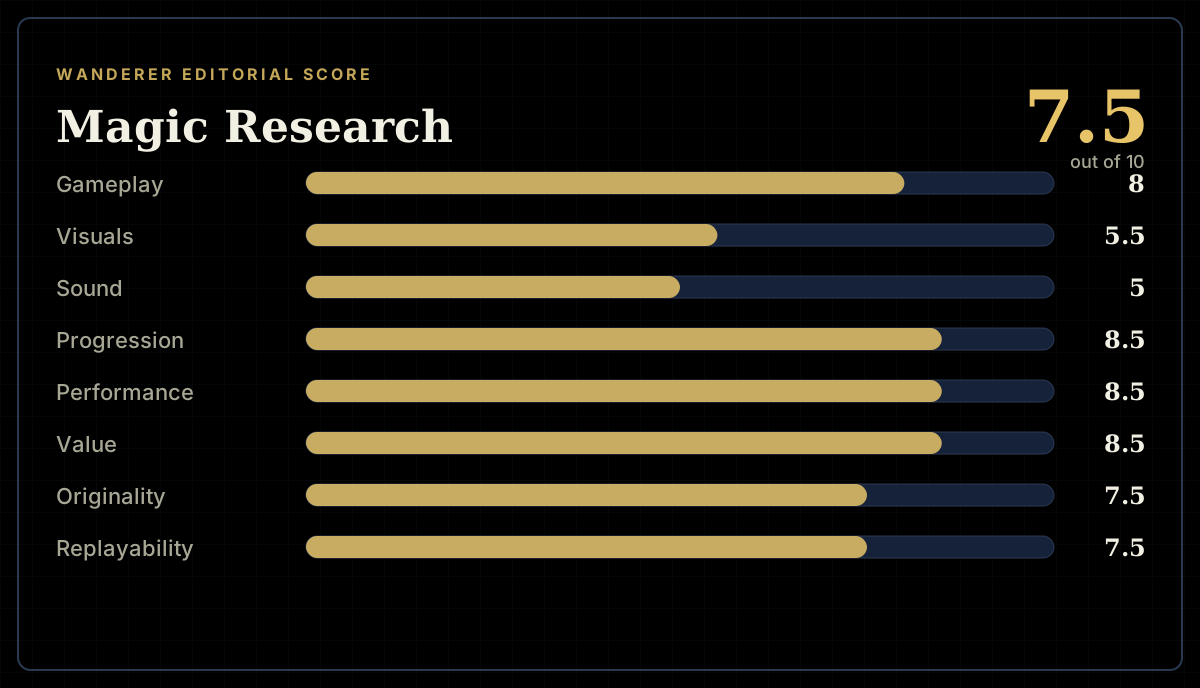
7.5 / 10
- Developer
- Maticolotto
- Publisher
- Maticolotto
- Released
- 22 March 2023
- Platforms
- Windows, Android, iOS
- Genre
- Incremental RPG
- Monetisation
- One-time purchase, no ads, no in-app purchases, no DLC; a free demo is available on every platform it ships on
- Players
- Single-player
The short version
Magic Research puts you in charge of a fledgling school of magic and asks you to research your way through six schools of spellcasting, a growing campus and a run of increasingly nasty boss fights, all narrated through menus and short text pop-ups rather than any art or animation. The research tree is genuinely well built — new schools change what earlier ones can do, and the retirement system turns every eventual dead end into a permanent head start rather than a wasted save file.
What holds it back from the genre's top tier is presentation and polish rather than design. There's effectively nothing to look at, a scattering of player reports describe corrupted or vanished save files with no in-game backup safety net, and the difficulty spikes around boss fights ask for a level of manual combat management that sits at odds with how idle the early hours feel.
Biggest strengths
- Six interconnected magic schools genuinely change strategy rather than just adding bigger numbers to the same spell list
- Retirement carries forward unlocked schools, elements and storyline bonuses, turning every eventual wall into a permanent advantage for the next run
- Over eighty hidden Storylines reward exploring the menus rather than just grinding the fastest path through them
Biggest weaknesses
- Presentation is limited to text, icons and a handful of static panels with no meaningful art direction or animation
- Sound design is minimal and easy to forget within the first hour
- Multiple player reviews describe save files becoming corrupted or disappearing, with no built-in backup or cloud-restore safety net beyond a manually-found local folder
Who it's for: Incremental fans who want a real research tree and a finishable story rather than an infinite number-go-up loop, and who don't need art or animation to stay interested.
Our recommendation: Try the free demo first to see whether the text-only presentation and hold-to-click early game suit you — it covers a meaningful opening slice. If it clicks, the full game is cheap for the amount of content on offer, but back up your save folder manually before committing real hours to it.
7.5 / 10
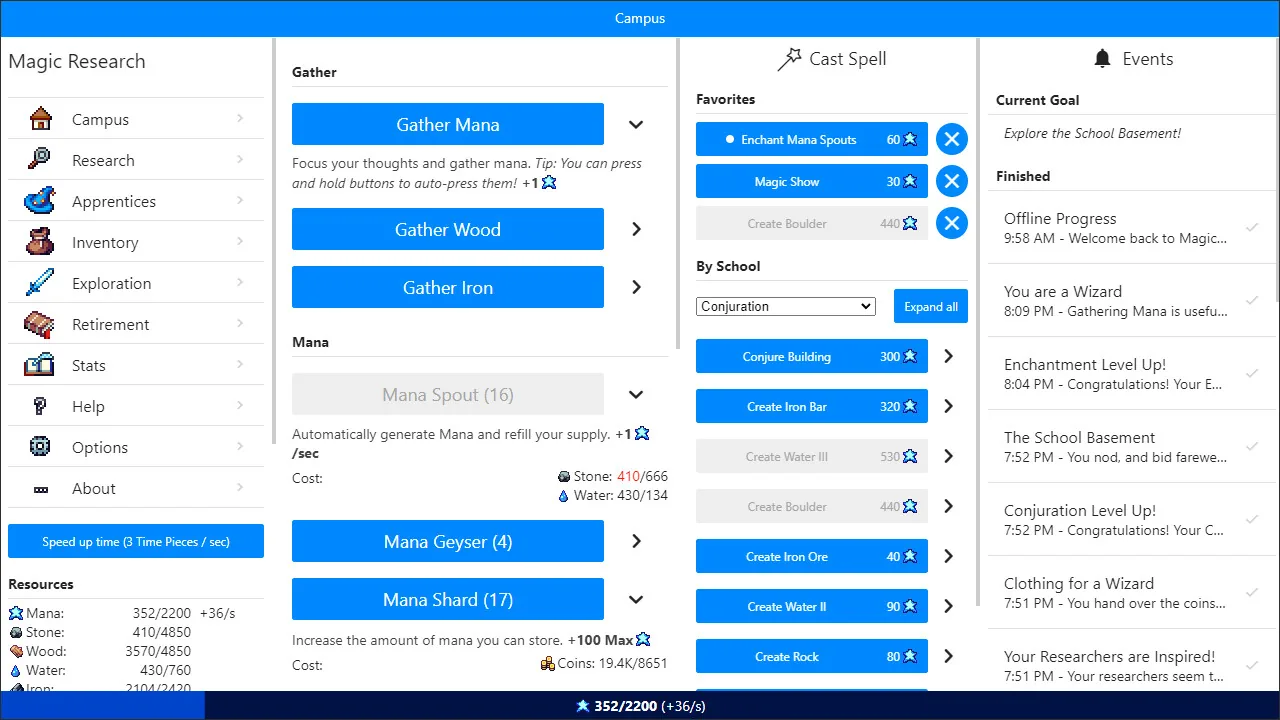
Most incremental games hide their systems behind a skin of some kind — an idle RPG with pixel heroes, a clicker with a cartoon empire growing on screen. Magic Research doesn't bother. Open it and you get a school administration screen: a list of researchers, a list of spells, a list of buildings to construct, and a "study" button. There's no map, no character portrait, barely an icon that isn't a placeholder-looking symbol for a spell school. It's an unusually blunt way to present a game, and it works because Maticolotto, working solo, spent the effort that would have gone into art on the research tree instead — and the research tree is genuinely one of the more thoughtfully built systems this site has looked at.
The loop: research feeds research
The premise is that you're the headmaster of a new magic school, trying to accumulate enough fame to compete in the Tournament of Magic. Getting there means researching spells across six schools of magic — each governing a different family of effects — while managing a growing staff of researchers and apprentices, gathering resources, and expanding a campus that unlocks new projects as it grows. Over a hundred spells exist across those schools, and importantly, they aren't gated in a straight line: picking up an early spell in one school routinely opens up unexpected combinations with a spell you researched somewhere else entirely, which is the single best reason to actually read the text the game hands you instead of clicking through it.
That cross-pollination is what keeps the early hours from feeling like busywork. A resource-gathering spell in one school makes a construction project in another finish faster, which frees up researchers to push a combat school further, which changes what's viable in the next boss encounter. None of this is explained with a tutorial hand-holding you through it — the game expects you to notice the connections yourself, which is either a strength or a frustration depending on how much you enjoy reading fifteen lines of flavour text to find the one sentence that matters mechanically.
Combat is the one place idle stops being idle
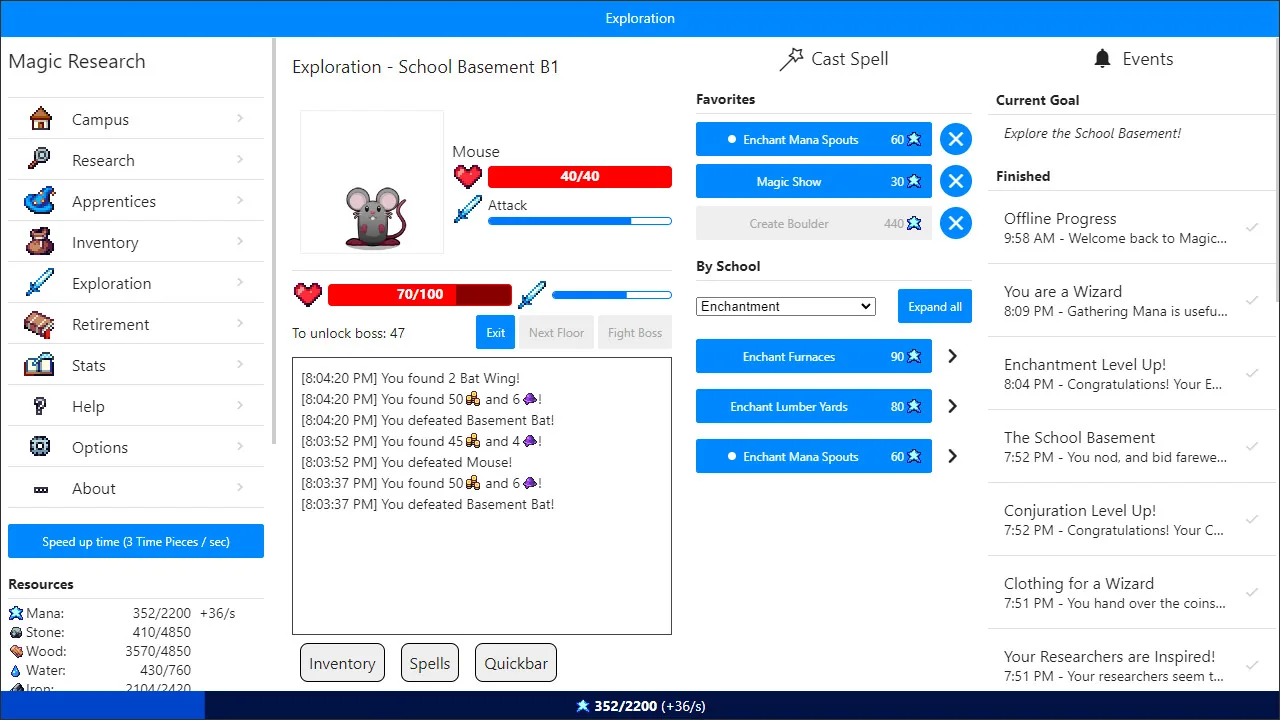
Early Magic Research trains you to expect an idle rhythm: queue some research, let resource gathering tick along, check back periodically. Boss fights break that pattern hard. Each dungeon floor ends in a boss that hits noticeably above the difficulty curve around it, and beating one reliably takes deliberate preparation — crafting the right gear, stocking the right potions, picking spells for the specific fight rather than whatever's been carrying you so far — followed by genuinely active play once the fight starts, since items aren't used automatically and mana management under pressure is a real skill the game is testing. Player accounts consistently describe this as the game's most demanding stretch, and it's a deliberate design choice rather than a difficulty spike that slipped through balancing: the harder and more obtuse a fight is, the more the game can justify handing out a genuinely powerful permanent reward for clearing it.
The trade-off is a tonal seam that never quite closes. The game spends its opening hours teaching you to automate — auto-cast toggles for building spells, auto-farming for exploration, systems that reward leaving the game running — and then periodically demands your full, undivided attention for a boss fight with none of that automation available. Players who came in expecting a background-tab idle game are the ones most likely to bounce off this; players who came in wanting an incremental with actual teeth in its combat will find it's one of the more honest examples of that pitch.
Retirement turns dead ends into head starts
The system that elevates Magic Research above a well-made research-tree curiosity is retirement. When progress stalls — and eventually it does, since spell costs and boss difficulty keep climbing — retiring resets your school back to its starting state, but keeps the things that matter: any school or element you unlocked stays unlocked permanently, storyline rewards persist, and your next run starts with a boost to research speed, building output and loot scaled off how far the previous run got. It's the same basic idea Increlution built its entire structure around, but Magic Research applies it more gently — retirement here is a strategic reset you choose when a run has run its course, not a countdown clock forcing the issue on every single life.
Layered on top of that are the game's Storylines: more than eighty hidden objectives scattered through the systems, each one triggered by doing something specific rather than by hitting a level number, and each one granting a permanent, game-altering bonus once discovered. Some are obvious once you're looking for them; plenty aren't, and the appeal of a second and third retirement often comes down to curiosity about what a Storyline you haven't found yet actually does. It's a meaningfully different kind of replay incentive than most incrementals offer, where retirement resets are usually just about a bigger number arriving faster.
Where the system shows its edges is in how unevenly it explains itself. The retirement screen tells you what carries over in broad strokes, but the actual math behind how a maximum level translates into a research or production bonus isn't spelled out anywhere in the game, and the school and element choices you make on a fresh run affect that bonus in ways that reward having already played through once before you can plan intelligently around them. New players get a genuinely useful system; players optimising their third or fourth run get a genuinely opaque one.
A save system that hasn't earned full trust
This is the one area where the review has to step outside pure design analysis. A recurring, if minority, thread in Magic Research's Steam reviews describes save files becoming corrupted or disappearing entirely, sometimes after dozens of hours of progress, with no in-game backup system and no official cloud-restore path beyond players discovering a local save folder and copying it manually. It doesn't appear to be the norm — the overwhelming majority of the 415 Steam reviews are positive, many from players who logged hundreds of hours without incident — but it's frequent enough, and severe enough when it happens, that it's worth building a habit around: back up the save folder yourself, periodically, rather than trusting the game to protect a long run for you. For a game whose entire hook is a research tree measured in tens of hours, that's a real gap, not a cosmetic complaint.
Presentation, performance and where it actually runs
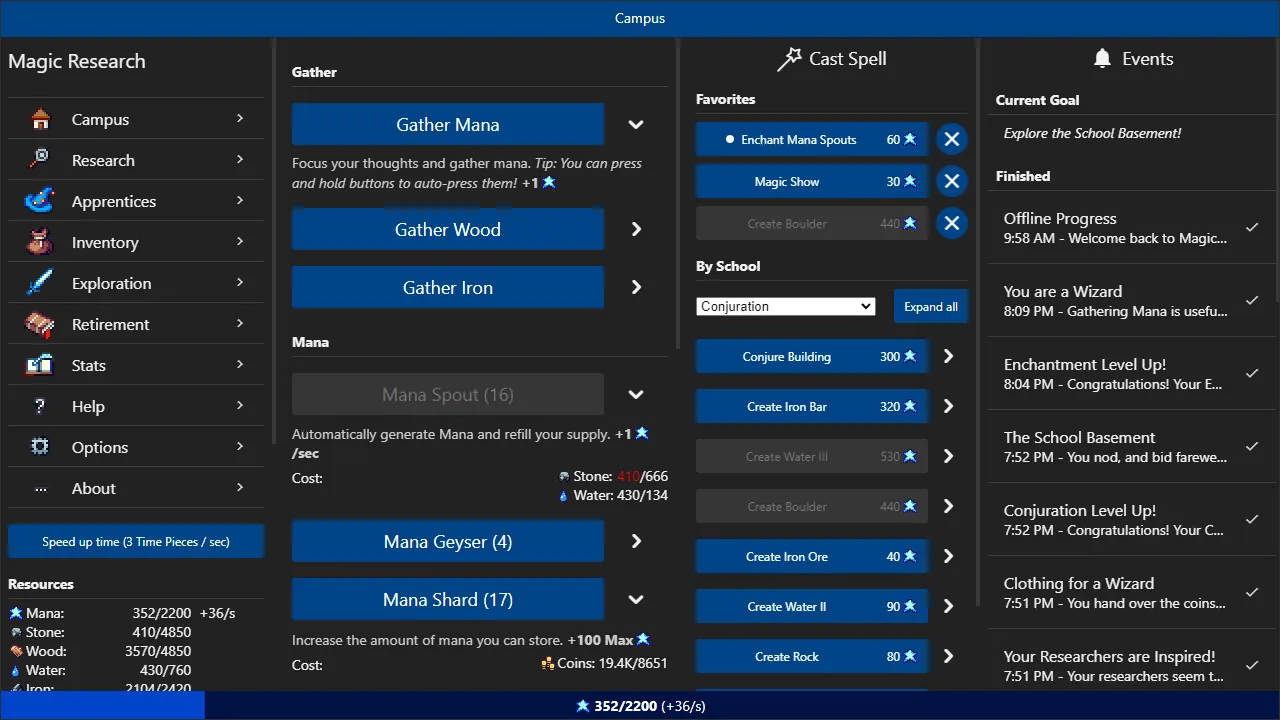
There's no pretending Magic Research is trying to look like anything. It's static UI panels, spell lists and text boxes throughout, with almost no illustration and a sound design that fades into the background within the first sitting. That's a defensible allocation of a solo developer's time — every hour not spent on art is an hour spent on the research tree, and the tree is where the game's actual quality lives — but it does mean the score on visuals and sound here reflects a genre minimum rather than any real effort at atmosphere.
The upside of that minimalism is that Magic Research runs on almost anything. Steam's own listed requirements ask for little more than 4GB of RAM and a mid-range processor from a decade ago, and the game ships as native, separately purchased apps on both iOS and Android in addition to the Steam release, with a free demo available on every platform. There's no cross-save between the Steam version and the mobile versions, which is a real inconvenience for anyone who wants to research on a commute and play boss fights at a desk, but the fact that a fully separate, functional mobile build exists at all puts Magic Research ahead of most PC-first incrementals on portability, even without cloud sync tying the copies together.
Value
At NZ$7.39 with no ads, no microtransactions and no DLC splitting the content up, Magic Research is priced honestly for what's here. The developer's own estimate of "over 40 hours" of content is, if anything, conservative — Steam reviews from players who've cleared the Tournament of Magic and gone on to chase remaining Storylines regularly report playtimes well past a hundred hours, and a free demo on every platform means nobody has to take that claim on faith before spending money. This isn't a game that pressures a purchase with a timer or a capped trial; it's a demo that's genuinely representative of the full product, attached to a full release that costs less than most in the genre and asks for nothing further afterward.
Verdict
Magic Research earns a 7.5 by being unusually good at the one thing it set out to do — build a research tree deep enough that six schools of magic keep generating new combinations for dozens of hours, wrapped in a retirement system that respects the time spent on a run that eventually stalls. The Storylines give it a reason to retire more than once, the Tournament of Magic gives it an actual ending, and the price is fair for the amount of finished, well-liked content on offer. It loses ground for reasons that have nothing to do with that core design: presentation that asks a lot of a player's patience with plain text, boss fights that ask for a kind of active attention the early game doesn't prepare you for, and a save system with just enough documented failures that "back up your files" has to be part of the recommendation rather than an afterthought.
Anyone who wants an incremental that behaves like a genuine RPG underneath its menus — six schools of spells worth specialising in, gear worth crafting for a specific fight, a story that actually concludes — will find Magic Research one of the more substantial entries in the genre for the price. Anyone who needs art or animation to stay engaged with a progress bar should try the demo first and expect to bounce off quickly. Players drawn to Wanderer's own mix of active exploration and background progression will recognise the appeal of a game that keeps making that trade-off explicit rather than picking one side and staying there.
Pricing and monetisation checked 30 July 2026.
Pros and cons
Pros
- Six interconnected magic schools genuinely change strategy rather than just adding bigger numbers to the same spell list
- Retirement carries forward unlocked schools, elements and storyline bonuses, turning every eventual wall into a permanent advantage for the next run
- Over eighty hidden Storylines reward exploring the menus rather than just grinding the fastest path through them
- The story has a real ending in the Tournament of Magic, so the game can actually be completed instead of running forever
- A genuinely lightweight game that runs on almost any PC and has native, separately sold ports on iOS and Android
Cons
- Presentation is limited to text, icons and a handful of static panels with no meaningful art direction or animation
- Sound design is minimal and easy to forget within the first hour
- Multiple player reviews describe save files becoming corrupted or disappearing, with no built-in backup or cloud-restore safety net beyond a manually-found local folder
- Boss fights demand active, attentive play, which sits awkwardly next to how idle and automatable the early game trains you to expect
- No controller support and no cross-save between the Steam version and the separate mobile purchases
Screenshots
-
Magic ResearchImage: Maticolotto via Steam -
Magic ResearchImage: Maticolotto via Steam -
Magic ResearchImage: Maticolotto via Steam -
How the review scores each part of the gameWanderer Editorial -
The short versionWanderer Editorial