
Game review
Love Curse: Find Your Soulmate
7 / 10
- Developer
- Xso
- Publisher
- Xso
- Released
- 19 April 2025
- Platforms
- Windows
- Genre
- RPG
- Players
- Single-player
The short version
Biggest strengths
- A genuinely rare multi-route, otome-style structure applied to a GL (yuri) visual novel, a format reviewers say is uncommon enough in the genre to be a real draw on its own
- Gorgeous, consistently praised art direction and voice acting that even the harshest critical reviewers single out as a genuine strength
- A well-regarded, unusually polished English localization for the game's launch, specifically noted as a pleasant surprise by reviewers who'd braced for rougher translation quality
Biggest weaknesses
- Players must commit to a specific route almost immediately, since the game's core texting mechanic tracks progress by month rather than by choice, breaking continuity if players try to explore multiple love interests before settling
- A protagonist several detailed reviewers describe as flat and personality-light, a structural criticism common to the otome genre this game borrows its format from
- Supporting characters are criticized by multiple reviewers as leaning on familiar romantic archetypes rather than feeling like fully developed individuals
7 / 10
Filling a real gap in an underserved genre
Love Curse: Find Your Soulmate casts its protagonist under a curse breakable only by finding true love, sending her toward a cast of romanceable women across multiple distinct routes and endings. Based on the available English-language review sample of 1,091 reviews — 1,079 positive, 12 negative, landing at an Overwhelmingly Positive rating — its reception has been shaped heavily by genre scarcity: multi-route, otome-style structure applied specifically to a GL (girls'-love) visual novel is genuinely uncommon, and reviewers repeatedly frame that structural choice as the game's biggest single draw. "It's so rare to have GL visual novels with multiple routes like classic otome games do. Story is also quite good overall. I definitely recommend all routes, they are all worth it!" one reviewer writes. A separate reviewer situates the game within a broader trend of the genre's current best output coming from Chinese developers and writers: "It kind of feels like we're getting fewer yuri VNs than we used to, so I've been especially thankful for the Chinese yuri writers and artists who've been stepping up for the genre... what I love most is that they're not trapped in that tired 'wholesome schoolgirls' mold that so much of Japanese yuri still refuses to break out of."
That genre enthusiasm translates into real, sustained engagement from a meaningful share of the review sample, several of whom report completing the game to full achievement completion. One especially thorough reviewer frames their assessment after finishing everything: "I'll give a breakdown of my personal thoughts on the game after finishing 100% of its achievements, with my playtime being nearly 38 hours invested," offering a data point on just how much content a completionist playthrough actually represents. A separate completionist reviewer reaches a similarly positive verdict: "I have finally completed this game 100% and what I have to say is that it is amazing. All the endings are worth it, in each one you will see a new side of the character."
A translation that surprised even skeptical fans
One specific, recurring point of praise concerns localization quality, an area where visual novels from this specific development pipeline don't always land well with English-speaking audiences. "I've been waiting for this since it got announced. Waited the whole day, and when it got released, I haven't put down the game. Most of all, the translation is the most pleasant surprise. It's written well, and the story is great," one reviewer writes, specifically framing the translation as exceeding expectations rather than simply being adequate. That kind of specific, comparative praise — a genre fan explicitly noting a translation beat their prior expectations — is a meaningfully stronger signal of quality than generic compliments would be.
A route structure that locks in fast
The single most substantive, most specific structural criticism in this review sample concerns how quickly players are forced to commit to a single romantic path. "The routes are uninteresting and poorly-written, the game doesn't allow for exploration of routes. You have to choose your route immediately, otherwise the texting mechanic makes no sense since it's based on month rather than what date you went on," one detailed reviewer writes, identifying a specific mechanical constraint rather than a purely subjective complaint about writing quality. That's a genuinely useful, concrete warning for prospective buyers used to visual novels that allow more flexible route-sampling before committing, and it recurs in substance across several of the more detailed critical reviews even when the specific framing differs.
Familiar genre archetypes, and a protagonist some find thin
A separate, recurring complaint concerns character writing, particularly the protagonist and supporting cast. "Love Curse has the worst traditions carried over from otome games: a milquetoast protagonist with no personality, an assortment of characters who are more tropes than people, and most frustratingly, a best friend character who is more interesting than any of them, meaning she isn't an option," one detailed reviewer writes, listing the specific archetypes they feel dominate the cast: "the happy-go-lucky childhood friend, the aloof yet cool executive," and others in a similar vein. A separate reviewer identifies the same underlying weakness from a different angle, focused on the central romantic hook rather than character writing broadly: "Love Curse ranges from mediocre to awful, dependent entirely on whether the hook of the supernatural elements is focused on. The writing is largely boring and uninspired, at its best only when it leans into the wish fulfilment angle of having attractive successful women dote on you, but even that leaves much to be desired. The supernatural elements are awful, poorly explained."
At least one reviewer raises a specific, concrete disappointment about romantic content actually delivered within a chosen route: "I wasn't going into this expecting anything crazy, but for there not to even be a kiss scene with my love interest was very disappointing. It never felt like my character ever had a very meaningful connection with them either." That's worth flagging directly as a route-specific rather than universal complaint, since other reviewers describe considerably more romantic payoff in different routes — but it's a fair warning that content quality and depth appears to vary noticeably depending on which path a player chooses.
What the achievement data confirms about structure
The achievement data offers a useful, corroborating window into how the game's route structure actually plays out for its broader playerbase. Across 31 total achievements, early story-chapter milestones sit at a healthy 67-81%, while route-specific "happy ending" achievements cluster in the mid-40s, and the toughest post-ending content and full-completion achievements fall to between 5.8% and 13.7%. That spread is consistent with a game where most players commit early to one or two favoured routes rather than exhaustively exploring every path — directly supporting the "must choose immediately" structural complaint from the negative review sample, even as the wide range of achievement types confirms real, substantial content variety exists across the full route set for those willing to pursue it.
Where this leaves it
Love Curse: Find Your Soulmate fills a genuine, specifically-identified gap in the yuri visual novel space with a multi-route, otome-inspired structure, backed by genuinely strong art, voice acting, and an unusually well-regarded translation for its launch. Its most substantive criticisms are structural and specific rather than vague: a route-commitment mechanic that discourages exploration before locking players in, character writing that leans on familiar archetypes over individualized personalities, and an underdeveloped supernatural premise that several detailed critics feel does less work than the character writing around it. Strongly recommended for GL and yuri visual novel fans specifically hungry for multi-route structure and variety in tone across routes, from wholesome to genuinely dark; worth tempering expectations around the depth of any single individual romance path before diving in.
Pros and cons
Pros
- A genuinely rare multi-route, otome-style structure applied to a GL (yuri) visual novel, a format reviewers say is uncommon enough in the genre to be a real draw on its own
- Gorgeous, consistently praised art direction and voice acting that even the harshest critical reviewers single out as a genuine strength
- A well-regarded, unusually polished English localization for the game's launch, specifically noted as a pleasant surprise by reviewers who'd braced for rougher translation quality
- A wide range of tonally distinct routes, including well-received dark, "doomed" bad-ending content, giving genre fans real variety across a single package
Cons
- Players must commit to a specific route almost immediately, since the game's core texting mechanic tracks progress by month rather than by choice, breaking continuity if players try to explore multiple love interests before settling
- A protagonist several detailed reviewers describe as flat and personality-light, a structural criticism common to the otome genre this game borrows its format from
- Supporting characters are criticized by multiple reviewers as leaning on familiar romantic archetypes rather than feeling like fully developed individuals
- The supernatural curse premise driving the plot is called poorly explained and underdeveloped by several critical reviewers, with the story's central hook doing less work than its character writing
- At least one detailed reviewer reports a chosen route lacking even a kiss scene, describing a disconnect between the game's romantic marketing and its actual content in some paths
Screenshots
-

Love Curse: Find Your SoulmateImage: Xso via Steam -

Love Curse: Find Your SoulmateImage: Xso via Steam -

Love Curse: Find Your SoulmateImage: Xso via Steam -
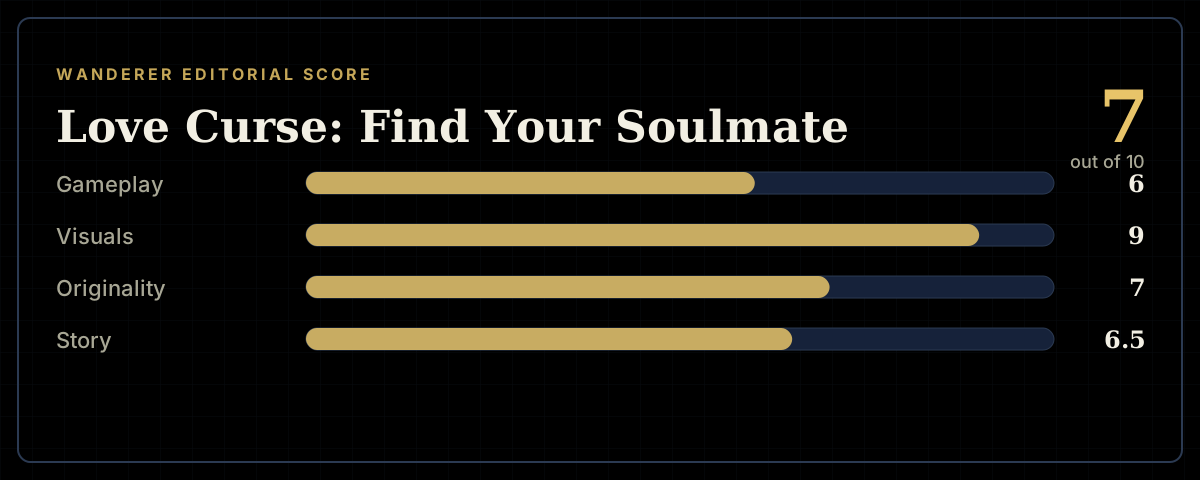
How the review scores each part of the gameWanderer Editorial -
The short versionWanderer Editorial