Game review
Loop Hero
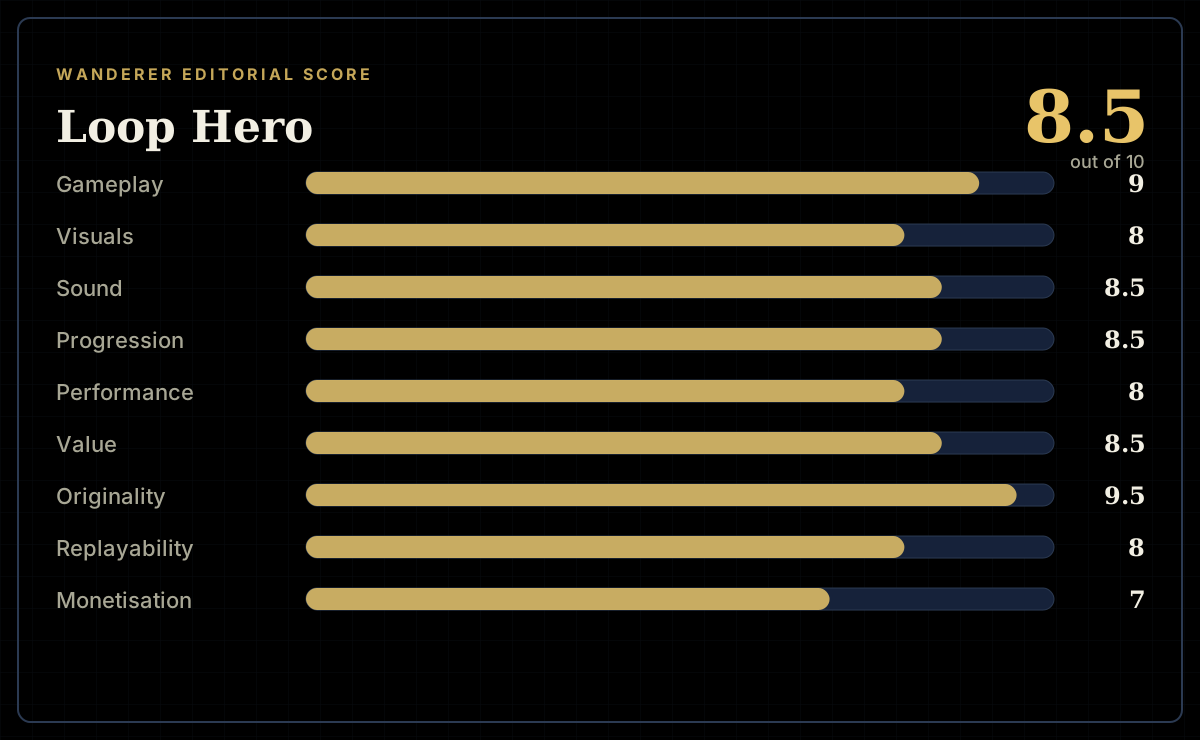
8.5 / 10
- Developer
- Four Quarters
- Publisher
- Devolver Digital
- Released
- 4 March 2021
- Platforms
- Windows, macOS, Linux, Nintendo Switch, Xbox One, Xbox Series X|S, iOS, Android
- Genre
- Roguelite / Deckbuilding Auto-Battler
- Monetisation
- Premium one-off purchase on PC, Switch and Xbox; on iOS and Android the app is a free download with a single unlock purchase and no other in-app purchases or ads
- Players
- Single-player only
The short version
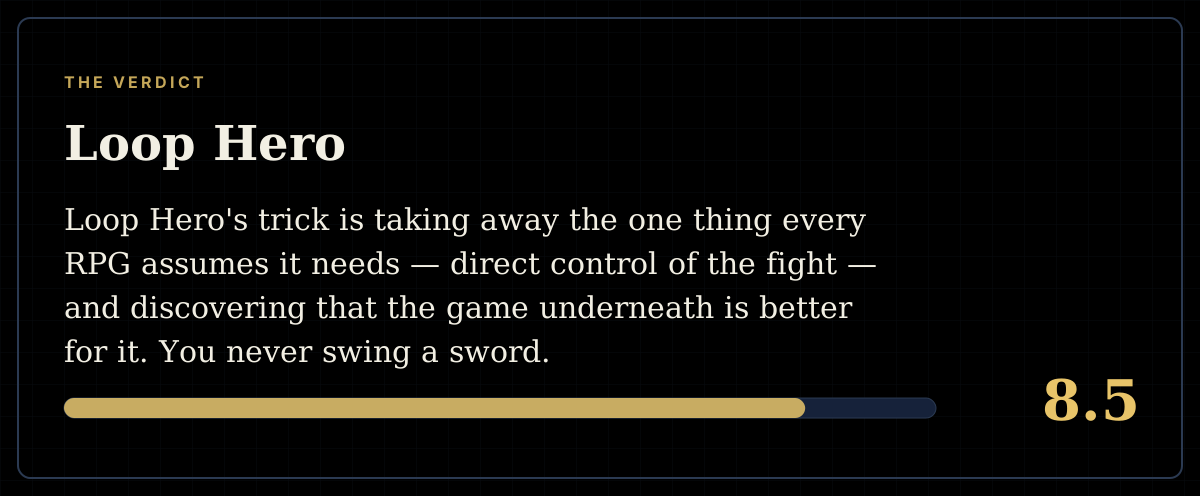
Loop Hero's trick is taking away the one thing every RPG assumes it needs — direct control of the fight — and discovering that the game underneath is better for it. You never swing a sword. You place a graveyard next to a road, decide whether a second battlefield tile is worth the loot it promises, and choose the moment your greed has to lose to your good sense. That's the whole game, and for a long stretch it's a genuinely great one.
It doesn't fully escape the trap every game in this shape falls into: once a loop's build is set and the outcome isn't really in doubt, you're watching health bars tick down rather than making decisions. Loop Hero fights that better than most, mainly because the fights themselves are short and the next placement decision is never far away, but the stretches exist.
Biggest strengths
- A Vampire Mansion tile heals the hero on every kill but gets more dangerous the longer it stands, which is the whole card-synergy design in one example
- Retreating to camp banks your gear at the cost of ending the run, turning every extra lap into a real bet rather than padding
- The camp's tech tree keeps unlocking new card types and hero options for a long stretch before the pool starts repeating
Biggest weaknesses
- Once a loop's build is locked in, several minutes can pass with nothing to do but watch the health bars empty
- No PlayStation release exists as of this writing, unusual for a Devolver-published game this well regarded
- The three-class roster hasn't grown since launch, so committed players eventually see the entire card pool
Who it's for: Strategy and roguelite players who want their tension to come from planning rather than reflexes, and anyone curious what an RPG looks like with the combat removed and the decisions kept.
Our recommendation: Buy it on whichever platform you'll actually return to. PC and Switch owners get the fullest, cheapest version of the game outright; players who only want it in short mobile bursts can try the free download first and pay to unlock it if the loop holds.
8.5 / 10
There's a moment in most RPGs where the interesting part of the game — the planning, the build, the risk assessment — gets interrupted by the part where you actually have to fight something. Loop Hero deletes that interruption. The hero walks the loop, swings when something's in range, and handles their own combat with zero input from you. What you control is everything around the fighting: which terrain gets laid on which tile, which buildings your camp is allowed to construct, and the one decision that actually costs something — when to stop.
That's a strange pitch for a game and an even stranger one for a genre that's usually sold on the fighting. It works because Four Quarters understood that removing combat doesn't remove tension. It relocates it.
Cards you place, not cards you play
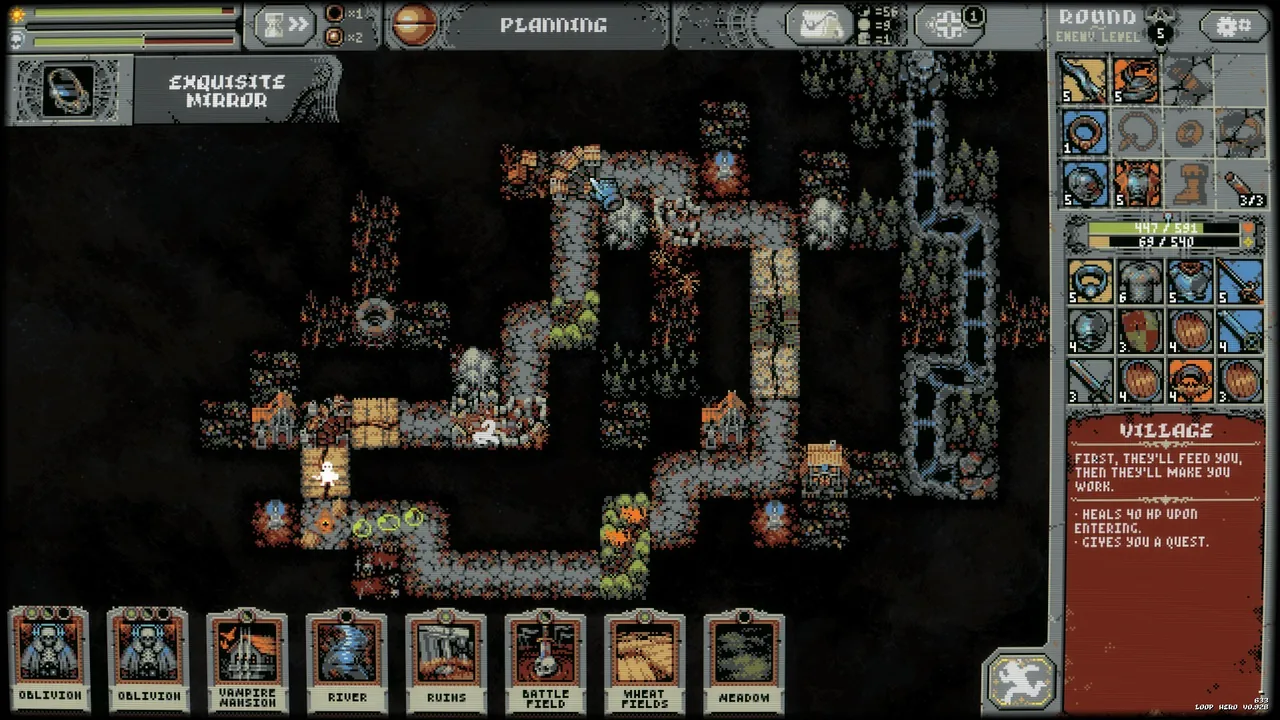
The deck in Loop Hero doesn't work like a card game's deck. There's no hand, no mana, no turns. Cards are terrain — meadows, groves, rock formations, graveyards, vampire mansions, battlefields — and placing one on an empty loop tile changes two things at once: what spawns near it, and what passive effect it grants for as long as it stays down. A meadow slowly heals the hero. A grove of trees does the same but sheds them for lumber. A graveyard spawns skeletons that get tougher the longer the tile survives, but killing them enough times upgrades it into something worse and more rewarding. A vampire mansion heals the hero on every kill nearby, which sounds like a pure win until the mansion itself starts scaling and the fights it produces get harder to actually survive.
This is the game's real achievement: almost nothing you place is simply good. Every tile is a trade, and the trades compound. A road lined entirely with meadows is safe and boring. A road with three battlefields back to back spikes the loot and the danger together. Learning which combinations turn a loop into a farm and which ones turn it into a death sentence — and learning it by testing, because the game explains very little up front — is most of what Loop Hero actually asks of you. It's a puzzle about consequences, dressed as a deckbuilder, wearing the skin of an RPG.
The camp is the other half of the game
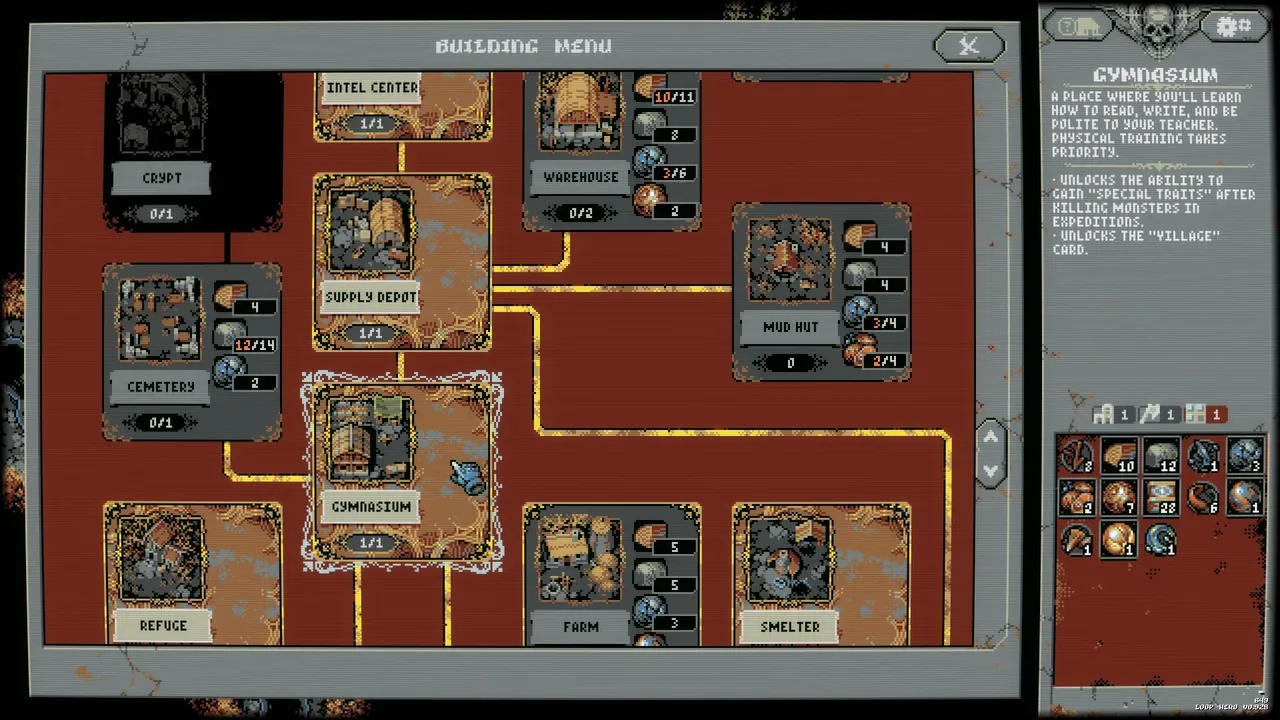
None of the terrain unlocks mean anything without the village behind the loop. Resources gathered on expeditions — wood, stone, food, metal, and stranger currencies found later — get spent at camp on new buildings, and those buildings are what actually expand the deck. A blacksmith unlocks smithing. A field kitchen changes what food does. New structures introduce new terrain cards outright, so the tools available on your tenth expedition look nothing like the tools you started with. This is the progression that gives the whole structure its shape: expedition earns resources, resources buy camp upgrades, camp upgrades change what the next expedition can attempt.
It's a satisfying ladder for a long stretch. The problem every game built this way eventually runs into is that the ladder has a top. Loop Hero's card pool and building list are generous but finite, and a player who's put real hours in will eventually have unlocked most of what there is to unlock. At that point the game becomes about optimising known combinations rather than discovering new ones, which is a perfectly fine way to spend more time with it but a noticeably different game than the one that hooked you in the first ten hours.
Knowing when to go home
Here's the actual spine of the design, and it's the part that separates Loop Hero from a game that merely watches itself play. Loot picked up on an expedition doesn't count until the hero passes back through camp. Every additional lap around the loop is a bet that the run holds together long enough to bank what you've already earned. Push for one more loop with a build that's starting to strain and you might walk home richer — or you might not walk home with the gear you were carrying at all.
This is where the genre's usual weakness — deciding whether to keep going is really just watching a number and guessing — gets undercut a little. Because terrain effects are visible and their scaling is roughly legible once you've learned the cards, an experienced player isn't purely guessing. They can read a graveyard's tile count and know it's about to get dangerous, or watch a battlefield cluster and recognise the loot is about to outpace the hero's healing. The tension is real because the information to act on it is mostly there, even if the game never states it as a number. That's a meaningfully different kind of decision than staring at a health bar and hoping.
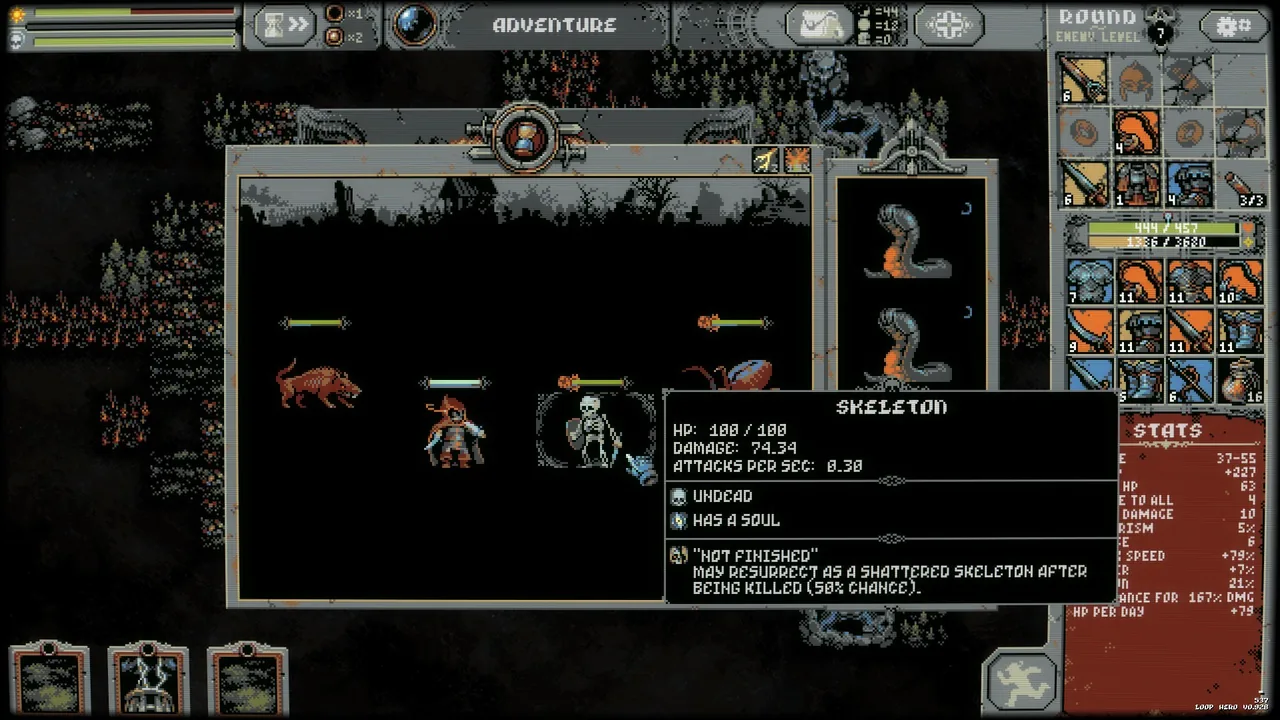
It doesn't hold for the entire runtime, though. Once a build is settled and the loop is stable, there are stretches — sometimes several minutes — where nothing changes and nothing needs deciding. The hero fights, the timer ticks, and you're a spectator waiting for the next placement opportunity or the next boss gate. Loop Hero fights this better than most games in its shape because the individual fights are quick and the loop itself is short, so the dead air rarely lasts long enough to feel like a chore. But it's there, and calling it anything else would be generous.
Three classes, one board
The Warrior, Rogue and Necromancer aren't cosmetic reskins of the same numbers. The Warrior wants tanky terrain that trades HP regeneration for combat time — a slow grind built to be survived. The Rogue leans into evasion and burst, which rewards different tile choices entirely, favouring cards that boost dodge or crit over raw defence. The Necromancer plays almost a separate game, summoning skeletons and building around a resource that has nothing to do with the other two classes' loops. Switching class means relearning which cards are good, which is the single strongest argument for sticking with Loop Hero past the point where the base loop has started to feel familiar. It's the game's most effective tool against its own repetition problem, even if three classes is a modest ceiling for a game this focused on build variety.
A cursed, quiet world
The pixel art commits fully to its premise — a world the Lich has erased, rebuilt tile by tile out of a hero's memory as they walk it back into existence. It's a clever visual justification for the mechanic (you're not just placing terrain, you're reconstructing a reality) and the muted, slightly melancholy palette sells it better than a louder art style would have. The soundtrack, credited to blinch, does a similarly understated job — ambient and atmospheric rather than propulsive, built to sit under long uneventful stretches without becoming annoying, which given how much of the runtime is spent watching a loop tick over is exactly the right call. Neither system is showy. Both are doing real work.
Glancing at a phone, not leaving it running
The mobile version, ported by Playdigious and released for iOS and Android in April 2024, is worth judging on its own terms rather than as a compromise. It is worth being precise about what it is: Loop Hero has no offline or away-from-device progression on any platform, mobile included. Closing the app stops the loop entirely. Anyone coming from idle or incremental games expecting the phone version to keep accumulating loot in a pocket will be disappointed — this was never that kind of game, on any platform, and the mobile release doesn't change that.
What it does get right is something closer to what "glancing at a screen" actually means for most players: expeditions are short, retreating is always available, and a session can end cleanly at almost any point without losing progress that mattered. That structure happens to suit a phone far better than a game demanding you sit through an uninterruptible raid or dungeon would. Playdigious also rebuilt the interface rather than shrinking the PC one — card placement, camp menus and combat log are all redesigned for touch, and it shows; this isn't a port that makes you pinch-zoom to hit a button sized for a mouse cursor. The trade-off is monetisation: the app is a free download that caps out after a limited trial, with a single US$6.99 purchase to unlock the rest. That's a fair, honest structure by mobile standards — no ads, no currency, no second purchase waiting behind the first — but it's still a purchase decision PC and Switch owners never have to make, and it's worth knowing about before you start a run you might not be able to finish without paying.
Consoles, and one conspicuous absence
Nintendo Switch got Loop Hero at the end of 2021, and it's a comfortable fit — the loop-and-retreat structure works fine in short handheld sessions, and the game's modest system requirements mean nothing was cut to get it running. Xbox followed later, landing on Xbox One and Series X|S. What's missing, even now, is a PlayStation release. There's no announced version and no listing on PlayStation's store, which is unusual for a game this well reviewed from a publisher with PlayStation relationships elsewhere in its catalogue. If you're a PlayStation-only player, this is one you'll need a PC, Switch, Xbox or phone to actually play.
Where the value sits
On PC, Loop Hero is inexpensive for how much game is here — dozens of hours before the card pool and camp tree stop producing anything new, for the price of a couple of coffees. Switch and Xbox owners get the same deal at the same structure. Mobile players get a genuinely fair freemium arrangement rather than the usual energy-timer, ad-break nonsense the platform is known for, even if paying twice for the same game (once on PC, once again to unlock the phone version) stings a little in the moment.
Verdict
Loop Hero earns its reputation by committing completely to a strange idea and following it all the way through — a fully automated hero, a deck that's really a map, and a design where the only real skill on display is judging risk rather than executing it. The terrain synergies are deep enough to reward real thought, the camp progression gives that thought somewhere to go, and the retreat decision is one of the smarter risk-reward hooks the genre has produced. It loses half a point to the same problem every game like it eventually runs into — a settled build turns you into a spectator for a while — and to a class roster and card pool that, however well-tuned, do eventually run out of new things to show a dedicated player. Neither of those stops it from being one of the better arguments the genre has for removing control from the player rather than adding more of it.
Pricing and platform details checked 30 July 2026.
Pros and cons
Pros
- A Vampire Mansion tile heals the hero on every kill but gets more dangerous the longer it stands, which is the whole card-synergy design in one example
- Retreating to camp banks your gear at the cost of ending the run, turning every extra lap into a real bet rather than padding
- The camp's tech tree keeps unlocking new card types and hero options for a long stretch before the pool starts repeating
- Warrior, Rogue and Necromancer reward genuinely different placement strategies rather than reskinned stats
- Runs comfortably on hardware from a decade ago, which the Switch and mobile ports both benefit from directly
- Playdigious rebuilt the mobile interface for touch instead of shrinking the PC layout onto a phone screen
Cons
- Once a loop's build is locked in, several minutes can pass with nothing to do but watch the health bars empty
- No PlayStation release exists as of this writing, unusual for a Devolver-published game this well regarded
- The three-class roster hasn't grown since launch, so committed players eventually see the entire card pool
- The story is delivered through sparse, half-legible text logs and will disappoint anyone expecting real narrative payoff
- Gating the full mobile game behind a paid unlock after a capped free trial adds a purchase decision PC and Switch owners never face
Screenshots
-
Loop HeroImage: Devolver Digital via Steam -
Loop HeroImage: Devolver Digital via Steam -
Loop HeroImage: Devolver Digital via Steam -
How the review scores each part of the gameWanderer Editorial -
The short versionWanderer Editorial