
Game review
Life Eater
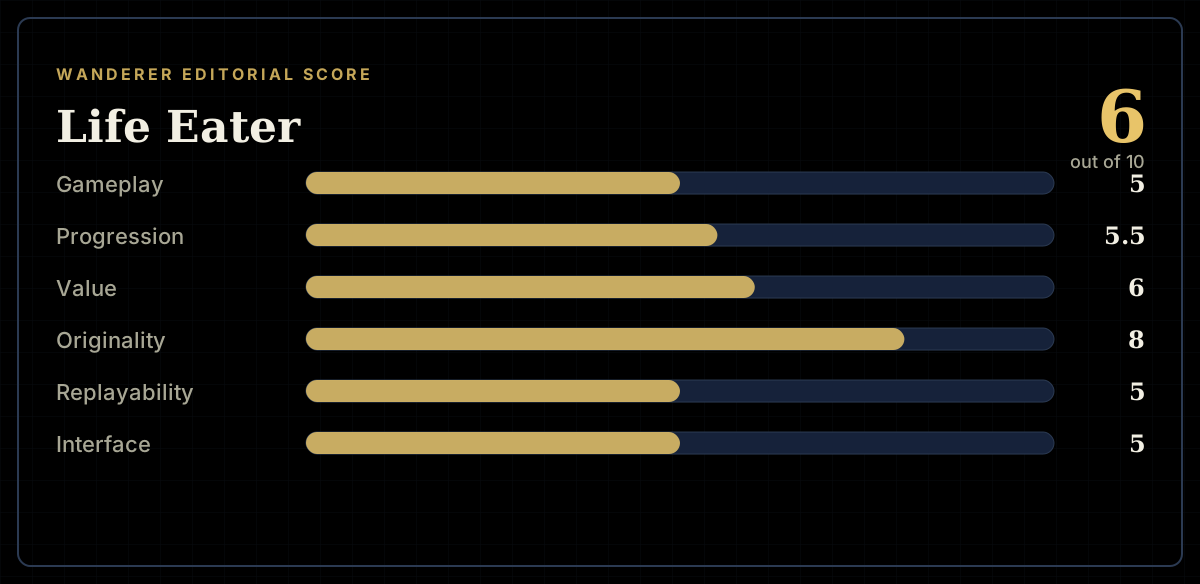
6 / 10
- Developer
- Strange Scaffold
- Publisher
- Strange Scaffold, Frosty Pop
- Released
- 16 April 2024
- Platforms
- Windows
- Genre
- Horror-fantasy stalking simulator
- Monetisation
- One-time purchase, no in-game store or additional currency purchases
- Players
- Single-player only
The short version
Life Eater casts you as an ordinary suburban druid forced to sacrifice a specific but vaguely described neighbor each year to delay the end of the world, using a video-editing-style timeline interface to learn everything about your target's schedule before deciding when and how to abduct them. This review's sample responds strongly to the premise itself, praising the writing, voice acting, and unusually thoughtful handling of genuinely dark subject matter. What tempers that praise, repeated with real consistency across the negative sample, is a specific complaint about the core stalking mechanic: reviewers describe an insufficient tutorial and unclear rules that leave the central gameplay loop feeling more like guesswork than genuine investigation, all wrapped around a story that most describe finishing in well under five hours.
Biggest strengths
- The premise and writing earn genuine, specific praise, with reviewers describing thoughtful, dark storytelling that handles disturbing subject matter without feeling gratuitous or self-indulgent
- The voice acting and soundtrack draw consistent, enthusiastic credit, with multiple reviewers specifically praising the cast and the mood-appropriate scoring of individual scenes
- The unusual timeline-based interface for investigating victims earns recognition as a genuinely novel approach to horror-game mechanics, even from reviewers who found its execution lacking
Biggest weaknesses
- A specific, widely repeated complaint concerns the core stalking mechanic's tutorial and clarity, with multiple reviewers describing the timeline system as confusing and under-explained, leaving players to guess at correct information-gathering strategies through trial and error
- Several reviewers describe the moment-to-moment gameplay as thin and repetitive once the novelty of the premise fades, comparing the experience more to a short interactive story than a game with real mechanical depth
- Multiple reviewers report the difficulty curve flattening rather than genuinely escalating, describing later "years" of the ritual as repeating the same basic loop without meaningful new wrinkles
Who it's for: Fans of short, narratively driven horror games with dark comedic sensibilities who are drawn to a genuinely original premise and don't mind a thin, somewhat opaque core mechanic in exchange for strong writing and atmosphere.
Our recommendation: A genuinely original, well-written short horror experience best purchased on sale given how consistently reviewers describe its core stalking mechanic as underexplained and its runtime as brief — worth it for the story and voice work more than the moment-to-moment gameplay.
6 / 10
Life Eater asks you to play an ordinary person with an extraordinary, terrible job: a modern-day druid who must sacrifice a specific neighbor every year to keep an uncertain god from ending the world. You investigate potential victims through a video-editing-inspired timeline, piecing together their schedules and habits before deciding when to strike. It's a genuinely unusual premise for a game, and this review's sample confirms it lands with real narrative weight — while identifying, with unusual consistency, exactly where the mechanics underneath that premise leave players confused.
A dark premise handled with real craft
The writing and tonal execution earn specific, thoughtful praise from this review's sample. "Honestly, it isn't a poorly made game, and the story is gross (in a good way) but isn't self indulgent like a lot of other games of this kind (think things like Hatred or Postal). It tells a story of a serial killer who is sacrificing people to a god that may or may not exist. It is told in short sn[ippets between gameplay sections]," one reviewer writes, offering a useful, deliberate distinction between thoughtful dark storytelling and gratuitous shock content. Another describes a genuinely affecting experience: "I finished the game in one sitting, in the dark, and sat there afterward not really thinking about anything, just aware of how easily 'getting to know someone' and 'getting ready to hurt someone' had started to look identical on screen." A third simply calls it "a genuine masterclass of storytelling with pleasant visuals," with their only complaint being the short length.
The mechanic that consistently confuses players
Set against that narrative praise, this review's negative sample converges with real consistency on the game's core interactive system. "I really love the idea of this game, the story and art are great and I love the whole idea of it. I really wanted to love it, but the gameplay proved to be frustratingly vague. I appreciate that it doesn't hold your hand and wants you to figure things out yourself, but there's a complete lack of fee[dback about whether you're on the right track]," one reviewer writes. Another describes the same frustration more sharply: "The tutorial provided is not sufficient, and the information needed for the rituals is really confusing to obtain. After an hour I refunded the game." A third reviewer, having pushed through to completion, still lands on a critical note: "the stalking mechanic doesn't really feel like stalking. more of a click-here-and-guess typa thing, rather than actually stalking based on actual things." These reviewers aren't objecting to the premise's darkness — they're describing a genuine gap between the story's promise of careful, methodical investigation and the actual mechanical experience of playing it.
Repetition setting in after the early hours
Beyond onboarding confusion, several reviewers describe the core loop flattening rather than deepening as the story progresses. "I feel this concept, though very dark and disturbing, is quite good, but there's a monotony to this game after the first 3 years that I couldn't shake. Aside from the cutscenes (which aren't very lengthy), there are only two screens to look at and decipher," one reviewer writes. Another makes the same observation from a slightly different angle: "The story was interesting, but the game itself was basically doing the same thing over and over and over. I would liken this more to a point and click graphic novel, with 10 pages." That's a fair, specific critique distinct from the tutorial complaint — even players who understood the mechanics fully describe them running out of new wrinkles well before the story concludes.
A fair reckoning with the game's brevity
What's notable about this review's sample is how many reviewers treat the short runtime as an acceptable trade given the price, rather than a broken promise. "It is entirely possible to finish the main story of this game and 100% it in the process within 2 hours and request a refund. I'm choosing not to request that. This game isn't anything mind-blowing, but there is definitely a lot of passion and hard work put into it," one reviewer writes, choosing to support the developer despite acknowledging the thin content. Another frames the trade-off precisely: "It's around 5 hours long and i'd say it's quite worth it" at its low asking price. That generosity of spirit, echoed across several reviews, speaks to genuine goodwill toward the project even among reviewers with real reservations about its depth.
A specific platform complaint
At least one reviewer flags a concrete technical gap worth noting directly: "found it unintuitive and very boring, love the art between gameplay segments though. Also broken on linux," a specific compatibility issue distinct from the broader mechanical complaints raised elsewhere.
What the achievement data confirms about pacing
Steam's own completion figures show a smooth, gradual decline consistent with a short game most players see through to some conclusion. The first year's completion sits at 79.3%, falling steadily through each subsequent year down to around 30% for the later stages, with alternate-ending achievements settling around 22-24%. That gentle, gradual curve — rather than a steep cliff — supports reviewer descriptions of a short, largely accessible experience rather than one with a severe difficulty wall blocking most players from finishing.
A developer who kept supporting the game
Whatever this review's mechanical criticisms, Life Eater received real, continued attention after launch. The game's partner-events feed documents multiple hotfixes, a resolved cloud-save issue, and a free Endless Mode unlock made available to all players — a genuine, no-cost content addition for an already inexpensive game, showing the developer's ongoing investment beyond the initial release.
Final verdict
Life Eater tells a genuinely original, thoughtfully handled dark story with real craft in its writing and voice work, tempered by a core stalking mechanic that a large, consistent portion of this review's sample found confusingly explained and mechanically thin by the later stages. At its low price and short runtime, it's a reasonable, worthwhile pickup for horror fans drawn to its unusual premise — just go in expecting a strong story wrapped around a fairly simple game, not the other way around.
Pros and cons
Pros
- The premise and writing earn genuine, specific praise, with reviewers describing thoughtful, dark storytelling that handles disturbing subject matter without feeling gratuitous or self-indulgent
- The voice acting and soundtrack draw consistent, enthusiastic credit, with multiple reviewers specifically praising the cast and the mood-appropriate scoring of individual scenes
- The unusual timeline-based interface for investigating victims earns recognition as a genuinely novel approach to horror-game mechanics, even from reviewers who found its execution lacking
- Steam's own partner-events feed documents solid, responsive post-launch support, including multiple hotfixes, a cloud-save issue resolution, and a free Endless Mode unlocked for all players after launch
- The very short runtime is treated fairly by many reviewers as proportionate to the low asking price, with several explicitly recommending it as a worthwhile one-sitting experience despite its brevity
Cons
- A specific, widely repeated complaint concerns the core stalking mechanic's tutorial and clarity, with multiple reviewers describing the timeline system as confusing and under-explained, leaving players to guess at correct information-gathering strategies through trial and error
- Several reviewers describe the moment-to-moment gameplay as thin and repetitive once the novelty of the premise fades, comparing the experience more to a short interactive story than a game with real mechanical depth
- Multiple reviewers report the difficulty curve flattening rather than genuinely escalating, describing later "years" of the ritual as repeating the same basic loop without meaningful new wrinkles
- At least one reviewer reports the game being broken on Linux, a specific platform-compatibility gap worth flagging directly
- The overall runtime is consistently described as very short, with multiple reviewers reporting full completion and even 100% achievement completion in under three hours
Screenshots
-

Life EaterImage: Strange Scaffold via Steam -

Life EaterImage: Strange Scaffold via Steam -

Life EaterImage: Strange Scaffold via Steam -
How the review scores each part of the gameWanderer Editorial -
The short versionWanderer Editorial