
Game review
Kunitsu-Gami: Path of the Goddess
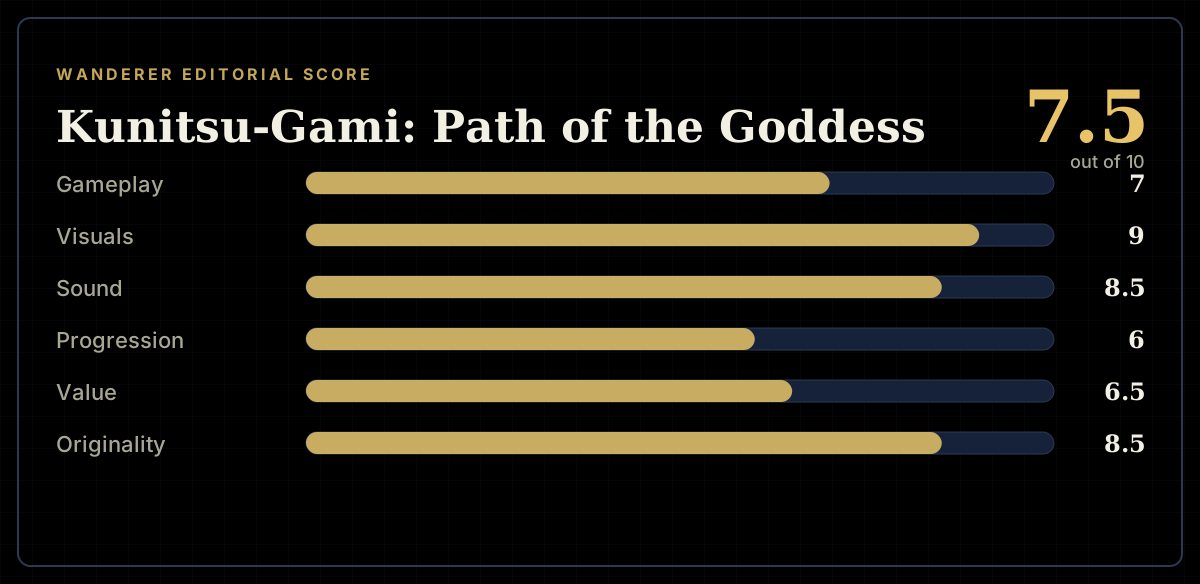
7.5 / 10
- Developer
- Capcom
- Publisher
- Capcom
- Released
- 18 July 2024
- Platforms
- Windows, PlayStation 4, PlayStation 5, Xbox Series X|S
- Genre
- Action Strategy
- Monetisation
- One-time purchase, no in-game currency
- Players
- Single-player
The short version
Kunitsu-Gami: Path of the Goddess is a new IP from Capcom that pairs a real-time tower-defense night phase, protecting a possessed maiden as she dances her way up a mountain, with a daytime village-management phase where rescued villagers are assigned classes, upgraded, and repositioned to defend the next stretch of the path. It's a genuinely distinctive combination critics rewarded well — 80 on Metacritic from 46 reviews — and Steam agrees, Very Positive at 92.1% across nearly 1,900 reviews. The specific, most-upvoted complaint in its own negative review sample isn't about the concept, though; it's that the moment-to-moment tower-defense combat is simple enough on many levels to solve by parking units in one spot and repeating the same action, and that the full campaign stretches a four-hour core idea across something closer to fourteen. Add real, reported crash issues at launch and a Denuvo device-authentication limit some players found genuinely restrictive, and the picture is a striking original concept that a meaningful share of its own fans say doesn't sustain its own runtime.
Biggest strengths
- The day-night structure — daytime village rebuilding and villager class assignment feeding directly into nighttime real-time tower-defense combat — is a genuinely novel hybrid critics and players both single out as the game's best idea
- Art direction and character/monster design draw close to unanimous praise, grounded specifically in Japanese mythology and kagura ritual dance rather than a generic fantasy aesthetic
- The soundtrack is repeatedly named a highlight even by reviewers otherwise critical of the gameplay loop
Biggest weaknesses
- The single most-upvoted negative Steam review specifically describes many levels as solvable by parking units in one spot and repeating the same attack, with the game reluctant to throw multiple enemy types at the player simultaneously
- Several detailed reviews independently describe the campaign as roughly a four-hour core idea stretched to 14 or more hours, with the mid-to-late game becoming tedious specifically because the format doesn't meaningfully escalate
- Later stages are criticised for weak map design that lacks the clear lanes or funnels tower-defense strategy depends on, leading to enemies arriving from too many directions at once on maps described as too open for the genre
Who it's for: Players drawn to Japanese folklore, distinctive art direction and genuinely novel genre hybrids will find a lot to like here, especially if they pace themselves rather than marathon the full campaign. Dedicated tower-defense fans expecting deep, escalating strategic depth across the whole runtime should read the specific level-design complaints below first — several detailed, 20-plus hour reviews say the format doesn't meaningfully evolve much past its early hours.
Our recommendation: Recommended, particularly on a discount given how consistently price shows up as a complaint even among positive reviews. The day-night structure and its cultural grounding in kagura ritual and Japanese myth are genuinely worth experiencing, but go in expecting a shorter, more repetitive strategic layer than the concept's strongest early hours promise, and budget for the possibility of crashes that several reviewers say cost real, lost progress at launch.
7.5 / 10
A new Capcom IP built on kagura, not combos
Kunitsu-Gami: Path of the Goddess is a genuine rarity for a major publisher: a brand-new IP built around a mechanical idea specific enough that it doesn't map cleanly onto an existing genre label. The player controls Soh, a sword-wielding guardian escorting the maiden Yoshiro as she performs a kagura purification dance up a mountain overrun by corruption, one stage at a time. Each stage runs on a day-night cycle: by day, the player scouts the area, rescues villagers trapped by the rot, and assigns those villagers classes — melee fighters, archers, and later healers, sumo wrestlers, cannoneers and sorcerers — while spending resources to rebuild shrines that grant permanent upgrades. By night, those same villagers become the front line in a real-time tower-defense sequence protecting Yoshiro as monsters converge on her position, with Soh able to jump directly into the fighting himself. Critics responded well to the whole package, landing the game at 80 on Metacritic from 46 reviews, and Steam's own userbase agrees at Very Positive, 92.1% across nearly 1,900 reviews.
Where the hybrid earns its praise
The cultural specificity is the first thing every review, positive or negative, tends to agree on. This isn't a generic fantasy skin over a tower-defense template — the kagura dance ritual, the mountain-shrine structure, and the character and monster designs are all rooted specifically in Japanese folklore, and reviewers consistently credit the game with a distinct visual and thematic identity that stands out even in a year full of well-regarded Japanese releases. The soundtrack gets the same treatment, named a highlight across positive and negative reviews alike. Mechanically, the class system given to rescued villagers is where the day-phase and night-phase halves connect most satisfyingly: choosing which villager becomes an archer versus a melee fighter, and where to physically position them along Yoshiro's route, gives the defensive layer real texture once several classes are unlocked, and multiple reviews describe the earliest hours of discovering this system as genuinely compelling.
Where the format runs out of ideas before the campaign does
The trouble several of the most detailed negative reviews describe isn't with the concept — it's with how much of the campaign the game asks that concept to carry. The single most-upvoted negative Steam review (197 votes, nearly 25 hours logged) puts it plainly: too many stages can be solved by parking defensive units in one spot and repeating the same action as enemies walk into range one or two at a time, because the game is reluctant to throw varied enemy compositions at the player simultaneously. A second, related complaint concerns map design specifically: later stages open up into space too broad for the lanes and funnels that tower-defense strategy normally depends on, leaving players managing enemies converging from four directions at once rather than making the kind of deliberate positioning choices the genre usually rewards. One especially candid review, comparing the pacing to 2013's Brutal Legend, describes the core idea as roughly four hours of genuinely interesting design "stretched to 14-plus," with no real desire to replay content once the main campaign's tedium sets in.
Technical issues compound the frustration for some players. Multiple reviews report real, disruptive crashes, including one describing a crash severe enough to take down the game's own crash reporter with it, and another citing six hours of lost progress as a direct result. Denuvo's device-authentication limit, capped at three devices, is a separate but specific complaint from players who move between a desktop, a laptop and a Steam Deck or similar handheld regularly enough to hit that ceiling. None of these problems appear to be the majority experience — the game's overall Steam sentiment stays comfortably Very Positive — but they're specific, repeated and verifiable rather than vague grumbling, and worth knowing about before buying at full price.
A shape few other games attempt, even where it wobbles
It's worth dwelling on how unusual the basic structure remains, even accounting for its late-game repetition. Most action-strategy hybrids pick one half of that label to be the real game and the other to be a light wrapper; Kunitsu-Gami commits to both halves as genuinely load-bearing, which is part of why reviewers who bounce off the tower-defense combat still tend to credit the overall design with ambition rather than dismiss it outright. The villager-rescue loop that opens each daytime phase also does real narrative work that a plain wave-defense game wouldn't bother with — finding and freeing corrupted villagers ties the mechanical objective directly to the game's folklore framing, rather than treating the day phase as a shopping menu bolted onto the night phase's combat. Whether that's enough to justify the campaign's full length is exactly the question its own player base is visibly split on, and it's a fair question to ask of any strategy game whose most interesting ideas front-load into the opening hours.
Verdict
Kunitsu-Gami: Path of the Goddess deserves real credit simply for being a new idea from a major publisher rather than another sequel or remaster, and its day-night structure, cultural grounding and art direction earn the strong critical reception it received at launch. Where it comes up short, according to a real and specific slice of its own player base, is stamina: the tower-defense combat that carries its second half doesn't meaningfully escalate the way the genre's best examples do, and a four-hour idea gets asked to fill roughly three times that length. Buy it for the concept and the presentation, expect the strategic depth to plateau earlier than the best late-game stages might suggest, and consider waiting for a sale given how often price shows up as a complaint even among the game's fans.
Pros and cons
Pros
- The day-night structure — daytime village rebuilding and villager class assignment feeding directly into nighttime real-time tower-defense combat — is a genuinely novel hybrid critics and players both single out as the game's best idea
- Art direction and character/monster design draw close to unanimous praise, grounded specifically in Japanese mythology and kagura ritual dance rather than a generic fantasy aesthetic
- The soundtrack is repeatedly named a highlight even by reviewers otherwise critical of the gameplay loop
- Villager classes (melee, archer, healer, sumo wrestler, cannoneer, sorcerer) give the defensive layer real build variety once several are unlocked
- Critics were solidly positive, with an 80 Metacritic average across 46 reviews, putting it comfortably in "generally favourable" territory for a brand-new IP
Cons
- The single most-upvoted negative Steam review specifically describes many levels as solvable by parking units in one spot and repeating the same attack, with the game reluctant to throw multiple enemy types at the player simultaneously
- Several detailed reviews independently describe the campaign as roughly a four-hour core idea stretched to 14 or more hours, with the mid-to-late game becoming tedious specifically because the format doesn't meaningfully escalate
- Later stages are criticised for weak map design that lacks the clear lanes or funnels tower-defense strategy depends on, leading to enemies arriving from too many directions at once on maps described as too open for the genre
- Denuvo DRM limits authentication to three devices, a real and specific frustration for players who reported switching between desktop, laptop, Steam Deck and other handhelds
- Multiple reviews report significant crashes at launch, including at least one describing a crash severe enough to also crash the game's own crash reporter, with one player citing six hours of lost progress
Screenshots
-

Kunitsu-Gami: Path of the GoddessImage: CAPCOM Co., Ltd. via Steam -

Kunitsu-Gami: Path of the GoddessImage: CAPCOM Co., Ltd. via Steam -

Kunitsu-Gami: Path of the GoddessImage: CAPCOM Co., Ltd. via Steam -
How the review scores each part of the gameWanderer Editorial -
The short versionWanderer Editorial