
Game review
Kingdom Two Crowns
7.5 / 10
- Developer
- Fury Studios, Coatsink
- Publisher
- Raw Fury
- Released
- 11 December 2018
- Platforms
- Windows, macOS, Linux
- Genre
- Micro-Strategy, Tower Defense
- Monetisation
- One-time purchase, paid DLC campaigns available
- Players
- Local and online co-op (2 players)
The short version
Kingdom Two Crowns asks very little of the player mechanically — ride a horse, throw coins at waiting villagers, watch a kingdom assemble itself around you while nightly waves of "Greed" monsters test what you've built — and 90% of its more than 10,000 reviewers call the result something close to essential, several describing it in genuinely personal terms as a comfort game they return to during hard periods of their lives. What keeps this from a still-higher score is that the series' oldest, most specific complaint hasn't gone away: builder units that stop responding to repair or construction orders, sometimes ending an hours-long run for reasons the game never explains, a bug multiple long-time players say has outlived several sequels.
Biggest strengths
- A near-wordless, three-button control scheme carries genuine strategic depth — where to place walls, when to expand, which technologies to prioritise before nightfall — without a single tutorial popup interrupting the mood
- Pixel art and an understated, atmospheric score draw close to unanimous praise even from the harshest critical reviews in the corpus, several calling it one of the most visually distinctive small games on Steam
- Full local and online co-op, split-screen and Remote Play Together let two players share one kingdom, and reviewers who've played it that way describe it as a genuinely different, communal experience from the solo game
Biggest weaknesses
- A specific, repeatedly documented bug sees builder units abandon repair or construction assignments with no player-visible cause, sometimes silently undermining a kingdom's defences hours into a run; one reviewer says the exact same issue existed in the original Kingdom and has survived unaddressed through multiple sequels
- Online co-op draws recurring synchronisation complaints, including desyncs serious enough that some reviewers say restarting the session became a normal part of playing together rather than an occasional annoyance
- At least one specific instant-death mechanic is called out by name as capable of ending a long, otherwise-successful run in a single unavoidable hit, a design choice several detailed reviews argue undercuts the game's own patient pacing
Who it's for: Players who want a genuinely meditative, low-input strategy game with real tension underneath its calm surface — and are willing to tolerate the occasional lost run to an AI hiccup as the price of admission — are exactly who this was built for, and the review corpus backs that up emphatically. Anyone who needs mechanical reliability from a strategy game more than atmosphere should read the bug reports below before committing a long solo run to it.
Our recommendation: Recommended, with one honest caveat: this is a beloved, atmospheric, genuinely well-designed game that a large and vocal minority of its own fans say still breaks in the same specific way it did at launch. Go in with save-scumming habits intact for long runs, and the rest of what's here is very easy to love.
7.5 / 10
Coins, a crown, and almost nothing else
Kingdom Two Crowns hands the player one horse, one crown and a pouch of coins, and asks them to build a kingdom by throwing money at NPCs waiting along a side-scrolling landscape — a farmer becomes productive with coin, a soldier gets hired the same way, a wall goes up when there's a builder standing nearby to fund. There's no tutorial dialogue explaining any of this in words, and reviewers consistently treat that restraint as a feature rather than an oversight: the game teaches its systems entirely through the coins-in, structure-out logic of its own economy, and the moment that logic clicks is a genuine, specific pleasure the review corpus returns to again and again. Nightfall brings waves of "Greed" monsters that test whatever defences the day's spending bought, and the tension between "expand further to find more resources" and "fortify what you already have before dark" is where the real strategic decision-making lives, wrapped in a presentation calm enough that more than one reviewer describes the whole experience as closer to a meditation than a strategy game.
That framing — a strategy game that plays like a meditation — is also exactly why the reviewers who love this most describe it in unusually personal terms. One credits it directly with helping them through "grief, illness and boredom." Several others call it their specific "comfort game," the thing they boot up for half an hour to decompress rather than to optimise. That's a rare kind of praise for a genre built around numbers and systems, and it's earned rather than incidental — the pixel art and understated score do real work to make failure feel like a gentle setback rather than a punishment, which is precisely the tone a comfort game needs.
The bug that outlived two sequels
Set against that affection is a specific, mechanical complaint that shows up with unusual consistency across years of reviews: builder units simply stop responding. A tree gets marked for cutting, or a wall gets marked for repair, and if no builder happens to be available at that exact moment, the order is quietly dropped rather than queued — silently undermining defences a player believes are being maintained. One reviewer states plainly that this exact failure existed in the original Kingdom and "STILL HASN'T BEEN FIXED AFTER 7 YEARS," a claim consistent with several other, separately worded reports of builders "deciding to stop repairing" walls with no apparent trigger. This isn't a vague "the AI feels a bit dumb sometimes" complaint — it's a specific, named, reproducible failure mode that a meaningful slice of the review corpus has been reporting since long before this particular entry existed, carried forward rather than resolved.
Online co-op adds its own separate reliability complaint on top: reviewers describe synchronisation issues serious enough that restarting a shared session became routine rather than exceptional, and at least one detailed review calls objects behaving unpredictably in multiplayer — catapults acting on their own, in one specific account — "painful, incomprehensible" by the point a session breaks down. A rarer but more severe complaint concerns a failure to board the escape ship at an island's end, described as capable of corrupting run progress outright. None of these are framed by their reporters as one-off bad luck; each is described as a known, recurring category of failure rather than a single unlucky session.
Value, DLC and where the grind complaint comes from
The base game ships alone at NZ$28.99 and has since been expanded by eight additional pieces of paid content, including full campaign-style additions such as Shogun that reskin the core loop into new biomes and enemy sets rather than selling cosmetics or convenience. Reviewers who've bought into the DLC generally treat it the way most well-regarded strategy-game expansions get treated — worthwhile for players who've already fallen for the base loop, unnecessary for anyone still deciding whether the core game is for them. Nothing in the review corpus suggests the DLC campaigns are needed to get a complete experience out of the base purchase; they're additional content for people who already know they want more of it.
The smaller, more consistent complaint about the core loop itself is worth separating from the builder-AI bug, because it's a design opinion rather than a technical failure. A minority of reviewers, including some who otherwise recommend the game, describe the repeated coin-management rhythm as genuinely punishing once its initial charm wears off, arguing that a survival game's difficulty curve shouldn't rely quite so heavily on time pressure to generate money before nightfall. That's a fair, specific criticism distinct from "the game is broken" — it's closer to "the meditative pacing the majority loves can tip into repetitive busywork for players who don't click with it the same way," and it's worth knowing which camp you're likely to fall into before buying.
Verdict
Kingdom Two Crowns earns its Very Positive rating honestly — a genuinely distinctive, wordlessly-taught strategy game wrapped in some of the most quietly beautiful pixel art and sound design on the platform, capable of real emotional resonance for players who let its slow rhythm in. That's not marketing language borrowed from the store page; it's the plain, repeated substance of what thousands of its own reviewers say in their own words. But a specific, years-old builder-AI failure and a real multiplayer reliability problem are documented often enough, by detailed enough accounts, that this review can't call the game mechanically airtight to earn a higher score. Go in loving what it's trying to be, save periodically during long runs, and the gap between this score and a perfect one will likely never touch you directly — but it's real, and it's been real for a long time.
Pros and cons
Pros
- A near-wordless, three-button control scheme carries genuine strategic depth — where to place walls, when to expand, which technologies to prioritise before nightfall — without a single tutorial popup interrupting the mood
- Pixel art and an understated, atmospheric score draw close to unanimous praise even from the harshest critical reviews in the corpus, several calling it one of the most visually distinctive small games on Steam
- Full local and online co-op, split-screen and Remote Play Together let two players share one kingdom, and reviewers who've played it that way describe it as a genuinely different, communal experience from the solo game
- Multiple long-time players describe returning to specific runs during genuinely difficult periods in their own lives, crediting the game's calm, low-pressure pacing directly
- Consolidates and improves on the earlier Kingdom titles rather than simply re-skinning them — permadeath is softened to a heavy penalty rather than a full reset, and new biomes, mounts and a second-crown structure add real variety to returning players
Cons
- A specific, repeatedly documented bug sees builder units abandon repair or construction assignments with no player-visible cause, sometimes silently undermining a kingdom's defences hours into a run; one reviewer says the exact same issue existed in the original Kingdom and has survived unaddressed through multiple sequels
- Online co-op draws recurring synchronisation complaints, including desyncs serious enough that some reviewers say restarting the session became a normal part of playing together rather than an occasional annoyance
- At least one specific instant-death mechanic is called out by name as capable of ending a long, otherwise-successful run in a single unavoidable hit, a design choice several detailed reviews argue undercuts the game's own patient pacing
- The core loop is acknowledged even by fans to boil down to repeated coin management once the initial charm wears off, and a smaller but consistent minority of reviews call the resulting grind punishing rather than meditative
- A "boat sails without you" failure state — missing the escape ship at the end of an island — has been reported as a persistent, run-corrupting bug for years rather than an intentional tension mechanic
Screenshots
-

Kingdom Two CrownsImage: Raw Fury via Steam -

Kingdom Two CrownsImage: Raw Fury via Steam -

Kingdom Two CrownsImage: Raw Fury via Steam -
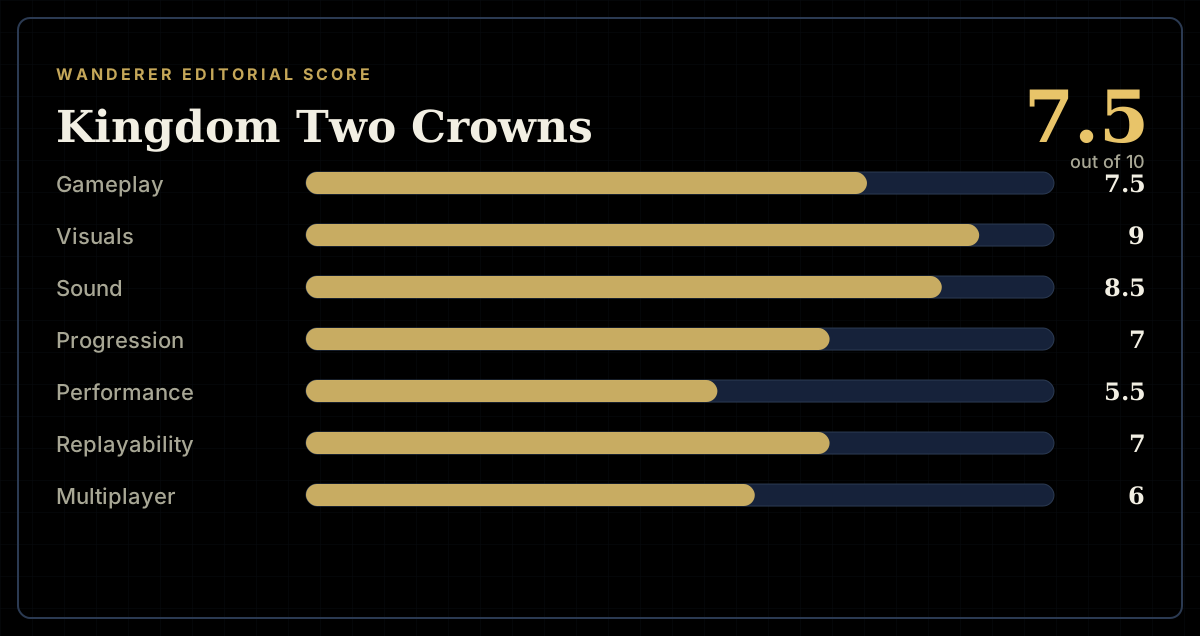
How the review scores each part of the gameWanderer Editorial -
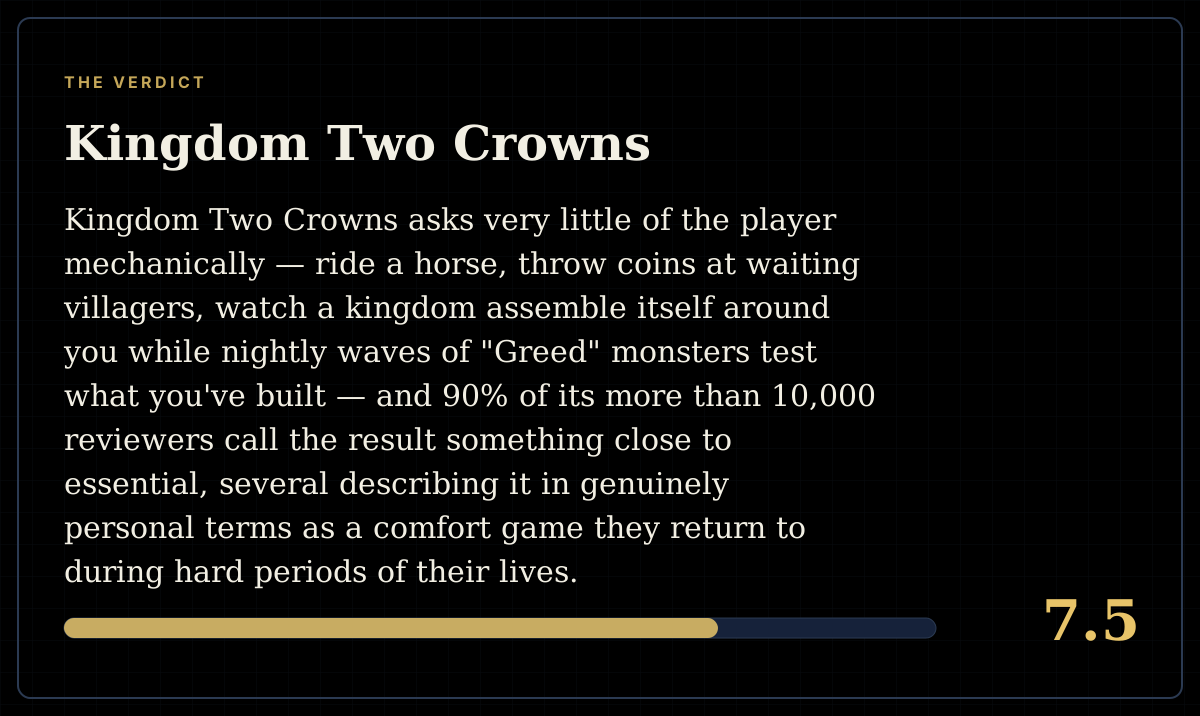
The short versionWanderer Editorial