Game review
King Of The Dark Circuit
5.5 / 10
- Developer
- SavicNode
- Publisher
- SavicNode
- Released
- 26 May 2026
- Platforms
- PC
- Genre
- Idle Clicker
A throne built from spreadsheets and skulls
King Of The Dark Circuit commits harder to its theme than most idle clickers bother to. Where a lot of games in this genre settle for a generic fantasy skin over generator lists, SavicNode's dark industrial-gothic setting — a dead empire's half-living "circuit" of cathedral spires and blood-fuelled reactors — runs through every system the store page describes: the currencies are Blood Fuel and Grave Data, the prestige tiers are named things like "Blood Tithe" and "Undying Emperor," and even the death screen frames a failed dive as the Circuit "claiming its due." It's committed, overwritten prose in places (the store description alone runs to nine separate feature headers), but it gives the mechanical skeleton underneath — which is a fairly standard prestige-and-generators idle loop — a stronger identity than the genre usually bothers with.
The stated structure is a hub-and-spoke layout, confirmed directly by the game's own main menu: a central "Dark Circuit" combat node surrounded by separate screens for Generators (The Engines), Upgrades (The Workshop), Decrees (The Royal Court), and Ascension (The Throne), with two further systems — The Archives and The Reliquary — shown locked behind progression gates. That's a reasonable amount of surface area for an idle clicker at this price point, assuming each of those screens holds up its own systems as described rather than just relabeling the same upgrade list.
Clicking that's meant to matter
The core combat loop is pitched as more actively engaged than typical idle-genre fare, and the developer is explicit about that framing: shrinking "weak point" reticles that reward a well-timed click with a 5x critical strike, a combo-and-frenzy meter for chaining hits, and titled boss encounters every fifth depth (the store names four: the Rusted Cardinal, Sovereign of Static, Throne-Eater, and Archlich of the Grid). Whether those reticle-timing windows feel genuinely skill-based in practice, rather than a light veneer over auto-battling, isn't something documentation alone can settle — that's a pacing and feel question that would need direct play to answer honestly, and this review doesn't claim to have logged that time.
What is independently verifiable is the risk-and-reward descent structure the store describes, because it shows up directly in the game's own death screen: dying at depth mid-dive costs a real chunk of banked Blood Fuel (nearly 20,000 units lost in the captured screenshot) and applies two stacking debuff curses — Grave Weakness, halving damage output, and Bloodless, halving fuel intake — that persist for a fixed 60-second window before fading. That's a meaningfully punishing loss condition for an idle game, closer to a roguelite's death penalty than the soft resets most incremental games use, and it lines up with the "greed and caution are both strategies" pitch on the store page rather than overselling it.
Extra systems, real or padding
Beyond the core dive-and-die loop, the game layers in two things worth flagging specifically. First, a set of optional cipher and rune-matching puzzle encounters that break from the clicking entirely — confirmed directly by a captured "Secret Word" decode puzzle, where the player matches scrambled code letters against a shifted alphabet key to spell out a hidden word for a Blood Fuel bonus. It's a small, low-stakes diversion rather than a deep puzzle system, but its presence as an optional, no-penalty side activity is a genuine point of difference from most idle clickers, which rarely break their own loop at all. Second, the stacked prestige structure — a six-tier Ascension tree feeding into a separate "Reliquary" layer that converts a different currency (Hollow Relics) into permanent bonuses — promises the kind of compounding long-term structure that keeps dedicated incremental-game players invested for dozens of hours, assuming the tuning between tiers holds up over that stretch.
A dense HUD for a dense economy
The screenshots also give a useful, checkable read on how the interface handles all of this at once. The in-combat HUD packs four separate resource counters (with live per-second rates) across the top of the screen alongside depth, vitality, and cooldown-ready ability icons along the bottom — a genuinely busy readout, but one that stays legible rather than collapsing into noise, with colour-coding doing a lot of the work to separate currencies at a glance. That's a reasonable outcome for a game juggling this many simultaneous systems, though it does mean the game is asking a new player to track meaningfully more on-screen state than a typical single-currency clicker from the first few minutes onward, which is worth factoring into the interface score alongside the puzzle overlay's own smaller, cleaner presentation.
On the performance side, there's no independently verifiable data available — no player account has reported on framerate, load times, or offline-catch-up calculation speed at depth, and the developer's own materials don't address it either. Given the density of simultaneously ticking systems (four currencies, auto-strikers, offline progress calculation, cooldown timers) it's the kind of scope where performance at very long idle-away intervals would be worth watching for, but that's a flagged unknown rather than a confirmed issue.
Thin evidence, fair caveats
At the time of writing, King Of The Dark Circuit has exactly one Steam user review, a brief positive note with no real detail beyond enthusiasm, from a player who logged 78 minutes. That's nowhere near enough of a sample to draw any reliable read on bugs, balance, or how the promised depth actually plays out over a long session — this write-up leans on the developer's own documented feature list and the screenshots it publishes rather than a verified player consensus, and anyone considering the NZ$9.59 asking price should treat pacing, puzzle frequency, and endgame tuning as open questions rather than settled facts.
Where it lands
For a genre that's often content to reskin the same generator-and-multiplier math, King Of The Dark Circuit deserves credit for building a cohesive, genuinely dark aesthetic and layering in real structural variety — active-click combat windows, a punishing death-and-curse system, optional puzzle breaks, and a two-tier prestige economy — rather than just another spreadsheet with a fantasy coat of paint. Whether the moment-to-moment feel lives up to that ambition, and whether nearly ten dollars is a fair ask against a one-review track record, are questions the current evidence can't fully answer. It's a reasonable, riskier-than-usual pick for idle-clicker fans specifically drawn to darker theming and heavier stakes, and a much harder sell for anyone wanting a track record to lean on first.
Screenshots
-
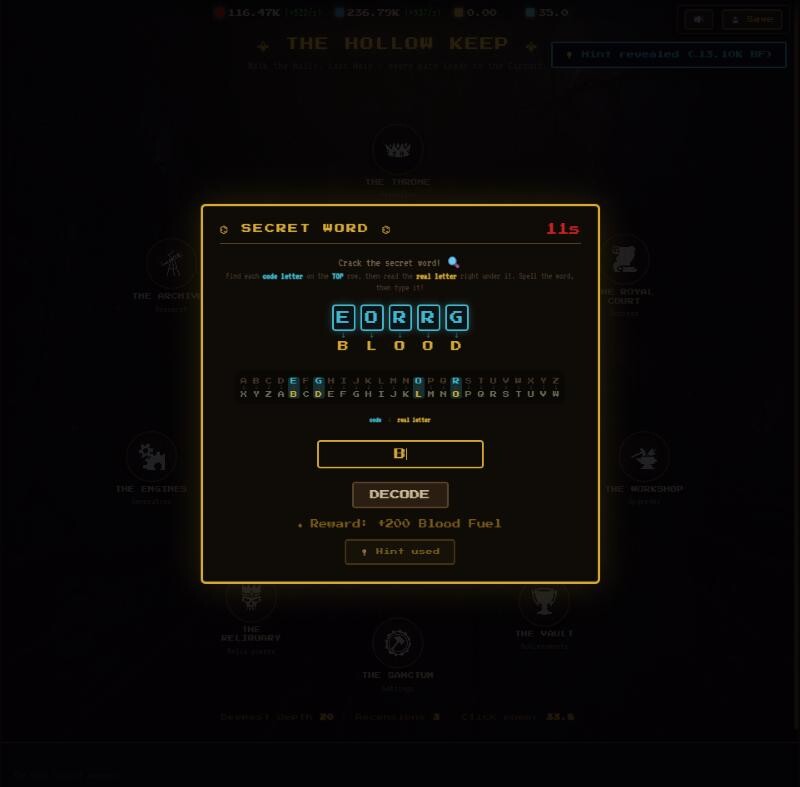
Optional decode puzzles interrupt the idle loop for a Blood Fuel reward, matching a scrambled cipher against a shifted alphabet key.Steam store page -

Diving too deep and dying strips a chunk of banked currency and applies a temporary debuff curse, exactly as the store page describes.Steam store page -
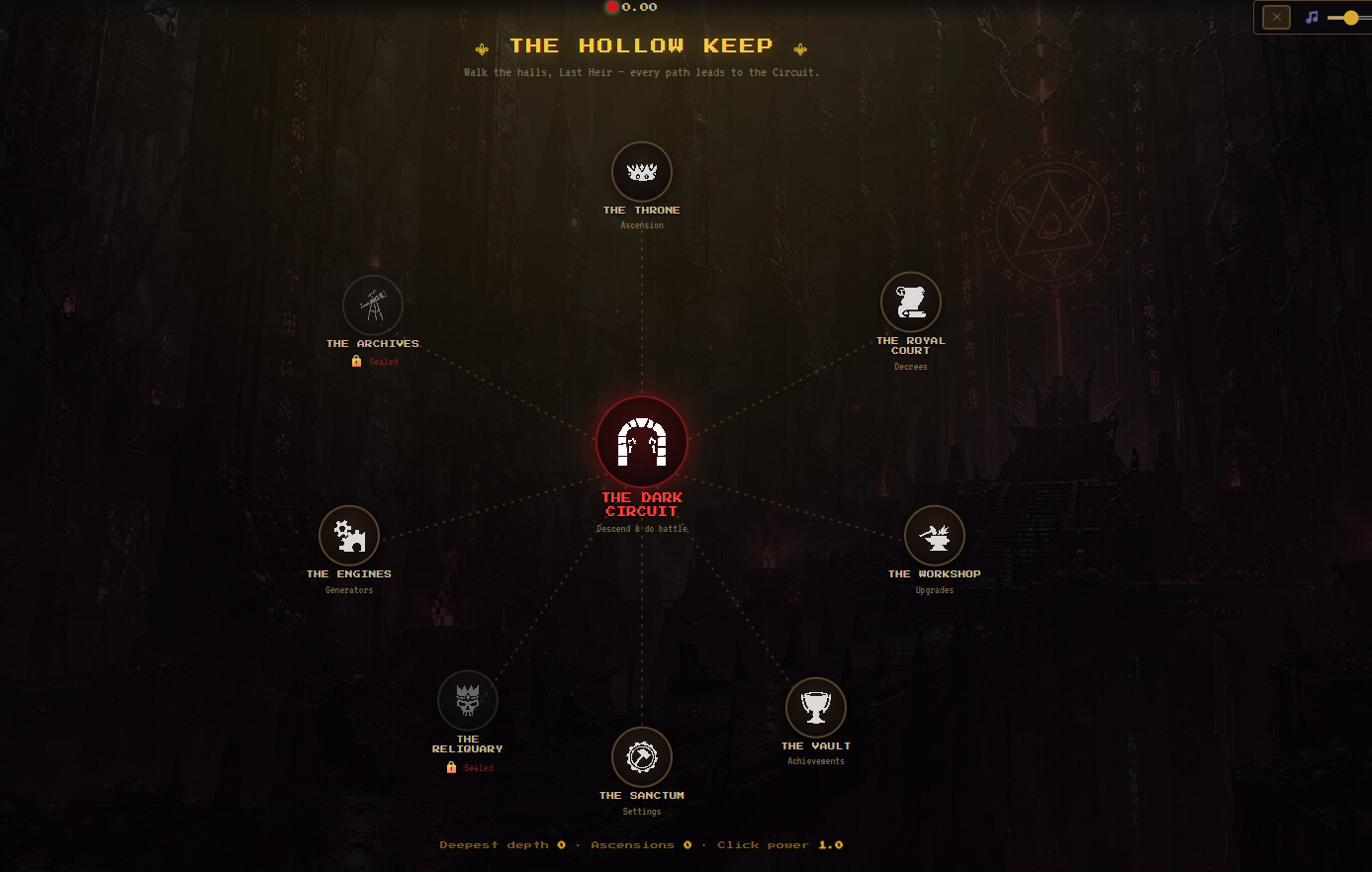
The main menu is a hub of separate systems — generators, upgrades, decrees, ascension, and a locked Reliquary layer — radiating out from the central combat node.Steam store page