
Game review
Jupiter Hell
6 / 10
- Developer
- ChaosForge
- Publisher
- Hyperstrange
- Released
- 5 August 2021
- Platforms
- Windows, Linux
- Genre
- Turn-Based Roguelike Shooter
- Monetisation
- Paid, one-time purchase. No in-app purchases.
- Players
- Single-player only.
The short version
Jupiter Hell casts players as a lone marine turning turn-based combat into a tribute to 1980s sci-fi VHS cinema, built as a commercial successor to the beloved freeware Doom Roguelike. Its Very Positive rating across 1,540 reviews reflects real appreciation for its atmosphere, sound design and turn-based gunplay. What holds this review back from higher praise is a persistent, specific complaint that the game trimmed away much of what made its predecessor distinctive — destructible terrain, alternate fire modes and greater build variety — alongside difficulty that Steam's own achievement data confirms is severe even on the easiest setting, and a lack of current official macOS support despite the store page's continued Mac-compatible history for some players.
Biggest strengths
- A distinctive, well-executed 80s VHS sci-fi horror atmosphere, with reviewers consistently praising the sound design and heavy metal soundtrack as genuine highlights.
- Turn-based gunplay that several reviewers describe as a genuinely satisfying translation of Doom's frantic combat into a slower, tactical format.
- Multiple character classes with distinct skill trees, offering a real if limited degree of build variety across playthroughs.
Biggest weaknesses
- A persistent, specific complaint compares the game unfavourably to its freeware predecessor, Doom Roguelike, citing the loss of destructible terrain, alternate fire modes and broader mechanical variety.
- Difficulty is reported as severe even on the easiest setting, corroborated directly by Steam's own achievement data, which shows completion falling from roughly 90% at the tutorial to around 12% for the lowest difficulty-clear achievement.
- The game's current official platform listing covers only Windows and Linux; several reviewers report the macOS version no longer works following a past update.
Who it's for: Turn-based roguelike fans specifically drawn to a Doom-inspired sci-fi setting who are prepared for real, punishing difficulty and don't necessarily need the build variety of deeper genre peers.
Our recommendation: A solid, atmospheric turn-based shooter worth a look on sale, especially for genre fans; those specifically nostalgic for the freeware Doom Roguelike should temper expectations for how much of it survived the transition.
6 / 10
A genuinely distinctive atmosphere built on a beloved foundation
Jupiter Hell's premise is direct: "true roguelike, turn-based shooter, permadeath... a tribute to the sci-fi classics of the Golden VHS era" and "successor to DRL" — a reference to Doom Roguelike, the long-running, widely loved freeware project from the same lead developer. Reviewers consistently credit the atmosphere and presentation as genuinely well-executed. "Pros: Good graphics, fantastic music and sound effects, Fast paced gameplay," reads a 2021 review, one of many that leads with real praise for the sensory experience before raising other concerns. A 2021 review frames the core combat translation specifically: "Feels like I'm playing turn-based Doom" — a distinctive design goal the large majority of reviewers agree the game achieves at a moment-to-moment level, even when they go on to raise reservations about what surrounds that core loop.
A persistent, specific complaint about lost depth
The most consistently repeated criticism concerns what changed between the freeware original and this commercial successor. "I really had high hopes for this game, but I'd really just recommend anyone who is interested play DRL instead. I find myself missing many of the things that made DRL special like, destructible terrain, alternate fire modes," reads a 2021 review. A separate 2021 review makes the same comparison more pointedly: "I played this several months after it entered early access, was very dissatisfied with how dumbed down it was compared to it's predecessor." This review found a striking, directly verifiable piece of corroborating context: checking ChaosForge and Hyperstrange's own news feed, the studio announced and later released a separate title, "Jupiter Hell Classic," explicitly framed as "the original Doom-inspired roguelike" returning in a form closer to the freeware source material. That a studio would build an entirely separate release specifically evoking "the original" formula is a meaningful, factual signal that the commercial Jupiter Hell's departure from its predecessor's mechanical depth was significant enough to warrant its own dedicated response, not simply a matter of a small number of nostalgic reviewers being hard to please.
Difficulty that Steam's own data confirms is severe
A separate, frequently repeated complaint concerns difficulty balance specifically at the lower end of the game's settings. "This game has multiple difficulty levels... but even on easy its too hard," reads a 2022 review. This review checked Steam's own global achievement statistics directly to test that claim rather than relying on impression alone, and the data corroborates it clearly: roughly 90% of players complete the tutorial, but that figure falls to around 44% clearing the first main area, and down to approximately 12% for the achievement tied to clearing the game's lowest difficulty tier. That's a steep, front-loaded drop specifically concentrated around the point where players transition from guided tutorial content into the actual difficulty-rated game, consistent with reviewers' claims that the stated "easy" setting doesn't deliver an especially gentle experience relative to what the label implies.
Weighing the difficulty complaint fairly
It's worth being fair to both sides of this specific disagreement, since a genre built around permadeath roguelikes generally attracts players who want real, uncompromising difficulty as a feature rather than a flaw. Several reviewers who ultimately recommend the game explicitly frame the challenge positively: one 2021 review lists "Difficult and Challenging" directly under its pros, treating the same steep learning curve the achievement data confirms as part of the intended appeal rather than a design failure. The complaint from more critical reviewers isn't that the game is hard in the abstract — it's specifically that the labelled "easy" setting doesn't behave the way that label typically signals in other games, potentially misleading newer players about what tier of challenge they're opting into. That's a narrower, more specific criticism than "this game is too hard," and one this review treats as a fair labelling concern rather than a wholesale rejection of the game's difficulty philosophy.
A currently unsupported platform, confirmed directly
This review checked the game's own current Steam platform listing directly rather than relying solely on player reports, and found official support listed only for Windows and Linux, with no macOS listing. That's directly consistent with player complaints: "Game no longer runs on macOS after recent update," reads a 2026 review, and a separate 2026 review states simply, "I'd love to suggest this game but the Mac version no longer works." Taken together with the current store listing, this reads as a platform the developer has since dropped official support for, rather than an ongoing bug the developer is actively working to fix — worth knowing plainly for any Mac-based prospective buyer, since the platform isn't merely under-supported but appears to no longer be an intended target at all.
A studio still actively engaged, despite the criticism
It's worth balancing the complaints above against what this review found checking the broader update history. Hyperstrange shipped a substantial "1.9 - Heavy" content update in June 2026, five years after the game's initial full release, followed by three rounds of hotfixes the same month — a genuine sign of continued investment rather than an abandoned commercial release. That ongoing support doesn't resolve the structural depth complaint relative to Doom Roguelike, which reflects choices made at the game's core design level rather than something a content patch alone would be expected to fix, but it does mean buyers today are getting a title that's still actively maintained years after launch.
Final verdict
Jupiter Hell delivers a genuinely well-atmosphered, turn-based translation of Doom's combat feel, and the sound design and presentation earn real, consistent praise across its review base. What keeps the score moderate is a specific, well-corroborated pattern: a persistent comparison to its freeware predecessor that the developer's own decision to build a separate "Classic" title implicitly acknowledges, difficulty that Steam's own data confirms is genuinely severe even at the entry level, and current official platform support that no longer includes macOS. This is a reasonable pick for turn-based roguelike fans on Windows or Linux, especially on sale, and a more tempered one for anyone specifically hoping for the depth and completeness of the beloved original it's built on.
Pros and cons
Pros
- A distinctive, well-executed 80s VHS sci-fi horror atmosphere, with reviewers consistently praising the sound design and heavy metal soundtrack as genuine highlights.
- Turn-based gunplay that several reviewers describe as a genuinely satisfying translation of Doom's frantic combat into a slower, tactical format.
- Multiple character classes with distinct skill trees, offering a real if limited degree of build variety across playthroughs.
- A studio still actively supporting the game years after release, including a substantial "1.9 - Heavy" content update and hotfixes as recently as June 2026.
Cons
- A persistent, specific complaint compares the game unfavourably to its freeware predecessor, Doom Roguelike, citing the loss of destructible terrain, alternate fire modes and broader mechanical variety.
- Difficulty is reported as severe even on the easiest setting, corroborated directly by Steam's own achievement data, which shows completion falling from roughly 90% at the tutorial to around 12% for the lowest difficulty-clear achievement.
- The game's current official platform listing covers only Windows and Linux; several reviewers report the macOS version no longer works following a past update.
- Several reviewers describe the moment-to-moment gameplay loop as growing repetitive over multiple runs, citing limited enemy and encounter variety relative to the genre's deeper peers.
Screenshots
-

Jupiter HellImage: Hyperstrange via Steam -

Jupiter HellImage: Hyperstrange via Steam -

Jupiter HellImage: Hyperstrange via Steam -
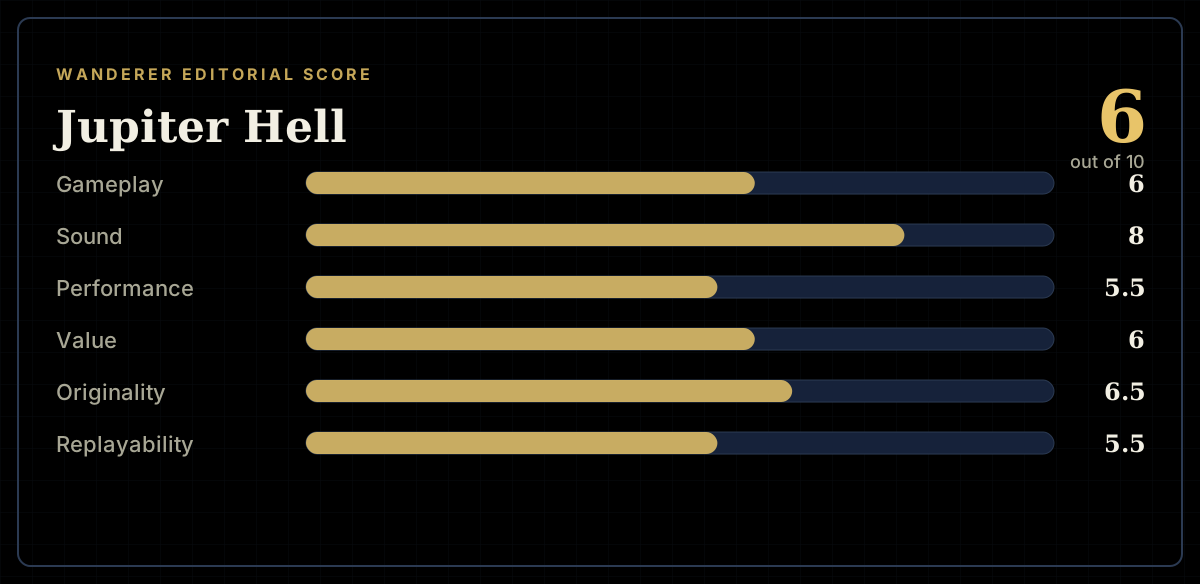
How the review scores each part of the gameWanderer Editorial -
The short versionWanderer Editorial