
Game review
Island Off Outer Darkness
7.1 / 10
- Developer
- Zugerujk
- Publisher
- Zugerujk
- Released
- 24 July 2025
- Platforms
- [Windows]
- Genre
- RPG
- Monetisation
- Paid
- Players
- Single-player only
The short version
Island Off Outer Darkness takes a simple premise — deliver the mail, talk to everyone — and spins it into one of the most singular narrative experiences reviewers say they've played, built on dense character writing and an unsettling, slowly-revealed sense of place. Real bugs, demanding late-game platforming, and a metafictional swerve near the end that leans hard on the developer's own personal history keep it from being an easy universal recommendation, but for the players it clicks with, it clicks hard.
Biggest strengths
- Extraordinarily dense, distinctive character writing, with reviewers repeatedly calling it some of the best they've encountered in a game
- A genuinely novel structure — a slow-paced "conversational imsim" where the postal-delivery loop exists mainly to justify daily conversations
- A striking abstract, minimalist visual style paired with a widely-praised, atmospheric soundtrack
Biggest weaknesses
- Real technical bugs, including a reported text-and-visual "desync" glitch and occasional geometry softlocks that force restarting a day
- Required platforming sections, especially in the game's demanding later stretch, clash with controls built for slow, contemplative walking
- A late metafictional twist ties the plot directly to the developer's own online community history, which some reviewers found moving and others found alienating or insider-focused
Who it's for: Fans of dialogue-heavy, slow-paced narrative games like Night in the Woods, Kentucky Route Zero, or Disco Elysium's conversational density, who don't mind rough technical edges and an ending that asks a lot of interpretive trust from the player.
Our recommendation: Recommend
7.1 / 10
The Mail Is Just an Excuse to Talk
Island Off Outer Darkness casts you as a postal worker newly arrived at a remote fishing village perched beside a volcano, delivering letters to a small, tightly-drawn cast of residents while the world around them quietly starts to warp. Reviewers describe the actual delivery loop as almost secondary to the point of the game: one calls it "a game centered around talking. Getting to know the inhabitants, unlocking new conversation topics... all connected with the premise of making deliveries." Another goes further, framing the dialogue system as a direct homage to Morrowind's approach of talking to NPCs repeatedly and habitually rather than through discrete quest markers, calling the result "really neat" precisely because it treats conversation as an ongoing relationship rather than a transaction.
That structure produces something reviewers struggle to categorise cleanly, and more than one settles on inventing a label for it rather than reaching for an existing genre — "conversational imsim" comes up explicitly, as does comparison to Night in the Woods, Kentucky Route Zero, and even Boku no Natsuyasumi. What unites the comparisons is less mechanical similarity than a shared commitment to a slow, walking pace that gives space for dense, idiosyncratic character writing. Nobody in the sample describes the cast as simply likeable — several reviewers are explicit that many characters are unpleasant, prejudiced, or difficult, and that the game is stronger for not softening them. One reviewer notes getting information about the wider world mostly from "a racist guy under a bridge," framing it as tonally exact rather than a misstep.
A Tiny Village, an Enormous Amount of World
Given how small its central setting is, Island Off Outer Darkness earns unusually consistent praise for the depth of its world-building. Reviewers describe learning new details about the town, its history, and its residents' relationships day after day, with one noting that even after logging over thirty hours, they were still checking in on every character daily to avoid missing anything. The visual style — abstract, low-poly, built around striking character portraits that read as more art than illustration — draws mixed initial reactions in the sample but wins most reviewers over quickly; one admits some portraits initially read as "just abstract art" before becoming some of the most distinct, memorable character designs they'd encountered. The soundtrack is close to universally praised, with multiple reviewers singling it out as essential to the game's mood — one bought it outright immediately after finishing their review.
Small systemic touches round the loop out without pulling focus from the writing. A fishing minigame shows up in nearly every glowing review as a genuine highlight rather than a chore, and the farming system is specifically credited with "a fun logic puzzle aspect" that rewards understanding it rather than just repeating an action. None of this reads as filler; reviewers consistently frame the minigames as connective tissue between the conversations that are clearly the game's real substance.
A Demanding, Divisive Final Stretch
Not everything holds together as cleanly. Several reviewers flag required platforming sections — particularly a late-game stretch some call "week 8" — as a real mismatch with the game's overall pacing and control scheme, built as they are for slow, deliberate walking rather than precision movement. One otherwise enthusiastic review calls the platforming "punishing" specifically because the rest of the game already demands patience and forgiveness from the player, making a sudden difficulty spike feel unearned rather than climactic. Technical bugs come up more than once as well, including a reported "desync" glitch where text and visuals fail to line up correctly, and occasional instances of getting stuck in the environment that require restarting the day from the pause menu — frustrating in a game this dialogue-dependent, since missed or garbled text can mean missing the exact character beats the whole experience is built around.
The game's ending is where opinions genuinely diverge, and it's worth flagging clearly for anyone considering picking this up. Late in the story, the plot pivots into explicitly metafictional territory, revealing that a central plot thread is a direct retelling of the developer's own history with an online creative community that fell apart. One long, detailed review describes this reveal as initially "offputting," "like a callout blog post being dropped in realtime," before working through a genuine process of re-examination and ultimately finding real value in the vulnerability of it — while still concluding the ending doesn't quite do justice to everything that came before it, in part because so much of the final act leans on context outside the game itself. It's a rare kind of criticism to see articulated this thoughtfully, and it suggests the ending is less a flaw to dismiss than a deliberate risk that will land differently depending on the player.
Not for Everyone, Exactly as Intended
Island Off Outer Darkness is not shy about being a niche game, and several reviewers say so explicitly rather than treating it as a caveat to bury. It demands patience with a deliberately slow walking pace, tolerance for a plot that reveals itself obliquely through routine and repetition rather than conventional stakes, and — at least for its ending — willingness to sit with ambiguity that draws on the developer's personal life rather than the game's internal fiction alone. For the right player, though, the response in the sample borders on evangelical: reviewers describe it entering their "all-time games pantheon," call it a game they'll "think about often" when making their own art, and openly wonder why it hasn't built a larger cult following yet, given how fully formed its influences and ideas feel for what multiple reviewers note was a solo or near-solo project from a very young developer.
Verdict
Island Off Outer Darkness is a genuinely singular game — a slow, talk-driven "postman simulator" with more going on beneath its minimalist surface than its premise suggests, anchored by some of the sharpest character writing reviewers describe encountering in the medium. Real bugs, a punishing late platforming stretch, and a deeply personal, polarising ending keep it from being a clean recommendation to everyone, but for players drawn to its specific, patient rhythm, it's the kind of game people come back to talk about for years.
Pros and cons
Pros
- Extraordinarily dense, distinctive character writing, with reviewers repeatedly calling it some of the best they've encountered in a game
- A genuinely novel structure — a slow-paced "conversational imsim" where the postal-delivery loop exists mainly to justify daily conversations
- A striking abstract, minimalist visual style paired with a widely-praised, atmospheric soundtrack
- Small but well-integrated minigames (fishing, farming with a real logic-puzzle element) that add texture without overwhelming the narrative focus
- A world that rewards close attention, with new dialogue and revelations unlocking daily across a tightly-built cast
Cons
- Real technical bugs, including a reported text-and-visual "desync" glitch and occasional geometry softlocks that force restarting a day
- Required platforming sections, especially in the game's demanding later stretch, clash with controls built for slow, contemplative walking
- A late metafictional twist ties the plot directly to the developer's own online community history, which some reviewers found moving and others found alienating or insider-focused
- Extremely slow pace and minimal traditional gameplay will not suit players outside its niche
- A small, self-published release with limited review volume, so word of mouth is still thin
Screenshots
-
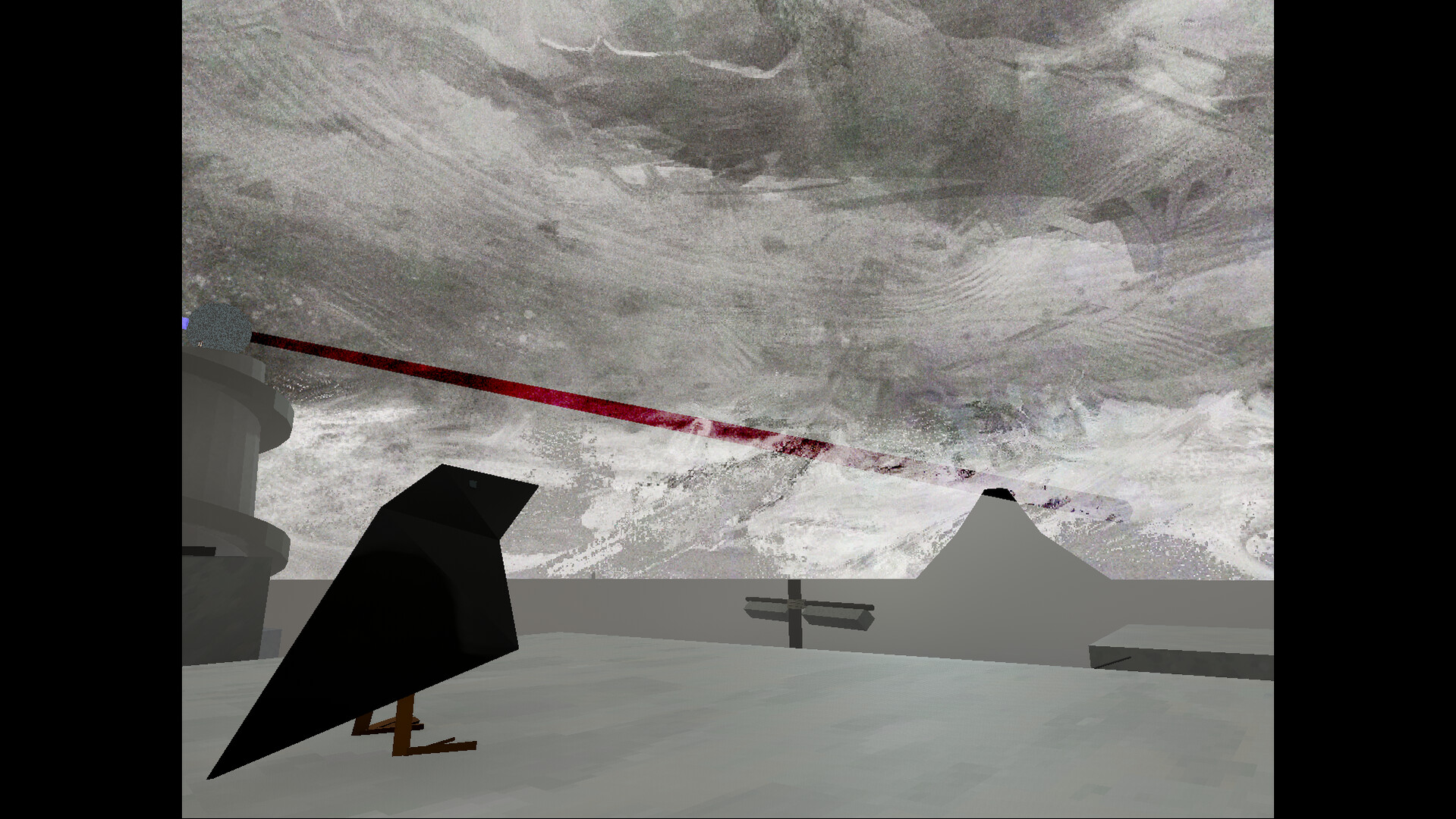
The abstract, painterly sky and minimalist low-poly figures set the game's unsettling, dreamlike toneZugerujk -
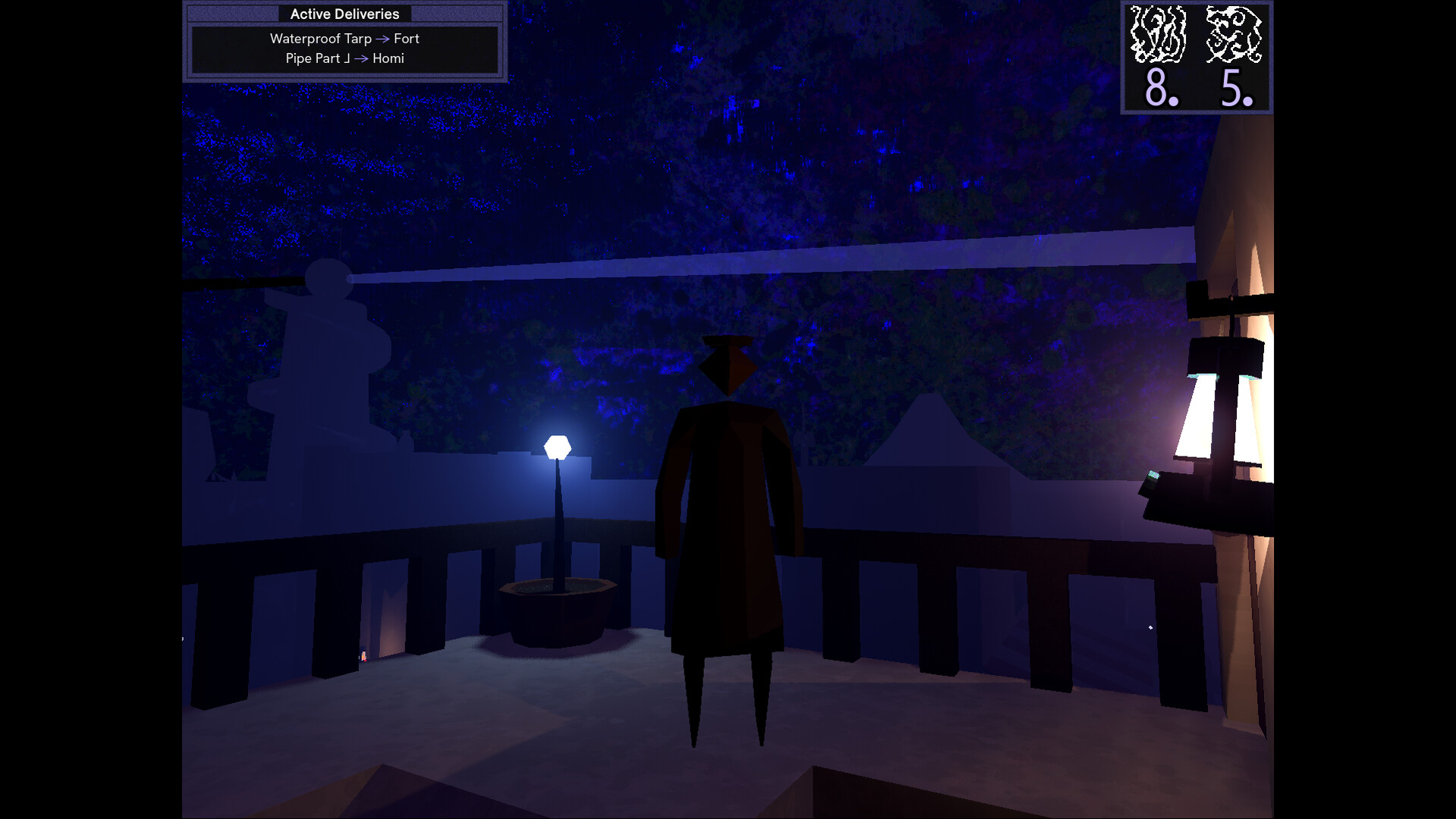
The delivery checklist is the game's throughline, sending the postal worker back out to talk to villagers each dayZugerujk -
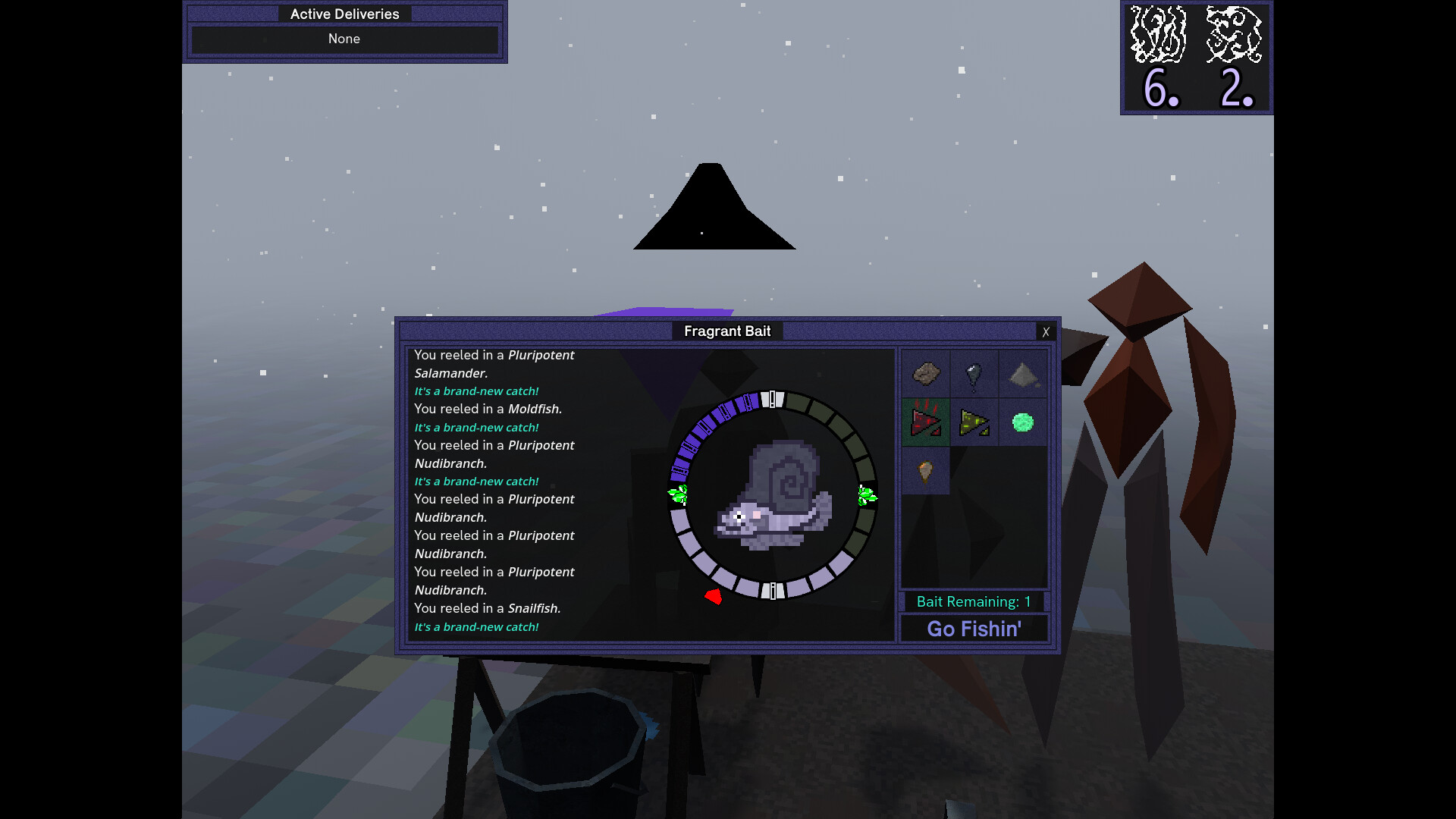
The fishing minigame is one of several small systems reviewers single out as a highlight alongside the writingZugerujk -
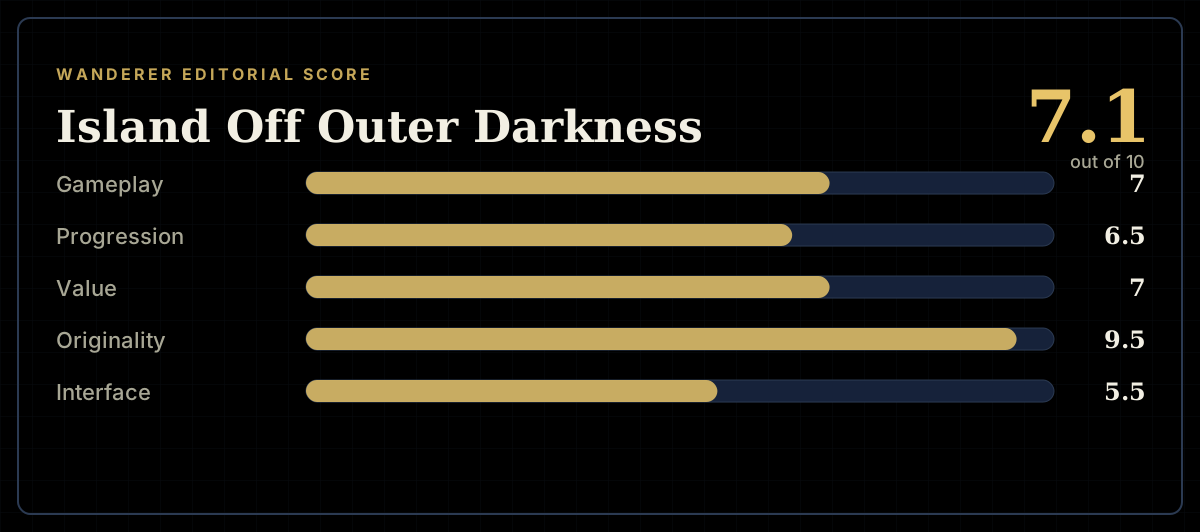
How the review scores each part of the gameWanderer Editorial -
The short versionWanderer Editorial