
Game review
Is this Game Trying to Kill Me?
6 / 10
- Developer
- Stately Snail
- Publisher
- Stately Snail
- Released
- 12 November 2024
- Platforms
- Windows
- Genre
- First-person meta-puzzle horror
- Monetisation
- One-time purchase, no in-game store or additional currency purchases
- Players
- Single-player only
The short version
Is this Game Trying to Kill Me? traps you inside a cabin deep in the forest, where the owner offers you freedom in exchange for playing a computer game — a game that turns out to be intimately, mechanically connected to the room you're actually standing in. This review's sample shows the concept working genuinely well for a large number of players, several drawing direct and enthusiastic comparisons to Inscryption. A comparably sized, more skeptical portion of the sample pushes back specifically on that comparison, arguing the puzzles here are simpler and more arbitrary than the premise's ambition suggests, and that the whole experience runs considerably shorter than its price tag implies.
Biggest strengths
- The core "game inside a game" concept, where actions taken in the in-fiction computer game directly affect the cabin environment around you, earns genuine, specific praise for how cleverly the two layers interact
- The pixelated retro-3D aesthetic draws consistent, appreciative mentions across the review sample as distinctive and well-executed for the game's modest scope
- The hint system is credited by multiple reviewers as a fair, welcome accommodation that kept them moving forward without fully solving puzzles for them
Biggest weaknesses
- A specific, detailed portion of the negative sample argues the game invites an Inscryption comparison it doesn't fully earn, describing the puzzles as considerably simpler and occasionally more arbitrary than that comparison implies, with solutions some reviewers call counter-intuitive rather than genuinely clever
- The single most repeated complaint concerns runtime relative to price, with multiple reviewers independently reporting completion in two to three hours and describing the roughly twenty-two dollar asking price as difficult to justify at that length
- Several reviewers who loved an earlier public demo report disappointment that the full game's puzzles felt similarly thin rather than expanding meaningfully in depth or ambition
Who it's for: Fans of short, atmospheric meta-puzzle games who enjoyed the game-within-a-game concept of Inscryption or There Is No Game and don't mind a lighter puzzle difficulty and a two-to-three-hour runtime, ideally bought on sale.
Our recommendation: A genuinely creative, well-atmosphered puzzle experience best purchased at a discount given how consistently reviewers report finishing it in two to three hours — go in for the concept and presentation rather than expecting Inscryption-level puzzle depth or narrative weight.
6 / 10
You're trapped in a cabin deep in the woods, and its unsettling owner offers a deal: play a game on an old computer terminal, and you're free to go. Is this Game Trying to Kill Me? builds its entire identity around the twist that the game on that terminal and the cabin around you aren't separate at all — actions taken in one directly reshape the other. It's a premise practically engineered to invite comparisons to Inscryption, and this review's sample shows that invitation both paying off richly for many players and falling short for others in specific, worthwhile ways.
When the dual-layer concept clicks
For reviewers who connect with it, the interplay between the in-fiction game and the physical cabin space is the clear highlight. "A unique escape game experience! The puzzles are brilliant, blending two worlds: a pixel virtual game on a vintage computer, and a mysterious cabin in a forest. Actions in the pc game directly affect the environment in the cabin, creating a clever play between the two settings," one reviewer writes. Another captures the appeal in genre terms directly: "This is so good! It's sort of what I wanted from 'Tormenture', a game you play that affects the world around you, meta puzzles that go between the 'game' and your surroundings." A third sums up the atmosphere concisely: "the atmosphere is quite great and immersive, and I simply adore the pixelated old-school 3D graphics look of the game."
Where the Inscryption comparison starts to strain
The negative sample doesn't dispute that the concept is interesting — it argues specifically that the execution doesn't sustain the comparison the premise invites. "This game is intriguing as someone who loved Inscryption, however the mystery, plot and sadly the puzzles all fall flat. This is a glorified walking simulator, and there's no single puzzle that stands out against the rest," one reviewer writes. Another is considerably blunter: "Trying hard to be Inscryption but it has no heart and soul of its own. The puzzles are so easy a toddler could get through most of them and the challenging ones are not actually puzzles but just random interactions." A third reviewer offers a more measured version of the same critique: "Right off the bat: Good graphics, good concept, with few eureka moments... everything seems cryptic, everything seems important, and thus, nothing is since you can't tell. Arbitrary and oddly specific solutions." That's a specific, useful distinction for prospective buyers — the atmosphere and concept are genuinely well-realized, but the puzzle design itself is where this sample's more experienced puzzle-game critics find the execution thinner than the premise's ambition suggests.
The runtime-versus-price complaint, stated plainly and often
Beyond puzzle depth, the single most repeated concern in this review's sample is straightforward value math. "VERY SHORT. Game is great vibe/puzzles etc., but I beat it just over 2 hours and was pretty disappointed to be done with it. I was really expecting something closer to 10 hours," one reviewer writes. Another does the math even more directly: "Costs too much for what it is - an escape room game with some extra steps that is full of extremely simple puzzles, mostly just going through the motions." A third reviewer, who'd played and loved the developer's earlier demo, reports specific disappointment that the full release didn't expand meaningfully beyond what the free preview already offered: "I loved the prologue and the demo so I bought the game... unfortunately full of meaningless puzzles and sadly the game itself is pretty boring... only took 3 hours or so to finish." That's a genuinely useful data point — the demo apparently represents the game's ceiling rather than a small taste of something larger.
A specific, documented bug worth flagging
At least one reviewer reports a concrete, reproducible technical problem rather than a general complaint: "I was really enjoying this game until I got to a part I couldn't figure out. The solution seemed pretty clear, but nothing I tried worked. I looked up a guide, and I found that the solution I had been trying was the correct one, but my game had bugged out, and there was an item I was not able to interact with." That's the kind of specific, checkable report worth taking seriously as a real quality-control gap rather than player error, since the reviewer confirmed via community guides that their approach was correct.
What the achievement data shows about completion
Steam's own figures are consistent with a short, largely finishable experience rather than one that strands most buyers partway through. An early milestone sits at 96.1%, and even the hardest tracked achievement sits at a comparatively healthy 37.9% — a gradual, sensible falloff without the severe cliffs seen in games where most players never finish. That supports the reviewer-described picture of a compact, largely completable game rather than one padded with inaccessible late content; the criticism here is about length and depth relative to price, not about players getting stuck and giving up en masse.
A modest release with no ongoing roadmap, and that's fine
This review's check of the partner-events feed found only three posts total: a release-date announcement, the launch itself, and a later Steam Trading Cards addition. That's thin compared to many titles in this review series, but no reviewer in this sample alleges neglect or abandonment — the complaints here are entirely about the base game's length and puzzle depth, not about promised content that never arrived. For a self-contained, narrative-driven puzzle experience with a clear beginning and end, a quiet post-launch history isn't itself a red flag.
Final verdict
Is this Game Trying to Kill Me? executes a genuinely clever dual-layer concept with real atmosphere and craft, earning sincere comparisons to Inscryption from a substantial part of its audience — but a comparably substantial, more experienced-puzzle-game portion of that same audience makes a fair case that the puzzles themselves don't fully earn that comparison, and that its roughly two-to-three-hour runtime sits uncomfortably against its price. Best approached on sale, with expectations set for a short, atmospheric curiosity rather than a deep puzzle-box experience.
Pros and cons
Pros
- The core "game inside a game" concept, where actions taken in the in-fiction computer game directly affect the cabin environment around you, earns genuine, specific praise for how cleverly the two layers interact
- The pixelated retro-3D aesthetic draws consistent, appreciative mentions across the review sample as distinctive and well-executed for the game's modest scope
- The hint system is credited by multiple reviewers as a fair, welcome accommodation that kept them moving forward without fully solving puzzles for them
- Several reviewers describe the game successfully filling a specific niche left open since Inscryption, offering a similar tonal and structural thrill in a smaller, more focused package
- Achievement data shows a smooth, gradual completion curve without any severe late-game cliff, consistent with a short, largely finishable experience rather than one that strands most players partway through
Cons
- A specific, detailed portion of the negative sample argues the game invites an Inscryption comparison it doesn't fully earn, describing the puzzles as considerably simpler and occasionally more arbitrary than that comparison implies, with solutions some reviewers call counter-intuitive rather than genuinely clever
- The single most repeated complaint concerns runtime relative to price, with multiple reviewers independently reporting completion in two to three hours and describing the roughly twenty-two dollar asking price as difficult to justify at that length
- Several reviewers who loved an earlier public demo report disappointment that the full game's puzzles felt similarly thin rather than expanding meaningfully in depth or ambition
- At least one reviewer documents a specific, reproducible progression-blocking bug, where an item became impossible to interact with despite following a community-confirmed correct solution
- The game's endings are criticized by at least one detailed reviewer as thin payoff for the build-up, describing them as just a couple of paragraphs of text over a static image rather than a more substantial narrative conclusion
Screenshots
-

Is this Game Trying to Kill Me?Image: Stately Snail via Steam -

Is this Game Trying to Kill Me?Image: Stately Snail via Steam -

Is this Game Trying to Kill Me?Image: Stately Snail via Steam -
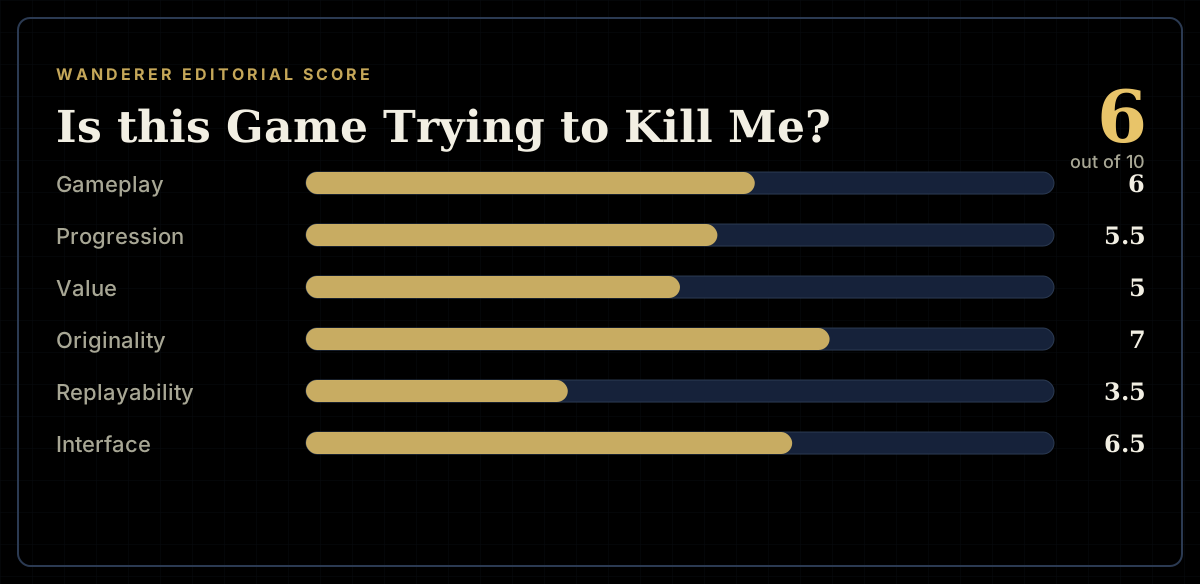
How the review scores each part of the gameWanderer Editorial -
The short versionWanderer Editorial