Game review
Into the Breach
8.5 / 10
- Developer
- Subset Games
- Publisher
- Subset Games
- Released
- 27 February 2018
- Platforms
- Windows, macOS, Linux
- Genre
- Tactics Puzzle
- Monetisation
- One-time purchase, NZ$18.49. No microtransactions, no paid DLC.
- Players
- Single-player only
The short version
Into the Breach compresses tactical combat into an 8x8 grid where every enemy telegraphs its exact next move before you act, turning each turn into a solvable puzzle rather than a probability gamble. 94.2% positive across 22,150 reviews reflects wide recognition that Subset Games, the studio behind FTL, pulled off something genuinely rare: a completely different design philosophy that still carries the same obsessive replayability.
The honest, well-articulated dissent comes almost entirely from FTL fans who arrived expecting more of what made that game beloved and found something structurally opposite instead. One of the most-upvoted positive reviews in the game's history admits to exactly this reaction — "initially, I was disappointed that this game was nothing like it" — before describing how that resentment faded. Not every FTL fan's resentment fades, and the reviews from those it doesn't are specific enough to take seriously rather than dismiss as simple nostalgia.
Biggest strengths
- A genuinely rare design achievement — full-information tactical puzzles where skill, not luck, determines outcomes, executed with real elegance on a small grid
- Extremely high replayability for a short-session game, with reviewers logging hundreds of hours across many distinct squad and pilot combinations
- Tight, economical presentation that never wastes the player's time with padding
Biggest weaknesses
- The single most consistent criticism across every year since launch: players who came for more of FTL's randomness-and-repeated-failure loop find the deterministic puzzle structure a poor substitute, sometimes describing genuine, lasting disappointment rather than a settled taste mismatch
- Some reviewers describe the game as too easy on a first attempt, with an anticlimactic early difficulty curve before the real challenge appears on harder settings
- Roguelike elements are described by a meaningful minority as thin compared to FTL's variety, with runs feeling more repetitive across mission types than the genre label implies
Who it's for: Fans of tightly-designed, perfect-information tactics puzzles who enjoy solving a situation rather than gambling on one — closer to chess than to FTL's push-your-luck randomness. Less suited to players specifically seeking FTL's chaotic, knowledge-through-repeated-failure design, or anyone who wants a long, narratively driven campaign.
Our recommendation: Buy it on its own terms rather than as "FTL but mechs" — the two games share a developer and very little else philosophically, and going in with that understood is the single biggest factor separating reviewers who love it from reviewers who don't. If you finish an early run without much difficulty, that's reportedly common; the game's real depth and challenge opens up on repeated, harder attempts rather than the first one.
8.5 / 10
The clearest, most precise line in this entire review corpus comes from a reviewer trying to explain why Into the Breach feels so different from Subset Games' previous work: "While FTL used the mechanic of 'knowledge is power,' in that you learn to game the system to get RNG on your side, Into the Breach is much more a match of chess." That distinction is the whole review in one sentence, and understanding it explains almost everything about who loves this game and who doesn't.
Full information, real puzzles
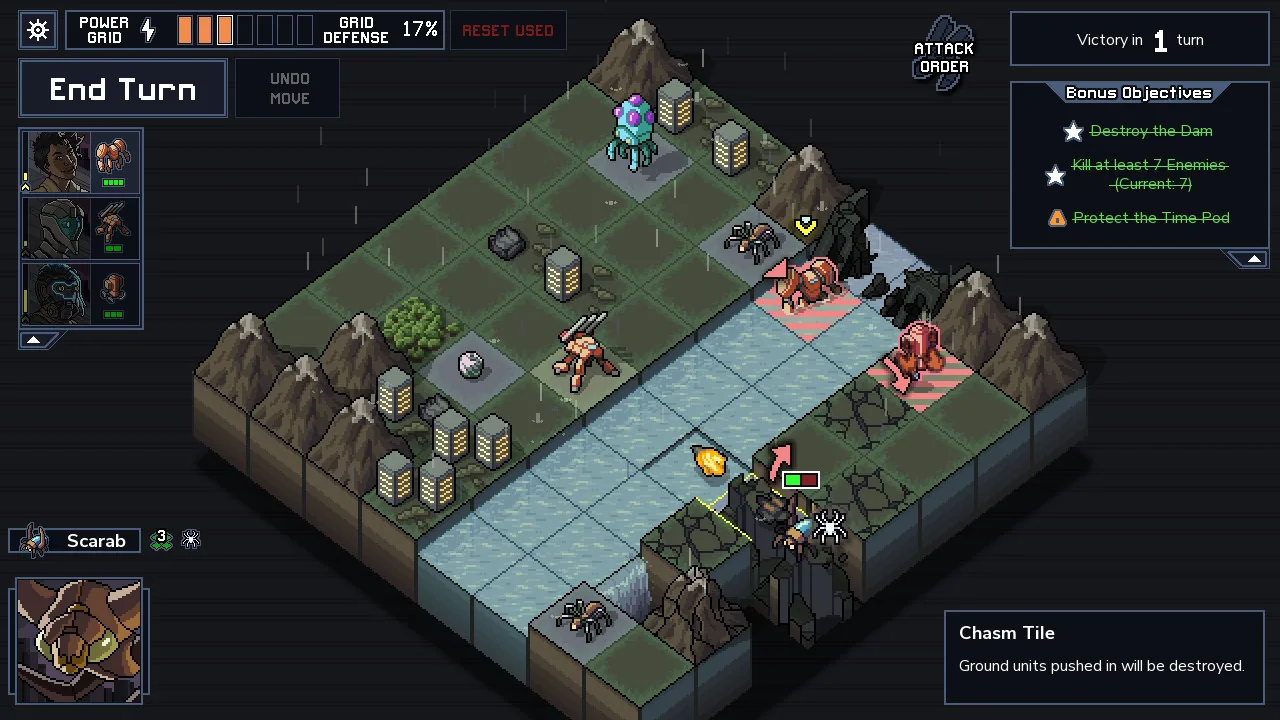
Every enemy on Into the Breach's small grid shows you exactly what it's about to do next turn — which tile it will attack, which unit it's targeting — before you move. That single design choice transforms combat from a probability-management problem, FTL's specialty, into a genuine puzzle: given complete information, can you find the sequence of moves that saves everyone? Reviewers consistently praise how much tension and satisfaction Subset extracted from that constraint, squeezing real tactical depth out of an 8x8 grid and a handful of unit types. It's a completely different kind of game from its predecessor, executed with the same obsessive polish.
The FTL problem, argued honestly on both sides
Here's what makes this game's review corpus genuinely interesting rather than simply positive: the dissent is almost entirely made of FTL fans working through a specific, named disappointment, and the corpus contains its own best rebuttal. One of the most-upvoted positive reviews in the game's history states the tension directly: "FTL was so amazing that initially, I was disappointed that this game was nothing like it. That mild resentment quickly went away once I actually spent some time playing." That's an honest admission of the exact reaction the negative reviews describe, followed by an account of moving past it.
Not every reviewer's resentment resolves the same way. "I've held off on a review because I'm still confused as to why I didn't like this game," one writes, five hours in, despite loving the genre and FTL specifically. "This game is unforgiving in the wrong way." Another, comparing the two games directly, calls the roguelike elements here "incredibly weak" next to FTL's variety and charm. A third makes a specific structural complaint: because the AI's next move is always knowable, the puzzle can start to feel like "figuring out the 'out' that the AI set" rather than open tactical freedom — a fair criticism of exactly the design choice that draws the most praise elsewhere.
Reading the completion data
The achievement curve across the game's 70 achievements shows a genuinely broad, sustained engagement level. Early milestones sit between 67% and 75%, meaning most buyers get deep into the core systems rather than bouncing off quickly. The rarest achievements, tied to the hardest difficulty tiers and toughest squad challenges, fall to around 4-5%, a reasonable long tail for a game whose replayability comes from remixing squads and difficulty rather than new content per se.
8.5 out of 10. Into the Breach is a genuine design achievement — a small, perfectly legible tactics puzzle that rewards precise thinking over lucky rolls, and a bold, successful departure from what made its developer's previous game beloved. It loses a fraction of a point to a real, honestly argued tension: for a meaningful share of FTL's fans, the switch from randomness to certainty isn't a trade they've made peace with, and their reviews describe genuine, specific disappointment rather than simple unmet nostalgia. Go in understanding it's a different game entirely, and the design Subset actually built is very hard to fault on its own terms.
Pros and cons
Pros
- A genuinely rare design achievement — full-information tactical puzzles where skill, not luck, determines outcomes, executed with real elegance on a small grid
- Extremely high replayability for a short-session game, with reviewers logging hundreds of hours across many distinct squad and pilot combinations
- Tight, economical presentation that never wastes the player's time with padding
- A meaningful design achievement in its own right, separate from and not merely a sequel to Subset's beloved FTL
Cons
- The single most consistent criticism across every year since launch: players who came for more of FTL's randomness-and-repeated-failure loop find the deterministic puzzle structure a poor substitute, sometimes describing genuine, lasting disappointment rather than a settled taste mismatch
- Some reviewers describe the game as too easy on a first attempt, with an anticlimactic early difficulty curve before the real challenge appears on harder settings
- Roguelike elements are described by a meaningful minority as thin compared to FTL's variety, with runs feeling more repetitive across mission types than the genre label implies
- The AI's telegraphed, "solvable" nature is precisely what some reviewers count against it — once you see the intended solution, several describe the puzzle as feeling closer to following the designer's answer key than genuine tactical freedom
Screenshots
-
Into the BreachImage: Subset Games via Steam -
Into the BreachImage: Subset Games via Steam -
Into the BreachImage: Subset Games via Steam -
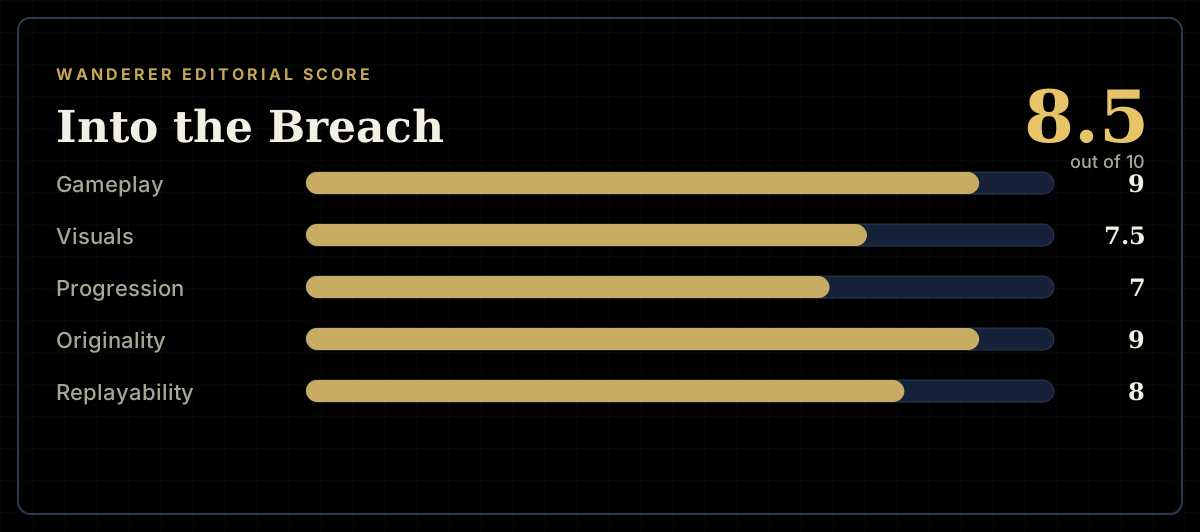
How the review scores each part of the gameWanderer Editorial -
The short versionWanderer Editorial