
Game review
Idle Fleet
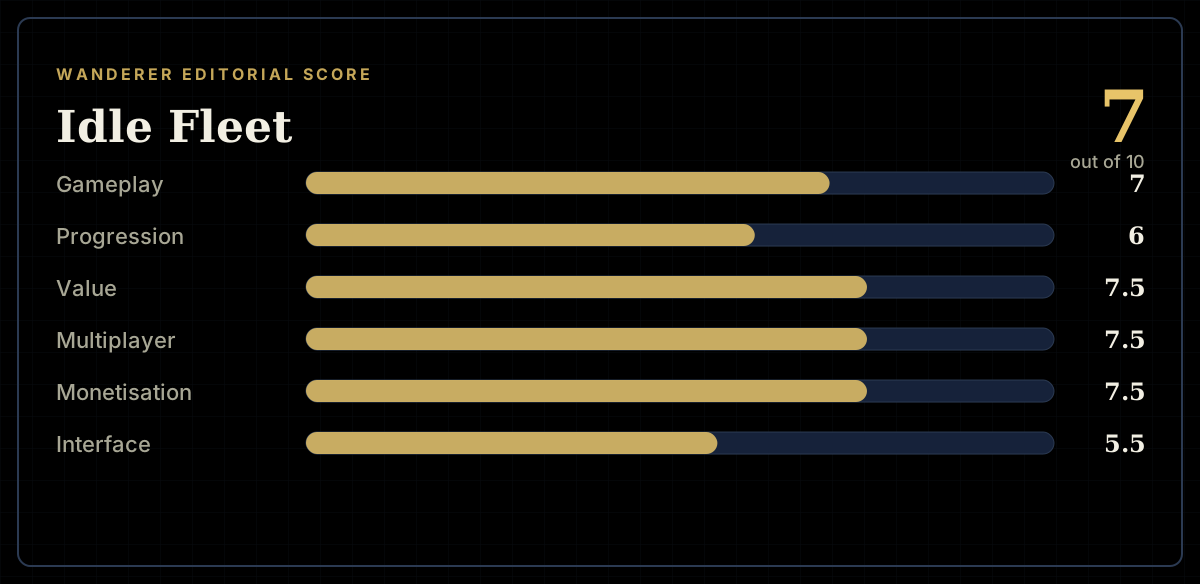
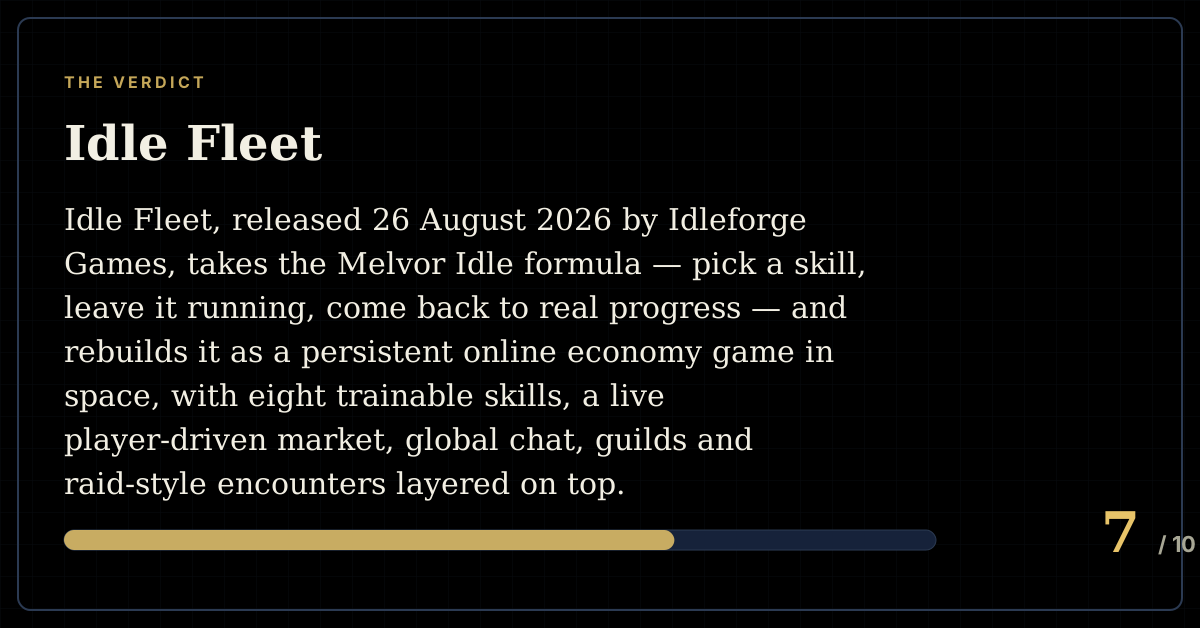
7 / 10
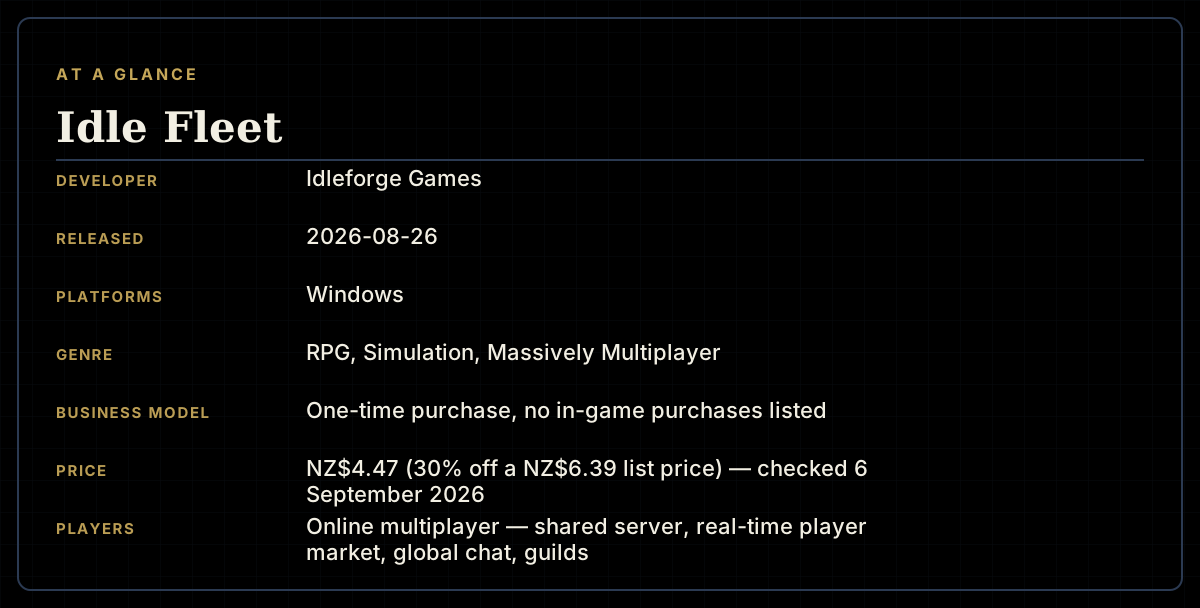
- Developer
- Idleforge Games
- Publisher
- Idleforge Games
- Released
- 26 August 2026
- Platforms
- Windows
- Genre
- RPG, Simulation, Massively Multiplayer
- Monetisation
- One-time purchase, no in-game purchases listed
- Players
- Online multiplayer — shared server, real-time player market, global chat, guilds
The short version
Idle Fleet, released 26 August 2026 by Idleforge Games, takes the Melvor Idle formula — pick a skill, leave it running, come back to real progress — and rebuilds it as a persistent online economy game in space, with eight trainable skills, a live player-driven market, global chat, guilds and raid-style encounters layered on top. It sits Positive with English-speaking players, 84.2% across 38 reviews as of this check, and reviewers across English, Japanese, Chinese, Polish and several other languages converge on the same specific strength: an in-game chat and market that feel genuinely alive in a genre where most games are solitary. Set against that, a real structural tradeoff shows up repeatedly — the game requires a live server connection at all times, so an outage locks out even players with no interest in trading or leaderboards — and at least one deeply invested player already reports hitting the level cap eleven days after launch, a concerning ceiling for a paid game whose entire pitch is long-term progression.
Biggest strengths
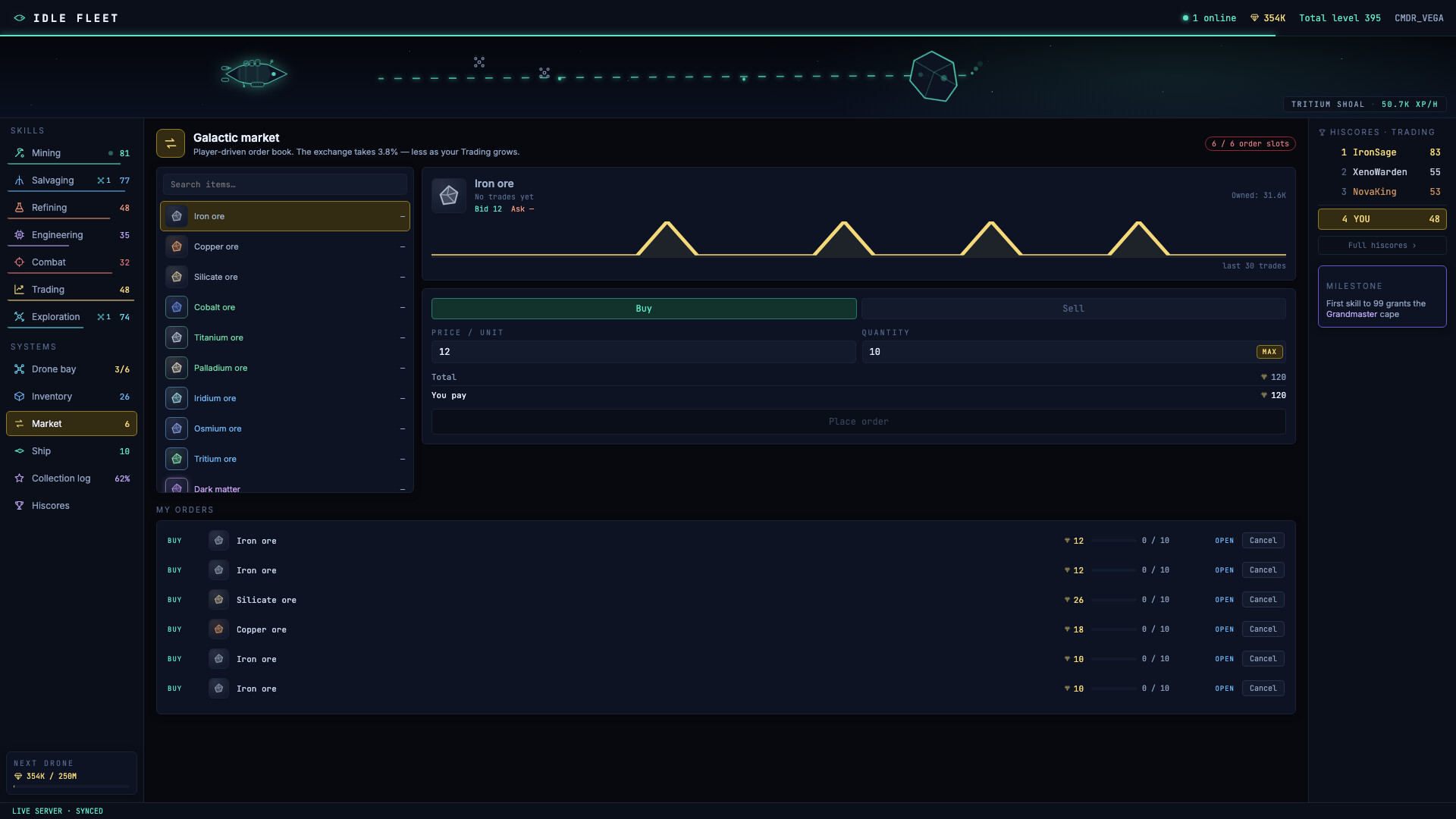
- An unusually active player-driven market, global chat and guild system draw specific, repeated praise across reviews in multiple languages as genuinely livelier than the typical single-player idle game, with several reviewers explicitly comparing it to EVE Online's economy or Albion Online layered onto a Melvor Idle-style skilling loop
- The developer is repeatedly and specifically praised for fast, frequent updates and quick bug fixes in direct response to in-game chat feedback, cited independently by reviewers in English and Chinese
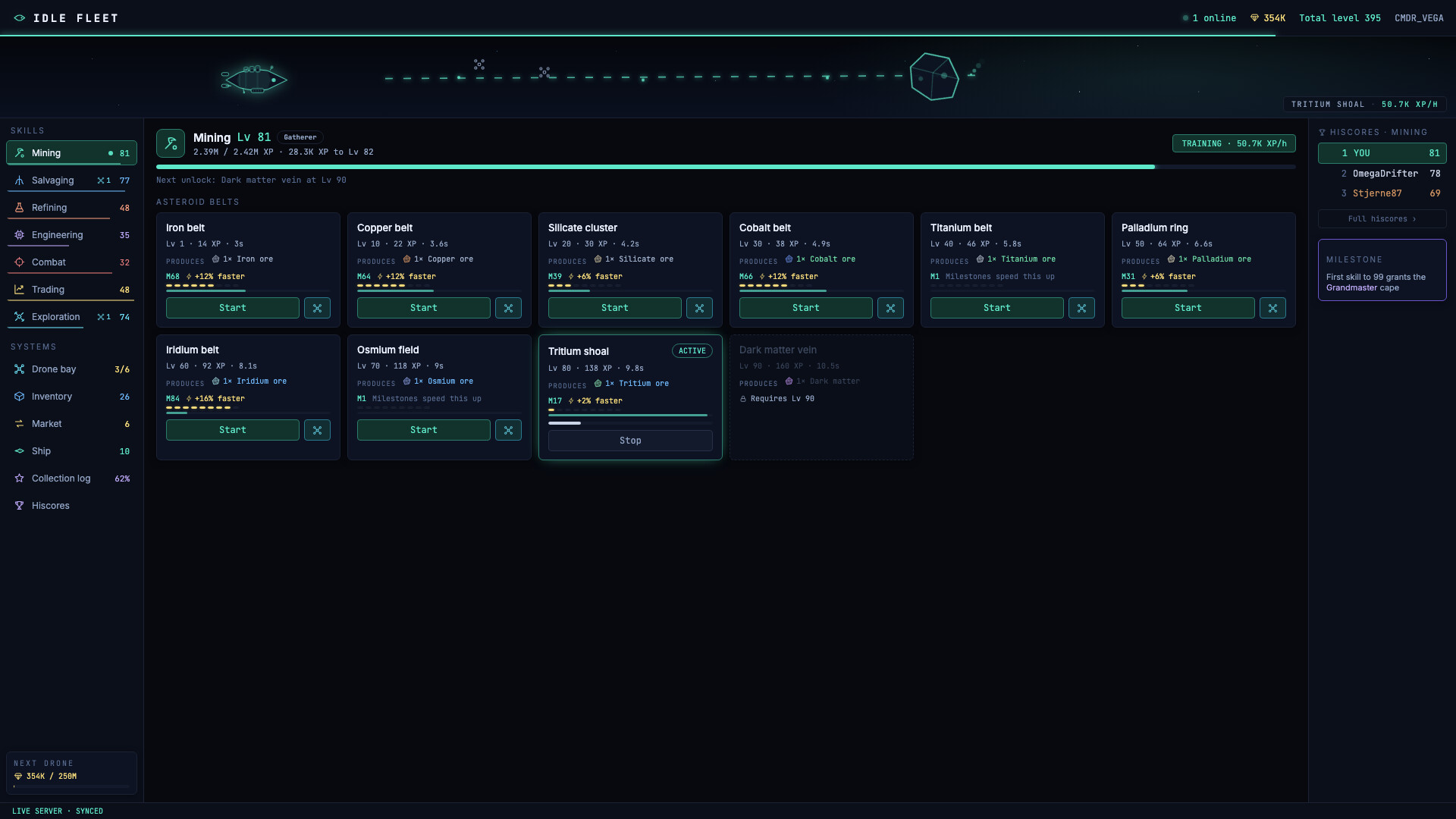
- Eight distinct, interconnected skills — mining, salvage, refining, engineering, combat, trading, exploration and reclamation — give genuine breadth, and several reviewers specifically like how resources gathered early stay valuable to players who craft with them later
Biggest weaknesses
- The game requires a constant live connection to Idleforge's servers to function at all, a structural choice multiple reviewers flag directly — when the server has problems, players lose access even if they have no interest in the market, leaderboards or any other online feature
- One reviewer with roughly 76 hours logged reports the level cap already reached at 99, with no indication of further verticality, a specific concern for a paid game whose core promise is long-term "number go up" progression rather than a short arc
- Simplified and Traditional Chinese localization remains incomplete at points despite being an officially supported language, with one heavily invested reviewer withholding a positive review specifically until translation is finished
Who it's for: Fans of skill-based idle games like Melvor Idle or Idle Clans who specifically want the social and economic layer a persistent shared server can add, and who are comfortable being an early adopter of a young server population.
Our recommendation: A strong pick if the MMO-economy angle is what draws you in and you can accept needing a live connection at all times; wait if you want a purely solo, always-available idle game, or if a level 99 cap reached within two weeks of launch worries you about the long-term ceiling.
7 / 10
Introduction
Idle Fleet, released 26 August 2026 by Idleforge Games, takes a formula the idle genre already knows well — pick a skill, leave the game running, come back to real progress — and rebuilds it as a persistent online economy set in space. Eight trainable skills (mining, salvage, refining, engineering, combat, trading, exploration and reclamation) sit on top of a shared server, a real-time player-driven market, global chat, guilds and raid-style encounters. Eleven days after launch it sits Positive with English-speaking players, 84.2% across 38 reviews, and reading across that sample — which spans English, Japanese, Chinese, Spanish, Polish, German, Italian, French and Russian — turns up an unusually consistent, specific pattern: reviewers keep independently describing the same thing as the game's standout strength, and it isn't the idle mechanics themselves.
An idle game with a genuinely alive community layer
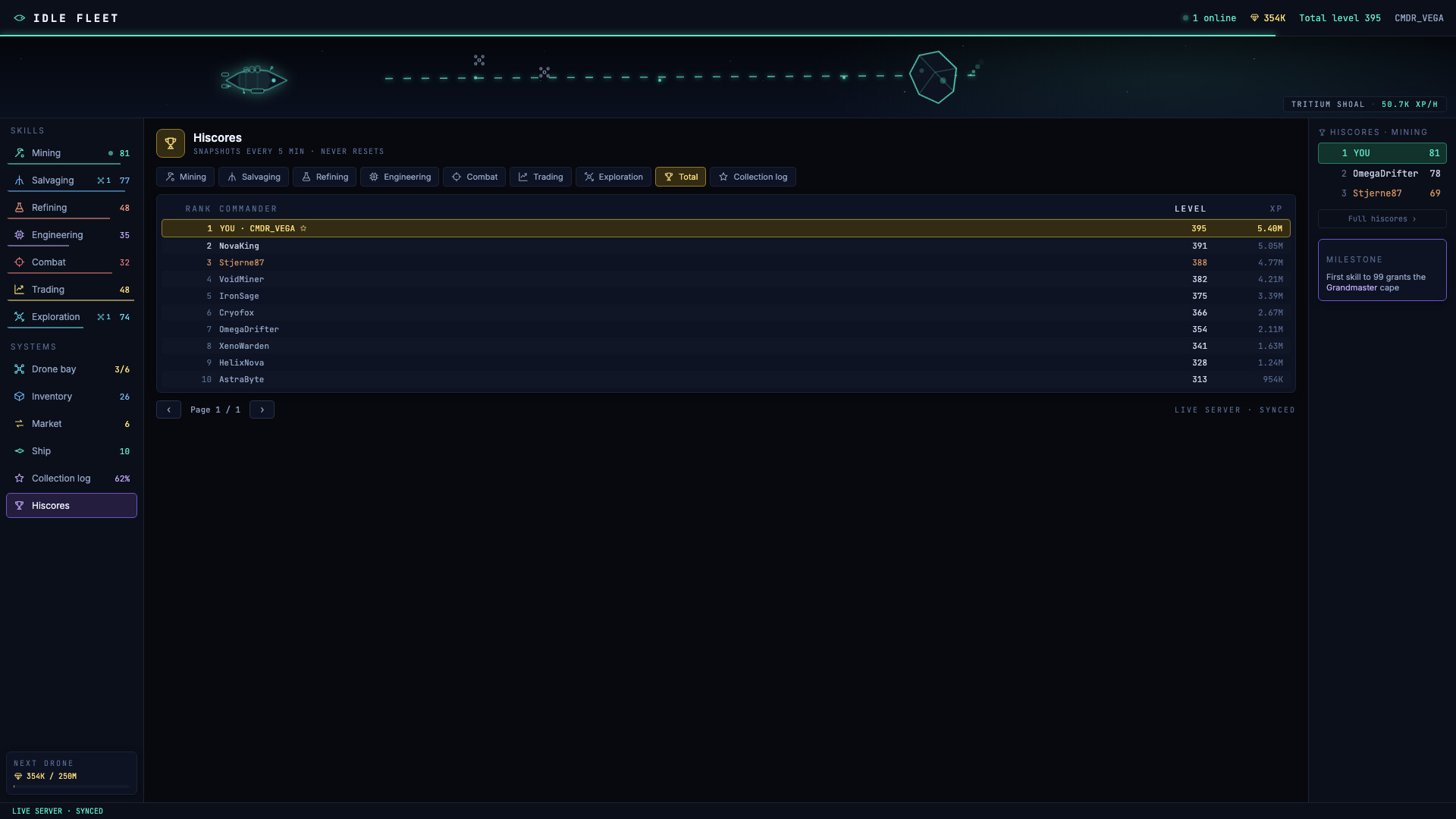
The most repeated praise across the sample has nothing to do with numbers going up while you're away — that part is table stakes for the genre — and everything to do with what's built around it. Reviewers across multiple languages independently compare Idle Fleet to Melvor Idle with EVE Online's economy grafted on, or to Albion Online crossed with a skilling idler, specifically calling out a real-time player-driven market, an active global chat, and guild and raid systems as things they haven't seen done this well in an idle game before. One English reviewer says outright they haven't seen "such an active chat in many other idle games." That's a meaningfully different pitch from the genre's usual solitary loop, and it's the thing drawing the most specific, repeated enthusiasm rather than generic positivity.
Layered onto that is consistent praise for the developer's post-launch behaviour: multiple reviewers, independently and in different languages, specifically cite fast, frequent updates and bug fixes delivered in direct response to complaints raised in the game's own chat. For an eleven-day-old release, that's a concrete, repeated signal of active support rather than a launch-and-abandon pattern — and it shows up in reviews that otherwise still list real complaints, not just from unconditional fans.
The cost of going fully online
That same design choice comes with a real structural tradeoff, and reviewers on both sides of the recommendation line flag it directly: Idle Fleet requires a live connection to Idleforge's servers to do anything at all. One reviewer summarises the problem plainly — it's "an idle game that requires connection to game server," and when that connection breaks, "you can't do anything, even if you're not interested in trading or ranking." That's a meaningfully different risk profile from a traditional single-player idle game, where a server hiccup at worst costs you cloud sync rather than the ability to play at all. Reviewers in the positive sample describe the same underlying issue in gentler terms — a "little short on content at the moment" alongside a note that it "requires constant connectivity," and one Chinese-language reviewer asks, more bluntly, whether the laggy server ("土豆服" — literally a "potato server") can be fixed, since it causes disconnects.
An early ceiling on a game sold on long-term progression
More concerning for an idle game specifically sold on long-term number growth: one reviewer with roughly 76 hours logged — a serious, invested play history for a game not even two weeks old — reports having already reached the level cap at 99, with no clear indication of what comes next. Whether or not that ceiling gets raised in a future update, a paid idle game hitting its stated cap this quickly for its most dedicated players is worth flagging directly rather than assuming it will resolve itself; it's the kind of gap that either gets patched fast, given the developer's already- noted update pace, or becomes a real long-term liability for exactly the players the genre is built to retain.
A young economy, and an early fairness worry
Because the market and social layer are the game's most distinctive selling points, its current population matters more here than it would for a purely solo idle game. One Spanish-language reviewer says so directly — "Faltan jugadores" ("players are missing") — while still recommending the underlying concept and encouraging others to help fill it out. A separate reviewer raises a related, more pointed concern: because the market is player-driven and unrestricted, the earliest adopters accumulate outsized capital and can move prices more freely than anyone joining later, a dynamic that reviewer only half-jokingly compares to an unregulated stock exchange. Neither complaint is unusual for a brand-new online economy game, but they're specific enough, and consistent enough with the connectivity and population concerns above, to matter for anyone weighing whether to join now versus waiting for the server to fill out.
Rough edges: interface, localization, content depth
A smaller cluster of complaints rounds out the negative and mixed reviews. Even satisfied players describe the interface as minimalist to the point of feeling underdeveloped, with one asking for it to be "a bit more interesting" while still recommending the game overall. Chinese-language reviewers — both Simplified and Traditional — report incomplete localization despite the language being officially supported, and one long-term player, over 230 hours logged, says explicitly they will upgrade their review to positive once translation is finished, alongside a specific note that a recent server upgrade has already reduced disconnect-and-reconnect problems. Taken together, this reads less like a game with fundamental design flaws and more like one still catching up to its own early momentum — a pattern the developer's already-praised patch cadence gives some real reason for optimism about.
Final Verdict
Idle Fleet succeeds at something genuinely different from most of its genre: a skilling idle loop wrapped in a real, actively used player economy and social layer that reviewers across nine languages keep independently singling out as its best feature, backed by a developer reviewers specifically credit with fast, responsive updates. What keeps this from a higher score is that going fully online is a real tradeoff, not a free upgrade — a hard server-connectivity requirement, a population still filling out, an already-reported level cap for the most dedicated players, and incomplete localization all show up as specific, corroborated complaints rather than isolated grumbling. Worth buying now if the MMO-economy concept is what appeals to you and you're comfortable being an early adopter; worth a short wait if you'd rather join once the population and content have both had more time to grow.
Pros and cons
Pros
- An unusually active player-driven market, global chat and guild system draw specific, repeated praise across reviews in multiple languages as genuinely livelier than the typical single-player idle game, with several reviewers explicitly comparing it to EVE Online's economy or Albion Online layered onto a Melvor Idle-style skilling loop
- The developer is repeatedly and specifically praised for fast, frequent updates and quick bug fixes in direct response to in-game chat feedback, cited independently by reviewers in English and Chinese
- Eight distinct, interconnected skills — mining, salvage, refining, engineering, combat, trading, exploration and reclamation — give genuine breadth, and several reviewers specifically like how resources gathered early stay valuable to players who craft with them later
- Confirmed as a one-time purchase with no in-game purchases; one reviewer explicitly notes it is not pay-to-win, and the price is low enough that several reviewers call it worth trying purely out of curiosity
Cons
- The game requires a constant live connection to Idleforge's servers to function at all, a structural choice multiple reviewers flag directly — when the server has problems, players lose access even if they have no interest in the market, leaderboards or any other online feature
- One reviewer with roughly 76 hours logged reports the level cap already reached at 99, with no indication of further verticality, a specific concern for a paid game whose core promise is long-term "number go up" progression rather than a short arc
- Simplified and Traditional Chinese localization remains incomplete at points despite being an officially supported language, with one heavily invested reviewer withholding a positive review specifically until translation is finished
- Multiple reviewers, in the same breath as praising the concept, flag the current population as thin for an economy-and-social game barely two weeks old, and one specifically worries aloud that early adopters are already accumulating an outsized capital advantage in the player-driven market
- Even satisfied reviewers describe the interface as minimalist to the point of feeling underdeveloped, and more than one calls the amount of available content light for the price at this early stage
Screenshots
-
Idle FleetImage: Idleforge Games via Steam -
Idle FleetImage: Idleforge Games via Steam -
Idle FleetImage: Idleforge Games via Steam -
How the review scores each part of the gameWanderer Editorial -
The essentials at a glanceWanderer Editorial -
The short versionWanderer Editorial