
Game review
holoVillage: Our Cozy Days
5.3 / 10
- Developer
- Roboqlo
- Publisher
- holo Indie
- Released
- 24 April 2026
- Platforms
- ["Windows"]
- Genre
- Simulation
- Monetisation
- Paid
- Players
- Single-player
The short version
holoVillage: Our Cozy Days pairs a charming Hololive-themed farming and adventuring loop with the kind of rough edges, shallow villager interactions, and interface friction that make it feel unfinished for a full-price release.
Biggest strengths
- A likeable chibi 3D art style and a genuinely large pool of licensed Hololive talents to recruit, customize, and even play as directly
- A varied moment-to-moment loop mixing farming, fishing, mining, cooking, crafting, and combat, with an addictive 'one more day' pull that many long-session players single out
- Music built from remixed Hololive tracks that shift with the time of day, plus a responsive developer that has shipped steady bugfixes and quality-of-life patches since launch
Biggest weaknesses
- Villager interactions are shallow, mostly limited to a handful of recycled voice lines per HoloMember, with no schedules, dialogue trees, or real relationship building
- A building and furniture placement system tied to the player character's facing direction rather than a cursor or grid, widely singled out as tedious and imprecise
- Numerous launch-window bugs, from UI overflow and softlocks to inconsistent controller button prompts, plus a since-partially-patched always-online requirement that locked even solo play behind a server connection
Who it's for: Hololive fans looking for a licensed farming and adventuring game to spend time with their favorite talents, and Rune Factory or Stardew Valley players willing to overlook launch-week jank for a VTuber-flavored spin on the formula.
Our recommendation: Wait for a sale unless the Hololive branding alone is enough to justify the asking price. The core farming, fishing, and combat loop is playable and occasionally charming, but the building placement system, combat depth, and villager interactions all need more work to match the genre's best.
5.3 / 10
Farming Life With Familiar Faces
holoVillage: Our Cozy Days is a farming and light-RPG adventuring sim from Roboqlo, published by holo Indie, that transplants the Hololive VTuber roster into a Rune Factory-flavored loop of chopping wood, tending crops, fishing, cooking, and fighting bosses. Players build a custom character, who can be styled to resemble one of over 40 licensed Hololive talents, and set out from a central village hub to gather resources, craft gear, and gradually unlock new zones themed around different regions of the game's world. The chibi 3D art style draws consistent praise across reviews, and the soundtrack, built from remixed versions of well-known Hololive songs that shift as the in-game day passes from morning to night, is repeatedly called one of the game's strongest assets.
The moment-to-moment loop is broad rather than deep: a given day might involve watering crops, mining ore, fishing for the day's catch, cooking a meal for a stat buff, and pushing into a dungeon toward that zone's boss. Reviewers compare the formula most often to Stardew Valley, Rune Factory, and Fantasy Life, and while few call it innovative within that lineage, many describe the loop as genuinely addictive once it clicks, citing long completion times (several reviewers logging 40, 80, even over 200 hours) as evidence the core gameplay holds attention despite its rough edges.
Recruiting a Village That Doesn't Talk Back
The headline feature, recruiting HoloMembers to live in and work the village, turns out to be the game's most consistently disappointing system. Reviewers describe invited villagers as functioning like "sound boxes," playing a handful of recycled voice clips pulled from real streams while doing assigned jobs like farming or shopkeeping, with no schedules, no dialogue trees, and minimal interaction between the characters themselves. The village is capped at eight resident houses despite a roster of more than 40 available Hololive members, forcing players to make permanent-feeling choices about who to invite, and several generations, including Council, HoloX, and parts of Indonesia and Justice, were absent at launch, a gap many reviewers hope gets addressed in future updates given the developer's post-launch patch cadence.
Combat and progression fare similarly: players choose early between a melee or magic-focused adventuring tree, with no way to blend the two short of an in-game respec cost, and equipment upgrades through the smithing system often add stat bonuses as small as half a percent, making gear progression feel underwhelming even after significant investment. Fishing, meanwhile, is singled out repeatedly as slow and grindy, with rare-fish and legendary-seed hunts requiring RNG-heavy repetition that several completionist reviewers describe as the single most punishing part of the game.
Rough Around Every Edge
The most frequently repeated criticism across both positive and negative reviews is that holoVillage plays like an Early Access title that shipped without the label. Reported bugs range from cosmetic, controller button prompts inconsistently displaying Switch, Xbox, or PlayStation icons regardless of the controller actually connected, to serious, including menu overflow in the cooking screen that can make certain ingredients unreachable, characters falling through the map, and softlocks that have forced some players to force-quit entirely. Village and room decoration is widely criticized for tying furniture placement to the player character's facing direction rather than a cursor or grid, a design choice reviewers across the board call tedious and imprecise, particularly when paired with a fixed camera angle that makes lining up buildings a genuine chore.
An Always-Online Launch, and a Developer Trying to Fix It
The most contentious issue at launch was a requirement for a constant internet connection even in single-player, which blocked play entirely for some and drew direct comparisons to the DRM practices of far larger publishers. Because the requirement was tied to the Kumarine ticket system used to unlock furniture and outfits, players couldn't simply disconnect their network adapter and carry on the way they might with other online-locked games; the game would freeze or refuse to load basic actions instead. Several reviewers who initially refunded the game on principle returned after the developer shipped partial offline support in early May, noting that while offline mode still can't touch the ticket economy, the core farming, fishing, and combat loop is now playable without an internet connection at all.
That responsiveness extends beyond the offline patch. Roboqlo has kept up a steady cadence of bugfixes since launch, resolving specific complaints like the cooking-menu ingredient overflow and inconsistent controller button prompts that plagued early reviews, and shipped a larger free content update in late summer that added new areas, combat improvements like dodging and guarding for melee weapons, additional voice lines, and expanded interactions between HoloMembers. Reviewers who returned after these patches generally report a noticeably smoother experience than the one described in launch-week reviews, and the pattern of continued, substantive updates is one of the few things nearly every review, positive or negative, credits the developer for. Core structural complaints, thin villager interaction, small resident caps, and the tedious placement system, remain largely unaddressed as of this review, but the trajectory since release gives reason for cautious optimism about where the game ends up.
Verdict
holoVillage: Our Cozy Days has the pieces of a good licensed spin-off: a wide pool of genuinely popular characters, a pleasant art style, and a soundtrack fans clearly love, wrapped around a farming and adventuring loop that borrows comfortably from well-regarded genre touchstones. What it doesn't yet have is the polish or systemic depth to justify standing alongside those touchstones on its own merits. The villagers who should be the game's main draw are mostly decorative, the building tools fight the player at every turn, and a rocky always-online launch cost it a lot of early goodwill even after being partially walked back. None of this makes the game unplayable, and the developer's response since release, patching bugs and adding real content rather than going quiet, is a meaningfully positive sign for where the game could land in another six months to a year. Right now, though, it's an easy game to recommend waiting on: Hololive fans with patience for jank will likely still find things to enjoy, but anyone judging it purely as a farming sim would be better served putting the same money toward one of its more established inspirations.
Pros and cons
Pros
- A likeable chibi 3D art style and a genuinely large pool of licensed Hololive talents to recruit, customize, and even play as directly
- A varied moment-to-moment loop mixing farming, fishing, mining, cooking, crafting, and combat, with an addictive 'one more day' pull that many long-session players single out
- Music built from remixed Hololive tracks that shift with the time of day, plus a responsive developer that has shipped steady bugfixes and quality-of-life patches since launch
Cons
- Villager interactions are shallow, mostly limited to a handful of recycled voice lines per HoloMember, with no schedules, dialogue trees, or real relationship building
- A building and furniture placement system tied to the player character's facing direction rather than a cursor or grid, widely singled out as tedious and imprecise
- Numerous launch-window bugs, from UI overflow and softlocks to inconsistent controller button prompts, plus a since-partially-patched always-online requirement that locked even solo play behind a server connection
Screenshots
-

Farming plays out much like its genre inspirations, watering and tending crops plot by plotImage: Roboqlo -
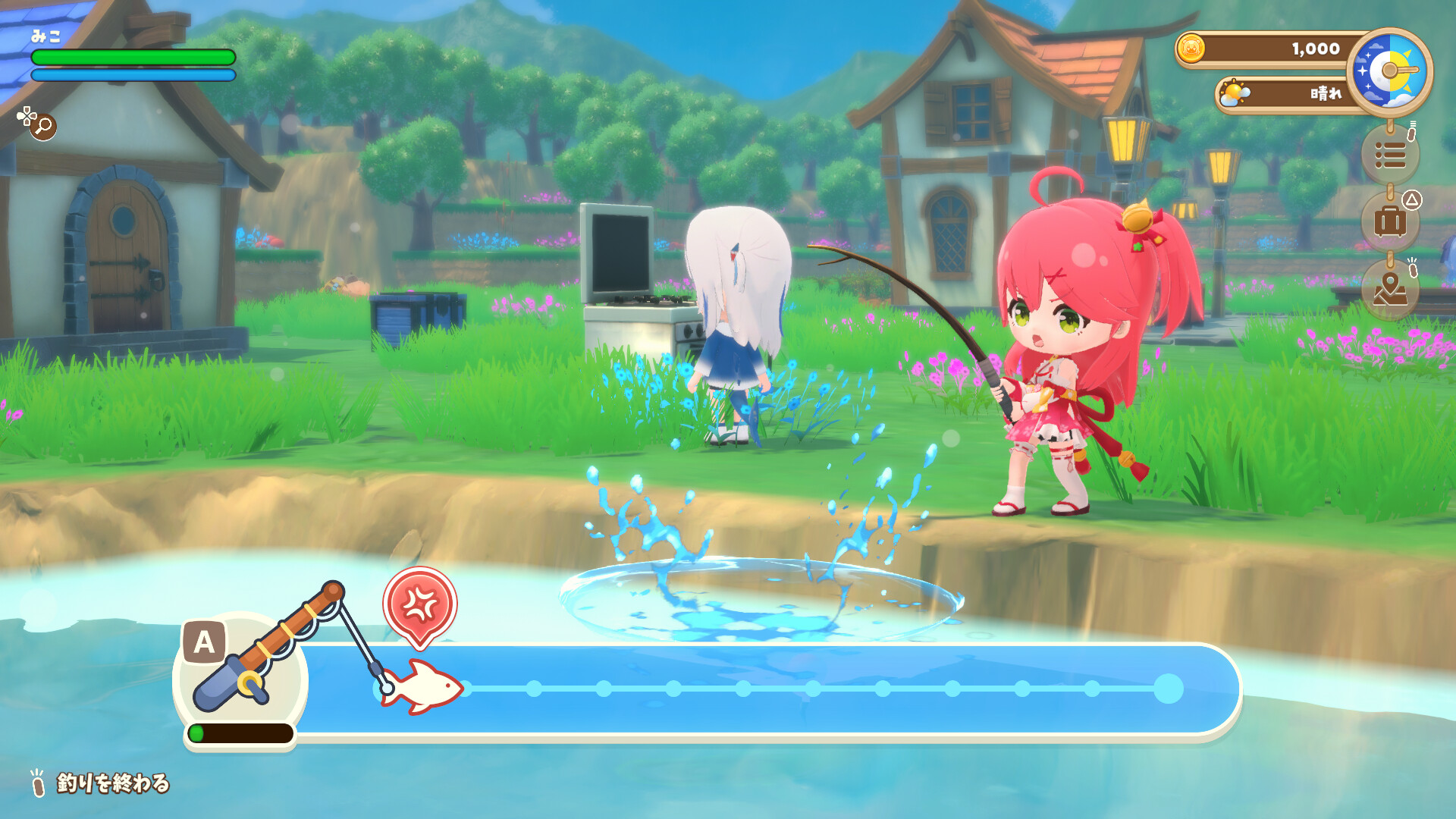
Fishing uses a timing-based minigame that several long-session reviewers call one of the more grindy parts of the gameImage: Roboqlo -

Combat splits early into a melee or magic skill tree, with magic generally considered the stronger of the twoImage: Roboqlo -
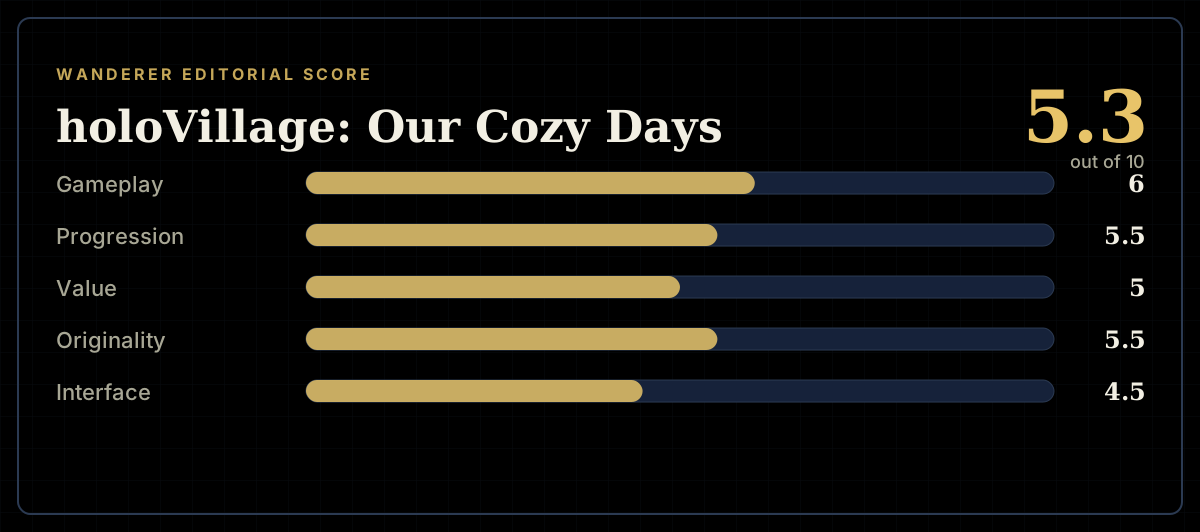
How the review scores each part of the gameWanderer Editorial -
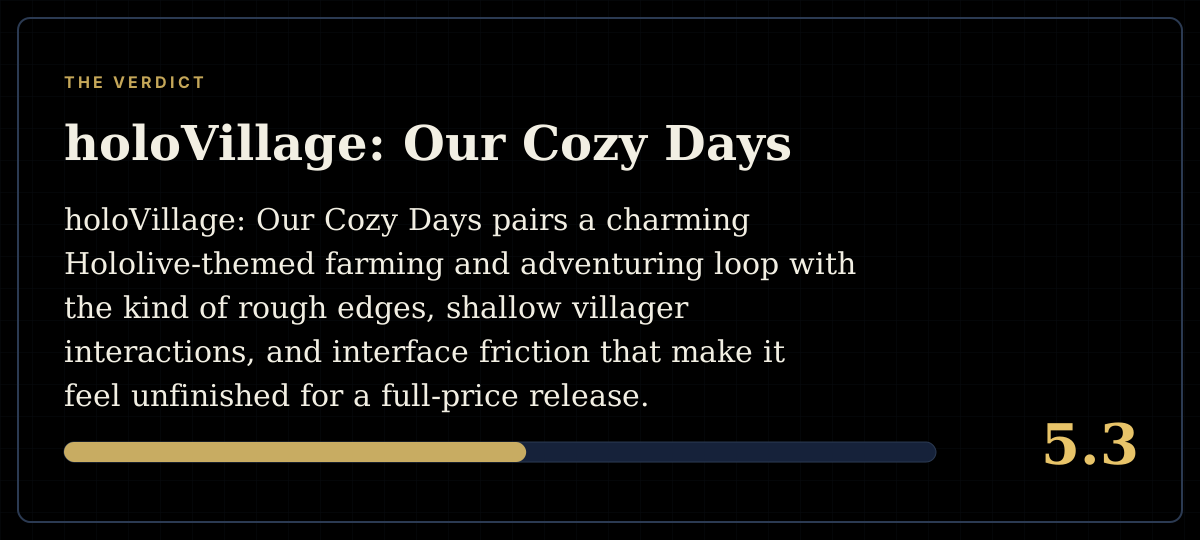
The short versionWanderer Editorial