
Game review
Hellfire: Wukong
3 / 10
- Developer
- 大唐互娱 (Da Tang Hu Yu)
- Publisher
- 大唐互娱 (Da Tang Hu Yu)
- Released
- 26 March 2026
- Platforms
- Windows
- Genre
- Simulation / Idle / RPG
- Monetisation
- One-time purchase
- Players
- Single-player
The short version
Hellfire: Wukong borrows Sun Wukong and the Journey to the West mythology for an idle cultivation game about brewing elixirs and grinding stat gains, and this review's sample makes clear the borrowed theme is the best thing about it. Developed and published by Da Tang Hu Yu, it released 26 March 2026 at $3.99 to a sample of 17 lifetime reviews, only 4 positive, for a "Mostly Negative" score. This review's read of that sample, plus the developer's own partner-events history, is a familiar and specific pattern: broken or misleading offline gains, no cloud saves protecting against outright data loss, a punishing early-game time wall, and a burst of frequent patches in the first two weeks after launch that appears to have simply stopped.
Biggest strengths
- This review's sample does credit the theme itself, with one reviewer writing the cultivation-and-alchemy structure 'operates simply and mindlessly' in an approachable, low-effort way that suits the genre's core appeal, even while criticizing the pacing around it
- This review checked the developer's partner-events feed and found a genuinely fast initial patch cadence, with seven numbered version updates released in the first two and a half weeks after launch, addressing balance and bug fixes in quick succession
- One long-playtime reviewer in this review's sample, who logged over 230 hours, described the underlying loop as having real incremental appeal for players specifically seeking a low-effort background activity, calling it well-suited to leaving running quietly at a workplace computer
Biggest weaknesses
- This review's sample repeatedly and specifically describes offline progression as broken or far weaker than advertised, with one reviewer writing that three consecutive attempts at the offline meditation feature added no cultivation progress at all, and another reporting overnight offline sessions yielding less than a single level of gain
- This review found multiple, independent reports of severe data loss with no cloud-save protection in place, including one reviewer who reported losing a 40-hour save outright and another who reported the game crashing to desktop frequently enough that sustained offline play was impractical
- This review's sample includes detailed, specific interface complaints, with one reviewer describing the batch-sell and quantity-input controls as poorly designed to the point of actively working against the player, including a bug where an accidental mouse-wheel scroll while entering a purchase quantity would silently change the entered number
Who it's for: Only for players with a very high tolerance for unpolished, thinly-content idle games who specifically want the Journey to the West setting and don't mind the real risk of losing hours of progress to a crash or a missing save; a poor fit for anyone who has played a genre leader like Melvor Idle and knows what a well-tuned idle game's economy should feel like.
Our recommendation: Skip it. The Journey to the West theme is the only real draw, the underlying systems are shallow and poorly balanced even by idle-game standards, and this review found multiple independent reports of lost save data with no cloud-save protection to fall back on.
3 / 10
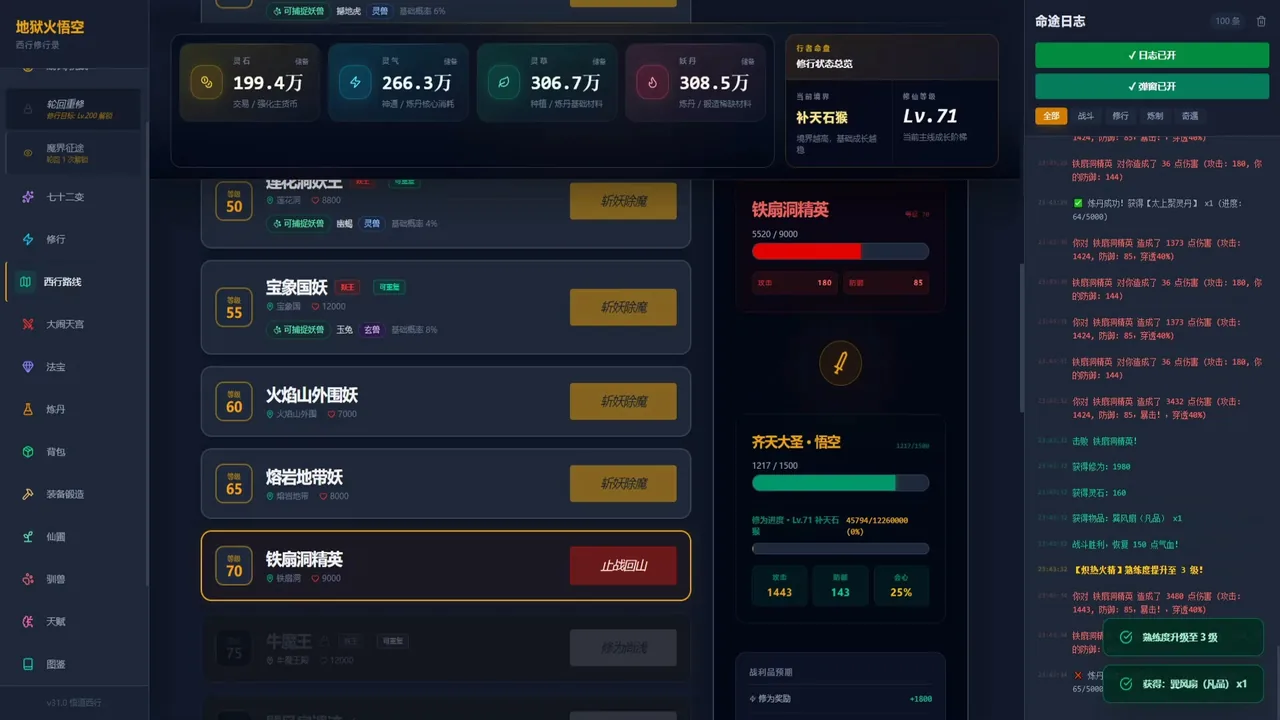
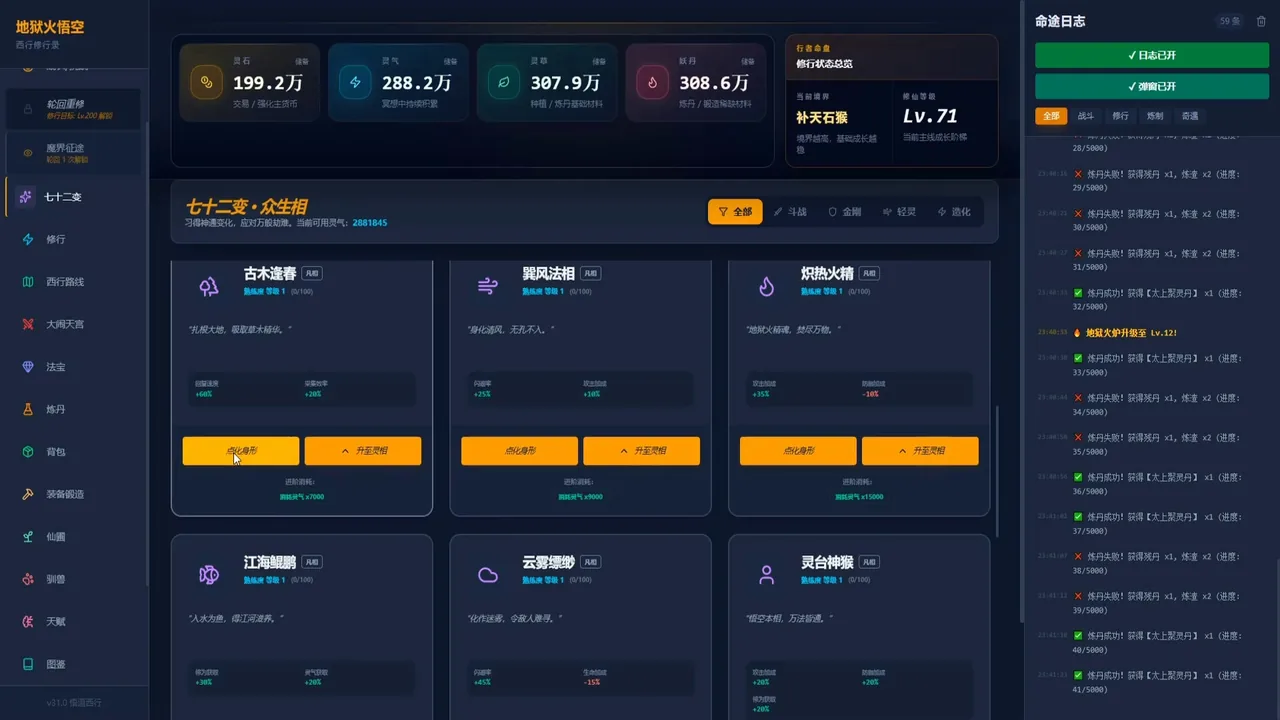
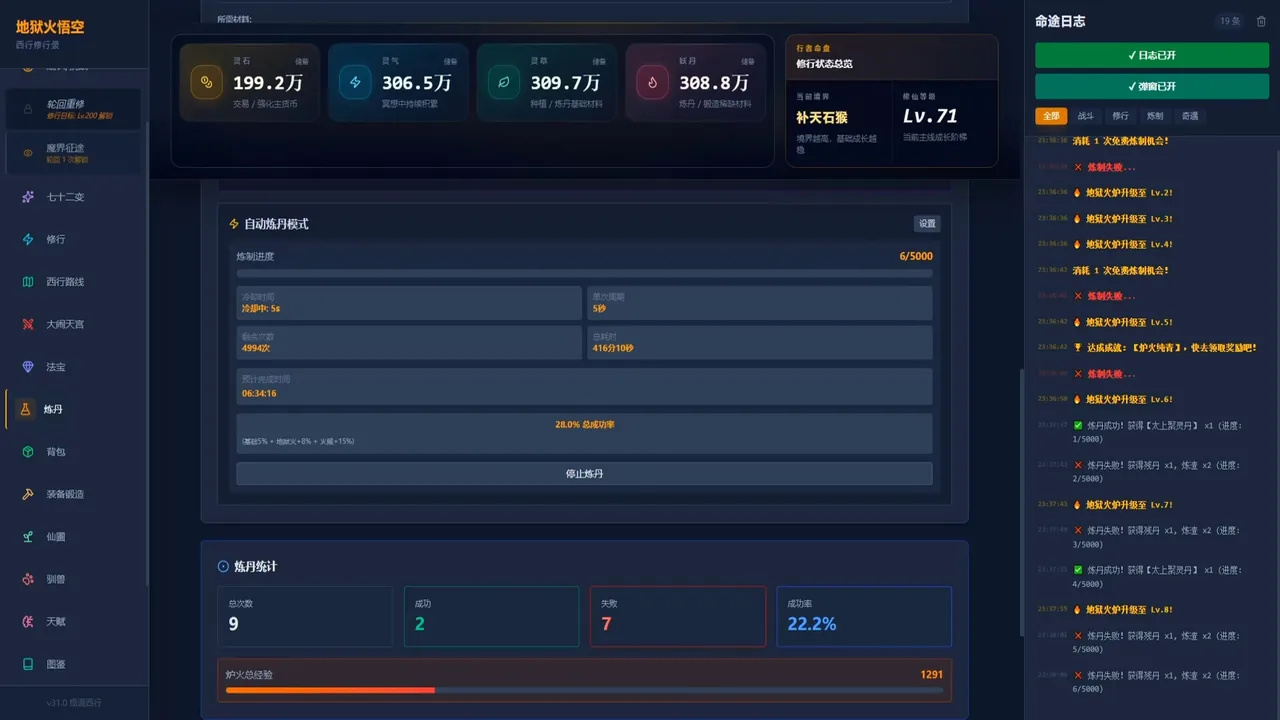
Hellfire: Wukong casts the player as Sun Wukong himself, brewing elixirs from "hellfire" and grinding through cultivation ranks while the game runs in the background. It's an idle progression game wrapped around Journey to the West mythology, developed and published by Da Tang Hu Yu and released 26 March 2026 at $3.99. This review draws on all 17 of the game's lifetime reviews, only 4 positive, for a "Mostly Negative" rating, and its own read of the developer's partner-events history to understand what happened between launch and now.
A theme with real appeal, undermined by the systems around it
This review's sample doesn't dismiss the premise outright. One reviewer with nearly 50 hours logged called the cultivation-and-alchemy theme genuinely appealing for idle-game fans, describing the controls as approachably "simple and mindless" in the way the genre generally rewards, and separately praised the developer for updating frequently in the early going. That's a real, specific point in the game's favor, and this review treats the Journey to the West setting itself as a reasonable hook, distinct from the execution built around it.
Offline progression that reviewers say barely works
The single most common complaint in this review's sample is that the game's core idle promise, meaningful progress while offline, frequently doesn't deliver. One reviewer described three consecutive attempts at the game's offline meditation feature adding no cultivation progress whatsoever, while a talent-point system marketed as offering roughly a 10% success chance seemed, in their testing, to behave identically regardless of the stated odds. Another reviewer with over 250 hours logged wrote that an entire overnight offline session failed to produce even a single level of gain, well below what the in-game experience numbers displayed to the player would suggest. For a genre whose entire value proposition rests on offline gains behaving predictably, this review reads that complaint, repeated independently by multiple reviewers, as a serious structural problem rather than a minor tuning gripe.
Data loss with no safety net
This review found multiple, independent, and specific reports of lost save data in the sample, a far more serious issue than typical idle-game roughness. One reviewer reported losing a 40-hour save outright, explicitly noting the game has no cloud-save support to fall back on. A separate reviewer described frequent crashes to desktop as a practical barrier to the extended offline play the genre depends on, since a crash silently halts all idle progress until the player notices and relaunches. This review treats the combination of no cloud saves and reviewer-reported crash-driven data loss as the single most serious mark against the game, well beyond ordinary pacing or balance complaints.
Interface design that reviewers say actively works against the player
Beyond the core loop, this review's sample includes unusually detailed interface complaints for a game this size. One reviewer described the inventory and batch-sell system at length, noting there is no way to sell a specific custom quantity of a stacked item without manually clicking a sell button once per unit, and separately flagged a purchase-quantity input where an accidental mouse-wheel scroll while typing would silently overwrite the entered number. Another reviewer stated flatly that without any auto-sell function, "it's not really an idle game" at all, since the player still has to check and manage inventory every few minutes regardless of how the core cultivation loop is meant to run unattended.
A frequent early patch cadence that appears to have stopped
This review checked the developer's own partner-events feed directly and found a genuinely fast initial response: seven numbered version updates released between 28 March and 12 April 2026, a two-and-a-half week span. But the feed shows nothing after 12 April, and this review's sample corroborates that gap directly. One reviewer with over 240 hours logged wrote they had originally left a positive review because the developer was actively responsive to feedback before launch, but that post-launch updates and maintenance stopped entirely, "no matter how much players asked for more," and that they believed the developer had moved on to other projects instead. This review reads the combination, an active first two weeks followed by apparent abandonment five months before this review was written, as consistent with the sample's broader complaint that promised content and fixes simply never arrived.
The AI-disclosure angle, and a reviewer who noticed it directly
This review checked the store page's own AI Generated Content Disclosure and found it covers both "the art of Capsule Library images" and the "game ui" itself. That second item is unusually specific among the AI disclosures this review has seen this lane, since most cover only visual art assets rather than interface elements, and at least one reviewer in the sample noticed it directly and negatively, writing with visible irritation about seeing what they described as "那个AI专用的√和×" (those AI-typical checkmark and X symbols) inside the game's log interface. This review treats that as a small but concrete example of AI-generated UI work reading as generic or off-brand to an attentive player, rather than a disqualifying factor on its own.
Verdict
Hellfire: Wukong has a genre and a setting worth wanting to like, but this review's sample describes systems that don't hold up their end: offline gains that multiple reviewers say don't function as advertised, save data that can vanish with no cloud backup, and a developer whose fast early patching appears to have stopped entirely five months before this review. At $3.99 the price is low, but this review's sample gives little reason to expect the core problems will be fixed, and the risk of losing hours of progress to a crash is a real, specifically-reported cost that outweighs the theme's appeal. Skip it.
Pros and cons
Pros
- This review's sample does credit the theme itself, with one reviewer writing the cultivation-and-alchemy structure 'operates simply and mindlessly' in an approachable, low-effort way that suits the genre's core appeal, even while criticizing the pacing around it
- This review checked the developer's partner-events feed and found a genuinely fast initial patch cadence, with seven numbered version updates released in the first two and a half weeks after launch, addressing balance and bug fixes in quick succession
- One long-playtime reviewer in this review's sample, who logged over 230 hours, described the underlying loop as having real incremental appeal for players specifically seeking a low-effort background activity, calling it well-suited to leaving running quietly at a workplace computer
- This review found at least one reviewer who initially rated the game positively specifically because the developer was actively and visibly responsive to player feedback before launch, a level of pre-release engagement this review has no independent way to verify but that the reviewer credited directly
Cons
- This review's sample repeatedly and specifically describes offline progression as broken or far weaker than advertised, with one reviewer writing that three consecutive attempts at the offline meditation feature added no cultivation progress at all, and another reporting overnight offline sessions yielding less than a single level of gain
- This review found multiple, independent reports of severe data loss with no cloud-save protection in place, including one reviewer who reported losing a 40-hour save outright and another who reported the game crashing to desktop frequently enough that sustained offline play was impractical
- This review's sample includes detailed, specific interface complaints, with one reviewer describing the batch-sell and quantity-input controls as poorly designed to the point of actively working against the player, including a bug where an accidental mouse-wheel scroll while entering a purchase quantity would silently change the entered number
- This review checked the developer's partner-events feed and found the patch cadence stopped abruptly after 12 April 2026, a pattern independently corroborated by one reviewer at 240+ hours who described giving an initial positive review for pre-launch responsiveness, only to report that post-launch updates dried up entirely 'no matter how much players asked for more'
Screenshots
-
Hellfire: WukongImage: 大唐互娱 via Steam -
Hellfire: WukongImage: 大唐互娱 via Steam -
Hellfire: WukongImage: 大唐互娱 via Steam