Game review
Greenhearth Necromancer
6.9 / 10
- Developer
- Silverstring Media Inc.
- Publisher
- indie.io
- Released
- 11 May 2026
- Platforms
- [Windows, macOS]
- Genre
- Simulation
- Monetisation
- Paid
- Players
- Single-player only
The short version
Greenhearth Necromancer takes an odd premise — a young necromancer inheriting her late grandmother's plant-magic garden — and turns it into a genuinely tender, slow-paced story about grief, anxiety and finding community, wrapped around a semi-idle gardening loop that rewards patience over active play. Reviewers who came in expecting a background-friendly incremental game were frequently caught off guard by how demanding the plant-care systems actually are, and the game's marketing and tagging haven't done it many favours there, but for players willing to check in every twenty or thirty minutes rather than walk away for hours, it's an unusually warm and well-written cozy game.
Biggest strengths
- A genuinely well-written, character-driven story about grief, anxiety and community
- A distinctive premise — necromancy plus gardening — that reviewers say is executed with real originality
- A queer-inclusive cast and a magic-school setting that avoids leaning on familiar genre tropes
Biggest weaknesses
- Marketed and tagged in ways that led some players to expect a true set-and-forget idle/incremental game, which this is not
- Plants can develop infections or die surprisingly fast if left unattended for too long, according to several reviewers
- At least one reviewer felt the core premise lacked enough substance to sustain the experience
Who it's for: Fans of slow, narrative-driven cozy games who don't mind checking in regularly, especially those drawn to character-focused stories with a queer-inclusive cast.
Our recommendation: A strong pick if you want a story-first cozy game to keep open in the background — just don't expect a true set-and-forget idle game, and be ready to actually tend your garden.
6.9 / 10
A Grandmother's Inheritance, Reimagined as a Garden
Greenhearth Necromancer opens with a premise that sounds like a joke until you actually play it: a recent graduate necromancer, described by one reviewer as "socially anxious" and freshly grieving, inherits an apartment in the Greenhearth complex from her grandmother, a powerful plant mage. The obvious question — how does a necromancer look after a bunch of plants — turns out to be almost beside the point. As one detailed review put it, "it's not really about that. It's about grieving and feeling anxious and lonely and trying to find your way in the world as a young person." That framing runs through nearly the entire review sample: reviewers consistently describe the game less as a gardening sim with a spooky coat of paint and more as a quiet, character-driven story that happens to be delivered through plant care and neighbourhood relationships.
The apartment-complex setting does real work here. Multiple reviewers highlighted the cast of neighbours and the slow unfolding of their individual arcs as the game's emotional core, with one comparing the community feel to "a Stars Hollow-esque community, but with an urban twist." Another reviewer specifically praised the game's queer-inclusive writing, noting with evident relief that its magic-school elements manage to avoid leaning on any familiar genre touchstones — "I didn't know how refreshing it would feel to play a 'magic school' game without even a cheeky sly Harry Potter reference," as they put it.
The Semi-Idle Loop That Divides Idle-Game Fans From Everyone Else
Mechanically, Greenhearth Necromancer asks players to tend a small garden of both living and undead plants, addressing their needs through charms, items and spells, while checking in every twenty to thirty minutes to keep them healthy. This is where the review sample splits most sharply. Several reviewers who came to the game expecting a conventional idle or incremental experience were disappointed to find it demands closer attention than that label implies. One reviewer, in a lengthy critical review, wrote that the game is "mislabed as incremental and idler," arguing it plays more "like a visual novel where you check every 30 minutes to see if the game will give you a few new pages to read" than a numbers-driven background game. A second critical reviewer described a similar frustration in harsher terms, reporting that plants develop mushrooms or aphids at what they called an "insane" infection rate whenever they stepped away, with curative brews too slow to keep pace — leaving them repeatedly re-raising dead plants rather than genuinely managing a thriving garden.
Reviewers who enjoyed the game generally framed this same friction as a feature rather than a flaw. One described it directly as "semi-idle" rather than fully idle, explaining that leaving the game alone for more than about twenty minutes means accepting some plant losses, which the game then lets you narratively and mechanically recover from — reviving dead plants rather than being punished outright. Several others echoed this same twenty-to-thirty-minute rhythm as the sweet spot for play, describing it as a pleasant companion app to have open while working, studying, or half-watching something else, rather than either a full-attention game or a true background idler.
A Slow-Burn Story That Rewards Real Patience
Progression in Greenhearth Necromancer is explicitly gated by real time in places, with some story content unlocking only once per day, and reviewers are split on how well that works. Positive reviews describe the pacing as a deliberate, successful choice — "it really is designed to be played in the background but is very satisfying to come back to," as one put it — while acknowledging that it demands a different kind of patience than most games ask for. Several reviewers explicitly warned that players looking to "speed-run" or optimize their way through the systems will be fighting the game's fundamental design rather than working with it; the intended experience is closer to checking on a physical garden than clearing objectives.
Not everyone found that patience rewarded. One brief but pointed negative review argued that "there is simply not enough meat on the bones" to sustain the premise over a longer playthrough, a view that stands in fairly stark contrast to the number of reviewers reporting well over a hundred hours logged. That gap is worth noting for prospective buyers: this is a game whose slow reveal of plot and mechanics is, for most of the sample, the entire appeal, but for a minority it reads as thin content stretched by design rather than genuine depth.
Undead Plants, Cozy Vibes, and a Soundtrack Worth Mentioning
Beyond the central loop, reviewers repeatedly singled out the game's presentation as a strength in its own right. The lo-fi music, in-game radio and ambient sound design come up unprompted across multiple reviews as ideal background listening for studying or working, and the plant designs themselves — with distinct living and undead versions revealed as players progress — were consistently described as charming rather than gimmicky. One reviewer noted the game includes a "focus mode" that lets players step away entirely, accepting that their garden will need reviving on return, which several described as a thoughtful concession to real life rather than a punishing mechanic.
Taken together, the strongest throughline across nearly ninety reviews is that Greenhearth Necromancer succeeds specifically because it commits fully to its odd, tender premise rather than hedging toward a more conventional idle or management game. The friction in the sample comes almost entirely from expectations set by its genre tags rather than from the execution of the game it actually is.
Verdict
Greenhearth Necromancer is a genuinely original cozy game — necromancy and gardening dressed up as a story about grief, anxiety and neighbourly connection — that asks for more regular attention than its "idle" framing suggests, and occasionally punishes players who don't give it that attention with dying, infected plants. For players who go in expecting a semi-active companion game rather than a true background idler, the reception is overwhelmingly warm, and the hours logged by much of the sample speak for themselves.
Pros and cons
Pros
- A genuinely well-written, character-driven story about grief, anxiety and community
- A distinctive premise — necromancy plus gardening — that reviewers say is executed with real originality
- A queer-inclusive cast and a magic-school setting that avoids leaning on familiar genre tropes
- Strong value for money, with many reviewers logging well over 50 hours
Cons
- Marketed and tagged in ways that led some players to expect a true set-and-forget idle/incremental game, which this is not
- Plants can develop infections or die surprisingly fast if left unattended for too long, according to several reviewers
- At least one reviewer felt the core premise lacked enough substance to sustain the experience
- Pacing is deliberately slow, with some story content gated to once per real-world day
Screenshots
-
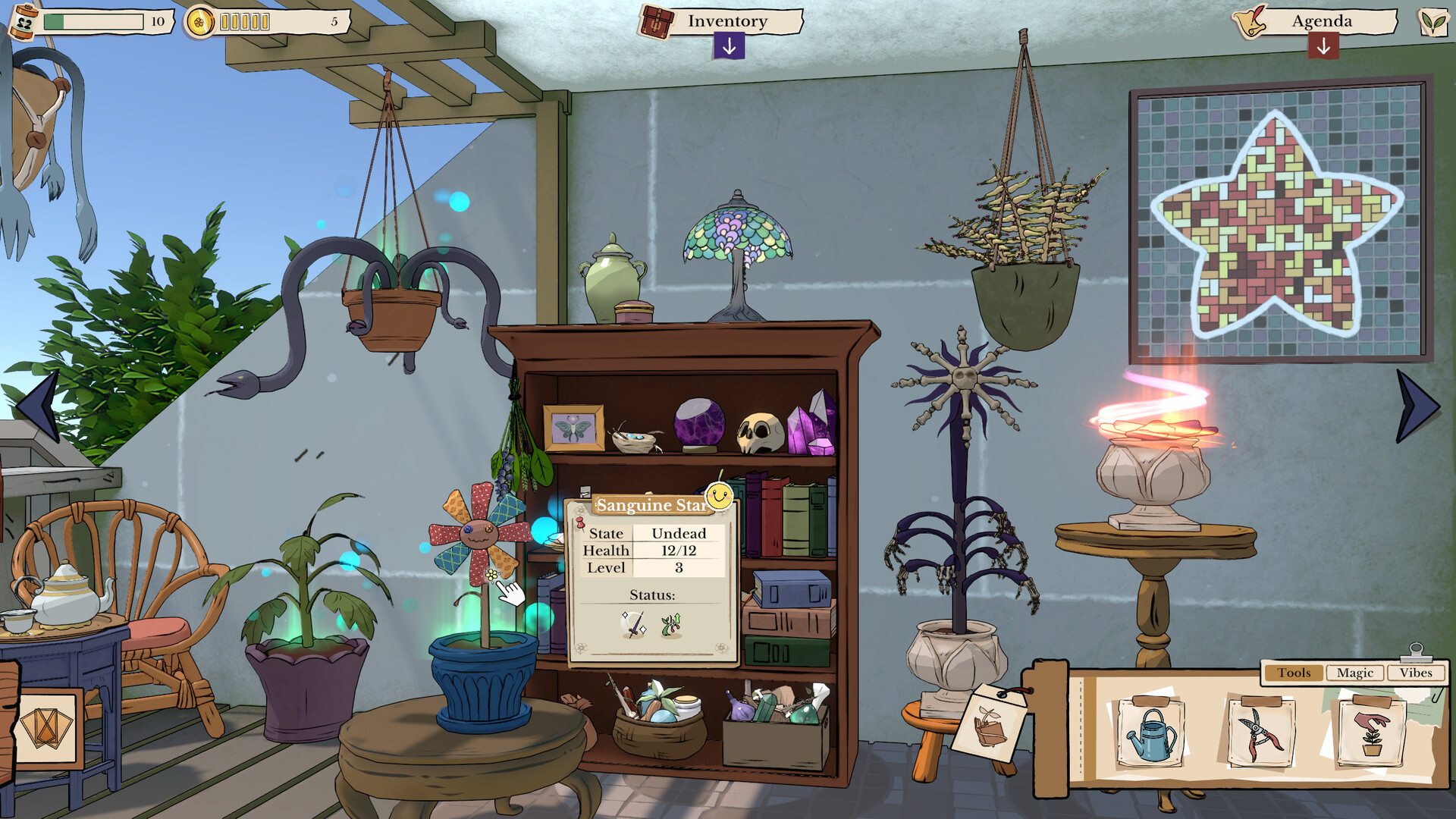
Tending a mix of living and undead plants is the core loop, each with its own health and needs to trackindie.io -
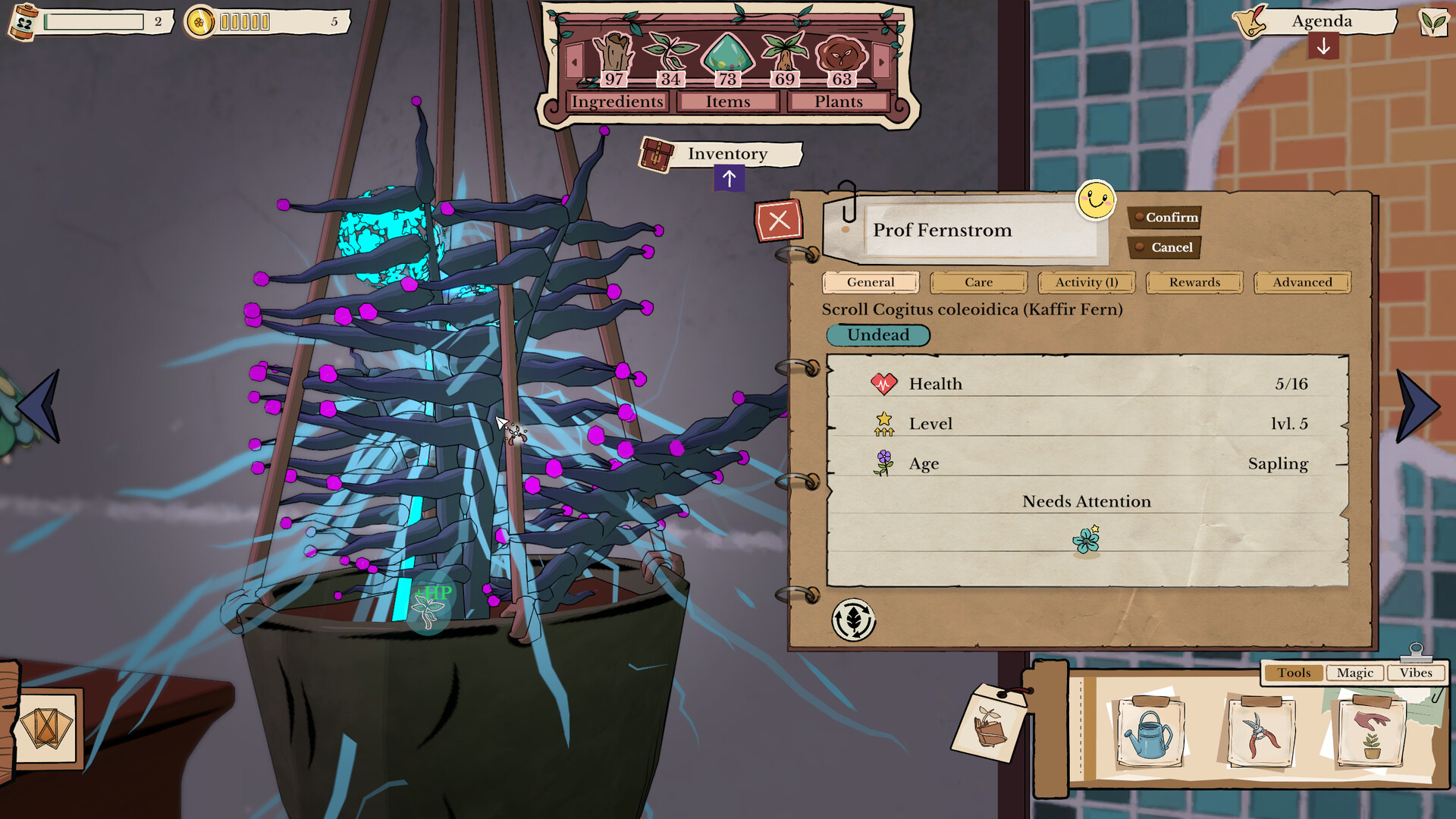
An undead plant's care menu, one of the systems reviewers said demands closer attention than a typical idle gameindie.io -
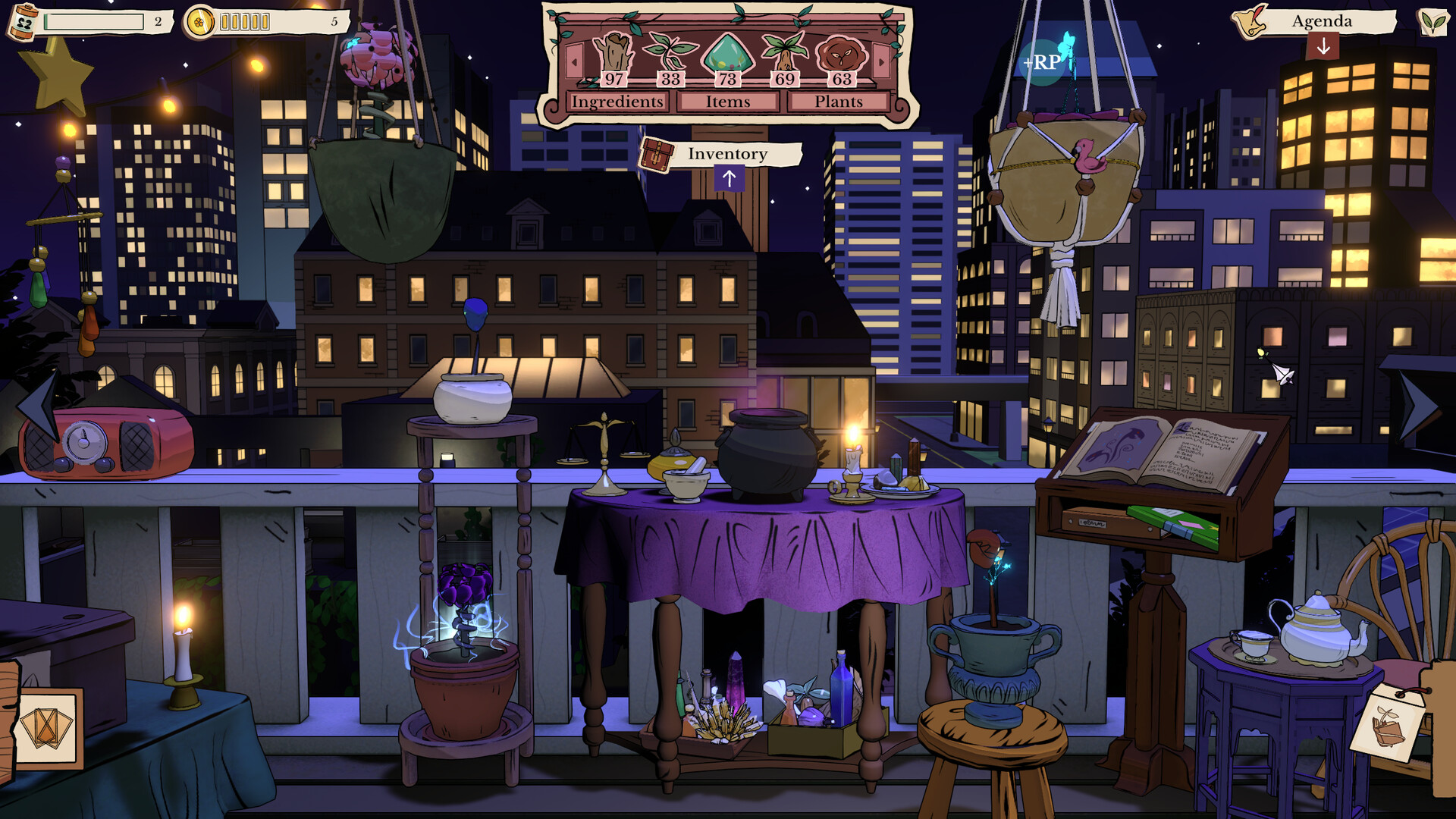
The apartment balcony at night, the cozy backdrop reviewers repeatedly credited alongside the game's lo-fi soundtrackindie.io -
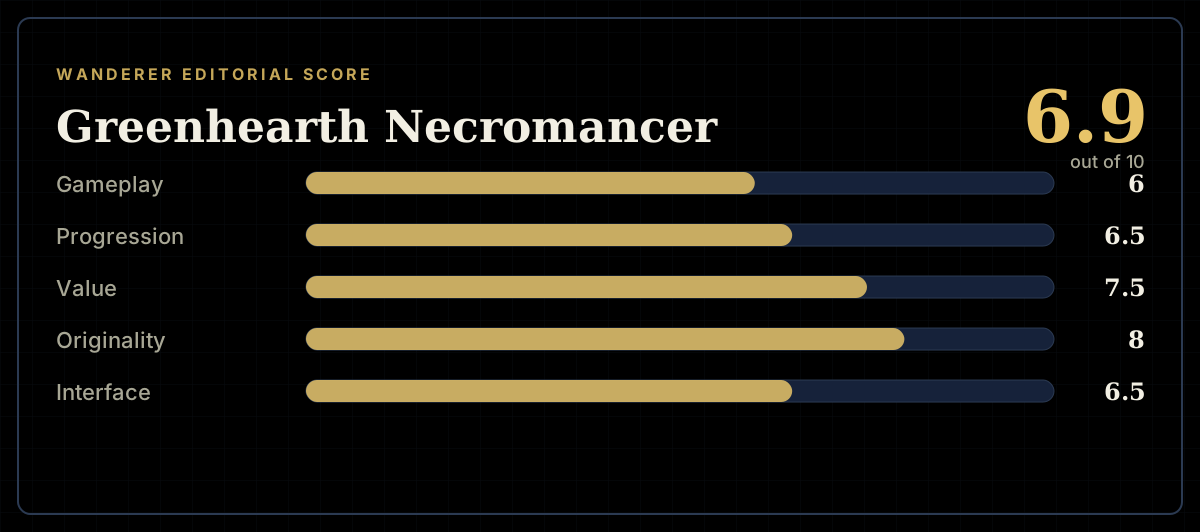
How the review scores each part of the gameWanderer Editorial -
The short versionWanderer Editorial